
Results
-
 £65.40
Interlude - Andrew Pearce
As a young man, Andrew Pearce had fond memories of playing Cornet in the local Youth Brass Band, where he first experienced the power and beauty of brass music. After completing 'Maestro' concertino for Philip Cobb, he decided to write a more gentle and lyrical piece for him, which paid homage to his musical roots in the Salvation Army. 'Interlude' is ideal for a proficient solo cornet player in any brass band: tuneful, reflective and elegiac with lots of expression.
Estimated dispatch 5-14 working days
-
 £115.60
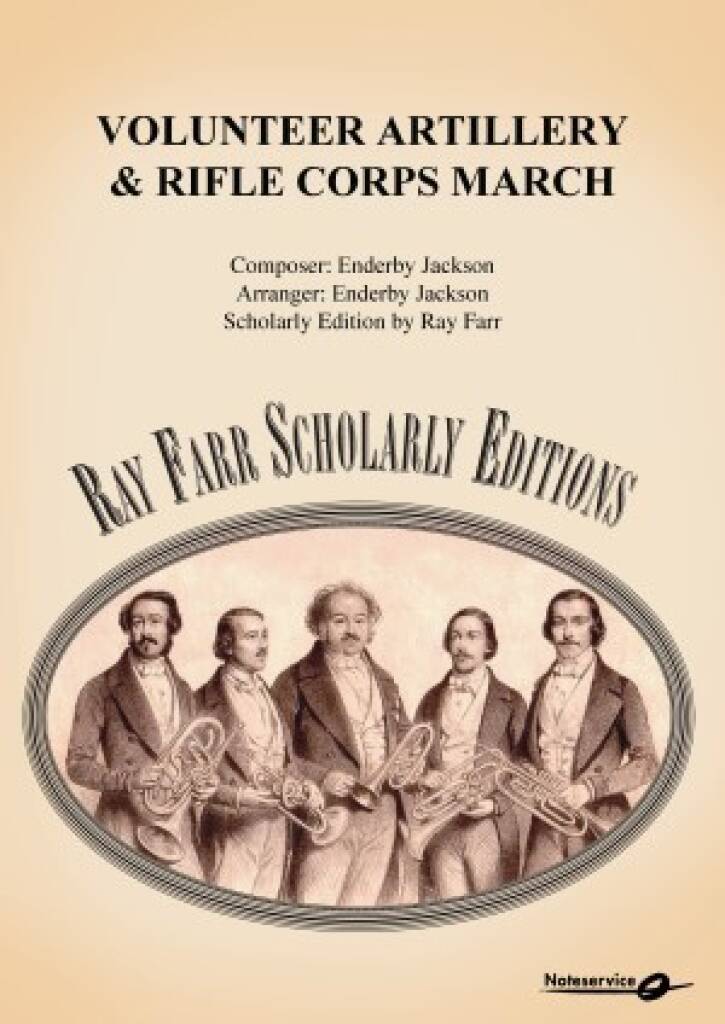
Voluntary Artillery & Rifle Corps March - Endeerby Jackson - Ray Farr
The march was written by Enderby Jackson and performed during a series of brass band events which took place at the Crystal Palace, London 1860 - 1863. Enderby Jackson was the organiser of these historically important events, and also conducted the massed band concerts. The Volunteer Force was a part-time, citizen army created in May 1859 by the British government as a result of increasing tensions between Britain and France. By 1862 more than 200,000 men had enlisted and were paid when on duty however, each member of the corps had to provide his own weapon and equipment.Some of the volunteer corps had bands which normally numbered between six and twelve players plus percussion1 and these bands became an important stimulant to the development of brass band.2 The corps were heavily subsidised by the government and considerable funding was spent on the bands3 which were often local brass bands. These bands were often provided with rehearsal rooms, instruments and uniforms,4 furthermore, the volunteer movement created and saved many brass bands.5Most of the musicians performing at the Crystal Palace Contests were affiliated to the Volunteer Force.
Estimated dispatch 5-14 working days
-
 £69.99
Brass Machine - Mark Taylor - Philip Sparke
Mark Taylor wrote the trumpet feature Scream Machine for a vinyl album by the Army Blues Jazz Ensemble in 1985. It was later published in a slightly simpler version called Brass Machine.This brass band arrangement by Philip Sparke has been arranged directly from the published jazz ensemble score and features soprano cornet and four solo cornets.
Estimated dispatch 5-14 working days
-
 £105.80
Scherzo - Andrew Pearce
Commissioned by Philip Cobb & The New York Staff Band of the Salvation Army. A classic trumpet solo full of exciting tempo changes and technical feats. A challenge for every modern trumpet player!
Estimated dispatch 5-14 working days
-
£29.95
Rhapsody in Brass (Score Only)
Rhapsody in Brass is in three movements and was written for the British Open Championships in 1949, held at Belle Vue in Manchester. The contest winners were Fairey Aviation Works Band under the baton of Harry Mortimer. Eric Ball came second with Ransome & Marles and Stanley Boddington 3rd with Munn and Felton Band. Rhapsody in Brass had the unusual distinction of being written as a test piece by a Salvation Army composer. Eric Ball's Resurgam was the only other piece to achieve that dual personality in that era.Dean Goffin was born in 1916 in Wellington, New Zealand, son of Henry Goffin, a Salvation Army officer and composer. At 19 he was appointed Bandmaster of the Wellington South Band and when World War II started, he enlisted in the New Zealand Armed Forces where he became Bandmaster of the 20th Infantry Battalion and later the 4th Brigade Band. During the time he served with them in the Middle East and Europe, he composed and arranged numerous pieces among which Rhapsody in Brass and the march Bel Hamid, later adapted for Salvation Army use and renamed Anthem of the Free.After the war, Dean kept on composing and his work was featured by the Wellington South Band. Later he transferred to Timaru for another job and became Bandmaster there. He was studying music at the time and as he wanted to take part in a competition for devotional selections for Salvation Army use, he sent some of his compositions to the International Headquarters. When Rhapsody for Brass was chosen as the test-piece for the British Open Championships, people at the Salvation Army started asking questions about the lack of publications of his work. It was discovered that the pieces submitted for the competition didn't meet the exact criteria. Among these pieces was one of his most appealing works The Light of the World which was published a year later, in 1950, the same year as he completed his Bachelor of Music studies at Otagu University.After entering the Salvation Army Training College in Wellington with his wife, Marjorie, Dean was in 1956 appointed National Bandmaster in the British Territory. Later he became National Secretary for Bands and Songster Brigades and in this period he organised the yearly festival in the Royal Albert Hall and was responsible for the national music schools in the UK. Dean returned to his home country in 1966 and to mark the centenary of the Salvation Army in New Zealand he was knighted by the Queen in 1983. Sir Dean Goffin died on 23 January 1984.
Estimated dispatch 7-14 working days
-
 £30.00
Finale from Tosca, Act 1 (Te Deum)
DescriptionPuccini's opera Tosca, one of his most successful and popular works is set in 1800 in Rome, as Napoleon's invading army is approaching. There are rebels in Rome who see Napoleon as a liberator from Neapolitan rule and are plotting secretly. One of those is the young firebrand artist Cavaradossi. He and his lover, the beautiful and tempestuous Tosca, are being pursued by the evil chief of the secret police, Scarpia. At the end of Act 1, Scarpia is revelling in his plot to capture Cavaradossi and trick Tosca into sleeping with him to buy her lover's freedom, all inside a church in Rome while a Te Deum service is being sung; in the background the bells are tolling and we hear distant cannonfire from the approaching army.In this arrangement the part of Scarpia is played mostly by the solo trombone. There is an optional organ part, although all of the organ part is covered in the band parts.This arrangement was first performed by the Harrogate Band conducted by Andrew Baker in 2022. Watch a video preview of the score below!
Estimated dispatch 7-14 working days
-
 £39.95
Judd: The Great Salvation War
James Curnow was inspired to compose this work after reading 'Marching to Glory', a history of The Salvation Army in the USA. The writer of the book, Dr. Edward H. McKinley, was a colleague of Curnow on the faculty of Asbury College and a member of The Salvation Army Student Fellowship Band. The work was written for this band and premiered by them at the Centennial National Congress in 1980 which was held at Asbury College. Curnow has endeavoured to capture the spirit of early day Salvationists as they gave themselves completely to the great salvation war. Three songs support the three-part structure; 1) Stand like the brave 2) In Thee, O Lord, do I put my trust 3) Rescue the perishing.
Estimated dispatch 7-14 working days
-
 £34.95
Judd: Stand Strong
This march was written for the North York Temple Band, Toronto, for their tour of the UK in 2012. Inspired by St Paul's words to the Ephesians to 'put on the full armour of God, so that when the day of evil comes, you may be able to stand your ground' (Ephesians 6:13 NIV), the music features three songs of warfare. The first song (S.A.S.B. 989) forms the introduction to the piece and is presented by Percussion and two muted Cornets. The image here is of a distant army approaching with banners aloft. The volume of the music increases as the army approaches:We'll shout aloud throughout the landThe praises of our God,We'll fight beneath our flag unfurled,Kept by his precious blood.
Estimated dispatch 7-14 working days
-
 £29.95
Judd: Anthem Of The Free
Prior to becoming a Salvation Army officer, Dean Goffin was the first Salvationist composer to gain a degree in music composition. This march was originally written for the 4th Brigade Band of the New Zealand Armed Forces (which Goffin conducted during World War Two) and called Bel Hamid before being adapted for Salvation Army use. The march contains the gospel song Ring the bells of heaven (...pealing forth the anthem of the free).
Estimated dispatch 7-14 working days
-
 £14.95
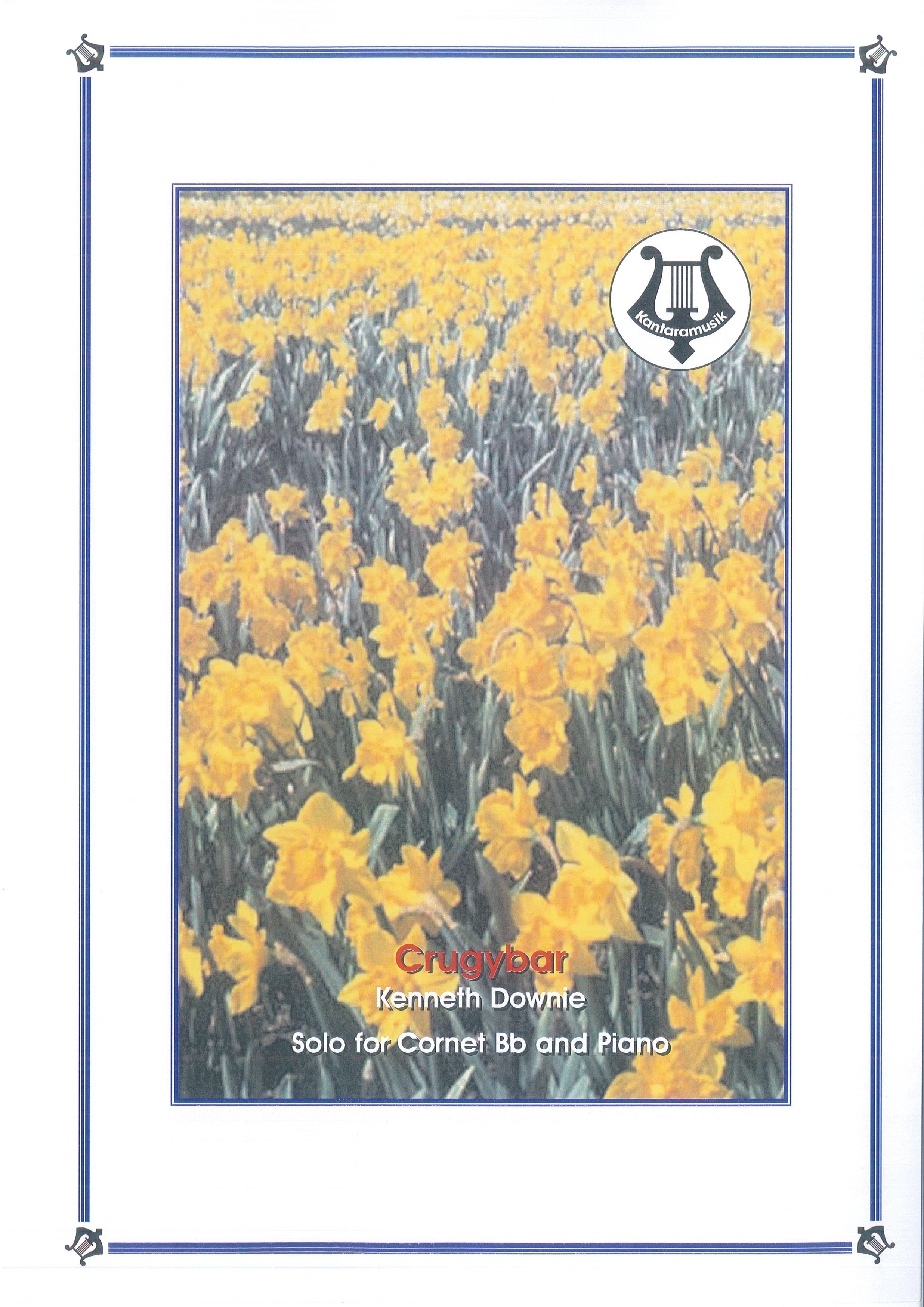
Crugybar (Cornet and Piano)
The traditional Welsh tune of Crugybar is most commonly associated with words by Howell Elvet Lewis which appear in the Baptist Hymn Book of 1962; 'The light of the morning is breaking, the shadows are passing away'. The Salvation Army Song Book of 1986 lists two further hymns that can be sung to the tune; 'I stand all bewildered with wonder and gaze on the ocean of love' ( W F Crafts) and 'When Jesus from Calvary called me, unfolding its meaning to me' (Will J Brand). This arrangement was made for Martyn Bryant, the long-serving principal cornetist of Bristol Easton Band of The Salvation Army.
Estimated dispatch 7-14 working days
 View Music