
Results
-
 £104.99
Scottish Dances - Peter Martin - Menno Haantjes
Scottish Dances is based on three Scottish traditionals: Cock of the North, The Bonnie Bank's O'Loch Lomond and Marie's Wedding. I. Cock of the North's name is used for multiple things or events. For example for a locomotive to a famous, it seems, delicious liqueur, and rallies to snowboard competitions. Furthermore is "Cock O' the North " a nickname of a famous Duke. (The 4th Duke of Gordon). In this composition Cock of the North (a Jig) is a traditional Scottish bagpipe tune, regularly played on tattoos by Pipe Bands. Not infrequently the drummers sing the text. Auntie Mary, had a canary, Up the leg of her trousers While she was sleeping Iwas peeping Up the leg of her trousers. II. " The Bonnie Bank's O'Loch Lomond " is about a sad story that took place during an revolt against the British. In 1745 Bonnie Prince Charlie had to retreat. Two of his men were captured. One was convicted and executed, while the other was released. The spirit of the executed soldier would arrive in Scotland via the 'low road' (underworld) before his companion, who had still a long way to go. You'll take the high road And I'll take the low road And I'll be in Scotland afore ye But me and my true love will never meet again On the Bonnie Bonnie Banks of Loch Lomond III. In a Scottish wedding, after the official ceremonies, there is often danced. This is called a ceilidh. For this we use traditional Scottish music such as "Marie's Wedding '. Mid dance we go back to the church, where a lovely song in honor of the couple sounds. Marie's Wedding has been recorded by Van Morrison (among many others). Step we gaely, on we go, heel for heel and toe for toe Arm and arm and on we go, all for Marie's wedding
Estimated dispatch 5-14 working days
-
 £119.99
Trimbeka - Carl Wittrock
Trimbeka is a composition which owes its existence to the anniversary of music society "de Vlecke" in Gorredijk. The name Gorredijk originates from "goor" or "gor", which means : bog. Along the marshy peat ran a "dijk" (the Dutch word for dike), called the Gordijk. The name of the village resembles that of the home town of the composer himself, who comes from a town in Twente called Goor. Three streams used to run through the area around Gorredijk. the historical name Trimbeets (Trimbeka), meaning three brooks, recalls this to mind. Gorredijk was a flourishing "Vlecke", i.e. large village, which was situated on an intersection of important connecting roads.The liveliness which this entailed is one of the distinctive elements in Trimbeka. Furthermore, ominous sounds possibly refer to the dangers of the bog, while the resonance of the merriment during the annual fair can also be heard. The slow middle movement is an ode to the beautiful landscape surrounding the village.
Estimated dispatch 5-14 working days
-
 £74.99
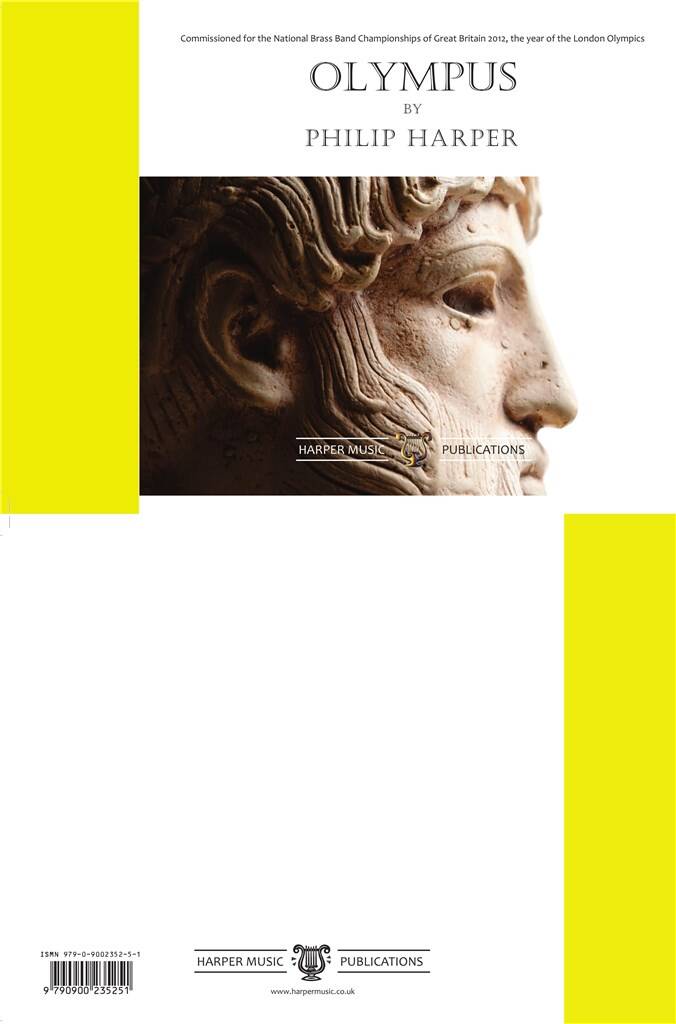
Olympus - Philip Harper
Selected as the test-piece for the 3rd Section Regional contests of the National Brass Band Championships 2012The music begins with a depiction of the exciting Opening Ceremony where noisy fanfares and sudden swells add to the cosmopolitan flag-waving clamour. Without a break the music leads to The Chariot Race, a fast compound-time gallop withthundering hooves in the basses and percussion, and a heroic melody introduced by the tenor horns. Chariot racing was the main equestrian event in the Ancient Greek Games, which were founded in memory of King Oenomaus. In the Greek legend he suffereddefeat in a chariot race to his son-in-law and Zeus' grandson, Pelops, but much of the music is bitter-sweet to symbolise the fact that Pelops had to cheat to win drawing parallels with some of the issues still facing modern-day athletics. A slow, mystical passage follows, describing The Temple of Zeus at Olympia. The statue of Zeus, who was honoured throughout the Ancient Games' history, was housed inside the temple and was one of the Seven Wonders of the Ancient World. Themusic depicts this period of the dawn of one of mankind's most ancient civilisations and there is a series of solo passages above a drone. The next section is called The Olympic Flame and a broad and lyrical anthem-like melody develops slowly in the euphoniums, which gradually ascends until the horns can take it over before passing upwards again to the cornets (Higher). The musicbursts into bright life at the lighting of the flame and the regular rhythmic pattern which has been established goes through an accelerando (Faster). The final section is called The Olympic Truce and aims to capture the cooperative spirit of the ancient practice of ending wars for the duration of the games. The anthem-like melody makes an affirmatory return (Stronger) and the work ends asit began with a blaze of colour and a real sense of optimism and global celebration. "Citius, Altius, Fortius" (Faster, Higher, Stonger)NOTES ON PERFORMANCEPercussion requirements: 1 to 3 players (3 Timpani, Snare Drum, Tenor Drum, Cymbals, Glockenspiel, Triangle)
Estimated dispatch 5-14 working days
-
 £154.99
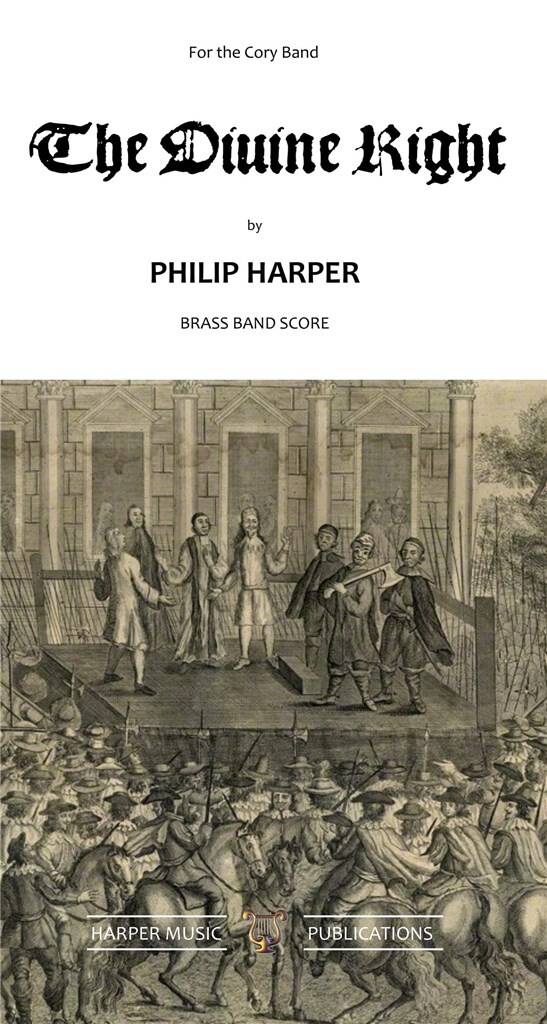
The Divine Right - Philip Harper
At the time of composing this piece, the Arab Spring was sweeping through the Middle East. It seemed that almost every week a new countrys people had risen up against the regimes and dictatorships which had prevailed for generations, leaving manynations at a defining crossroads in their history. There were so many possible ways ahead: so many hopes, yet so many uncertainties.My music is a depiction of these revolutionary times, and several musical themes are in turn presented, discussed, considered, fought over, altered, rejected or accepted. Most nations have had, or probably will have, their own Arab Spring, including my own, the United Kingdom. Events of 17th Century Britain provide the context for this piece, particularly those following the execution of the tyrant King Charles I on30 January 1649. The regicide was in part due to Charless steadfast belief in the Divine Right of Kings, and led to a tumultuous interregnum, where England stood at its own defining crossroads.The music begins turbulently, before King Charles appears and is led to the gallows outside Banqueting House in central London where he is brutally decapitated. From the assembled crowd rose, according to one observer, a moan as I never heard before and desire I may never hear again.The music descends to emptiness. The musical argument which follows is not strictly programmatic, but a number of musical themes are all thrown into the melting pot, representing ideas such as: religion; military force; reasoned Parliamentary debate; and the chattering,irrepressible voice of the people. Additionally, there are some quotations from the music of royalist composer Thomas Tomkins (1572-1656), who was often in tune with the feeling of the times. This defining episode in Englands history was brought to a close with the Restoration of the monarchy in 1660, and as the exiled King Charles II rode back into London the diarist John Evelyn wrote: Never was so joyful a day seen in this nation. I stood in the Strand and beheld it, and blessed God.At the end of the piece the bells ring out, and the musical appearance of the King has transformed from turbulent to triumphant. Philip Harper, 2013
Estimated dispatch 5-14 working days
-
 £78.20
The Rocketeer - James Horner - Roland Smeets
Before Titanic,James Horner was not above composing scores for cartoonish family films, and many of those that brought him on their production board owe him greatly. The Rocketeer entails the story of a young pilot during World War II who happens upon a rocket pack that allows him to fly. The film is based on the tradition of old film serials that left theater-goers hanging with "To be continued," and aside from modern production, it is old fashioned and innocent fun. Horner's score begins and ends with the brilliant "Main Title," which is so moving it was used in previews for later films that did not yet have finished scores. Most of th Rocketeersoundtrack elicits the adventure and lifting spirit of the film and reveals how Horner incorporates rich instrumentals in the tiniest crevices. Even when the film involves danger, as in "Jenny's Rescue," the composer takes care when it is hardly even required. Instead of some "duh-duh-duhs," he brings on a full, stunning orchestra and when he overdoes it, it is in a jolly way -- he never exhausts his medium. That is what separates him from inferior composers, and what makes a nice film like The Rocketeer extra nice. It is a soundtrack worth listening to.
Estimated dispatch 5-14 working days
-
 £85.90
Imaginations - Andrew Pearce
iMaginations is a bright and colourful overture with a strong memorable theme in a fast meter that is shared across the sections of the band. It drives forward relentlessly with great vigour and vitality, culminating in a soaring legato rendition of the main theme, first heard in trombones and trumpets. I have aimed this piece at more advanced bands who will find it an exciting ride. '
Estimated dispatch 5-14 working days
-
 £77.20
The Best of Andrew Lloyd Webber - Andrew Lloyd Webber - Henk Ummels
Once again Henk Ummels has succeeded to make a rich and full arrangement using only 5 voices. This time an arrangement of highlights from the biggest musical hits from the most well known musical composer of all time. It has been arranged for beginner bands, but also very suitable for lower level bands who want something fun and entertaining. Includes music from: The Phantom of the Opera, Jesus Christ Superstar, Cats, and Joseph and the Amazing Technicolour Dreamcoat.
Estimated dispatch 5-14 working days
-
 £105.20
Last Christmas - George Michael - Haakon Esplo
Who does not know the big hit Last Christmas from the pop group Wham! The duo sold 25 million albums between 1982 until they dissolved in 1986. The front figure, vocalist George Michael and guitarist/singer Andrew Ridgeley is also known for hits such as Club Tropicana and Wake Me Up Before You Go-Go which was their first song to reache the top on both the UK and US hitlists. Last Christmas is a natural choice for the next Christmas concert. And the audience will definitely sing along....
Estimated dispatch 5-14 working days
-
 £127.30
Haven't Met You Yet - Michael Bublé - Bjørn Morten Kjærnes
"Haven't Met You Yet" is the first single from Canadian singer Michael Buble's sixth album, Crazy Love, released on August 31, 2009. According to Buble, the single and its official music video are "about everyone's dream of finding a relationship and love." Buble co-wrote "Haven't Met You Yet" with Alan Chang and Amy Foster-Gillies and dedicated it to his then fiancee and now wife, Luisana Lopilato (who appears as his love interest in the music video).2012, Nick Jonas covered the song in the TV series Smash, so this music can also be used in a TV/Movie theme concert.Soloist options:Attached is a vocal lead that can be used with the arrangement. It is then recommended to dampen the melody in the ensemble, especially on the verses. (See list below)There are some performers or groups that can have these bars as solos:9-17 Flugelhorn17-24 Euphonium/Horn37-45 Euphonium45-52 Baritone/Trombone61-69 Horn/ Flugelhorn78-85 Euphonium/Baritone86-95 Flugelhorn107-end Flugelhorn/EuphoniumIf you want to use an instrumental soloist throughout the piece, they can use the vocal lead and transpose it to their instrument. Then the conductor should dampen or remove the above solos in the band.
Estimated dispatch 5-14 working days
-
 £59.95
Essay - Edward Gregson
This work was specially commissioned as the test piece for a new brass band competition in 1971, held at the Royal Albert Hall, London. It is in three movements, the titles of which all have literary connotations. The first movement, Dialoguetakes the form of 'conversations' between the instruments. The second movement, Soliloquy is dedicated to the memory of Gilbert Vinter - a composer who did so much in the 1960s to bring the brass band into the modern world. The final movement,Epigram, creates strong rhythmic contrasts and exploits the more virtuoso character of the brass band.
Estimated dispatch 5-14 working days
 View Music