
Results
-
£24.50
The Humming Chorus - Puccini - Alan Beaumont
This most beautiful piece from Puccini's opera Madame Butterfly has been wonderfully arranged for a brass band of any standard to perform to perfection. Simple and well structured, whether it is performed to a full concert hall, or on a bandstand in the park, audiences everywhere will appreciate this lovely piece.
In Stock: Estimated dispatch 1-3 working days
-
 £29.50
I Believe In Father Christmas - Greg Lake - Gavin Somerset
Released in 1975, this well loved song was written intentionally by as a protest about the commercialisation of Christmas. The release saw it shoot to No.2 in the charts and remains Greg Lake's only hit solo release. The instrumental riff used between verses is the tune from "Troika" by Sergei Prokofiev that has aided its popularity. This piece is familiar to all audiences, perfect to get them in the mood for your Christmas concerts & get them singing along.
In Stock: Estimated dispatch 1-3 working days
-
£24.50
Perpetuum - Dave Collins
A new and very exciting concert work for band. It is based upon driving additive patterns similar to those use in action and spy films. This is a brilliant new addition to the concert repertoire and is composed with energy right from the start. Thick block chords underneath the driving rhythms will allow your audience to feel the band's presence. This title was originally commissioned by the VBS Poynton band and works equally well on the bandstand or in the concert hall.
In Stock: Estimated dispatch 1-3 working days
-
 £37.50
A Small Christmas Suite - Jonathan Mead
This fresh new Christmas Suite is an upbeat 'festive suite' from the pen of Welsh Composer, Jonathan Mead. It features three well known carols that have been given an overhaul concerts this year. The three movements can be played as one continuous suite, or separated and performed individually if time doesn't permit for the full suite to be performed. The first Movement features a 'jazzed up' version of O Come All Ye Faithful. Movement 2 allows the bands soloists to shine if a stunningly reflective setting of See Amid the Winter's Snow. The final movement sees Silent Night in a way you've never heard before and has all the 'razzmatazz', and big finish that your concert needs. A must for your band and audiences this Christmas Season.
In Stock: Estimated dispatch 1-3 working days
-
£24.50
Sailor's Hymn - Amber Hooton
Sailor's Hymn depicts a scene of sailors preparing to depart from the port of Liverpool, looking out over the docks as the Blue Peter flag flies,beckoning the sailors aboard to begin their long journey. It is a piece about saying goodbye to what was once familiar, moving on and pushing towards new horizons.This piece was written for a cultural exchange between brass and wind bands from St Helens (Valley Brass Band) and Normandy (Harmonie Courselles Sur Mer), culminating in a massed bands concert in Normandy during April 2024. The piece was one of several arrangements and original compositions written especially for the exchange, supported by grants from the Victoria Wood Foundation and Johnson Foundation. The concert celebrated the local cultures of Merseyside and Normandy, as well as the wider national cultures of the United Kingdom and France.
In Stock: Estimated dispatch 1-3 working days
-
 £134.99
Alpina Brass (Brass Band - Score and Parts) - Van der Roost, Jan
Alpina Brass was the test piece for the first division of the Ftes Cantonales on 8 and 9 June 2019 in Naters, Switzerland. It consists of three movements, and features a variety of aspects, as is common for a competition work. However, as a whole, it has been written in such a way that it can perfectly serve as a concert work as well. It is a challenging piece for every section and offers colourful and melodic as well as spectacular rhythmic sequences and a most impressive ending!Duration: 11.00
Estimated dispatch 7-14 working days
-
 £54.99
Circus Delight - Dagmar Kildevann
'Circus Delight' is a five-part suite which is set, how could it be otherwise, in a big circus tent. The suite starts with a part called 'Entrance'. The orchestra, positioned above the entrance of the ring asks for the attention of the audience and then the ring announcer enters. The show can begin! The elephants play a central role in the first act. These colossal grey animals are rather slow and perform their tricks in a moderate tempo. ('Elephant Blues') How different are 'The Acrobats'. At high speed they run, jump and fly through the ring, until ....... It gets very exciting. Fortunately, all's well that ends well and they take their leave of the audienceat a trot. Everyone knows, and yet it is mostly not spoken about, that when a clown has taken off his red nose and rubbed off his make-up, his face off-stage is not always a happy one. ('Tears of the Clown') The piece ends on a cheerful note with 'The Parade', in which all the artists make their entrance in the ring once again to gratefully acknowledge the audience's overwhelming applause.
Estimated dispatch 5-14 working days
-
 £119.50
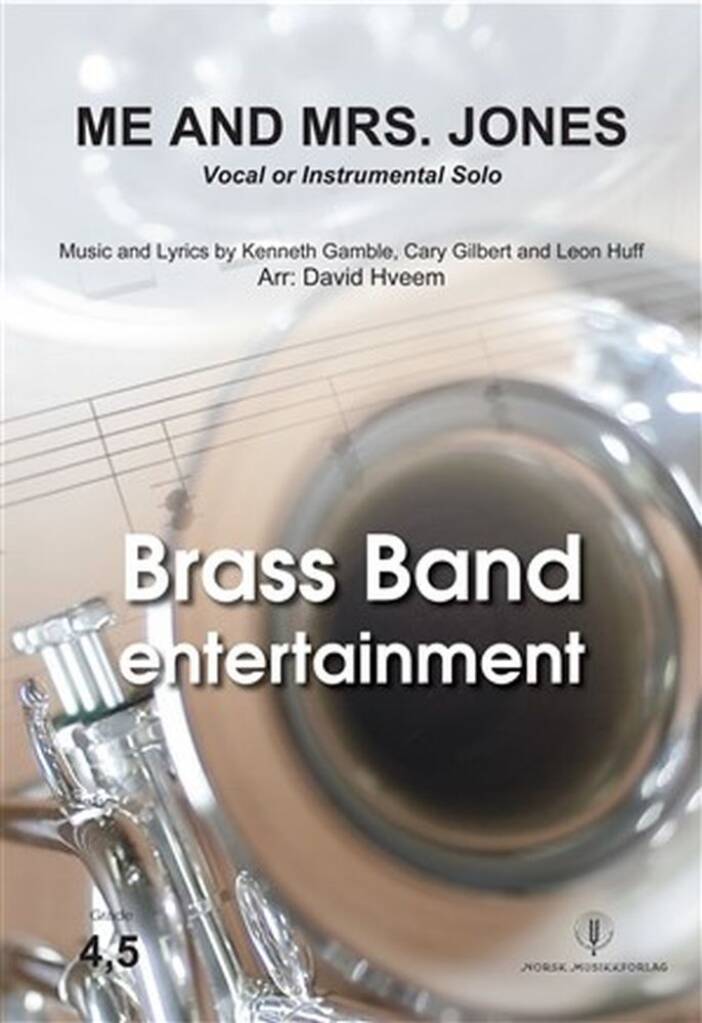
Me and Mrs. Jones - Kenneth Gamble - David Hveem
Me and Mrs. Jones was written by Kenny Gamble, Leon Huff and Cary Gilbert in 1972, and was first recorded by Billy Paul on the album 360 Degrees of Billy Paul. The song is about a man who has an affair with Mrs. Jones, and how the two secretly meet every day in the same cafe, even though they may know it's not quite right: "We got a thing going on/we both know that it's wrong/but it's much too strong/to let it go now." Paul has stated that he was sure the song was going to be a hit even before it was released, as "it's a song everyone can relate to", but already from the start the lyrics were considered somewhat controversial and the song were banned from several radio stations. Nevertheless, it became one of the best-selling singles of 1972 and Paul received a Grammy for Best Male R&B Vocal Performance.Well known is also Michael Buble's version of the song, released on the album Call Me Irresponsible in 2007. It is his version that has been the inspiration for this arrangement, which brings out even more of the jazz elements Buble has found in the song. The arrangement is quite demanding for the ensemble, and requires great rhythmic precision in particular.
Estimated dispatch 5-14 working days
-
 £119.99
The Binding of the Wolf - Torstein Aagaard-Nilsen
This piece was commissioned by Nordhordland Brass Seminar in 1990 and written for a youth band. The title referes to a story from norse mythology. "The Binding of the Wolf" is not a programmatic piece of music, but I felt that there was a kind of coherence between the music and the dramatic story: "...The wolf Fenrir was one of the demonic offspring of Loki, and as he grew up in Asgard among the gods, he became so huge and fierce that only Tyr was willing to feed him. It was decided that he must be bound, and Odin in his wisdom caused the cunning dwarfs to forge a chain which could not be broken. It was made from the invisible and yet potent powers ofthe world, such as the roots of a mountain, the noise of a moving cat, the breath of a fish. When completed, this chain seemed to be no more than a silken cord, but the wolf refused to let it be laid upon him unless one of the gods would put a hand between his jaws as a pledge that it was harmless. Only Tyr was prepared to do this, and when the wolf found that the chain was unbreakable, the gods rejoiced, but Tyr lost his hand. The binding of the wolf may be seen as a means of protecting the world of men, as well as that of the gods, from destruction. The story of the god losing his hand appears to be one of the fundamental myths of nothern Europe..."
Estimated dispatch 5-14 working days
-
 £115.60
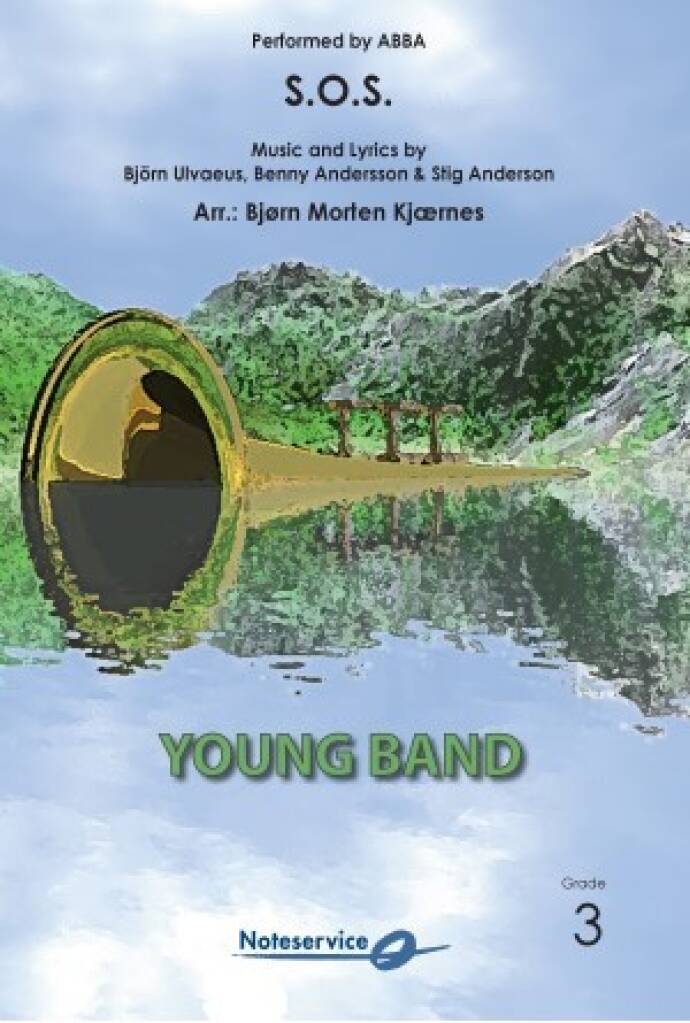
S.O.S. - Björn Ulvaeus - Bjørn Morten Kjærnes
When the publisher asked me to make an arrangement of an ABBA tune, S.O.S. was the first song I thought of. Its introduction and melody are well suited to play for Wind Band. Admittedly, the key had to be shifted to make it sound good for this instrumentation. To me, this is nostalgia, while for others, the Mamma Mia movie/show will be what they associate with this wonderful song. Apart from a few medleys, few of ABBA's songs are available to Wind Band. So, it was very fun to work on this classic.The arrangement is made quite simply to fit many sizes of Bands. Technically, it is also relatively simple both in range and rhythm. As you can see, there are many ways to adjust this arrangement to your own ensemble. Bring out melody lines and the bassline, and a lot is done. If needed, simplify to make it sound nice.Bjorn Morten Kjaernes
Estimated dispatch 5-14 working days
 View Music
 Listen to MP3