
Results
-
 £33.91
Kojo no Tsuki (Bb Cornet Solo) - Kevin Ackford
Unveil the emotional depth of 'Kojo no Tsuki' (Bb Cornet Solo). Feel the connection to Japan's castles and wars through this timeless piece.
Estimated dispatch 5-7 working days
-
 £30.00
La Musica Notturna Delle Strade di Madrid
DescriptionLuigi Boccherini was born in Lucca, Italy, into a musical family. His father, a cellist and double-bass player, sent him to study in Rome at a young age. In 1757 they both went to Vienna, where the court employed them as musicians in the Burgtheater. In 1761 Boccherini went to Madrid, entering the employ of Prince Luis Antonio of Spain, younger brother of King Charles III. There he flourished under royal patronage, until one day when the King expressed his disapproval at a passage in a new trio, and ordered Boccherini to change it. The composer, no doubt irritated with this intrusion into his art, doubled the passage instead, which led to his immediate dismissal. Then he accompanied Don Luis to Arenas de San Pedro, a little town in the Gredos mountains, where Boccherini wrote many of his most famous works. Although neglected after his death and throughout the 19th and early 20th century (he was known mockingly as 'Haydn's Wife' for a time), Boccherini's music has been rediscovered in recent decades.La Musica Notturna delle Strade di Madrid('Night Music of the Streets of Madrid') is a string quintet of seven short movements composed during Boccherini's exile in Arenas, no doubt to remind him and his prince of happier times. The music is reminiscent of "the gaiety and bustle of Spain's capital, recalling the sound of the city's church bells ringing for evening prayer, the popular dances that were the delight of its young people, and the blind beggars singing their typical songs". This arrangement excludes the first and last two movements, comprising the middle four:Il Tamburo di Soldati(The Soldier's Drum)Minuetto dei Ciechi(The Minuet of the Blind Beggars)Il Rosario(The Rosary)Passe Calle(The Passacaglia of the Street Singers)The music was featured in the Russell Crowe filmMaster and Commander: The Far Side of the World(2003) set during the Napoleonic Wars and featuring the adventures of the Royal Navy ship HMS Surprise and her captain Jack Aubrey as they pursue the French ship Acheron into the Pacific Ocean.You can listen to an audio preview while following the score in the video below!Duration approximately 5'00".
Estimated dispatch 7-14 working days
-
£34.95
CRUSADERS (Brass Band Set) - Dean Goffin
This march is based on the hymn tune 'Ascalon' named after the Palestinian city which was of strategic importance in the Crusader Wars. The tune is also called 'The Crusader's Hymn' and was used as such by Franz Liszt in his oratorio 'St. Elizabeth'. The melody is seldom absent and it can be heard in some form or other throughout the march.
Estimated dispatch 7-14 working days
-
£44.95
DAWNING, The (Brass Band Set) - Peter Graham
This early Peter Graham work in Sinfonietta form, takes as its central theme Joy Webb's original melody 'There will be God', which speaks of 'the dawning of a brand new day'. Peter Graham's dramatic treatment takes us into a world of 'cosmic power' and evokes ideas that one day wars will end as God will rule supreme.
Estimated dispatch 7-14 working days
-
£35.00
These Mist Covered Mountains - Peter Meechan
These Mist Covered Mountains was commissioned by Keith Johnson (KMJ Recordings) for soprano cornetist, Mandy Crowther, to whom the piece is dedicated.In an age where we seem to be inundated with endless news cycles of various wars that we as a nation are involved in, and also those that we are not, it seems that war is now a constant, and we are in a never ending state.This short piece is intended to represent the cyclic nature of war, and the way that war never seems to have a true conclusion.
Estimated dispatch 12-14 working days
-
 £30.00
Gallipoli - James Stretton
My interest in the disastrous Dardanelles campaign of WW1 was first stimulated when I saw Peter Weir's 1981 film "Gallipoli" starring a very youthful Mel Gibson. The campaign ran from February 19th 1915 to January 9th 1916. The Turkish victory ultimately stemmed from the British foolhardy underestimation of the military potential of the declining Ottoman Empire. Significant numbers of British and French troops were involved against the Turkish & German forces. However, it is the heroic involvement of the ANZAC forces comprising of 50,000 Australians and 15,000 New Zealanders that is now at the forefront of our memories. The ANZACS were at the spearhead of the amphibious assault of April 25th 1915 and sustained appalling losses in dreadful conditions. Indeed, many historians consider the bravery and fortitude displayed by the ANZACS at Gallipoli to be an important component in the national consciousness of Australia and New Zealand. A century on from the end of "The Great War", the war to end all wars it is to the brave ANZAC soldiers that this concert march is humbly dedicated. James Stretton - Blenheim, New Zealand.
-
Sharpe's Theme - John Tams & Dominic Muldowney - Len Jenkins
"Sharpe" is a popular British series of television dramas starring Sean Bean as Richard Sharpe, a fictional British soldier in the Napoleonic Wars, principally in Spain, Portugal and France. His activities and adventures are based on a number of novels by Bernard Cornwell, which reflect the military campaigns of the Duke of Wellington (as he became) and were filmed mainly in Turkey and Crimea, although some filming was also done in England, Spain and Portugal. This music, composed by John Tams and Dominic Muldowney, contains two aspects of the series; the iconic introductory signature tune and the equally familiar 'Over the Hills and Far Away' originally sung by John Tams (who also acted in the series) which features in the closing scenes of each episode. This arrangement is within the capabilities of a good 4th section brass band.
-
 £90.00
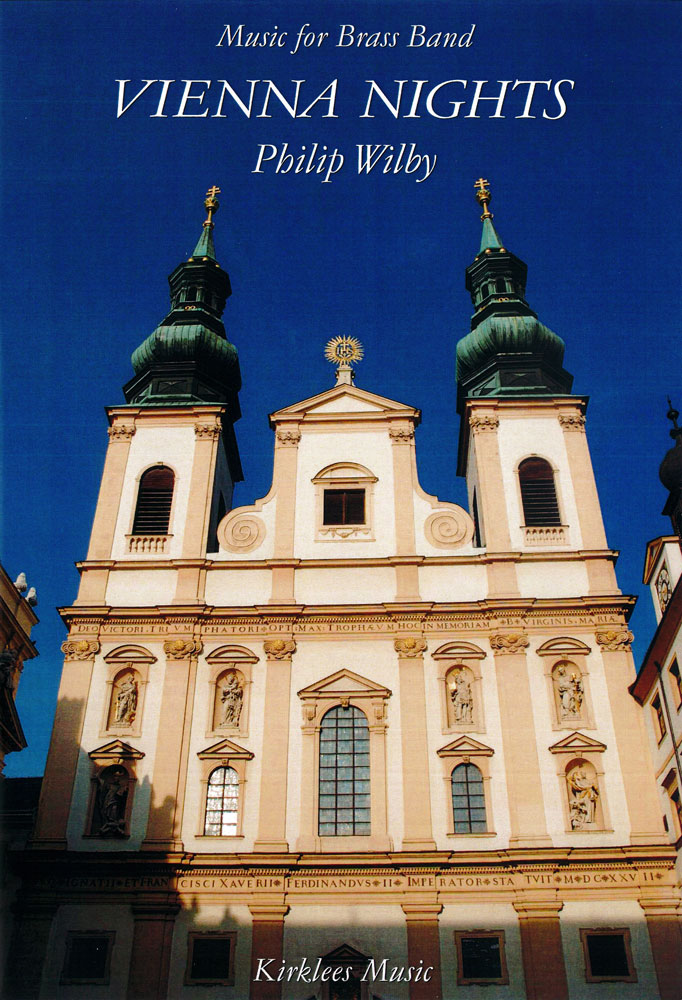
Vienna Nights (Brass Band - Score and Parts)
The City of Vienna stands at one of the historic crossroads of the world, linking east and west and embracing artistic influences from all sides. In the 250th anniversary year of Mozart's birth, this fantasy on Mozart's celebrated Piano Sonata in A (K331), has been composed true to the form and content of the original, but also to the underlying substance of the conception.One of Mozart's distinguishing features, and one that links him to later music by Beethoven, Schubert, Mahler and Schoenberg, is the breadth of his musical vision. His music links intellectual rigour with ecstatic utterance and darker preoccupations. It is, perhaps, this shadow-laden side of his musical nature which gives his work a profundity often absent in the work of his contemporaries. Admirers of his Requiem Mass or the Statue music in Don Giovanni will recognise that it is this extra sense of reality which makes Mozart so relevant to the modern age, and where he may link hands with the other great Viennese thinkers such as Berg, Webern and Adorno.The composer follows the three movement plan of the Sonata closely. The original begins with a Theme and Variations which is freely quoted. His Minuet is mirrored in the Recitative and Notturno, where each section of the band lays down a metaphoric rose to his memory. Famously, the sonata ends in populistic style with a Turkish Rondo. Ever since the Hapsburg-Ottoman Wars, which came to an end in the seventeenth century, Viennese composers have included Turkish elements in their music, not least in the use of certain percussion instruments. Vienna Nights is thusly a homage.It celebrates the world's greatest composer, but also the city which fostered his work. Here, in your imagination, you might easily conjure up a caf table near the Opera House, where Mozart, Mahler and Sigmund Freud, observed by us all from a discreet distance, may meet as old friends.
Estimated dispatch 7-14 working days
-
£12.00
Vienna Nights (Brass Band - Study Score)
The City of Vienna stands at one of the historic crossroads of the world, linking east and west and embracing artistic influences from all sides. In the 250th anniversary year of Mozart's birth, this fantasy on Mozart's celebrated Piano Sonata in A (K331), has been composed true to the form and content of the original, but also to the underlying substance of the conception.One of Mozart's distinguishing features, and one that links him to later music by Beethoven, Schubert, Mahler and Schoenberg, is the breadth of his musical vision. His music links intellectual rigour with ecstatic utterance and darker preoccupations. It is, perhaps, this shadow-laden side of his musical nature which gives his work a profundity often absent in the work of his contemporaries. Admirers of his Requiem Mass or the Statue music in Don Giovanni will recognise that it is this extra sense of reality which makes Mozart so relevant to the modern age, and where he may link hands with the other great Viennese thinkers such as Berg, Webern and Adorno.The composer follows the three movement plan of the Sonata closely. The original begins with a Theme and Variations which is freely quoted. His Minuet is mirrored in the Recitative and Notturno, where each section of the band lays down a metaphoric rose to his memory. Famously, the sonata ends in populistic style with a Turkish Rondo. Ever since the Hapsburg-Ottoman Wars, which came to an end in the seventeenth century, Viennese composers have included Turkish elements in their music, not least in the use of certain percussion instruments. Vienna Nights is thusly a homage.It celebrates the world's greatest composer, but also the city which fostered his work. Here, in your imagination, you might easily conjure up a caf table near the Opera House, where Mozart, Mahler and Sigmund Freud, observed by us all from a discreet distance, may meet as old friends.
Estimated dispatch 7-14 working days
-
 £54.99
Scherzo for X-Wings (Brass Band - Score and Parts)
From the blockbuster film Star Wars: The Force Awakens this exciting music is featured in the climactic battle scene with our heroes and their X-Wing fighters. A dynamic tour de force for mature bands.
Estimated dispatch 7-14 working days
 View Music