
Results
-
 £109.99
The Road to the West - Carl Wittrock
As he did before in the often played and commonly appreciated 'Lord Tullamore', in which he poetically depicted the landscape and the cultural elements of a small Irish village, in his composition 'The Road to the West' Carl Wittrock has sketched pioneer existence in America in a cinematic manner.In 'The Road to the West' the composer has tried to capture images of pioneer life during the period dating from 1850 to 1890, the days of the so-called Wild West.In those days, the Wild West used to be the territory west of civilization, the domain of cowboys, trappers, and other fortune hunters. In short, ample ingredients for a captivating story.In the firstscene a lonely adventurer struggles against nature and the elements. After an exciting adventure he passes through 'the Plains', where majestic views alternated by colossal mountain ranges display an almost unimaginable beauty.After weeks of isolation civilization is reached again. 'The Saloon' is the perfect meeting place here news is exchanged and hilarious scenes regularly take place.
Estimated dispatch 5-14 working days
-
 £154.99
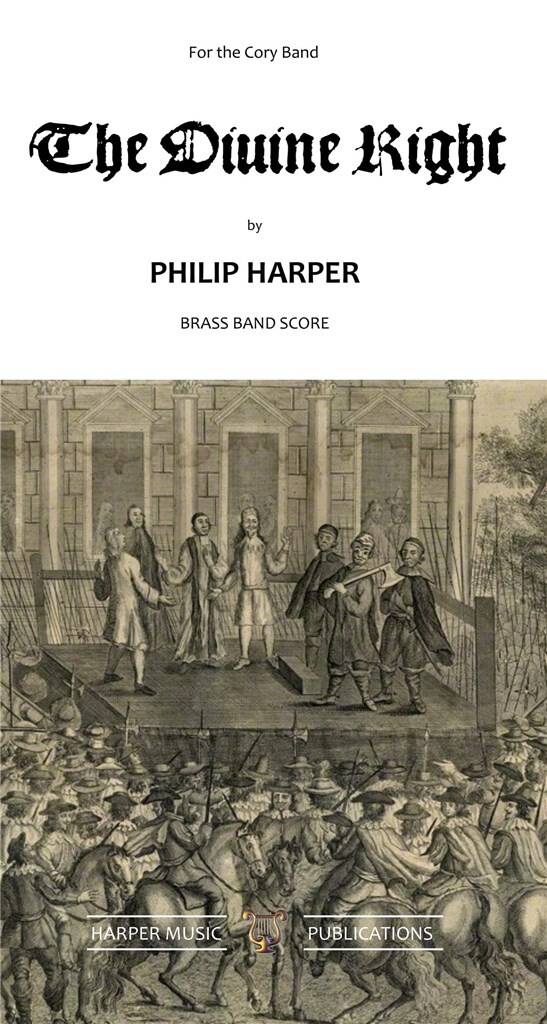
The Divine Right - Philip Harper
At the time of composing this piece, the Arab Spring was sweeping through the Middle East. It seemed that almost every week a new countrys people had risen up against the regimes and dictatorships which had prevailed for generations, leaving manynations at a defining crossroads in their history. There were so many possible ways ahead: so many hopes, yet so many uncertainties.My music is a depiction of these revolutionary times, and several musical themes are in turn presented, discussed, considered, fought over, altered, rejected or accepted. Most nations have had, or probably will have, their own Arab Spring, including my own, the United Kingdom. Events of 17th Century Britain provide the context for this piece, particularly those following the execution of the tyrant King Charles I on30 January 1649. The regicide was in part due to Charless steadfast belief in the Divine Right of Kings, and led to a tumultuous interregnum, where England stood at its own defining crossroads.The music begins turbulently, before King Charles appears and is led to the gallows outside Banqueting House in central London where he is brutally decapitated. From the assembled crowd rose, according to one observer, a moan as I never heard before and desire I may never hear again.The music descends to emptiness. The musical argument which follows is not strictly programmatic, but a number of musical themes are all thrown into the melting pot, representing ideas such as: religion; military force; reasoned Parliamentary debate; and the chattering,irrepressible voice of the people. Additionally, there are some quotations from the music of royalist composer Thomas Tomkins (1572-1656), who was often in tune with the feeling of the times. This defining episode in Englands history was brought to a close with the Restoration of the monarchy in 1660, and as the exiled King Charles II rode back into London the diarist John Evelyn wrote: Never was so joyful a day seen in this nation. I stood in the Strand and beheld it, and blessed God.At the end of the piece the bells ring out, and the musical appearance of the King has transformed from turbulent to triumphant. Philip Harper, 2013
Estimated dispatch 5-14 working days
-
 £68.80
When the lights go down - Kevin Houben
Kevin Houben created with When the Lights Go Down, a wonderful chorale that can be a moment of reflection in any concert program.The resigned, magnificent melodies at the beginning of this composition slowly build up to a highlight with an increasing orchestration. The piece starts with a suggestive Adagio Meditativo, after which the main theme is immediately announced. A central bridge section takes the listener along through the different spheres at which the melodic and rhythmic drums embellish the chorale melodies. Thematic elements from the introduction brings the piece to a quiet and peaceful end.The sheer simplicity with which this work is written, makes it a resplendent, magnificent concert piece. 'When the Lights Go Down', refers to a moment when time stand still for a while, stillness within and around yourself.
Estimated dispatch 5-14 working days
-
 £69.00
All Through The Night - Michal Worek - Bertrand Moren
Estimated dispatch 5-14 working days
-
£37.95
I Made It Through the Rain - Terry Kenny
Estimated dispatch 5-14 working days
-
£39.95
Through the 30s - Edrich Siebert
Estimated dispatch 5-14 working days
-
 £59.77
Horizon: The Promise of the Lord (Brass Band) Andrew Wainwright
Horizon: The Promise of the Lord was written at the request of Bandmaster Stephen Cobb for The International Staff Band. It is based on the much loved hymn of the church, Cwm Rhondda (Guide me O thou great Jehovah). The work was recorded on the ISB's CD Manuscripts II (released 2023). This highly descriptive piece will be an excellent addition to concert programs, as well as being appropriate as a test piece. The inspiration for the work comes from the book of Exodus. Whilst the music is not intended to be directly programmatic, like the hymn Cwm Rhondda, the work takes the listener through the Exodus from Egypt to the promised land of Israel as a metaphor of the spiritual pilgrimage of the individual Christian through his or her earthly life. The music aims to evoke a sense of God's guidance through strife and affirm the reality that God provides for us and redeems all the wrong in the world. This God who provided for the Hebrew people wandering amidst 'barren lands' with 'bread of heaven' is still and ever will be a God of provisional grace. Through listening to the music, it is the composer's intention that we are reminded of God's promise of Deliverance as set out in Exodus 6 v7-8: 'I will take you as my own people, and I will be your God. Then you will know that I am the Lord your God, who brought you out from under the yoke of the Egyptians. And I will bring you to the land I swore with uplifted hand to give to Abraham, to Isaac and to Jacob. I will give it to you as a possession. I am the Lord.' Like the hymn, Horizon: The Promise of the Lord is intended as a prayer for guidance. The Christian is a pilgrim through 'this barren land'. The music is often chromatic and in large parts verging on atonality, as a reflection of the strife that the Israelites endured in their 40 years in the wilderness. However, it ends in climactic fashion with the Hebrew people finally reaching their destination after many years of wandering in the desert - as they approach the 'Horizon' promised by the Lord. To view a performance of the work by the National Youth Brass Band of Great Britain please visit www.youtube.com/watch?v=LjOHf7QEw1g PDF download includes score and parts. Sheet music available from: UK - www.brassband.co.uk USA - https://satradecentral.org Difficulty Level: 1st Section + Length: c11.00 minutes Instrumentation: Soprano Cornet Eb Solo Cornet Bb Repiano Cornet Bb 2nd Cornet Bb 3rd Cornet Bb Flugel Horn Bb Solo Horn Eb 1st Horn Eb 2nd Horn Eb 1st Baritone Bb 2nd Baritone Bb 1st Trombone Bb 2nd Trombone Bb Bass Trombone Euphonium Bb Bass Eb Bass Bb Percussion 1-4
In Stock: Estimated dispatch 1-3 working days
-
 £29.95
The Strong Tower (Brass Band - Score and Parts)
Following the popularity of Turris Fortissima, I decided, albeit many years later, to revisit some of the material it contains and create a shorter piece, expanding on some of the ideas and motifs, allowing myself to follow those in different directions altogether. The result is this piece which I hope will also excite players and listeners alike.The music is marked at a quick tempo from the start, but despite several changes in meter, the tempo doesn't change until the small accelerando leads us into the presto section. In order to maintain the excitement and drama, it's important to set the pace and keep it consistent throughout.Section A introduces a few of the motifs that will be developed during the piece, including the main Turris Fortissima theme from bar 13 to 18.At section B, ensure the quavers are tight across the whole band with a strong attack, making an obvious difference in dynamic when fff is marked, in bars 23, 25 and 27. A more lyrical approach will be effective from the Horns in section C, with vigorous interruptions from the rest of the band breaking up their melody.Section D features long notes from muted 1st and 2nd Cornets and Trombones, with crescendos each time. These should be significant and sound as though they emerge from nowhere, completely cutting through the overall texture.Section D features long notes from muted 1st and 2nd Cornets and Trombones, with crescendos each time. These should be significant and sound as though they emerge from nowhere, completely cutting through the overall texture.Sections E and F are both passages of building intensity. Various contrasting motifs are layered, including a subtle reference to the hymn tune Ein' feste Burg (A mighty fortress is our God) from the Euphonium. The music becomes more busy and muddled, before reaching its climax at section G where the lyrical melody is heard again, this time from the Solo Cornets and Euphonium.In bars 141 to 145, there is a reference to Dean Goffin's My strength, my tower in the Basses, as used in Turris Fortissima. Allow this motif to dominate, keeping the notes full and grand-sounding. In bars 149 to 151 there is further use of the line from Ein' feste Burg in the Baritones, Trombones, Euphoniums and Basses leading into the final section.- Steven Ponsford
Estimated dispatch 7-14 working days
-
 £25.00
...and the winter moon rises
Description...and the winter moon riseswas inspired by a winter's evening car journey across the Pennines from Manchester to Huddersfield, through the brass band heartland of Saddleworth. There was recent snow on the ground, and the sun had just set. A bright clear moon was rising into a sky coloured with orange from the setting sun, and the moonlight made all the snow and ice sparkle.The work is the fourth movement of a larger 5 movement suite entitled "North!", but can be (and has been) performed in isolation. This work was a finalist in the 2012 Ohio Brass Arts Festival composition competition.Performance NotesThe percussion parts should be playable by three players; the "arco" parts of the vibraphone parts should be played by drawing a cello or double bass bow up the side of the bar. Motors should be left off throughout.Three of the brass players are asked to double on triangles for the first part of the piece; ideally these should be of different sizes giving clearly different sounds. The easiest solution is to tie a triangle to the music stand, rather than try to hold it and then swap instruments later in the piece.Click below to watch a playback preview of the score!
Estimated dispatch 7-14 working days
-
£59.95
PLANTAGENETS, The (Brass Band Set) - Edward Gregson
The Plantagenets was composed for the Championship Section of the Regional contests of the National Brass Band Championships of Great Britain 1973. The work is not intended to be programme music but rather it tries to portray the mood and feelings of an age, that of the House of Plantagenet, which lasted from the middle of the 12th century to the end of the 14th century. To many, it conjures up an Age of Chivalry and this is represented by fanfare motifs which occur throughout the work in varied form. The opening thematic figure, rising through the band in thirds and followed by the fanfares, is important as nearly all the subsequent material is based upon it. There follows two themes, the second of which is lyrical and introduced by horns. In the long, slow middle section, a new theme is introduced by a solo horn (recurring on cornet and euphonium in canon) and is developed at some length. A lively fugato scherzino, however, leads to a recapitulation of the opening section music and the work ends with a maestoso statement of the slow movement theme. A final reference to the fanfares ends the work.
Estimated dispatch 7-14 working days
 View Music