
Results
-
 £85.00
Freaks! - Gavin Higgins
Freaks! was written for Lisa Sarasini in 2006 and first performed by her with Zone One Brass at the Royal College of Music, London.This tuneful and flamboyant showpiece was inspired by the Tod Browning film of the samename. The 1932 black and white cult classic was banned for many years due to its controversial morality issues and lead characters real life side show freaks . It is one of the most bizarre things to have ever come out ofHollywood. Gavin Higgins' virtuoso trombone solo is programmatic in style, full of humour with a sinister undercurrent, and is broken into seven short scenes:IntroductionRoll up... See theFreaksThe Amazing Cleopatra Queen of the AirGooble Gobble one of us The Wedding PartyThe Fall of CleopatraThe Freaks Take RevengeCleopatra The Duck Lady
Estimated dispatch 5-14 working days
-
 £134.99
Alienus - Thomas Doss
"Alienus" - a word that means more than just extraterrestrial. It speaks of the foreign, the unfamiliar, the strange. Of that which comes from beyond - and yet stirs questions deep within us.In this work, it may represent many things: an alien, an unknown being, a stranger - or a human soul we cannot understand. My fantasy for brass band, tells the story of an encounter: humans come upon a sleeping, enigmatic creature. They gaze upon it in wonder - and in fear. Hesitantly, they draw near, driven by curiosity. Their inquisitive nature drives them to explore it, gradually crossing the invisible boundaries of reverence and humility - until the creature awakens. What follows remains untold. Each listener is invited to imagine their own story - or simply to be carried away by the music. The sound world of the piece draws from ancient roots: the hymn Wachet auf, ruft uns die Stimme ("Sleepers Wake, a Voice is Calling"), written in 1599 by Philipp Nicolai and later immortalized by Johann Sebastian Bach in his famous cantata. In the finale, the chorale resounds in its full glory - performed simultaneously in two different time signatures, evoking the echo of a vast, sacred space.
Estimated dispatch 5-14 working days
-
 £131.00
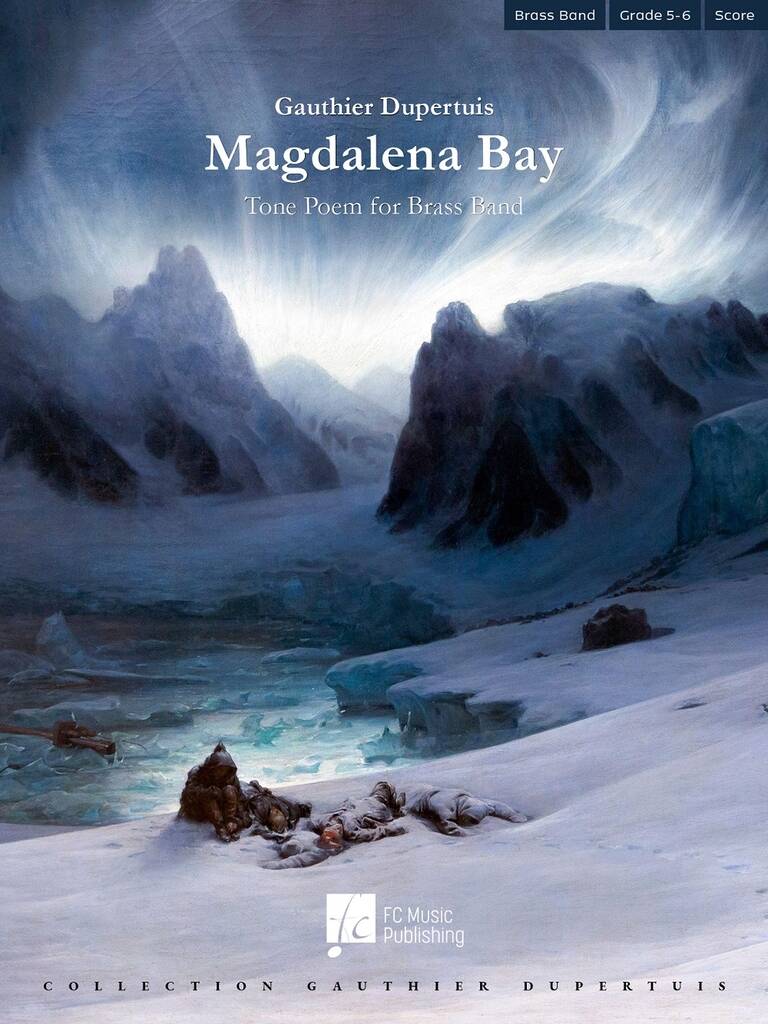
Magdalena Bay - Gauthier Dupertuis
While admiring many masterpieces at the Louvre Museum in Paris, Gauthier Dupertuis' attention was drawn to a less famous painting: Magdalena Bay, by French painter Francois-Auguste Biard (1799-1882).The work depicts a magnificent snowy landscape on the Norwegian island of Spitsbergen. However, in the foreground, the presence of the wreckage of a ship, bodies covered in snow and a visibly dying character make us understand that tragic events took place there. Thus, a strong contrast is formed between death and the sublime, between the desolation of the survivors of the shipwreck and the magnificence of the landscape. When we look in more detail at the painting, we notice that footprints have been made in the snow: so, could someone have gone to get help? This little glimmer of hope makes the picture even more touching. In this work, Gauthier Dupertuis tried to describe the different elements of the painting, using contrasting sections and dissonances (in particular, the conflict between the minor and the major) to convey the duality between death and the sublime. The work also attempts to highlight a wide palette of orchestral colors, from the most shimmering lines to the darkest low brass colours. In 2024, Magdalena Bay was awarded the first Prize as well as the band Prize at the 9th European Composition Competition for Brass Band, which was held in Palanga (LT). It was premiered on May 2, 2024 by The Cory Band, conducted by Philip Harper.
Estimated dispatch 5-14 working days
-
 £104.99
Sinfonietta No. 4 - Etienne Crausaz
This work was composed for the occasion of the 28. Fete Cantonale des Musiques Vaudoises (28th Music Festival of the Canton Vaud), taking place in the Valley of Joux in June 2018. The music begins with a very simple fanfare consisting of five ascending legato notes which constitute the fundamental framework of the piece. This contrasts with the more cantabile sounding theme we hear after. The following Allegro section uses the sequence in a contrapuntal style reminding us of the Renaissance period, but with more modern day harmonies. Two solo cadenzas played by cornet and euphonium initiate the middle section, in which a theme also based on the sequence builds uptowards the climax of the piece. The sequence in the last section is played in time but gives the feeling of a "one to the bar" beat. Shortly before the festive finale, the music heard in the middle part resumes.
Estimated dispatch 5-14 working days
-
£54.99
Eres Tu - J.C.Calderon Lopez de Arroyabe - John Blanken
In 1973 Juan Carlo Calderon wrote Eres Tu for the Spanish Basque pop group Mocedades. The song was placed second in that years Eurovision Song Contest and is one of only five Spanish language songs to get into the US top ten. Subsequently the song was translated into 15 different languages including an English version entitled Touch the Wind. This romantic ballad is a great inspirational item that will be well received by your audience.
Estimated dispatch 5-14 working days
-
 £69.99
The Pioneers - Philip Sparke
In The Pioneers Philip Sparke salutes the bicentenary of an expedition by two all time American heroes - Meriwether Lewis and William Clark. They were commissioned by US President Thomas Jefferson to find the headwaters of the Missouri and a route to the Pacific following the Louisiana Purchase, which doubled the size of the USA. They set out as the 'Corps of Discovery' from Louisville, Kentucky, in May 1804 and not only did they succeed in reaching the Pacific through hostile territory, but also found their way back - in 3 years! The piece is not descriptive of the journey but gives the composer the opportunity to celebrate the 200th anniversary of this amazing feat. Add atouch of the wild-west to any concert with this exciting work.
Estimated dispatch 5-14 working days
-
 £76.99
Leonesse - Bert Appermont
Leonesse is the name of the castle and landed estates of Lady Guinevere, from the famous story of King Arthur. This stately concert march leads us to the old England with its legendary castles and the beautiful and impressive landscapes where many knights have died. Following a festive opening, a majestic melody symbolises the atmosphere of courtly elegance and refinement. The second part of this original composition describes, with a broad and dignified melody, the beauty and extensiveness of the English hills.
Estimated dispatch 5-14 working days
-
 £76.99
On Wings of Liberty - Rob Goorhuis
On Wings of Liberty shows us that Rob Goorhuis, one of Holland's greatest contemporary composers of music for wind instruments, is a natural when it comes to writing concert marches. His first work of this type is suitable for just about every event.
Estimated dispatch 5-14 working days
-
£76.99
American Dances - Bertrand Moren
This entertaining work highlights the cornet and trombone sections. Several dances of American origin are presented by the soloists, supported by band accompaniment. Following a short introduction a country and western passage takes us to the far West and the home of the cowboys. The second part, a blues section, opens with a terrific trombone cadenza. The final jazz based passage is rather acrobatic in style and ends with a fantastic percussion improvisation.
Estimated dispatch 5-14 working days
-
 £91.99
Time Remembered - Philip Sparke
The initial idea was for a millennium piece, which it is, but rather than add to the many celebratory pieces that have understandably been written to salute the 3rd millennium, Philip Sparke thought it would perhaps be appropriate to think about the aspects of life that are constantly with us (such as faith and philosophy) rather than the exciting changes that the year 2000 has undeniably wrought. This calm meditative work will bring a moment of serenity and reflection to any concert.
Estimated dispatch 5-14 working days
 View Music