
Results
-
£24.50
The Cheshire Waltz - Traditional - A. Cook
A gentle setting of the traditional Cheshire folk melody, featuring solo and ensemble contributions from around the stand, this arrangement is playable by most levels of band and ideal for a lighter moment in your concert programme as an alternative to a slow melody.Starting as softly as a summer breeze, slowly gaining enthusiasm, before waltzing brightly to its peaceful conclusion, it's music as light as a victoria sponge and as English as a game of cricket on the village green.
In Stock: Estimated dispatch 1-3 working days
-
 £104.99
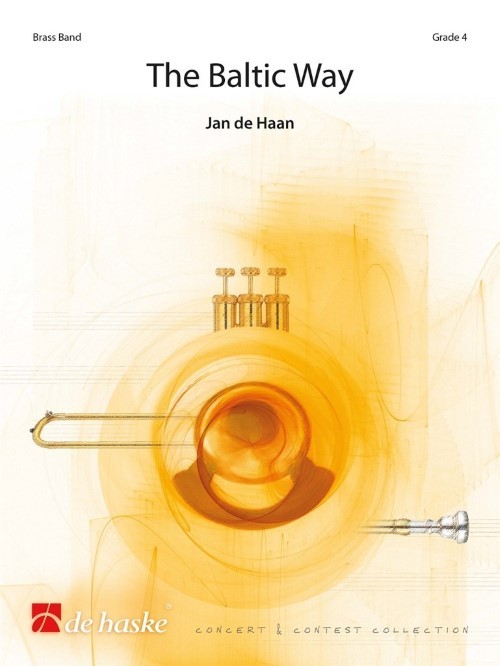
The Baltic Way (Brass Band - Score and Parts) - De Haan, Jan
In 1989, the demonstration named the Baltic Way also known as the Baltic Chain-- was held in the Baltic states of Estonia, Latvia and Lithuania by its citizens in a call for independence from the Soviet Union. On 23rd August 1989, some two million participants formed a human chain, hand-in-hand all the way from the Estonian capital of Tallinn its Latvian counterpart, Riga, through to the Lithuanian capital of Vilnius - six hundred kilometres long. It became the longest human chain ever created and turned out to be the final push needed for much sought-after independence. This historic event became the source of inspiration for this composition. The introduction of thefirst movement, 'Struggle for Independence', is based on a nocturne for piano by the renowned Lithuanian composer and painter Mikalojus Konstantinas iurlionis (1875-1911), thematic material from which has been incorporated throughout the whole composition. The melancholic beginning is followed by a powerful theme which reflects the resolve of the Baltic people. The sudden aggressive, dissonant chords and a dominant and--in rhythmic terms--contrary bass drum announce that the resistance is not going smoothly. Just for a moment, we hear the anthem of the Soviet Union in the lower brass, but this is relentlessly pushed to the background by the rest of the band playing the Lithuanian national anthem, 'Tautika giesm ' (Lithuania, our homeland). The second movement, 'Decades of Suffering', echoes life under the Soviet Union's thumb. In the pursuit of independence, a peaceful protest is planned in which a human chain is formed across the Baltic states of Estonia, Latvia and Lithuania. This 'Chain of Freedom' is depicted in the final movement of the work. Duration: 10.30
Estimated dispatch 7-14 working days
-
 £69.99
Twins (Brass Band - Score and Parts) - Hadermann, Jan
Twins is a composition about two children, born at the same moment, growing up together yet with totally different characters. One twin is sensitive and introverted whilst the other is much more lively and energetic. This is reflected in the musical motifs of the piece. The quiet first melody which gains tension through continuous transposition is succeeded by the joyous rocking melody of the second twin.Duration: 5:30
Estimated dispatch 7-14 working days
-
 £168.50
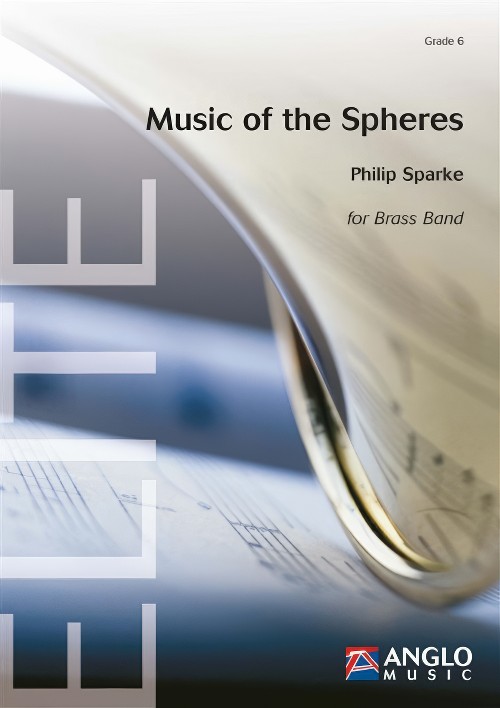
Music of the Spheres (Brass Band - Score and Parts) - Sparke, Philip
Music of the Spheres was commissioned by the Yorkshire Building Society Band and first performed by them at the European Brass Band Championships in Glasgow, May 2004. The piece reflects the composers fascination with the origins of the universe and deep space in general. The title comes from a theory, formulated by Pythagoras, that the cosmos was ruled by the same laws he had discovered that govern the ratios of note frequencies of the musical scale. ('Harmonia' in Ancient Greek, which means scale or tuning rather than harmony - Greek music was monophonic). He also believed that these ratios corresponded to the distances of the six known planets from the sun and thatthe planets each produced a musical note which combined to weave a continuous heavenly melody (which, unfortunately, we humans cannot hear). In this work, these six notes form the basis of the sections Music of the Spheres and Harmonia. The pieces opens with a horn solo called t = 0, a name given by some scientists to the moment of the Big Bang when time and space were created, and this is followed by a depiction of the Big Bang itself, as the entire universe bursts out from a single point. A slower section follows called The Lonely Planet which is a meditation on the incredible and unlikely set of circumstances which led to the creation of the Earth as a planet that can support life, and the constant search for other civilisations elsewhere in the universe. Asteroids and Shooting Stars depicts both the benign and dangerous objects that are flying through space and which constantly threaten our planet, and the piece ends with The Unknown, leaving in question whether our continually expanding exploration of the universe will eventually lead to enlightenment or destruction.Duration: 18:00
Estimated dispatch 7-14 working days
-
£42.50
Music of the Spheres (Brass Band - Score only) - Sparke, Philip
Music of the Spheres was commissioned by the Yorkshire Building Society Band and first performed by them at the European Brass Band Championships in Glasgow, May 2004. The piece reflects the composers fascination with the origins of the universe and deep space in general. The title comes from a theory, formulated by Pythagoras, that the cosmos was ruled by the same laws he had discovered that govern the ratios of note frequencies of the musical scale. ('Harmonia' in Ancient Greek, which means scale or tuning rather than harmony - Greek music was monophonic). He also believed that these ratios corresponded to the distances of the six known planets from the sun and thatthe planets each produced a musical note which combined to weave a continuous heavenly melody (which, unfortunately, we humans cannot hear). In this work, these six notes form the basis of the sections Music of the Spheres and Harmonia. The pieces opens with a horn solo called t = 0, a name given by some scientists to the moment of the Big Bang when time and space were created, and this is followed by a depiction of the Big Bang itself, as the entire universe bursts out from a single point. A slower section follows called The Lonely Planet which is a meditation on the incredible and unlikely set of circumstances which led to the creation of the Earth as a planet that can support life, and the constant search for other civilisations elsewhere in the universe. Asteroids and Shooting Stars depicts both the benign and dangerous objects that are flying through space and which constantly threaten our planet, and the piece ends with The Unknown, leaving in question whether our continually expanding exploration of the universe will eventually lead to enlightenment or destruction.Duration: 18:00
Estimated dispatch 7-14 working days
-
 £68.99
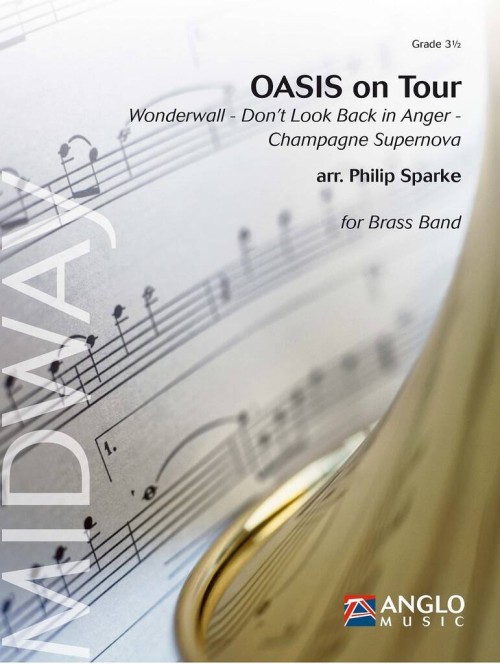
Oasis on Tour (Brass Band - Score and Parts) - Sparke, Philip
The legendary English rock band Oasis reunites after fifteen years! Brothers Liam and Noel Gallagher will once more work their musical magic in a spectacular reunion tour in 2025. This is the moment that fans worldwide have been waiting for.With timeless classics like Wonderwall, Don't Look Back in Anger, and Champagne Supernova, the brothers return to the stage, touching a chord in a new generation and taking old fans back to the heyday of the 1990s.For this occasion, Philip Sparke has arranged a breath-taking medley. The nostalgia and raw energy of these iconic songs are guaranteed to give every musician and listener goosebumps. And so, this unique arrangement will add a new dimension to your concert programme.Duration: 7.15
Estimated dispatch 7-14 working days
-
 £68.80
When the lights go down - Kevin Houben
Kevin Houben created with When the Lights Go Down, a wonderful chorale that can be a moment of reflection in any concert program.The resigned, magnificent melodies at the beginning of this composition slowly build up to a highlight with an increasing orchestration. The piece starts with a suggestive Adagio Meditativo, after which the main theme is immediately announced. A central bridge section takes the listener along through the different spheres at which the melodic and rhythmic drums embellish the chorale melodies. Thematic elements from the introduction brings the piece to a quiet and peaceful end.The sheer simplicity with which this work is written, makes it a resplendent, magnificent concert piece. 'When the Lights Go Down', refers to a moment when time stand still for a while, stillness within and around yourself.
Estimated dispatch 5-14 working days
-
 £54.99
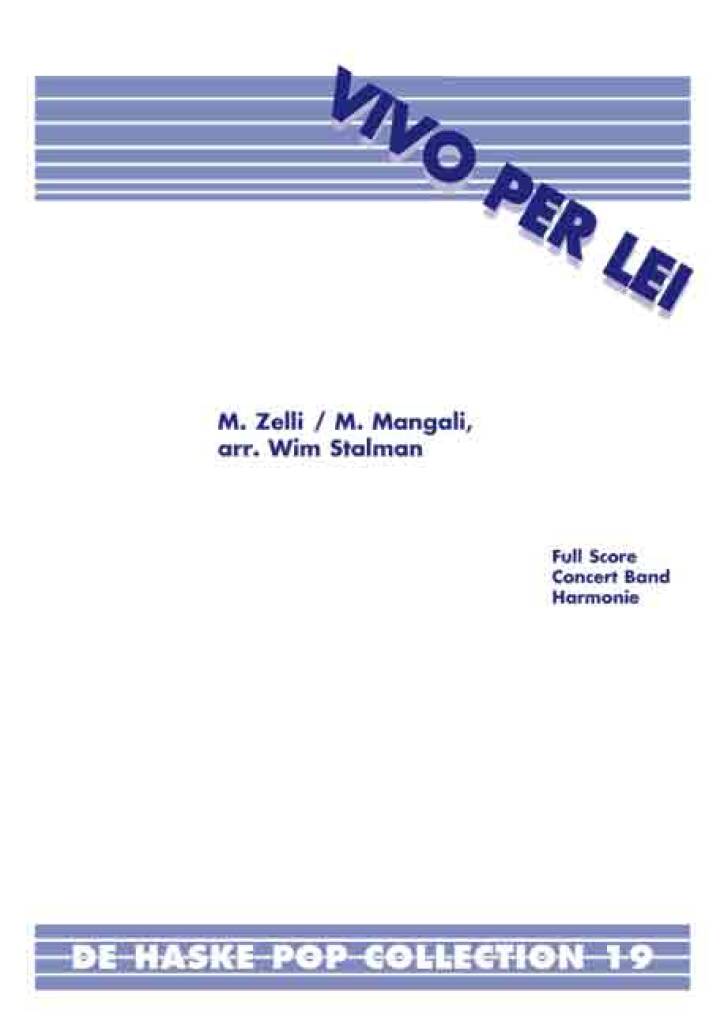
Vivo Per Lei - V. Zelli - Wim Stalman
A passionate desire for Andrea Bocelli's voice has spread across the world like wildfire for Andrea Bocelli possesses a truly remarkable voice. A voice as palpably powerful, as it is almost ethereal. Vivo Per Lei (I live for Her) tells of a passion so great that it is felt in every action, every moment of the day. This excellent arrangement will bring a moment of tender passion to any concert.
Estimated dispatch 5-14 working days
-
 £104.99
Cambridgeshire Impressions - Rieks van der Velde
In a four-part composition Rieks van der Velde takes us to the richly varied area surrounding the university city of Cambridge. The Dutch composer was especially inspired by the atmosphere of Cambridgeshire, the county which lies north ofLondon. 1. The Journey. Although on arrival the area looks peaceful and friendly, the ruggedness of its inhabitants and landscape have an unmistakable influence on the music. In the course of the tour, which starts with an Allegromovement, we are shown the vitality, energy and freshness of the Cambridgeshire countryside. Short themes, swift and sudden motifs and rhythmical patterns supported by the drive of percussion instruments give expression to this image. Thefirst part is concluded by two Calmo movements in which the music expresses how the cathedral in the city of Ely comes into sight and is gradually approached. 2. Visit to Ely Cathedral. The famous Norman cathedral church of Ely, whichwas built in 1109, has attracted tourists from all over the world apart from being a place of worship and heritage site. A cornet solo introduces the contemplative mood of the composition at this point. The mystical atmosphere of thecathedral runs through this lyrical part like a continuous thread. 3. The Pub. The thirst caused by this intensive journey makes a visit to the local pub a definite must. These "public houses", which may be open until the earlyhours of the morning, offer all kinds of entertainment. Drinks are served liberally and the atmosphere is lively. 4. The Journey Back. Time has flown: In other words, the moment of departure has come sooner than one would havewished. In a flashback which recaptures elements of the first part of the composition we say goodbye to Cambridgeshire in a fitting manner. Two scintillating final measures bring us abruptly back to the present.
Estimated dispatch 5-14 working days
-
 £52.50
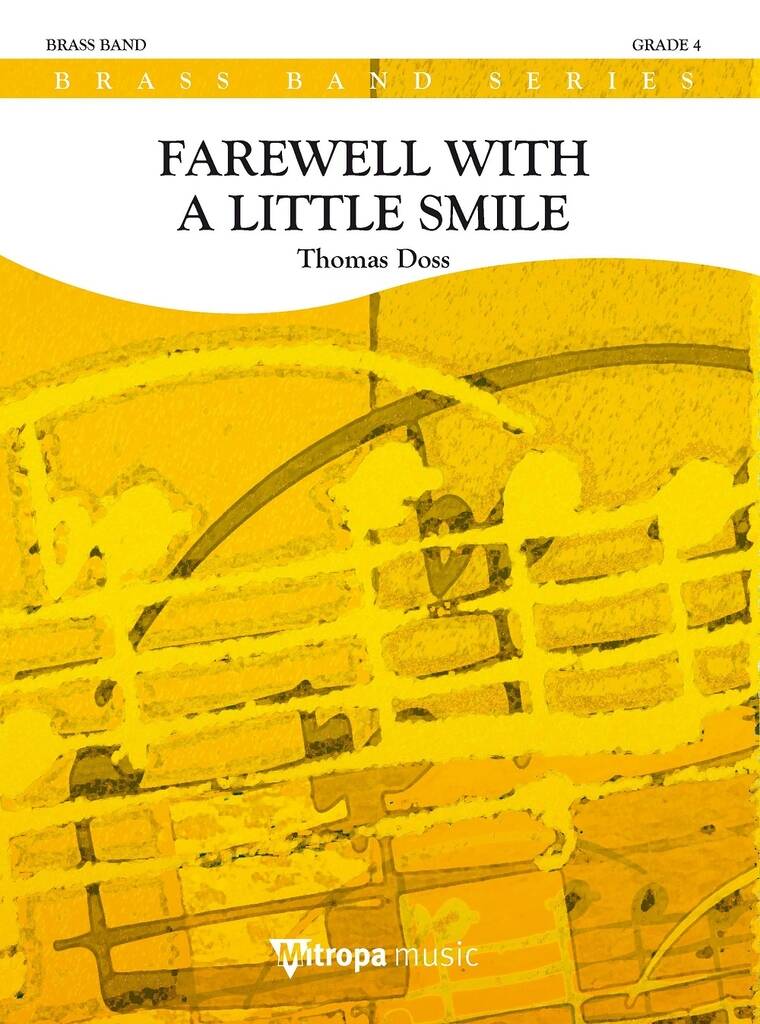
Farewell With a Little Smile - Thomas Doss
A farewell can have many faces: sad, happy, content, grateful... This special piece was composed as a heart-warming gift for an exceptional musician upon retirement from his beloved music society. The work carries an important message: every farewell is also an opportunity for a new beginning; a moment to cherish with a little smile.This atmospheric work opens with subdued, warm brass sounds that create a sense of intimacy. Through alternating (smaller) instrumentations, it builds up to a sonorous tutti climax, eventually leading to a subdued mood again. The closing passage offers room for reflection, memories, and gratitude.Farewell With a Little Smile is a beautiful, solemn composition suitable for countless occasions. Whether the work serves as a resting point in a concert programme or is used to frame a meaningful farewell, this music will add lustre to numerous precious moments.
Estimated dispatch 5-14 working days
 Listen to MP3
 View Music