
Results
-
£54.99
Joyful March - Bertrand Moren
As the title implies, this piece is all joy and cheerfulness. In Joyful March, the themes have been combined to make a spirited work that can give each concert an elated touch. From the opening vivid melody to the softer and colourful themes of the trio, Joyful March is full of joie de vivre. Its fairly simple structure makes it accessible to all brass bands.
Estimated dispatch 5-14 working days
-
 £55.00
The TV Detectives - Nigel Hess
The TV Detectives brings together five of Nigel Hess's best-known television themes, all originally written for small-screen sleuths in whodunnits that have been enjoyed by TV audiences worldwide. The themes stand aloneas imaginitive and challenging pieces that will stretch wind ensembles and delight audiences. This is a continuous suite arranged for wind band.
Estimated dispatch 5-14 working days
-
 £127.30
Rendezvous - Torstein Aagaard-Nilsen
Rendezvous was commissioned by Krohnengen Brass Band for their 50th Anniversary in 2019.Rendezvous is devided into three sections. Each section are referring to Edvard Grieg's own titles. but twisted, to make sure that everybody understand that this music is a mash-up of themes Edvard Grieg used in opus 54 (for piano) and opus 61 (songs for children).1. Trolltog med avsporing (March of the Trolls derailment)March of the Trolls is a famous part of Edvard Grieg lyric pieces, opus 54.2. Klokkeklang i feil sang (Bell ringing in wrong tune).Bell ringing show that Grieg was one of the first composers to write the way impressionists did. What happens if this beatiful piece is combined with several other themes from the same book? It somehow works in its own way.3. Pep talk til Blakken (Pep talk to Blakken)The riff used in the first part becomes an important part of the third part: a funky treat of the childrens song "Kveldssang for Blakken" (Evening song for Blakken).I felt that a rather tired old horse needed a pep talk more than a slow tune. So that is why you get this music(!) - and this is how my rendezvous with Grieg ends.Not sure what maestro Grieg would have thougt... But, I have read that the fiddlers that played the tunes Grieg used was not happy with the way Grieg used them.So there you go...Torstein Aagaard-Nilsen
Estimated dispatch 5-14 working days
-
 £154.99
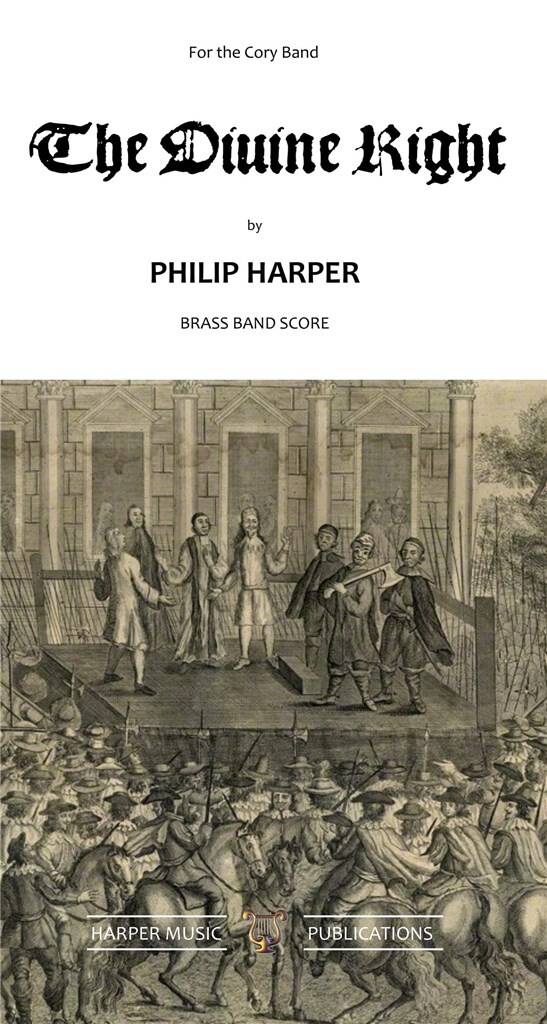
The Divine Right - Philip Harper
At the time of composing this piece, the Arab Spring was sweeping through the Middle East. It seemed that almost every week a new countrys people had risen up against the regimes and dictatorships which had prevailed for generations, leaving manynations at a defining crossroads in their history. There were so many possible ways ahead: so many hopes, yet so many uncertainties.My music is a depiction of these revolutionary times, and several musical themes are in turn presented, discussed, considered, fought over, altered, rejected or accepted. Most nations have had, or probably will have, their own Arab Spring, including my own, the United Kingdom. Events of 17th Century Britain provide the context for this piece, particularly those following the execution of the tyrant King Charles I on30 January 1649. The regicide was in part due to Charless steadfast belief in the Divine Right of Kings, and led to a tumultuous interregnum, where England stood at its own defining crossroads.The music begins turbulently, before King Charles appears and is led to the gallows outside Banqueting House in central London where he is brutally decapitated. From the assembled crowd rose, according to one observer, a moan as I never heard before and desire I may never hear again.The music descends to emptiness. The musical argument which follows is not strictly programmatic, but a number of musical themes are all thrown into the melting pot, representing ideas such as: religion; military force; reasoned Parliamentary debate; and the chattering,irrepressible voice of the people. Additionally, there are some quotations from the music of royalist composer Thomas Tomkins (1572-1656), who was often in tune with the feeling of the times. This defining episode in Englands history was brought to a close with the Restoration of the monarchy in 1660, and as the exiled King Charles II rode back into London the diarist John Evelyn wrote: Never was so joyful a day seen in this nation. I stood in the Strand and beheld it, and blessed God.At the end of the piece the bells ring out, and the musical appearance of the King has transformed from turbulent to triumphant. Philip Harper, 2013
Estimated dispatch 5-14 working days
-
 £99.99
Lucerne Dances - Philip Sparke
Lucerne Dances consists of three movements, which play without a break and offer variety in abundance, with athletic figures, full chords, suave melodies, and alternating robust and mysterious themes. Several soloists are brought into the limelight, but each section, as well as the band as a whole, will have the opportunity to shine. In short: a captivating work with a festive touch that both the band and the audience will enjoy.
Estimated dispatch 5-14 working days
-
 £105.20
Terrible Symphony - Haakon Esplo
Let us present "Terrible Symphony" - the perfect piece for beginner or junior bands!This fun composition gives young musicians the opportunity to have a great time while driving the conductor crazy. The piece includes well-known themes from great symphonies, along with new music, and not least, lots of silliness and fun. All musicians can join in and come up with more pranks and humorous elements. The audience will laugh out loud and enjoy this crazy and entertaining, yet terrible symphony.Make your concert an unforgettable experience with "Terrible Symphony"!In the score, you will find instructions and suggestions for the conductor as the musicians become increasingly impossible.
Estimated dispatch 5-14 working days
-
 £102.99
Sinfonietta No. 1 - Marc Jeanbourquin
Sinfonietta No.1 won first prize in the 2023 Composition Competition organized by the Swiss Brass Band Association. Various melodic themes and rhythmic motifs develop throughout the work. They combine with the numerous dynamic effects to bring a certain unity, from the beginning to the end of this competition piece. The technical and melodic difficulties allow the different soloists to show their virtuosity and musical prowess over five uninterrupted parts. After a first slow and misterioso part, there is a contrast with the following energico sequence based on an ostinato, creatings both a progression and a tension, to drive everything towards the third part mesto (sad), then lento, where some cadenzas and numerous dissonnances can be heard. The energico transition announces the fifth part, a ternary and fast con fuoco. This last part will lead the audience to a final apotheosis.
Estimated dispatch 5-14 working days
-
 £73.60
West of the Mississippi - Dean Jones
There's always a sense of adventure about America that makes it a really exciting topic to write about. The 3 States that sprang to mind in bringing a piece of music together were: California, Hawaii and Texas.We start out our American journey on the West Coast....California has provided much in the way of film and music for over 100 years. Combining this sense of free expression with the 'Surfing' culture, this initial section of the piece has an easy-going, fun feel in a pop idiom. Maybe wearing some shades might be quite a good look for this section!We move even further West now to the island of Hawaii where the free and easy goes onto a new level! The use of chromatics is a feature of Hawaiian melodies and has a feel a 'sliding' between notes that somehow sums up this feel of living on a tropical island! Have some fun with this section and have a Hawaiian garland to wear!Back into the USA mainland, and the fabulous state of Texas! Here we have the concept of the old fashioned rodeo and the 'Wild West'. Even today, the culture of horses, cowboys and tales of adventure are celebrated in places such as Fort Worth. The music captures some of these themes and has a fun and enjoyment...some get your Cowboy hats at the ready and enjoy the finale!
Estimated dispatch 5-14 working days
-
 £61.00
Lord of the Flies - Gauthier Dupertuis
The title of this work by Gauthier Dupertuis refers to the novel Lord of the Flies by William Golding, published in 1954. Lord of the Flies is intended to be a small symphonic poem describing different episodes of the book: the despair of the children stranded on the island, the use of the unifying conch and symbol of democracy, the adventures, and the formation of the camp and finally the savagery of the clan of Jack which undeniably leads to chaos. The finale is mysterious and half-tone, imbued with both the relief of having been rescued, and a deep sadness linked to the tragic events that have occurred on the island.All the main themes and elements developed in the work come from the idea "d-e-f", exposed from the first bars. The orchestration is intended to be variable in geometry and avoids the main technical difficulties related to the instruments. However, the composer wanted to find as many colors as possible and avoided confining himself to too "simple" harmonies.Lord of the Flies: a piece accessible to most brass bands.
Estimated dispatch 5-14 working days
-
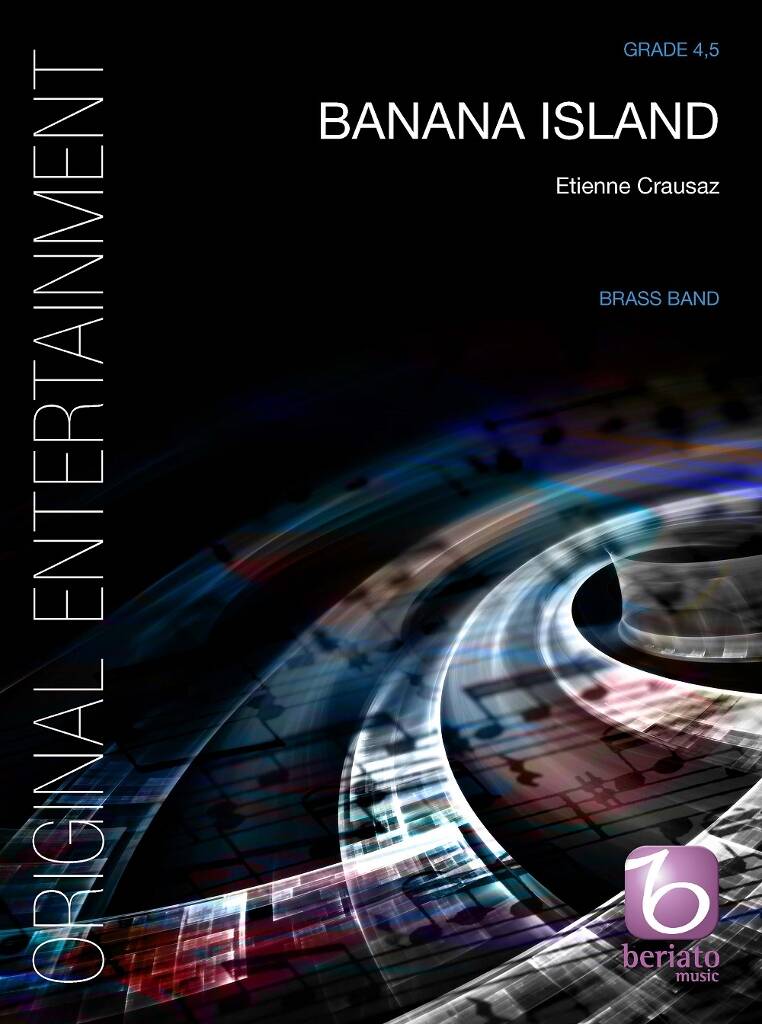 £64.99
Banana Island - Etienne Crausaz
Banana Island is an extraordinary fictional place: coconut palms, date palms, mango trees, banana trees and mangroves grow in abundance. Animals live there in heavenly harmony. On a Caribbean danse rhythm, the Soca, several themes develop and create a dialogue between the various registers. A central section offers the cornet and trombone the chance to display their soloist skills. This work is full of energy and brimming over with enthusiasm! This music forms part of the musical tale La Malediction d'Aragne (Aragne's Curse), written by Dominique Schweizer and commissioned by the Lyre de Courtion (dir. Dominique Morel) on the occasion of its 100th anniversary.
Estimated dispatch 5-14 working days
 View Music