
Results
-
 £59.99
Bare Necessities, The - Christopher Bond
First heard in the original 1967 movie, this familiar tune is featured again in the acclaimed 2016 version. In this clever arrangement for band, the arranger utilizes a peppy 2-beat style, beginning with the trombones taking the melody. Every section of the band soon gets into the act, including a solo or soli for tuba, and a brief slower section for a Dixieland combo leading to the rousing finish. This song is guaranteed to be a highlight at any concert. Note: whilst the demo video demonstrates the concert band arrangement, the version available to purchase on this website is the brass band transcription by Christopher Bond.
Estimated dispatch 10-14 working days
-
 £10.00
The Once and Future King
DescriptionThe Once and Future King is a suite of three movements; each movement was inspired by an Arthurian legend. The first movement, 'Tintagel', concerns the famous Cornish promontory said to be the birthplace of King Arthur. In Arthur's time, Tintagel was part of the court of King Mark of Cornwall and the music imagines a visit by the King of the Britons to his Cornish neighbour and the place of his birth, reflecting the ceremony and drama of such an occasion; the music is strongly antiphonal, contrasting the more strident fanfares of the cornets and trombones with the warmth of the saxhorns and tubas.The second movement, 'Lyonesse', takes its inspiration from the mythical land which once joined Cornwall to the Isles of Scilly. One legend claims that after the disastrous battle of Camlan where Arthur and Mordred were both killed, the remnants of Arthur's army were pursued across Lyonesse to Scilly, whereupon Merlin cast a spell to sink Lyonesse behind them and drown the pursuers. Some say the bells of the 140 churches inundated that day can still be heard ringing. All the material in this movement derives from two short motifs heard in counterpoint at the very beginning, which are intentionally dissonant and bitonal in character.The final movement, 'Badon Hill', takes its title from the legendary site of Arthur's last battle with the Saxons and is a lively toccata based on the medieval secular song L'Homme Armee ('The Armed Man'). The music uses a number of medieval devices including "hocketing" (passing melody from one voice to another). The actual site of Badon Hill is unknown but it has been associated with Badbury Rings in Dorset and a lot of evidence now points towards the town of Bath. Arthur's victory at Badon Hill was the last great victory for Celtic Britain over the Saxon invaders, but in the end only set the conquest back by a few decades. Arthur himself was dead by then, betrayed and defeated by his nephew Mordred, but it is said that Arthur only sleeps and will return in a time of dire need - hence the legend that Arthur's dying words were: Bury me in Britain, for I am the Once and Future King.Performance NotesWhere space and practicality permits the opening movement should be played with cornets and trombones standing behind the band facing the audience; they should retake their seats for the second and third movements.PercussionConcert Bass Drum (ideally NOT Kit/Pedal Bass Drum), Suspended Cymbal, pair of Clash Cymbals, Glockenspiel, Snare Drum, Tambourine, 2 x Timpani (Eb-G, Bb-D), 2 x Tom-toms, Triangle, Tam-Tam* (only if available), Tubular Bells *(only if available).MutesBaritones, all cornets and trombones will require metal straight mutes; all trombones and cornets will require cup mutes.*The Once and Future King was set as the test-piece for the 3rd section of the Swiss National Championships in 2007. The score was then slightly revised in July 2008, the main alteration being the exclusion of the tubular bells part for the Regional Championships of Great Britain in 2009. Some parts which were optional (or cued on other instruments) at the request of the Swiss Brass Band Association were restored to their original octaves and instruments. In 2015 the tubular bells part was restored in the optional Percussion 3 part; all parts in Percussion 3 are optional, although some are cued in the percussion 1 & 2 parts (and the cues should be played if only two players are available).Listen to a preview and follow along with the score below!
Estimated dispatch 7-14 working days
-
 £35.00
The water is wide. Trad. Arr Andrew Duncan
Recommended - Championship to 3rd Section The Water is Wide or, Oh Wally Wally, is an arrangement for brass band of the popular and hauntingly beautiful traditional song. This arrangement is a feature for the Solo Cornet section of the band, beginning with just one solo cornet then adding another until all four are playing the melody line together. Includes Score & Parts
-
.png) £29.95
£29.95Ghost of Christmas Past, The - Jonathan Bates
DURATION: 2'30". DIFFICULTY: 2nd+. Composed for Strata Brass in 2020 as part of their COVID-19 induced, virtually recorded 'A Christmas Carol' (a new suite for brass bandlasting around 30 minutes in total), 'The Ghost of Christmas Past' is a lively and virtuosic cornet solo portraying the visions Scrooge is shown of his childhood. Beginning in a jovial mood, the ghost then shows Scrooge his early love life, before showing how Scrooge's unsympathetic and callous ways lead to his loss of love and friendship throughout the years as the music gets gradually darker and darker with each passing section. .
In Stock: Estimated dispatch 1-3 working days
-
£44.95
PRAISE TO THE LORD (Brass Band Set) - Andrew Mackereth
Written for the 2003 tour of Canada and USA by Bristol Easton Band of The Salvation Army, this set of variations provides the whole band with a stern examination of technical and musical aptitude, whilst engaging the listener from beginning to end. The commission given to the composer was to create a set of variations with a similar framework to that of Edward Gregson's 'Variations on Laudate Dominum'. As in the famous Gregson work, the theme (Lobe den Herren) is not heard in its entirety until the final section when the majestic tune provides a fitting and stirring conclusion to the music.
Estimated dispatch 7-14 working days
-
 £25.95
Hymn for Africa - Peter Meechan
Part of the Brass Band Aid SeriesBrass Band Aid is a Charitable Organisation formed by members of Stanhope Silver Band, based in the North of England. From an original aim to raise awareness of the Make Poverty History campaign in their local area, a brass band CD recording was planned. The initiative took on a whole new dimension when the collection of local bands performing on CD were then joined by, what is now known as, The Brass Band Aid Celebrity Band, made up of many of the top brass musicians in the country.Following the success of this initial project the Celebrity Band has come together again to record a new CD - "Into Africa". This is a compilation of pieces especially written for the recording by some of the most esteemed brass band writers of today. 'Hymn for Africa' is one such piece, generously contributed by Peter Meechan in support of the ongoing work of the charity."Hymn for Africa is inspired by the the release of Nelson Mandela in the early 1990's and the effect it had upon not only South Africa, but all over the continent of Africa, as well as the World as a whole. The fact that one man can achieve this with peace and great dignity will always be an inspiration, not only to me, but many, many millions of humans around the globe.sense of dignity and peace the composer . A simple 8 bar melody, first heard on an unaccompanied flugel horn at the beginning, is the basis of the composition. A drone is then added, before a chorale, and finally a rousing climax when the percussion and full band enter. The piece ends at it began, with a peaceful, unaccompanied, flugel solo." (Peter Meechan).All sets sold raise money for Brass Band Aid - a charity The Music Company has continued to actively support since 25.
In Stock: Estimated dispatch 3-5 working days
-
 £15.00
Pomp and Circumstance No. 1 (Land of Hope and Glory) - Elgar
Performance Notes by Andrew Duncan:This fine march theme is arranged in two distinct parts.From the beginning up to two bars before letter C the melody is played quietly with the Horns carrying the tune - the Horns have to play up to a high F in this section. If this is not something that your band can manage then you have two options of where you can start playing the arrangement from.If your band can manage the chromatic notes, then begin playing from two bars before letter C. Alternatively, simply start playing directly from letter C .The musical concepts of Rallentando and A tempo are encountered in this arrangement. These can be difficult concepts for inexperienced players to grasp, so playing this arrangement should help to establish this technique.The Flexi-Collection ApproachFlexible scoring tailored to your needs - A perfect solution for expanding the repertoire of training and junior brass bands. The Flexi-Collection currently offers two series - Popular Classics and World Tour. Based on four-part harmony, these collections provide groups with the advantage of complete flexibility when they may not be balanced. If players or instruments are missing, the show can still go on!The Flexi-Collection - Popular Classics Series, encapsulates all that is great about the wonderful range of musical styles produced by Holst, Elgar, Handel, Verdi, Tchaikovsky, Grieg, Bizet and Parry.The thoughtful scoring and arranging by Andrew Duncan now means that groups of all abilities have access to a truly flexible set of music for their needs. With world parts, rudimentary theory, terminology translations and large format typesetting, The Flexi-Collection ticks all the boxes when it comes to bringing interesting music to the training and junior band/brass group environment.Available individually or as part of the money-saving Flexi-Collection Popular ClassicsAlbum.Scored for Brass Band and supplied with additional Easy Bb, Easy Eb and world parts - The Flexi-Collection offers flexibility in every sense of the word.
In Stock: Estimated dispatch 3-5 working days
-
 £30.00
1989 - Tim Paton
Tim Paton composed this work originally for piano, and later went on to score it into this effective version for brass band.Tim comments:What happened in 1989? I wrote this piece for piano, and later scored it for brass band! The piece begins in a thoughtful mood, then very soon moves into a bluesy style. After an up-tempo dance section, and a brief re-cap of the beginning, it finishes with a majestic coda, which really shows off that special sound that only a brass band can make. Although it is called 1989, it can be any memorable year that the listener wishes it to be.
In Stock: Estimated dispatch 3-5 working days
-
 £94.99
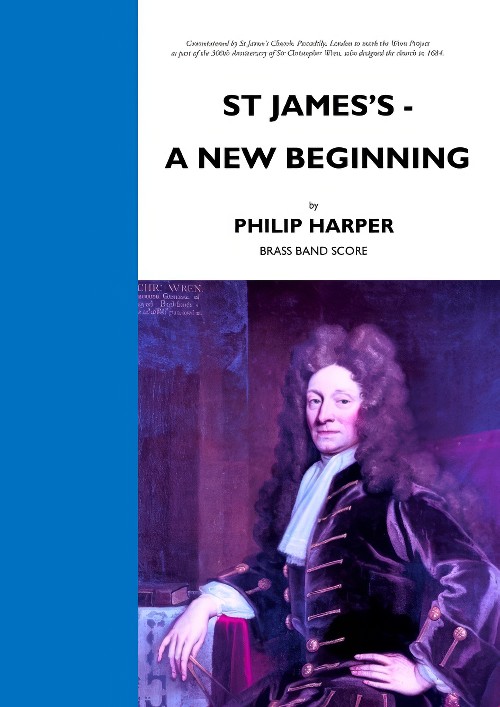
St James's - A New Beginning (Brass Band - Score and Parts) - Harper, Philip
1st Section Finals test-piece for the National Brass Band Champtionships of Great BritainSt James's - A New Beginning commemorates 300 years since the death of English architect Sir Christopher Wren who redesigned and rebuilt London after the Great Fire in 1666.The piece is in four parts:I. The Great FireII. AftermathIII. VisionIV. RenaissanceThe bells ring the alarm and, as the capital city is engulfed by flames, panic and desperation spread. As the fire burns out, we are left to contemplate the aftermath of the inferno. Enter Sir Christopher Wren. His vision and courage were some of the most influential forces in the rebuilding of London which rose to reclaim its place as one of the great cities of the world.Duration: 12:00
Estimated dispatch 7-14 working days
-
 £28.95
A New Beginning (Brass Band - Score and Parts) - Wiffin, Rob
An extended fanfare/opener, A New Beginning is a joyous and exuberant outburst, an affirmation of the eternal hope of the human spirit. It starts and ends with the drama and splendour of a simple fanfare and the sections in between are full of energy, drive and purpose.The musical language is typically American in style with its typical feel of openness, space and grandeur. There are plenty of big moments but players and conductors are asked to pay careful attention to the various layers to prevent it all being performed at full volume.Duration: 4.30
Estimated dispatch 7-14 working days
 View Music