
Results
-
 £79.95
Indian Summer (Brass Band - Score and Parts) - Ball, Eric
The 'Indian Summer' is that of North America, and the music, entertaining but more than half serious, will perhaps evoke memories of tales of Native Americans.There are four movements:The Great Chief SpeaksBy the Cool WatersTotem DanceHymn to the Great SpiritProgramme Notes:This Fantasy is in the form of a Suite, although there should be no long break between each movement. The composer sometimes concocts a little story to illustrate the music, somewhat as follows:"The Great Chief Speaks": the warmth of Autumn's "Indian Summer" will soon be a memory, and hard Winter will set in; so the Chief must hold a great Powwow with his people"By the Coll Waters": a little girl, not interested in grown-up solemnities, slips away to a nearby lake. She gazes at her reflection in the water; executes a little dance, then falls to dreaming."Totem Dance": this will be exciting - the little girl goes running to see! The dancing becomes wilder, then rhythm more insistent, then suddenly silence."Hymn to the Great Spirit": the Powwow closes with a majestic utterance by the Great Chief. A hymn is sung to the "Great White Spirit", and the people turn their thoughts to preparations for the coming Winter.
Estimated dispatch 7-14 working days
-
£39.95
Indian Summer (Brass Band - Score only) - Ball, Eric
The 'Indian Summer' is that of North America, and the music, entertaining but more than half serious, will perhaps evoke memories of tales of Native American.There are four movements:The Great Chief SpeaksBy the Cool WatersTotem DanceHymn to the Great SpiritProgramme Notes:This Fantasy is in the form of a Suite, although there should be no long break between each movement. The composer sometimes concocts a little story to illustrate the music, somewhat as follows:"The Great Chief Speaks": the warmth of Autumn's "Indian Summer" will soon be a memory, and hard Winter will set in; so the Chief must hold a great Powwow with his people"By the Coll Waters": a little girl, not interested in grown-up solemnities, slips away to a nearby lake. She gazes at her reflection in the water; executes a little dance, then falls to dreaming."Totem Dance": this will be exciting - the little girl goes running to see! The dancing becomes wilder, then rhythm more insistent, then suddenly silence."Hymn to the Great Spirit": the Powwow closes with a majestic utterance by the Great Chief. A hymn is sung to the "Great White Spirit", and the Indians turn their thoughts to preparations for the coming Winter.
Estimated dispatch 7-14 working days
-
 £95.00
Tenor Horn Concerto 'Three Gods' (Tenor Horn Solo with Brass Band - Score and Parts) - Gregson, Edward
Edward Gregson's Tenor Horn Concerto (Three Gods) was commissioned by the Belgian tenor horn soloist Tim de Maeseneer for a recording of commissioned works he made in 2024 with his own band, Brass Band Willebroek.The subtitle of 'Three Gods' refers to three mythological Greek Gods: Zeus, Hermes and Apollo. The idea for this came from Gregson's Viola Concerto, which he composed in 2023 and which was similarly subtitled 'Three Goddesses'. Indeed, the first movement of the horn concerto shares some common material with the viola concerto, although the other movements are newly composed.The concerto exploits the noble character of the horn, but the writing is also virtuosic in character as well as lyrical and melodic, demanding an extended playing range of nearly four octaves with a variety of colouration in its sonorities. The unifying motif of the whole concerto is the interval of a rising 5th, heard at the outset. The opening also has some other surprises (both seen and heard).The musical ideas, cast in three separate movements, take their starting point from the characters of the Three Gods in the title:Zeus, ruled as King of the Gods on Mount Olympus, and was the God of Thunder and Lightning and of War. His music is often threatening and violent, but also has a more tender side as portrayed in the lyrical second subject. However, the dominant mood is one of foreboding.Hermes was the great messenger to the Gods who could travel between realms on his winged sandals. Thus, his music is fast, fleet of foot, and mercurial - a dashing scherzo, but with lyrical and expressive moments.Apollo, the God of Music and Dance (and the Sun), symbolises virtue and beauty. This final movement, 'Hymn to Apollo', is mainly slow and hymn-like and cast in a continuous stream of melody passed between soloist and band. Brief fanfares herald a triumphant march, before the music returns to its quiet opening, gradually rising to a triumphant climax with glittering melodic percussion leading the way. The music ends in a blaze of glory!Duration: 17.00
Estimated dispatch 7-14 working days
-
£40.00
Tenor Horn Concerto 'Three Gods' (Tenor Horn Solo with Brass Band - Score only) - Gregson, Edward
Edward Gregson's Tenor Horn Concerto (Three Gods) was commissioned by the Belgian tenor horn soloist Tim de Maeseneer for a recording of commissioned works he made in 2024 with his own band, Brass Band Willebroek.The subtitle of 'Three Gods' refers to three mythological Greek Gods: Zeus, Hermes and Apollo. The idea for this came from Gregson's Viola Concerto, which he composed in 2023 and which was similarly subtitled 'Three Goddesses'. Indeed, the first movement of the horn concerto shares some common material with the viola concerto, although the other movements are newly composed.The concerto exploits the noble character of the horn, but the writing is also virtuosic in character as well as lyrical and melodic, demanding an extended playing range of nearly four octaves with a variety of colouration in its sonorities. The unifying motif of the whole concerto is the interval of a rising 5th, heard at the outset. The opening also has some other surprises (both seen and heard).The musical ideas, cast in three separate movements, take their starting point from the characters of the Three Gods in the title:Zeus, ruled as King of the Gods on Mount Olympus, and was the God of Thunder and Lightning and of War. His music is often threatening and violent, but also has a more tender side as portrayed in the lyrical second subject. However, the dominant mood is one of foreboding.Hermes was the great messenger to the Gods who could travel between realms on his winged sandals. Thus, his music is fast, fleet of foot, and mercurial - a dashing scherzo, but with lyrical and expressive moments.Apollo, the God of Music and Dance (and the Sun), symbolises virtue and beauty. This final movement, 'Hymn to Apollo', is mainly slow and hymn-like and cast in a continuous stream of melody passed between soloist and band. Brief fanfares herald a triumphant march, before the music returns to its quiet opening, gradually rising to a triumphant climax with glittering melodic percussion leading the way. The music ends in a blaze of glory!Duration: 17.00
Estimated dispatch 7-14 working days
-
 £60.99
Klezmeriana (Brass Band - Score and Parts) - De Haan, Jan
The instrumental music of the Yiddish-speaking Jews, especially those of Eastern Europe, is known as klezmer. This terminology was originally used in Jewish cultural life as the name of a musician who played at weddings. At Jewish weddings, which usually last several days, klezmer musicians played not only dance music but also ceremonial music - for example during the wedding ceremony, and also music that was listened to during the wedding feast. Originally, there was no special term for this style of music. It was simply referred to as 'Jewish wedding music'. In the 1970s, the music - which is actually a fusion of different influences - enjoyed a resurgence in popularity and came to be known as klezmer. This music contains not only the sounds of the Balkans, but also influences of oriental and gypsy music too. Jan de Haan used no original klezmer melodies for Klezmeriana, but composed a series of sound-alike in an instrumentation for brass band.Duration: 6.00
Estimated dispatch 7-14 working days
-
 £44.95
Fantasia on 'Glory to his Name' (Brass Band - Score and Parts) - Bright, Dudley
This Fantasia is a celebration of the work of Ray Steadman-Allen. Through most of his 92 years, his music has had a profound and wide-ranging impact on Salvation Army music. Always innovative, rather than stylistically stereotypical, his music has led the way forward for Salvationist composers. As the title suggests, his light-hearted 1960's vocal solo provides thematic material and highlights his motivation. There are also references to and quotations from several more of his pieces. Yet, although much of his music can be challenging, he has also given us music that speaks directly to the heart. His much-loved songs 'He giveth more grace' ('Blacklands') and 'Remember Me' are heard in humble and sincere tribute to a life dedicated to giving the glory to God through his music.
Estimated dispatch 7-14 working days
-
£22.50
Fantasia on 'Glory to his Name' (Brass Band - Score only) - Bright, Dudley
This Fantasia is a celebration of the work of Ray Steadman-Allen. Through most of his 92 years, his music has had a profound and wide-ranging impact on Salvation Army music. Always innovative, rather than stylistically stereotypical, his music has led the way forward for Salvationist composers. As the title suggests, his light-hearted 1960's vocal solo provides thematic material and highlights his motivation. There are also references to and quotations from several more of his pieces. Yet, although much of his music can be challenging, he has also given us music that speaks directly to the heart. His much-loved songs 'He giveth more grace' ('Blacklands') and 'Remember Me' are heard in humble and sincere tribute to a life dedicated to giving the glory to God through his music.
Estimated dispatch 7-14 working days
-
 £38.00
Jubilee Gigue (Brass Band - Score and Parts) - Wiseman, Debbie - Houlding, Christopher
Composer Debbie Wiseman is one of the UK's most successful female music ambassadors. Throughout the past 20 years, there are probably few people in the UK who have not heard a theme from one of Debbie's many film or television productions. Honoured in the Queen's New Year's with an MBE for services to the music and film industry, she has been awarded honorary fellowships at both the music colleges where she studied, Trinity College of Music and the Guildhall School of Music and Drama. "Jubilee Gigue" was commissioned to be performed on the Georgian barge as part of the Queen's Diamond Jubilee Pageant. Inspired by the "Gigue" in Handel's original Water Music, the work has a rollicking, upbeat feel and is now newly arranged for brass band by Chris Houlding. Duration: 5.30. Suitable for 3rd Section Bands and above.
Estimated dispatch 7-14 working days
-
 £95.00
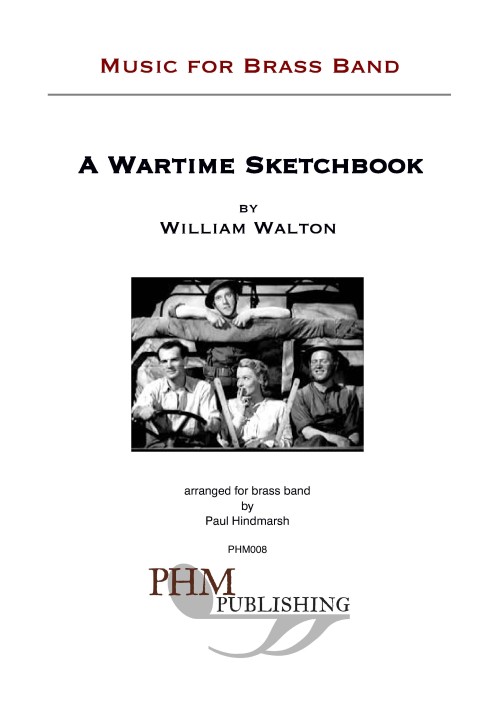
A Wartime Sketchbook (Brass Band - Score and Parts) - Walton, William - Hindmarsh, Paul
Early in 1941 William Walton, 39, received his call-up papers. He was by then one of the most eminent of British composers and was exempted from military service on condition that he provided music for films deemed to be of 'national importance'. Scoring Lawrence Olivier's Shakespeare epic Henry V in 1943 was the most substantial of these wartime projects. His role in patriotic films from 1941 and 42 like The Foreman went to France, Next of Kin, Went the day Well and The First of the Few was to provide appropriate title music and some underscoring at key moments. Walton extracted the most substantial portions of the latter as the popular Spitfire Prelude and Fugue for orchestra. The remaining music remained unpublished until 1990, when Christopher Palmer assembled the highlights into A Wartime Sketchbook. I was intrigued to hear these examples of Walton's wartime music and having discovered that they would fit naturally and idiomatically onto the brass band, I arranged six of the numbers into a suite for Besses o' th' Barn Band, which I was conducting at the time.In 1995 the brass band suite was recorded by the famous Black Dyke Mills Band as part of an all Walton album which I produced for the ASV label (ASV CD WHL 2093). This award- winning CD also included Walton's First Shoot, in the edition by Elgar Howarth, my transcription of movements from Music for Children and two substantial brass versions by Edward Watson of the suite from Henry V (with narrator) and the March and Siegfried Music from The Battle of Britain music.Prologue: This is the stirring title music from Went the day Well, a screen play by Graham Greene about a German airborne invasion of an English village. The main theme leads toBicycle Chase: Characteristic musical high-jinks for J.B.Priestley's The Foreman went to France.Refugees: From the same film, this is a poignant accompaniment to the long march of refugees. As Ernest Irving, the film's musical director, put it, "this really makes your feet sore and your knees sag."Young Siegfrieds: This lively movement comes from the music that Walton composed for The Battle of Britain in 1968, with the assistance of Malcolm Arnold, but which the film's producer rejected. It portrays first the Berliners, cheerfully ignoring the black-out and then, in the trio, the Young Siegfrieds of the Luftwaffe, courtesy of a parody of Siegfried's horn call from Wagner's opera.Romance: A soldier and a Dutch refugee snatch a few tender moments together in Next of Kin.Epilogue: At the end of The Foreman went to France, the French look forward with hope and optimism to eventual liberation.- Paul HindmarshDuration: 14.00
Estimated dispatch 7-14 working days
-
£40.00
A Wartime Sketchbook (Brass Band - Score only) - Walton, William - Hindmarsh, Paul
Early in 1941 William Walton, 39, received his call-up papers. He was by then one of the most eminent of British composers and was exempted from military service on condition that he provided music for films deemed to be of 'national importance'. Scoring Lawrence Olivier's Shakespeare epic Henry V in 1943 was the most substantial of these wartime projects. His role in patriotic films from 1941 and 42 like The Foreman went to France, Next of Kin, Went the day Well and The First of the Few was to provide appropriate title music and some underscoring at key moments. Walton extracted the most substantial portions of the latter as the popular Spitfire Prelude and Fugue for orchestra. The remaining music remained unpublished until 1990, when Christopher Palmer assembled the highlights into A Wartime Sketchbook. I was intrigued to hear these examples of Walton's wartime music and having discovered that they would fit naturally and idiomatically onto the brass band, I arranged six of the numbers into a suite for Besses o' th' Barn Band, which I was conducting at the time.In 1995 the brass band suite was recorded by the famous Black Dyke Mills Band as part of an all Walton album which I produced for the ASV label (ASV CD WHL 2093). This award- winning CD also included Walton's First Shoot, in the edition by Elgar Howarth, my transcription of movements from Music for Children and two substantial brass versions by Edward Watson of the suite from Henry V (with narrator) and the March and Siegfried Music from The Battle of Britain music.Prologue: This is the stirring title music from Went the day Well, a screen play by Graham Greene about a German airborne invasion of an English village. The main theme leads toBicycle Chase: Characteristic musical high-jinks for J.B.Priestley's The Foreman went to France.Refugees: From the same film, this is a poignant accompaniment to the long march of refugees. As Ernest Irving, the film's musical director, put it, "this really makes your feet sore and your knees sag."Young Siegfrieds: This lively movement comes from the music that Walton composed for The Battle of Britain in 1968, with the assistance of Malcolm Arnold, but which the film's producer rejected. It portrays first the Berliners, cheerfully ignoring the black-out and then, in the trio, the Young Siegfrieds of the Luftwaffe, courtesy of a parody of Siegfried's horn call from Wagner's opera.Romance: A soldier and a Dutch refugee snatch a few tender moments together in Next of Kin.Epilogue: At the end of The Foreman went to France, the French look forward with hope and optimism to eventual liberation.- Paul HindmarshDuration: 14.00
Estimated dispatch 7-14 working days
 View Music