
Results
-
 £45.00
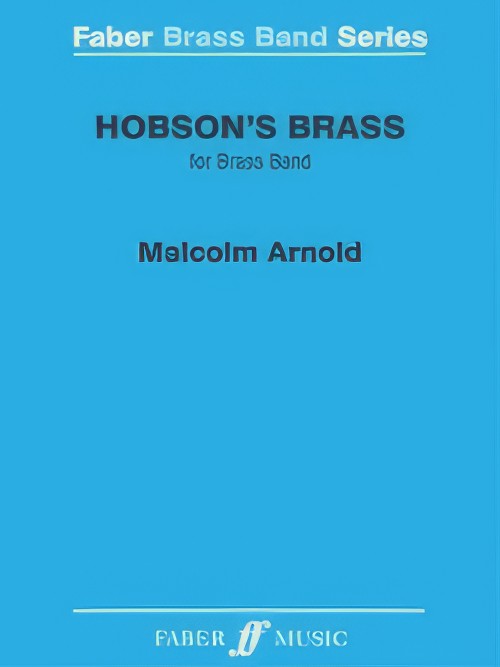
Hobson's Brass (Brass Band - Score and Parts) - Arnold, Malcolm
Hobson's Brass is Malcolm Arnold's score to David Lean's 1954 film, Hobson's Choice, was one of three collaborations between the composer and director. It's a story of Henry Hobson, played by Charles Laughtan who runs a successful bootmaker's shop in nineteenth-century Salford. A widower with a weakness for the pub, he tries forcefully to rule the lives of his three unruly daughters. Suitable for 1st Section Bands and above. Duration: 10.00
Estimated dispatch 7-14 working days
-
 £59.99
Carol of the Shepherds (Brass Band - Score and Parts) - Sparke, Philip
Carol of the Shepherds is based on the hymn tune 'Quem Pastores Laudavere' which dates back to the 14th century and is widely known throughout the Christian world. Although the melody has been set to a number of different texts in different countries it was originally a carol celebrating the Christmas story, in particular the visit of the Angel Gabriel to the shepherds.Duration: 2:50
Estimated dispatch 7-14 working days
-
 £42.50
The Forester (Brass Band - Score and Parts) - Hogestein, Henk
The Forester by Henk Hogestein tells the story of a forester who catches a poacher and is based on the cheery melody of the traditional jig 'the Lincolnshire Poacher'. In an unusual twist however, it is the poacher who triumphs over the forester with his jubilation being heard in the trio section of this march.Duration: 2:45
Estimated dispatch 7-14 working days
-
 £76.99
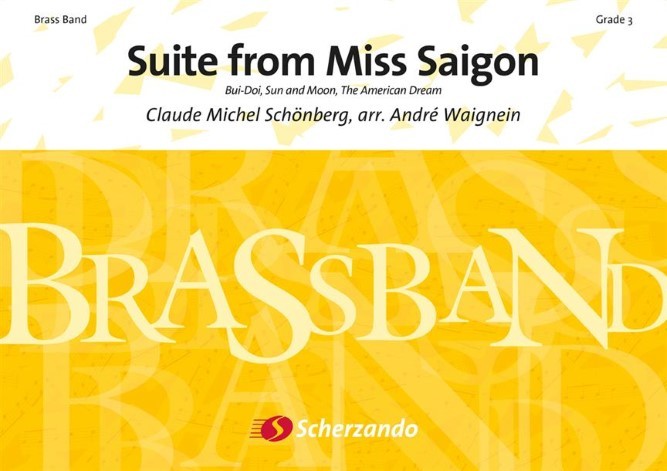
Suite from Miss Saigon (Brass Band - Score and Parts) - Schonberg, Claude-Michel - Waignein, Andre
The musical Miss Saigon was a massive hit in London, Broadway and throughout the world. Based on Puccini's opera, Madame Butterfly, this epic production centres on the romance between a strong-willed Vietnamese woman and an American soldier during the Vietnam War. The story tells of two young lovers torn apart by war yet still held together by a burning passion. This medley features three of the best songs from the musical and mixes desperate love with optimism and joy. Relive the hit show with this catchy medley.Duration: 10:30
Estimated dispatch 7-14 working days
-
 £60.99
Conzensus (Brass Band - Score and Parts) - Van der Roost, Jan
This stately concert opener was originally written by Jan Van der Roost for a special event in which six respected wind orchestras (two Belgian and four Dutch) of different composition (two symphonic bands, two fanfare bands and two brass bands) were featured during six concerts. Each evening brought forth a performance by a symphonic band, a fanfare, and brass band, so that the audience could experience all three types of ensembles. This was indeed an original concept. The name, ConZEnSus, comes from a combination of the words, 'Concert Cyclus' (concert series) and 'zes' (Dutch for 'six'). This leads to a new word, which refers to 'consensus'. The general tenor of the cycle is thus immediately indicated. The richness of color of the various ensembles is revealed through an open and friendly atmosphere. During all six concerts (over a span of three years), ConZEnSus functioned as a permanent opening number for each orchestra. Thus the same musical story was portrayed in three different packages.Duration: 2:30
Estimated dispatch 7-14 working days
-
 £60.99
Tochter Zion (See the Conquering Hero Comes) (Brass Band - Score and Parts) - Handel & Tchaikovsky - De Haan, Jan
Tochter Zion, also known as See the Conquering Hero Comes, is the most famous chorus from the oratorio Judas Maccabaeus (1746) by the composer George Frideric Handel (1685-1759). The heroic epic based on the Biblical story about commander-in-chief Judas Maccabaeus, was used by Handel to celebrate the English victory over the rebellious Scottish. The first performance of this patriotic work - written in the pleasing, rich baroque style that Handel's music is known for - was conducted by himself; the success was huge. The chorus See the Conquering Hero Comes was added later, in 1748, drawn from another oratorio (Joshua).Duration: 2:30
Estimated dispatch 7-14 working days
-
 £76.99
Oregon (Brass Band - Score and Parts) - De Haan, Jacob
This fantasy tells the story of Oregon, one of America's north-western states. Traveling by train on the Northern Pacific Railroad, the listener is taken through the fascinating Oregon landscape. Indians, cowboys, golddiggers and hooded wagons will file past on this adventurous journey. The piece has some similarities with a soundtrack of a movie. Various melodies, which could be the main themes of a movie, pass the review.The piece begins in a slow movement, introducing the first theme in minor. Then we hear in the following fast movement the trombones imitate the train, whistling the steam-flute. We hear the characteristic minor theme again, but now in different variants (also in major). The rhythmic structure of "western" stile and rock succeed each other. This is leading to the slow movement, where the signals of horns and trumpets introduce a wonderful vocal melody. After this characteristic melody, the fast movement appears shortly again, the trombones whistling the steam-flute again (now in major). We hear also some musical elements, that plays a part in the following Presto. Barchanges, jazzy chords, interesting rhythmic patterns (with bongo) and an original theme are the characteristics of this Presto. After this, the horns announce the last section of the piece. Interesting is the fact that we hear in this Allegro section a variant of the vocal melody in the slow movement. Also the Presto theme returns shortly, followed by the Allargando, which is a grand characteristic end of a soundtrack. The movie of our travelling fantasy has come to an end.Duration: 9:10
Estimated dispatch 7-14 working days
-
 £42.95
ANDANTE (from 6th Symphony) (Brass Band) - Barry, Darrol
This famous melody is adored around the world. It was also the basis for a very popular 'pop' song Story of a Starry Night.
Estimated dispatch 7-14 working days
-
 £89.99
Arctic Funk (Brass Band - Score and Parts) - Aagaard-Nilsen, Torstein
Arctic Funk might just as well have been a flashing sequel to a scene from Leonard Bernstein's West Side Story. Popular music but with a difference, as indicated by the title. The work's quiet section temporarily soothes down the heated passion of its two corner movements, but everywhere else action is required throughout. The work was commissioned in 1991 by Tromso Brass. Situated just above the Polar Circle, Tromso is one of Norway's northernmost towns. Topographically, the town probably comes across as freezing cold, but Tromso is famous for its 'warm' night-life.In Arctic Funk you might get a feeling of a party that takes place between ice-rocks and snow-capped mountains.Duration: 4.45
Estimated dispatch 7-14 working days
-
 £54.95
BATTLE OF BARROSSA (Brass Band Parts) - Scott, Andy
Brass Band parts only. For brass band & narrator and is one continuous movement. The piece tells the story of the famous Battle of Barossa in March 1811, with musical sections depicting events as they unravel. Duration: 16:00
Estimated dispatch 7-14 working days
 View Music