Searching for Wind Band Music? Visit the Wind Band Music Shop
We've found 40 matches for your search. Order by

Results

  • £14.95

    Finale from Symphony No.3 (Organ Symphony) (Brass Band) Additional Parts

    Saint-Saens' magnificent Finale from Symphony No.3 (widely known as the 'Organ Symphony') has here been arranged for brass band with optional organ by Kevin Norbury. It was recorded by The International Staff Band on its CD Manuscripts, although this version has been revised in places. Saint-Saens decided to add the organ and piano to his 3rd symphony as a pragmatic orchestration innovation. The composition of this symphony was probably started in 1885 and a first draft was completed in Prague in 1886. Saint-Saens later recalled its eventful genesis: 'The Symphony in C was three-quarters sketched out when I found it impossible to write the finale. I did not know how to resolve this situation, until one night I suddenly woke up and, in a sort of hallucination, I heard the whole finale, which I hastily wrote down in outline, knowing that if I went back to sleep without having put anything on paper, I would have forgotten it all the next day.' The symphony was first performed under the composer's direction at Saint James's Hall in London on May 19, 1886. This arrangement by Kevin Norbury can both function as a stand-alone brass band piece, and be performed with an organ by omitting the notes found in square brackets in the parts and score. To view a rolling score video please visit www.youtube.com/watch?v=OlUd_FppBY8 PDF download includes additional parts as listed below. Full set including score available here. Sheet music available from: UK - www.brassband.co.uk USA - www.cimarronmusic.com Difficulty Level: 1st Section + Length: 8.30 mins. Alternative Parts included in this download: Solo Horn F 1st Horn F 2nd Horn F 1st Baritone B.C. 2nd Baritone B.C. 1st Trombone B.C. 2nd Trombone B.C. Euphonium B.C. Tuba 1 B.C. (Bass Eb equivalent) Tuba 2 B.C. (Bass Bb equivalent)

    In Stock: Estimated dispatch 1-3 working days
  • £48.58

    Finale from Symphony No.3 (Organ Symphony) (Brass Band) Saint-Saens arr. Norbury

    Saint-Saens' magnificent Finale from Symphony No.3 (widely known as the 'Organ Symphony') has here been arranged for brass band with optional organ by Kevin Norbury. It was recorded by The International Staff Band on its CD Manuscripts, although this version has been revised in places. Saint-Saens decided to add the organ and piano to his 3rd symphony as a pragmatic orchestration innovation. The composition of this symphony was probably started in 1885 and a first draft was completed in Prague in 1886. Saint-Saens later recalled its eventful genesis: 'The Symphony in C was three-quarters sketched out when I found it impossible to write the finale. I did not know how to resolve this situation, until one night I suddenly woke up and, in a sort of hallucination, I heard the whole finale, which I hastily wrote down in outline, knowing that if I went back to sleep without having put anything on paper, I would have forgotten it all the next day.' The symphony was first performed under the composer's direction at Saint James's Hall in London on May 19, 1886. This arrangement by Kevin Norbury can both function as a stand-alone brass band piece, and be performed with an organ by omitting the notes found in square brackets in the parts and score. To view a rolling score video please visit www.youtube.com/watch?v=OlUd_FppBY8 PDF download includes score and parts. Additional parts (Horn in F and Baritone, Trombone, Euphonium & Tuba in Bass Clef) available here. Sheet music available from: UK - www.brassband.co.uk USA - www.cimarronmusic.com Difficulty Level: 1st Section + Length: 8.30 minutes Instrumentation: Soprano Cornet Eb Solo Cornet Bb Repiano Cornet Bb 2nd Cornet Bb 3rd Cornet Bb Flugel Horn Bb Solo Horn Eb 1st Horn Eb 2nd Horn Eb 1st Baritone Bb 2nd Baritone Bb 1st Trombone Bb 2nd Trombone Bb Bass Trombone Euphonium Bb Bass Eb Bass Bb Timpani Glockenspiel Percussion Organ (optional)

    In Stock: Estimated dispatch 1-3 working days
  • £45.00

    Caerfyrddin - Brass Band - LM957

    COMPOSER: Alex McGeeA four movement work describing the historic county town of Carmarthen.1. FanfareThe first movement is an opening Fanfare,2. Castell Caerfyrddyn(Carmarthen Castle)The second movement is a lament describing the now ruined castle.Carmarthen Castle(Welsh:Castell Caerfyrddin) is a ruinedcastleinCarmarthen,West Wales. First built by Walter, Sheriff of Gloucester in theearly 1100s, the castle was captured and destroyed on severaloccasions before being rebuilt in stoneduring the 1190s. The castle was captured byOwain Glyndrin 1405.Henry VII's father died at Carmarthen Castle in 1456. During theWars of the Rosesthe castle fell toWilliam Herbertand, during theCivil War,was captured by Parliamentary forces. It was dismantled by order ofOliver Cromwellin the mid 1600s.It has been used as the site of Carmarthen's gaol until the 1920s.The remains of the castle were given a Grade Iheritage listingin 1954and is currently a tourist attraction and site of the town's Tourist Information Centre.3. Pysgota Cwrwgl(Coracle Fishing)The third movement is a Scherzo which depicts coracle fishing on the river Towy.Should you take an evening stroll down by the River Towy,if the weather and river conditions are suitable, you may be lucky enough to see apair of coracles float gently down river with a net suspended between them.The coracle man will hold the net in one hand and skilfully moving the paddle in afigure of eight motion in the other. As soon as a fish in caught, which many havedescribed as a 'silent noise travelling from the fish, into the net and up into thefisherman's arm', the two coracles are drawn together by pulling at the net.Sewin (sea trout) or salmon being the chosen catch.4. MarchThe Fourth movement is a March representing the town itself. Carmarthenshire in West Wales lies on the River Towy and claims to be the oldest town in Wales. Some variants of theArthurian legendclaim thatMerlinwas born outside the town and that he lies imprisoned in a cave in nearbyBryn Myrddin(Merlin's Hill), which stands right by the A40 trunk road.The myth maintains that his groans can be heard issuing forth from the hill and will continue until he is called to help his fellow countrymen. It is also claimed that, when Merlin's Oak fell, it would be the downfall of the town.For many years great effort was employed to brace the tree, situated in the town.Although it eventually died, it is hoped that catastrophe was averted by preservingsome bits in theCarmarthenshire County Museum.Larger branches are in the Civic Hall in Nott Square and a statue of Merlincarved from another local tree stands in the town centre.St. Peter's Church, the largest parish church in Wales,also has thelongest navemeasuring 60 metres and its tower containseight bellswith the heaviest weighing just under a tonne.It is surprising that few traces survive of the medieval town; however,a small section ofCivil War defences, thrown up by the Royalists, survives on the south-west of the town. They are known as "The Bulwarks," and consist of an earthwork bank and a well-preserved four-sided bastion.Suitable for Most Bands - Duration 8 mins (Approx.)

    In Stock: Estimated dispatch 3-5 working days
  • £55.00

    Teens At The Junkyard - Brass Band Full Score & Parts - LM995

    COMPOSER: Chris AllenProgramme NotesWriting about beautiful rural scenes and seascapes seems to be a very British thing to do. The themes of the English Pastoral School seem especially alive and well in the brass band musical repertoire, featuring in popular works such as John McCabe's Cloudcatcher Fells and Ray Steadman-Allen's Seascapes among many others. McCabe's engrossing depictions of place in Cloudcatcher, Maunsell Forts and Scenes in America Deserta conviced me that music really can transport the listener to a different environment, but rather than describing a landmark or a pastoral scene, I decided to give some attention to an ugly, neglected place.In Square Enix's Life is Strange, an episodic adventure game released in 2015, two teens use the local junkyard as a place of escape from the drama of their lives, unbeknowst to the fact that their friend, recently missing, was murdered and buried in that very place. Inspired by these dark images, I sought to write music that reflected the strewn broken glass, the piles of trash, the stories left behind in the waste of the junkyard. In keeping with this theme of buried history, I unearthed a musical relic from the brass band repertoire, cannibalising themes from Eric Ball's Journey into Freedom. In fragmenting and distorting such a treasured work I hope to make the listener feel a process of wasting away of precious memories.The first movement should be spiky, clinical and bleak, with a similar character to that of Harrison Birtwistle's Grimethorpe Aria, and the second, an intense, reminiscing, lyrical slow section. The final movement is in a similar vein to Elgar Howarth's Songs for B.L., ending with a blazing finish as if standing upon the tallest pile of trash in the junkyard and looking down upon the chaos below.Chris Allen (2021)About the Composer:Chris Allen, 22, studied Music at the University of Birmingham, graduating with a 1st in his Bachelor's degree in 2020 and achieving a Distinction in his Master's in Composition in 2021. Chris won the University of Birmingham Music Society's Composition Competition in 2019 with his piece for brass band, The Sirens, and was published for the first time by Modrana Music after winning the Durham University Brass Band's inaugural composition competition with his suite, Three Images of North-East England. Both pieces have been performed in concert and recorded recently and Chris continues to write new, original works for brass band.Chris started playing the tenor horn at the age of 7 under the tutelage of Don Blakeson, first joining the Melton Band and then moving onto Hathern Band,conducted by David Newman. Upon moving to university in Birmingham,Chris studied performance on the tenor horn with Owen Farr for a year,started playing with the University of Birmingham Brass Band, under thebaton of Stuart Birnie, and began writing and occasionally conducting his ownworks for brass band. However, his work is not confined to this ensemble,and as part of his studies, he has written for the Ligeti Quartet and theBirmingham Contemporary Music Group.

    In Stock: Estimated dispatch 3-5 working days
  • £44.95

    CHRISTUS VICTOR (Brass Band Set) - Kenneth Downie

    This is a glorious selection of music to celebrate the supreme victory of Jesus Christ. The predominant theme of 'Crown Him!' comes from the Thomas Kelly hymn 'Look, ye saints! The sight is glorious' which are associated with Henry Smart's tune 'Regent Square'. Also featured are Andre Crouch's song 'Soon and very soon' as well as Dave Bilborough's 'All hail the lamb'. In the final pages of the score, all three tunes come together in a statement of affirmation.

    Estimated dispatch 7-14 working days
  • £102.99

    La Geometria - Bert Appermont

    Geometric figures, with their corresponding symbolism and numbers, appeal to the imagination. In La Geometria, the square, the circle, and the triangle are musically explored. On the one hand, the atmosphere and character of each figure formed a source of inspiration; in addition, the matching number in each case influenced the melody, harmony, and time signature. An interesting starting point with an excellent result!

    Estimated dispatch 5-14 working days

     PDF View Music

  • £60.99

    Cityscape - Jan Hadermann

    Cityscape was commissioned for the 't Stad Geblazen event, which took place during the weekend of European Heritage Days in 2024.This short concert piece describes the impressions given when approaching and visiting the beautiful Belgian city of Antwerp from the north across the river Scheldt. We first pass the busy bustle of the harbour, home to the impressive Port House. Then the old city comes into view: the graceful cathedral tower, surrounded by smaller church spires and modern buildings, dominates the distinctive skyline. After setting foot ashore, we are struck by the beautiful way the medieval buildings here blend harmoniously with modern architecture. Our walk through the city continues: we visit the serene cathedral and are impressed by the picturesque facades of and around the city hall, as well as the Brabo Fountain on the Grote Markt (Large Market Square). Finally, it is time to enjoy the merriment taking place on the many squares of the lively city centre.

    Estimated dispatch 5-14 working days

     PDF View Music

  • £55.00

    Coronation Scene. - Modest Mussorgsky

    Few operas have had such a remarkable history as Mussorgsky's masterpiece Boris Godunov. It exists in no less than three complete versions by the composer himself, as well as posthumous editions andorchestrations by Rimsky-Korsakov (from which this arrangement is taken), Shostakovich and others.The Coronation Scene is set in the Square of the Moscow Kremlin, between the Cathedral of the Assumption and theCathedral of Archangel Michael, the year is 1598. After being crowned as Tsar, Boris Godunov acknowledges the people's acclamations and the bells of the two cathedrals, as well as many churches within the vicinity, canbeheard ringing out across St Petersburg.Available here are the score and parts for Mussorgsky's Coronation Scene (Boris Godunov), as arranged for Brass Band by Phillip Littlemore.

    Estimated dispatch 5-14 working days
  • £60.99

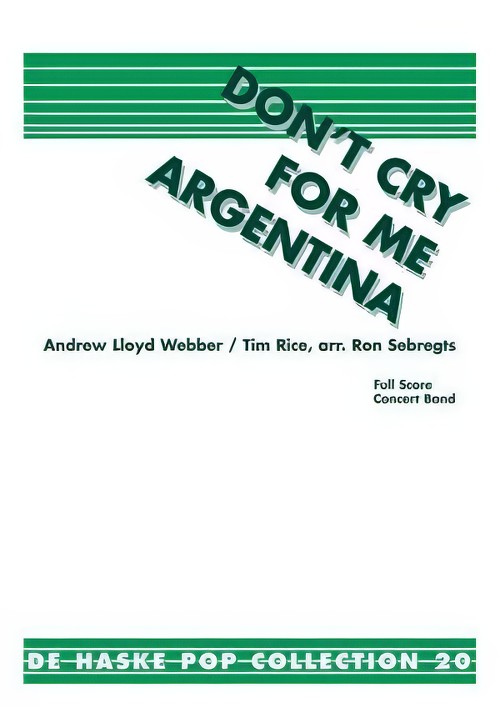
    Don't Cry For Me Argentina - Andrew Lloyd Webber - Ron Sebregts

    Don't Cry For Me Argentina is the best-known song from the 1976 musical Evita. It was sung by Eva Peron when she was addressing the crowds amassed in the square below her balcony. More recently it was a hit for Madonna, who sang it in the 1996 film version of Evita. This arrangement for Brass Band retains the broad emotive melody of the original together with its intense emotion.

    Estimated dispatch 5-14 working days

     PDF View Music

  • £84.99

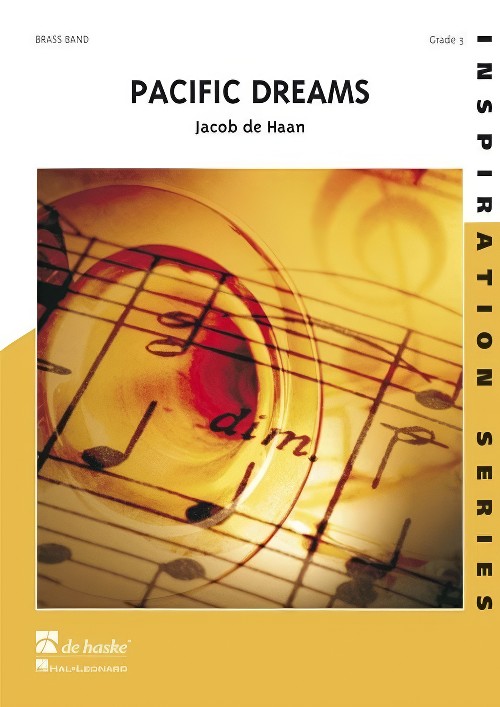
    Pacific Dreams - Jacob de Haan

    Pacific Dreams describes the experience of Miguel, a traveling composer from Spain who, feeling somewhat alienated from his homeland, is wandering through an area of Sydney known as The Rocks. At a small outdoor market in a typical street of this oldcolonial neighbourhood, he discovers a print of William DeShazos painting "Pacific Dreams" Portrayed in the painting is the surf of one of the exotic islands in the Pacific. Next, with the impressive Sydney Harbour Bridge looming over the narrowstreets of The Rocks, he envisions sultry Pacific beaches. Suddenly a theme he once composed about the lakes in Japan comes to him. Is it the Asian influences present in cosmopolitan Sydney that bring this theme to mind? Or perhaps the waters aroundSydney, over which he could sail to Tahiti? He is uncertain. Could this same theme be used to create a new composition about his feelings for the metropolis Sydney? How then to work his Pacific Dreams into the mix? Miguel is certainly no fan ofHawaiian music. Mayby he could use the vocabularies of islands like Hawaii and Tahiti, their beautiful vowel combinations being sung ad libitum by a mixed choir.With these ideas and his newly purchased print of "Pacific Dreams", he boards the Metroat Circular Quay. He has a final glimpse of the harbour and the Sydney Opera House as the train races into the ground. On to the hotel! To work! He must compose!Maestoso : Miguel is impressed as he gazes upon the Sydney Harbour Bridge. And yet, hewants to go away from this city. Away, to an exotic island in the Pacific.Steady Rock : In the Rocks, musicians are playing at a square. Miguel basks in the atmosphere but at the same time he is fantasizing about Hawaii and Tahiti.Andante Lamentoso :In his hotel room, Miguel is feeling sad and lonely in this big city. He takes comfort in his "Pacific Dreams".Allegro : Miguel boards the boat that takes him from Darling Harbour to Circular Quay. In his mind he is traveling on to Hawaii. Or is ithome, where the bolero is playing? He is pulled back to reality by the skyline of Sydney.

    Estimated dispatch 5-14 working days

     PDF View Music