
Results
-
 £42.00
The Beacons (Parts only) - Ray Steadman-Allen
For centuries hilltop beacon fires blazed across the land signals of important happenings or warnings of invasion. This music tells no specific story but the titles of the four thematically related sections are a guide to the idea: The Beacons; Far Horizons; The Invaders; Celebration. The first movement has something of the character of the march and the fanfare; spirited and tightly driving, it promises most of the thematic material of the work. The second is largelt tranquil and is thinly scores with solo passages. The third has the most dramatic potential; its energy and conflict subsides to a lament and a tolling bell before a vigorous rounding off. Appropriately, the fourth movement is in a merry-making mood, and the jubilant music concludes with fragment statements of the main themes. The Beacons was first performed by IMI Yorkshire Imperial Band (James Scott) at the 'Concert of the Century', celebrating the Centenary of the British Bandsman, at the Free Trade Hall, Manchester, on 5 September 1987. Duration: 12:30
Estimated dispatch 7-9 working days
-
 £48.56
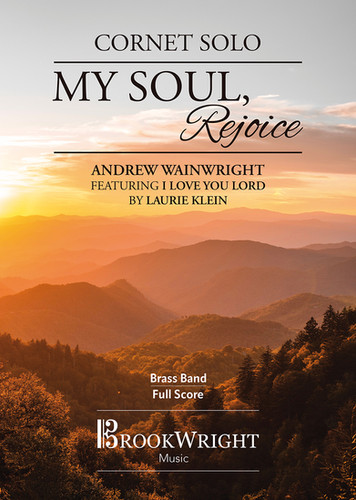
My soul, rejoice (Cornet Solo with Brass Band) Andrew Wainwright
My soul, rejoice (Andrew Wainwright) was commissioned in 2022 by Elizabeth Malovance, principal cornet of the Chicago Staff Band. A spirited and celebratory work, it is designed to showcase the dual nature of the cornet: its sparkling technical agility and its rich, vocal lyricism. The music begins in meditative fashion before transitioning into a joyful caprice featuring playful syncopations which are handed around the band. This is followed by a reflective section based on the much-loved worship song I love you Lord by Laurie Klein. The work concludes with a reprise of the original theme, building in momentum and intensity. Through a series of brilliant runs and virtuosic flourishes, the soloist leads the charge toward a majestic and triumphant finale, bringing the work to a ringing, glorious close. The solo was recorded by Richard Marshall on the 2026 CD Gothique Fantasy - The Music of Andrew Wainwright, which was his last solo recording of his 20-year tenure as principal cornet of Black Dyke Band. Technical Requirements & Electroacoustic Integration This work features an optional digital delay effect for the soloist, indicated in the score by "pedal on" and "pedal off" markings. If the required equipment is unavailable, the piece can be performed entirely acoustically. To listen to Beth Malovance performing the work with the Chicago Staff Band please visit https://on.soundcloud.com/c8IoU3CF3srTD4z0wX Duration: approx. 8 minutes Difficulty Level (Band): 2nd Section + Soloist: Advanced This PDF download includes the full score and parts. Sheet music available at www.brassband.co.uk (UK) or https://satradecentral.org (USA) Instrumentation: Soprano Cornet Eb Solo Cornet Bb 1st Cornet Bb 2nd Cornet Bb Flugel Horn Bb Solo Horn Eb 1st Horn Eb 2nd Horn Eb 1st Baritone Bb 2nd Baritone Bb 1st Trombone Bb 2nd Trombone Bb Bass Trombone Euphonium Bb Bass Eb Bass Bb Timpani & Bass Drum Percussion 1-3
In Stock: Estimated dispatch 1-3 working days
-
 £59.77
Sleigh Ride Suite (Brass Band) Leopold Mozart arr. Alex McGee
Today Leopold Mozart (1719-1787) is known almost exclusively as the stern father of Wolfgang, but he was a prominent and successful musician in his own time. The Sleigh Ride, composed just before Wolfgang was born, certainly shows that Mozart the elder had as good a sense of humour as his more famous son. Wolfgang must, in fact, have known and enjoyed his father's piece - he included a short Sleigh Ride in his German Dances, K.605, in 1791. Leopold's more complicated piece is a programmatic serenade, with short titles for each section: a musical picture of a cold evening's ride to a party. The score calls for sleigh bells, rattle, a whip, and triangle. The action begins with a short overture (Intrada), followed by the Sleigh Ride itself, a lively duple-meter dance accompanied by jangling sleigh bells and punctuated by the cracking of a whip. There is then a nice bit of musical pantomime - The Young Lady Shivers With Cold. The sleigh finally arrives at the party, a ball with a small dance orchestra. The Ball Begins, not surprisingly, with a courtly menuet, and the End of the Ball is a spirited Kehraus, a lively rondo-form dance. This transcription faithfully seeks to convey the light touch of the Age of Enlightenment to the modern brass band and provides ensembles with new material for their annual Christmas concerts. To view a rolling score video of the work please visit https://www.youtube.com/watch?v=tgrBe1u8Xag Duration: Approx. 11.45 minutes Difficulty Level: 3rd Section + PDF download includes parts and score. Sheet music available from www.brassband.co.uk Instrumentation: Soprano Cornet Eb Solo Cornet Bb Repiano Cornet Bb 2nd Cornet Bb 3rd Cornet Bb Flugel Horn Bb Solo Horn Eb 1st Horn Eb 2nd Horn Eb 1st Baritone Bb 2nd Baritone Bb 1st Trombone Bb 2nd Trombone Bb Bass Trombone Euphonium Bb Bass Eb Bass BbTimpani Percussion 1-2
In Stock: Estimated dispatch 1-3 working days
-
£33.00
Ding Dong Christmas - Broadbent, D
Ding Dong Christmas is a spirited and celebratory arrangement by Derek Broadbent, built around the classic carol Ding Dong Merrily on High.With energetic rhythms, foot-tapping momentum, and a lively brass-band flair, it elevates the original into a joyful encore piece. Perfect for festive concerts, it invites audiences to join in the exuberance of the season.
In Stock: Estimated dispatch 1-3 working days
-
 £38.95
Unity Series Band Journal - Numbers 550 - 553, February 2026
550: March - Century of celebration (Stephen Smith)This march follows a traditional pattern and should be accessible for most bands. It was written for the 100th anniversary of Camp Gifford in Loon Lake, Washington, therefore included are well-known songs with references to water as the camp is located on the shores of Deer Lake.551: Going Home (Alan Williams)Richard Jukes' song I'm a soldier bound for Glory (S.A.S.B. 856) displays the confidence of someone with a steadfast faith who is certain that by loving and serving their God they will be accepted into his Kingdom. This assurance results in a joyful song of testimony. Whilst not a direct setting of the five verses, the dance-like rhythm of this cha-cha should reflect the positive and encouraging nature of the lyrics and be full of joy and spirit.552: Whosoever will may come (Noel Jones)This is a two-verse arrangement of the song Whosoever will may come (S.A.S.B. 405), with words written by William John McAlonan and music composed by Alfred Braine. This song is included in the Invitation and Challenge section of the song book. The arrangement should be played in a spirited style.553: March - Sing a praise of celebration (Marcus Venables)This music was written at the request of the Singapore Central Corps Band, who asked that the work be based on two specific meaningful melodies. The first is To the Glory and Praise of God by Robert Redhead, a tune rooted in corporate worship and joyful proclamation, calling God's people to lift their voices in thanksgiving. The other is Home, a beloved Singaporean song that speaks of belonging.
Estimated dispatch 7-14 working days
-
 £55.00
Triumph Series Brass Band Journal, Numbers 1387 - 1391, July 2026
1387: March - Temple Foundations (Stephen Gibson)This march was composed for the Newcastle City Temple Band for the official opening of their new church buildings. It features several musical references (Showers of blessing (T.B. 411), I would be thy holy temple (S.A.S.B. 591), Come, ye thankful people, come (S.A.S.B. 9), All the promises of God are sure (S.A.S.B. 893) and Count your blessings (T.B. 183)), opening with the announcement that 'With timbrel and drum, and with flags they come' (N.S.Y.P. January 1977) to commence worship and witness in a new area of the city.1388: Holy Forever (arr. Marcus Venables)This is an arrangement of the popular worship song, written by Brian Johnson, Chris Tomlin, Jason Ingram, Jenn Johnson and Phil Wickham.1389: Goodness of God (arr. Paul Sharman) This is an arrangement of the well-known worship song, written by Ben Fielding, Brian Johnson, Ed Cash, Jason Ingram and Jenn Johnson.1390: The first Nowell (Noel Jones)This is an arrangement of the beautiful carol The first Nowell (C.C. 86). It commences with the motif 'Born is the King' which which is referenced throughout the work and the finishes with the spirited 'Nowell, Nowell, Nowell, Nowell, Born is the King of Israel'.1391: Gloria a Dios (Ian Clarke)Translated into English, the Spanish phrase 'Gloria a Dios' means 'Glory to God'. The style of this music has its roots in the small musical combinations that entertain the crowds in some Latin American towns and villages (many of which are Spanish speaking, hence the title). Once a melodic idea had taken hold, the chorus Jesus saves me now! (S.A.S.B. 478) seemed to fit perfectly, the words and the music complementing each other in this testament of praise.
Estimated dispatch 7-14 working days
-
 £55.00
Triumph Series Brass Band Journal, Numbers 1379 - 1382, November 2025
1379: March - True to the colours (Noel Jones)This march is a reminder of the symbolism of The Salvation Army flag - blue representing God's purity, red for the blood of Christ and yellow for the fire of the Holy Spirit. I love the dear old Army flag, I'll be true and Yellow star and red and blue are three songs featured where writers have been equally inspired and have made declaration of their allegiance to God by service in The Salvation Army.1380: In all its fullness (Alan Williams)This music was written for the East of England Youth Summer School in 2024, where the delegates explored the theme 'Living life in full colour with Jesus' and as such this work is a joyous and fun-filled celebration of all the good things God has provided.1381: Eternal Spring (Nick Simmons-Smith) This simple hymn tune arrangement is based on the tune Martyrdom which is associated with the words 'As pants the heart for cooling streams'. It is a Scottish tune written around 1800 by Hugh Wilson.1382: March Medley - Emblems of service (Stephen Bulla)This march celebrates the occasion of the Coorparoo Corps' reunion (now Carindale Corps, Australia) in 2022. The music itself features a spirited medley: Joy! joy! joy! there is joy in The Salvation Army, What a friend we have in Jesus and Steadily forward march!
Estimated dispatch 7-14 working days
-
 £80.00
The Unfortunate Traveller (Brass Band - Score and Parts)
Imogen Holst (1907-1984) submitted The Unfortunate Traveller (1929) as her final work as a student portfolio at the Royal College of Music, where her composition teacher was Gordon Jacob. The title was taken from Thomas Nashe's famous 1594 picaresque novel of the same title. The Suite was first performed on 12 February 1933 at her Majesty's Theatre, Carlisle, by the St. Stephen's Band, with the composer conducting. Te concert was given in memory of Holst's uncle, Dr. H.A. Lediard. Holst had been impressed with the band's performance of his A Moorside Suite at the 1928 National Brass Band Championships (The Crystal Palace, South London) and was keen to work with them. Writing in Imogen Holst, a life in music, Christopher Grogan indicates that it was Gustav Holst's suggestion to include his daughter's work in the programme, quoting Imogen Holst's remarks made in interview to The Daily Mail as follows: "....it is the first time, so far as I know, that a woman has conducted a brass band at a public concert....It has been a delight to rehearse the St. Stephen's Band. It was their performance at the Crystal Palace Festival that inspired me to write this Suite, which I have dedicated to them."Imogen Holst accompanied her father to the Crystal Palace in 1928 to hear the performances of A Moorside Suite, and was so excited by the played and, audibly, by her father's music that she decided to write a brass band piece for her final examination. Te result was The Unfortunate Traveller (1929). However, it was not possible for her to present a brass band work for examination. She arranged it for string orchestra so that it could be played before she left the RCM in July 1930. Following the premiere of the original in 1933, the manuscripts did not resurface until 1969 Imogen found them among her late mother's effects. Although she requested score and parts be destroyed, they ended up in the possession of Manchester composer John Golland, who marked up the score presumably with the intention of creating a new performing edition. The original scoring reveals a lack of experience with what can be a tricky medium.With the agreement of the Holst Foundation, a revised edition, with additional percussion, was prepared in 2011 since when the work has been fortunate to travel round the world as a concert and contest piece. The original includes drums in the March only. The title was taken from Tomas Nashe's famous 1594 picaresque novel of the same title. Several Morris Dance tunes are introduced during the course of the four short movements, including Bonnie Green Garters, Shepherd's Hey, The Rose and The Wind Blaws Cauld. Quirky twists and turns of harmony and spirited rhythms that remind us how much Imogen Holst loved tradition English dance music.In September 2025, I made a performing edition of the composer's arrangement for string orchestra. The manuscript lacks the final movement, which I arranged in a similar style, ie. without extending the upper ranges. Making this edition raised some issues regarding the accuracy of my band version and some of the solutions I used to smooth out the voicing. I have used the composer's second thoughts to refine my performing edition and to correct a textual errors.- Paul HindmarshDuration: 10.00
Estimated dispatch 7-14 working days
-
£40.00
The Unfortunate Traveller (Brass Band - Score only)
Imogen Holst (1907-1984) submitted The Unfortunate Traveller (1929) as her final work as a student portfolio at the Royal College of Music, where her composition teacher was Gordon Jacob. The title was taken from Thomas Nashe's famous 1594 picaresque novel of the same title. The Suite was first performed on 12 February 1933 at her Majesty's Theatre, Carlisle, by the St. Stephen's Band, with the composer conducting. Te concert was given in memory of Holst's uncle, Dr. H.A. Lediard. Holst had been impressed with the band's performance of his A Moorside Suite at the 1928 National Brass Band Championships (The Crystal Palace, South London) and was keen to work with them. Writing in Imogen Holst, a life in music, Christopher Grogan indicates that it was Gustav Holst's suggestion to include his daughter's work in the programme, quoting Imogen Holst's remarks made in interview to The Daily Mail as follows: "....it is the first time, so far as I know, that a woman has conducted a brass band at a public concert....It has been a delight to rehearse the St. Stephen's Band. It was their performance at the Crystal Palace Festival that inspired me to write this Suite, which I have dedicated to them."Imogen Holst accompanied her father to the Crystal Palace in 1928 to hear the performances of A Moorside Suite, and was so excited by the played and, audibly, by her father's music that she decided to write a brass band piece for her final examination. Te result was The Unfortunate Traveller (1929). However, it was not possible for her to present a brass band work for examination. She arranged it for string orchestra so that it could be played before she left the RCM in July 1930. Following the premiere of the original in 1933, the manuscripts did not resurface until 1969 Imogen found them among her late mother's effects. Although she requested score and parts be destroyed, they ended up in the possession of Manchester composer John Golland, who marked up the score presumably with the intention of creating a new performing edition. The original scoring reveals a lack of experience with what can be a tricky medium.With the agreement of the Holst Foundation, a revised edition, with additional percussion, was prepared in 2011 since when the work has been fortunate to travel round the world as a concert and contest piece. The original includes drums in the March only. The title was taken from Tomas Nashe's famous 1594 picaresque novel of the same title. Several Morris Dance tunes are introduced during the course of the four short movements, including Bonnie Green Garters, Shepherd's Hey, The Rose and The Wind Blaws Cauld. Quirky twists and turns of harmony and spirited rhythms that remind us how much Imogen Holst loved tradition English dance music.In September 2025, I made a performing edition of the composer's arrangement for string orchestra. The manuscript lacks the final movement, which I arranged in a similar style, ie. without extending the upper ranges. Making this edition raised some issues regarding the accuracy of my band version and some of the solutions I used to smooth out the voicing. I have used the composer's second thoughts to refine my performing edition and to correct a textual errors.- Paul HindmarshDuration: 10.00
Estimated dispatch 7-14 working days
-
 £31.50
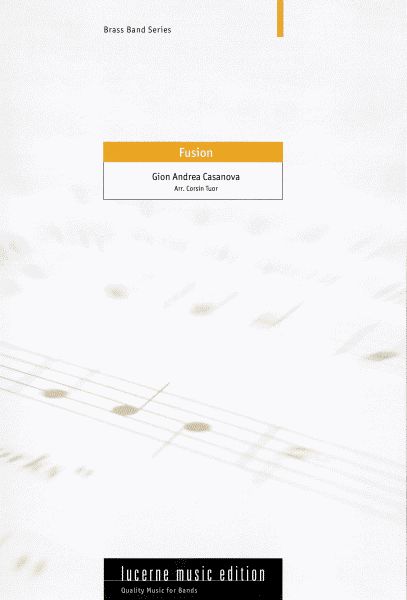
Fusion
Baroque meets jazz meets funk meets rock. Fusion is an exciting spirited concert item
Estimated dispatch 7-14 working days
 View Music