
Results
-
£29.95
SOLDIERS OF CHRIST (Brass Band Set) - George Marshall
This march was the second of Marshall's marches to be published and contained the note 'Revised by the Editor', who at the time was Lt. Colonel Richard Slater. Marshall maintained correspondence with the Colonel as his composing skills developed although this early work already demonstrates melodic charm and effective scoring.
Estimated dispatch 7-14 working days
-
 £29.95
Soldiers Of Christ (Brass Band - Score and Parts) - Marshall, George
This march was the second of Marshall's marches to be published and contained the note 'Revised by the Editor', who at the time was Lt. Colonel Richard Slater. Marshall maintained correspondence with the Colonel as his composing skills developed although this early work already demonstrates melodic charm and effective scoring.
Estimated dispatch 7-14 working days
-
£14.95
Soldiers Of Christ (Brass Band - Score only) - Marshall, George
This march was the second of Marshall's marches to be published and contained the note 'Revised by the Editor', who at the time was Lt. Colonel Richard Slater. Marshall maintained correspondence with the Colonel as his composing skills developed although this early work already demonstrates melodic charm and effective scoring.
Estimated dispatch 7-14 working days
-
 £105.80
March Of The Toy Soldiers - Gabriel Pierné - John Glenesk Mortimer
Estimated dispatch 5-14 working days
-
£37.50
Brass Monkey's Occasions - Gavin Somerset
Never be caught out again on a concert with this selection that caters for just about every occasion. Your training band will be prepared to perform anything from a Fanfare to the National Anthem and even 'He's A Jolly Good Fellow'. The music included in this publication is used all over the world, all year around. "Land Of Hope & Glory" is also included, in the same key as the popular senior band arrangement (by J. Ord Hume) so your training band can join in with the senor band in a proms concert finale. This release puts well-known, often requested tunes in one publication letting your training band shine, whatever the occasion. Music included isaAFANFARENATIONAL ANTHEM (God Save The Queen/King)ROYAL NAVY HYMN (Melita)HARVEST HYMN (St. George's Windsor)ONWARD CHRISTIAN SOLDIERS (St. Gertrude)DANNY BOY (Londonderry Air)HE'S A JOLLY GOOD FELLOWF.A. CUP THEME (Eventide)LAND OF HOPE & GLORY (Pomp & Circumstance March No.1)
In Stock: Estimated dispatch 1-3 working days
-
£29.95
INDOMITABLE (Brass Band Set) - Herbert Mountain
Herbert Mountain saw 15 marches published by The Salvation Army between 1922 and 1959. Favourites among these include tributes to several 'Citadel' corps like Sheffield, Blackpool and Stockport, and Indomitable dating from 1951. Beginning in the minor and unfolding in contest march style as a cornet soloist dialogues with the full band, the march switches to the major to present the chorus from 'Onward, Christian Soldiers'.
Estimated dispatch 7-14 working days
-
 £38.95
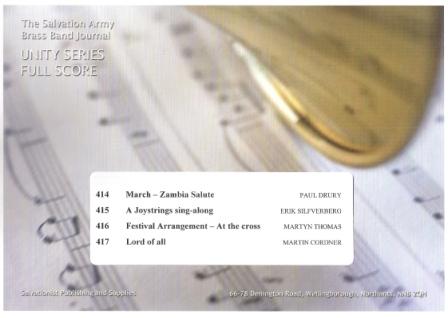
Unity Series Band Journal February 2014 Numbers 414-417
No.414 March - Zambia Salute (Paul Drury)In April 2009, a group from Chelmsford Citadel Corps visited Zambia. The purpose of the visit was to assist in the leadership of the Zambian Territorial Music School, held at Chikankata. This march was written to commemorate the event and received its premiere performance at the final festival. The melody featured is the chorus of the song, I know not why Dod's wondrous grace (S.A.S.B. 730).No.415 A Joystrings sing-along (Erik Silfverberg O.F.)This piece represents the first published work since the sudden Promotion to Glory of Bandmaster Erik Silfverberg O.F. The Joystrings made Salvation Army history about fifty years ago, introducing rock music on the Christian music scene. Many of their songs have become classics and have been used as thematic material in our brass music. Here is a selection of three of their songs, to be used either as a band piece or as accompaniment to a sing-along. The three songs are:- 'I want to sing it', 'It's an open secret' and 'Have faith in God'.No.416 Festival Arrangement - At the cross (Martyn Thomas)The well-known song, 'At the cross' (T.B. 580), is given a lively new setting by Martyn Thomas. The rock and swing treatment of this old melody should appeal to many!No.417 Lord of all (Martin Cordner)This piece was written for the 120th Anniversary of Balham corps (London Central Division) in 2011. In terms of a theme, the anniversary occasion prompted the primary thought that the piece should first be a praise-offering to God, acknowledging him for who he is. Therefore songs referenced in the piece are praide songs: 'Lord, reign in me', 'He is Lord', 'All hail the Lamb', along with a song of testimony, 'I'm a soldier bound for Glory' (T.B. 382),which speaks of the Christian hope in Heaven and challenges Salvationists to influence others by living out that hope. There is also a brief reference to the National Anthem of the Democratic Republic of Congo (4 bars before D)- man acknowledgement to the faithfulness of corps soldiers who in recent years have arrived from that country.
Estimated dispatch 7-14 working days
-
 £24.95
Judd: Indomitable
Herbert Mountain saw 15 marches published by The Salvation Army between 1922 and 1959. Favourites among these include tributes to several Citadel corps like Sheffield, Blackpool and Stockport, and Indomitable dating from 1951. Beginning in the minor and unfolding in contest march style as a cornet soloist dialogues with the full band, the march switches to the major to present the chorus from Onward, Christian Soldiers.
Estimated dispatch 7-14 working days
-
£34.95
MONTCLAIR CITADEL (Brass Band Set) - Stephen Bulla
Stephen Bulla is a former member of Monclair Citadel Band and gladly supplied Bandmaster Charles Baker with this fine march for a recording made by the band in 2001. The tune 'Onward Christian Soldiers' forms the bulk of the trio, first being tossed around in various registers and then, just the chorus, in the festive ending.
Estimated dispatch 7-14 working days
-
£34.95
DELIBERATE (Brass Band Set) - Andrew Mackereth
So that there is no doubt about the correct pronunciation, the title of this festival (concert) march means 'to think about'! It was written in 2010 for the Belfast Temple Music School and recalls a particularly impressive open-air meeting from the previous year's school. The main theme heard is 'Onward, Christian soldiers' while there is also reference to 'A mighty fortress is our God'.
Estimated dispatch 7-14 working days