
Results
-
 £74.60
Shakespeare March - Bedrich Smetana - John Glenesk Mortimer
Estimated dispatch 5-14 working days
-
 £115.00
Shakespeare in Love - Stephen Warbeck - Jan Ryant
Estimated dispatch 5-14 working days
-
£33.00
A Souvenir of Shakespeare - Rimmer, W
Includes a full band set (no score)
In Stock: Estimated dispatch 1-3 working days
-
 £33.00
 -
 £127.30
Symphony from The Fairy Queen - Henry Purchell - Kjell Olav Martinsen
Henry Purcell (1658 1695) is generally considered as one of the greatest English composers. He incorporated Italian and French stylistic elements into his compositions and made uniquely English baroque music. He has a rich production as composer, with works for orchestra, church, scene and vocal. In 1692, three years before his dead, he composed music to The Fairy Queen, who is a masque or semi opera who is a revised version of William Shakespeare's wedding comedy A Midsummer Night's Dream. This arrangement of Symphony is the overture to act number four.
Estimated dispatch 5-14 working days
-
 £74.99
Drink to Me Only with Thine Eyes - J. W. Callcott - Philip Sparke
The lyrics to Drink to Me Only with Thine Eyes can be traced to English poet Ben Jonson, a contemporary of Shakespeare. The melody's origin, on the other hand, is not certain. In this three- movement arrangement, Philip Sparke provides the soloist with plenty of substance while respecting the beautiful simplicity of the original tune.
Estimated dispatch 5-14 working days
-
 £60.99
Cornfield Rock - Jacob de Haan
Originally Cornfield Rock was written by Jacob de Haan as a version for male choir. It was based on a text by William Shakespeare on a melody of Thomas Morley (It was a lover and his lass). The original melody however was abandoned completely and in its place Jacob de Haan created a new one in rock style. The title refers to the text: That o're the green corne fields did passe.
Estimated dispatch 5-14 working days
-
 £35.00
Ariel
DescriptionAll hail, great master! Grave sir, hail! I come To answer thy best pleasure, be 't to fly, To swim, to dive into the fire, to ride On the curled cloud. To thy strong bidding, task Ariel and all his quality. - William Shakespeare: The Tempest, Act 1, Scene 2Ariel was written for the Hammonds Band to open their programme at the 2019 Brass in Concert Championships at The Sage Concert Hall in Gateshead, where it received its premiere. The title is taken from the character in Shakespeare's play 'The Tempest'. Ariel is an immensely powerful "air spirit" or demon bound to serve Prospero, the exiled Duke of Milan, after being released by Prospero from imprisonment in a tree. In the play Ariel's magical abilities are used to help Prospero revenge himself on his enemies and reclaim his dukedom, whereupon Ariel finally regains his freedom.You can hear an audio preview and follow the score below: Performance notes:The cornets and horns are split into two "choirs" to be placed left and right of the band. It may be possible for the choirs to play their opening flourish offstage, and the optional repeated sections in the opening are to accommodate stage movement if required. Trombones form a third "choir" which should ideally stand centrally between basses and percussion, and the euphoniums and baritones should sit in front of the basses. The work requires four percussionists, although if four are not available the 2nd part may be omitted.Percussion 1: Kit - bass drum, snare, 3 x toms, hi-hat, suspended cymbal - and 3 x temple blocksPercussion 2: Tam tam and orchestral bass drum.Percussion 3: Glockenspiel and timpaniPercussion 4: Tubular bellsSoprano, solo cornets and 3rd cornets require cup mutes. Solo trombone requires a cup mute, second trombone requires a metal straight mute.
Estimated dispatch 7-14 working days
-
 £29.88
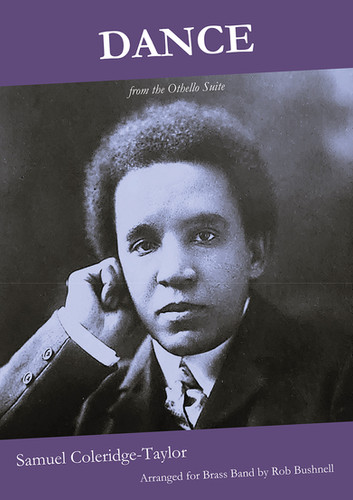
Dance from the Othello Suite (Brass Band) Coleridge-Taylor arr. Bushnell
Samuel Coleridge-Taylor is a British composer, who, from a young age, showed talent on the violin and entered the Royal College of Music, studying with Charles Villers Standford. His music become so popular that his Hiawatha trilogy was the second most performed choral piece (joint with Mendelssohn's Elijah, and only beaten by Handel's Messiah) with choral societies up and down the British Isles. In fact, Hiawatha was arranged by Charles Godfrey as a test-piece for the 1902 National Brass Band Championship of Great Britain, held at Crystal Palace.Commissioned by the theatre impresario Herbert Beerbohm, Coleridge-Taylor composed incidental music for His Majesty's Theatre London production of the Shakespeare play, Othello, in the West End, in 1909. In 1912, the play opened to the public, with a suite of five movements put together soon afterwards. The Dance, arranged here by Rob Bushnell, makes a great concert opener.This arrangement is for the British-style brass band, with alternative parts for horns in F and bass-clef lower brass. A recording of the original composition can be found at www.youtube.com/watch?v=OQeO_Ij9CV8 Duration: approx. 2.30 minutes Difficulty Level: 3rd Section + PDF download includes parts and score. Sheet music available at www.brassband.co.uk (UK) or https://satradecentral.org (USA) Instrumentation: Soprano Cornet Eb Solo Cornet Bb Repiano Cornet Bb 2nd Cornet Bb 3rd Cornet Bb Flugel Horn Bb Solo Horn Eb 1st Horn Eb 2nd Horn Eb 1st Baritone Bb 2nd Baritone Bb 1st Trombone Bb 2nd Trombone Bb Bass Trombone Euphonium Bb Bass Eb Bass Bb Timpani Percussion - Triangle, Cymbal & Bass Drum
In Stock: Estimated dispatch 1-3 working days
-
£35.00
Lament (from Macbeth) - Peter Meechan
Macbeth was commissioned by the Scottish Brass Band Association for the 2007 Scottish Open Championship, and takes itsa inspiration from the Shakespeare play of the same name.The Lament is the central, emotional core to the work. Although the play tells of Macbeth not feeling the pain of his wifeas death, this lament ponders not only her death, but the tale as a whole.
Estimated dispatch 12-14 working days
 View Music