
Results
-
 £34.95
Fire & the Phoenix, The - Christopher Bond
The Fire & the Phoenix (2015) was commissioned by Brett Baker in early 2015 as the opening track to his solo CD 'Myths & Legends'. Whilst structurally a single-movement work, it is presented so that it can link directly into the next work on the CD, adding to a continuous theme comprising a number of pieces from a number of composers. Opening with huge strident chords in the full band, the representation of the phoenix is instantly reflected; bold, powerful and a bird of great intensity. This makes way for a more mystical section marked 'distant' which reflect the beauty of the Phoenix and it's mythical nature where the trombone soars up into its higher register with a sweeping melody. Soon after, the music takes a sharp turn, becoming dramatic and instantly moving away from the mystical mood created previously. Here, we imagine the Phoenix catching fire, burning intensely with huge flames as it gradually turns into ash. We reach a tonic pedal point in the music, over which chord progressions subtly weave in and out of the texture. Here, we imagine the Phoenix rising from the ashes, with the dynamics gradually increasing to reflect this, slowly taking shape as it is born again. A return to earlier material follows, this time manipulated to reflect the Phoenix in its new form - the same bird; the same animal; but at the same time different. A beautiful chorale-like passage is heard before the music transports us back into a magical land, where delicate rhythmic ideas are juxtaposed against bolder lower chords; both ideas together transporting the listener forward into the next piece.
Estimated dispatch 10-14 working days
-
 £25.00
...and the winter moon rises
Description...and the winter moon riseswas inspired by a winter's evening car journey across the Pennines from Manchester to Huddersfield, through the brass band heartland of Saddleworth. There was recent snow on the ground, and the sun had just set. A bright clear moon was rising into a sky coloured with orange from the setting sun, and the moonlight made all the snow and ice sparkle.The work is the fourth movement of a larger 5 movement suite entitled "North!", but can be (and has been) performed in isolation. This work was a finalist in the 2012 Ohio Brass Arts Festival composition competition.Performance NotesThe percussion parts should be playable by three players; the "arco" parts of the vibraphone parts should be played by drawing a cello or double bass bow up the side of the bar. Motors should be left off throughout.Three of the brass players are asked to double on triangles for the first part of the piece; ideally these should be of different sizes giving clearly different sounds. The easiest solution is to tie a triangle to the music stand, rather than try to hold it and then swap instruments later in the piece.Click below to watch a playback preview of the score!
Estimated dispatch 7-14 working days
-
£59.95
PLANTAGENETS, The (Brass Band Set) - Edward Gregson
The Plantagenets was composed for the Championship Section of the Regional contests of the National Brass Band Championships of Great Britain 1973. The work is not intended to be programme music but rather it tries to portray the mood and feelings of an age, that of the House of Plantagenet, which lasted from the middle of the 12th century to the end of the 14th century. To many, it conjures up an Age of Chivalry and this is represented by fanfare motifs which occur throughout the work in varied form. The opening thematic figure, rising through the band in thirds and followed by the fanfares, is important as nearly all the subsequent material is based upon it. There follows two themes, the second of which is lyrical and introduced by horns. In the long, slow middle section, a new theme is introduced by a solo horn (recurring on cornet and euphonium in canon) and is developed at some length. A lively fugato scherzino, however, leads to a recapitulation of the opening section music and the work ends with a maestoso statement of the slow movement theme. A final reference to the fanfares ends the work.
Estimated dispatch 7-14 working days
-
 £55.00
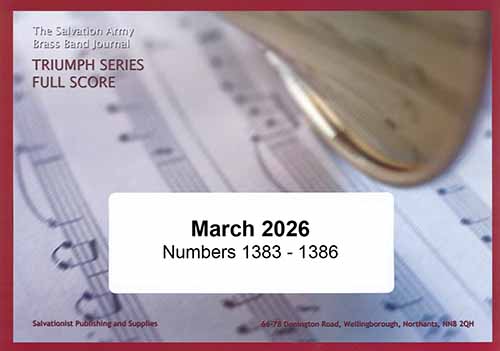
Triumph Series Brass Band Journal, Numbers 1383 - 1386, March 2026
1383: Festival March - Lead On! (Andrew Wainwright)A dynamic march, commissioned by Majors Paul and Dawn McFarland during their appointment as Area Commanders of The Salvation Army's Dallas-Fort Worth Area, premiered at the 2023 Thanksgiving service at the Dallas Adult Rehabilitation Centre. Featuring the classic hymns Storm the forts of darkness (S.A.S.B. 980) and Lead on, O King eternal (S.A.S.B. 964), the piece captures the drive, hope, and mission at the heart of The Salvation Army's work in North Texas.1384: Confession (Kenneth Downie)This arrangement is based on the tune Lord of all (T.B. 440), one of the welcome additions to the 2015 Salvation Army tune book. Introduced to the arranger by Andrew Blyth, whose appreciation for the melody highlighted its gentle charm, the piece is dedicated to Andrew and the Peterborough Citadel Band, where he served as Bandmaster and continues to play.The music pairs the tune with the reflective words of We have not known thee as we ought (S.A.S.B. 630), a hymn often used in worship as a moment of confession and heart-searching before God. Its inclusion encourages both performers and listeners to approach worship with humility and sincerity.Although labelled simply as "German traditional," the tune's graceful simplicity is immediately evident. This arrangement preserves that character while introducing subtle harmonic colour and developing the tune's rising fourth motif as a unifying musical thread. The gentle nature of the melody remains central throughout, with a slightly heightened energy in the fifth phrase carefully drawn out without disrupting the overall serenity. The sharing of thematic material between Cornets and Horns calls for smooth, unobtrusive ensemble playing, allowing the tune's beauty to speak naturally.1385: God in good (Stephen Hull) This arrangement brings together two much'loved melodies: Goodness of God, a favourite from the final years of the arranger's service as Divisional Music Director in the Wisconsin/Upper Michigan Division, and the simple, enduring chorus God is so good. Heard often at summer camps, the song's message stayed with him, eventually inspiring this thoughtful musical pairing that highlights God's unwavering goodness throughout our lives.1386: A march in time (Martin Cordner)Written to celebrate the 130th anniversary of Thetford Corps (UKI Territory), this lively march pays tribute to a legacy of faithful witness, joyful service, and a community moving forward in God's light. Premiered by Cambridge Citadel Band during the anniversary weekend, the piece weaves together three cherished songs: Marching on in the light of God (S.A.S.B. 968), Jesus, precious Saviour (S.A.S.B. 501), and Light up the sunshine in your heart.
Estimated dispatch 7-14 working days
-
 £34.95
The Fire and the Phoenix (Trombone Solo)
Trombone Solo with Brass BandThe Fire & the Phoenix (2015) was commissioned by Brett Baker in early 2015 as the opening track to his solo CD 'Myths & Legends'. Whilst structurally a single-movement work, it is presented so that it can link directly into the next work on the CD, adding to a continuous theme comprising a number of pieces from a number of composers.Opening with huge strident chords in the full band, the representation of the phoenix is instantly reflected; bold, powerful and a bird of great intensity. This makes way for a more mystical section marked 'distant' which reflect the beauty of the Phoenix and it's mythical nature where the trombone soars up into its higher register with a sweeping melody.Soon after, the music takes a sharp turn, becoming dramatic and instantly moving away from the mystical mood created previously. Here, we imagine the Phoenix catching fire, burning intensely with huge flames as it gradually turns into ash. We reach a tonic pedal point in the music, over which chord progressions subtly weave in and out of the texture. Here, we imagine the Phoenix rising from the ashes, with the dynamics gradually increasing to reflect this, slowly taking shape as it is born again.A return to earlier material follows, this time manipulated to reflect the Phoenix in its new form - the same bird; the same animal; but at the same time different. A beautiful chorale-like passage is heard before the music transports us back into a magical land, where delicate rhythmic ideas are juxtaposed against bolder lower chords; both ideas together transporting the listener forward into the next piece.
Estimated dispatch 7-14 working days
-
 £124.95
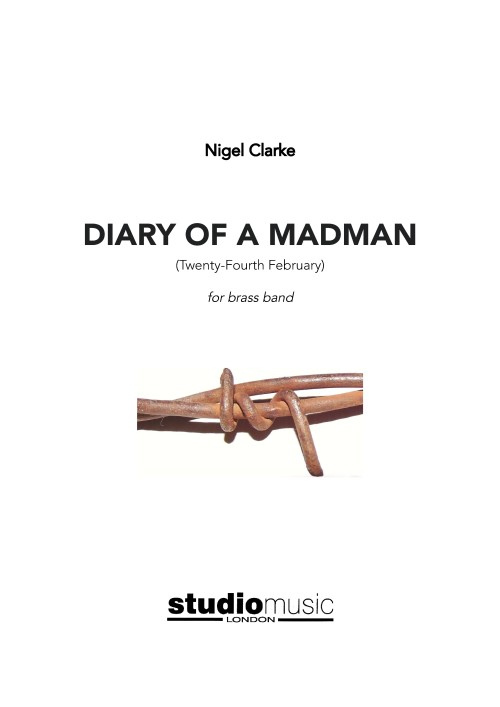
Diary of a Madman (Twenty-Fourth February) (Brass Band - Score and Parts) - Clarke, Nigel
From the beginning of history, warlords, emperors and dictators have risen up, some benign but many of them a scourge on humanity. Names that resonate to this day include Julius Caesar, Caligula, Genghis Khan, Ivan IV (The Terrible), Attila the Hun, Vlad IV (The Impaler), Hitler, Stalin, Mao Zedong, Pol Pot, all of whom were responsible for wanton destruction and the torture and death of millions of victims, either citizens of invaded countries and territories and or indeed, their own peoples.Diary of a Madman starts with a light-hearted march that gives the impression of toy tin soldiers parading in a brightly-coloured ceremonial pageant from a fairy tale, conveying peace and innocence. This spectacle is abruptly interrupted by a 'shock and awe' fanfare-like march, symbolising aggression and war. This theme grinds slowly to a halt, and an atmosphere of introspection, sadness and despair takes over. Rising above the smoky theatre of war, we then hear a distant cornet give a rendition of the Ukrainian Nation Anthem (The glory and freedom of Ukraine has not yet perished. Luck will still smile on us brother-Ukrainians). The solo cornet soon enters a fragile duet with a second cornet accompanied by dark undertones. One by one, we hear short shards of aggressive fanfare-like figures from various instruments in the band. The mood breaks - we hear strident fortissimo whole-tone scales representing pealing church bells, warning of danger. In contrast, we also hear pianissimo whole-tone scales announcing that the enemy's troops are falling back. A counter-offensive soon takes centre stage, and battles and skirmishes are heard, with short quotations from Mussorgsky's `Great Gates of Kyiv' symbolising the defenders' heroic struggle.All sides are victims of the Dictator's ambition! The slow central section offer us moments of melancholic beauty and utilises Henry Purcell's `When I am laid in earth' (`Dido's Lament' from Dido and Aeneas 1688). This music represents the loss of homes, dignity and loved ones. There are occasional hints at better times as the theme of the parading toy tin soldiers is heard from afar, like a distant memory.To announce the final push, we hear a church bell strike and an air raid siren signalling a ferocious musical counter-attack. After one final rendition of the Purcell theme, Diary of a Madman closes with a mood of triumph over tyranny.- Nigel Clarke
Estimated dispatch 7-14 working days
-
£57.95
Diary of a Madman (Twenty-Fourth February) (Brass Band - Score only) - Clarke, Nigel
From the beginning of history, warlords, emperors and dictators have risen up, some benign but many of them a scourge on humanity. Names that resonate to this day include Julius Caesar, Caligula, Genghis Khan, Ivan IV (The Terrible), Attila the Hun, Vlad IV (The Impaler), Hitler, Stalin, Mao Zedong, Pol Pot, all of whom were responsible for wanton destruction and the torture and death of millions of victims, either citizens of invaded countries and territories and or indeed, their own peoples.Diary of a Madman starts with a light-hearted march that gives the impression of toy tin soldiers parading in a brightly-coloured ceremonial pageant from a fairy tale, conveying peace and innocence. This spectacle is abruptly interrupted by a 'shock and awe' fanfare-like march, symbolising aggression and war. This theme grinds slowly to a halt, and an atmosphere of introspection, sadness and despair takes over. Rising above the smoky theatre of war, we then hear a distant cornet give a rendition of the Ukrainian Nation Anthem (The glory and freedom of Ukraine has not yet perished. Luck will still smile on us brother-Ukrainians). The solo cornet soon enters a fragile duet with a second cornet accompanied by dark undertones. One by one, we hear short shards of aggressive fanfare-like figures from various instruments in the band. The mood breaks - we hear strident fortissimo whole-tone scales representing pealing church bells, warning of danger. In contrast, we also hear pianissimo whole-tone scales announcing that the enemy's troops are falling back. A counter-offensive soon takes centre stage, and battles and skirmishes are heard, with short quotations from Mussorgsky's `Great Gates of Kyiv' symbolising the defenders' heroic struggle.All sides are victims of the Dictator's ambition! The slow central section offer us moments of melancholic beauty and utilises Henry Purcell's `When I am laid in earth' (`Dido's Lament' from Dido and Aeneas 1688). This music represents the loss of homes, dignity and loved ones. There are occasional hints at better times as the theme of the parading toy tin soldiers is heard from afar, like a distant memory.To announce the final push, we hear a church bell strike and an air raid siren signalling a ferocious musical counter-attack. After one final rendition of the Purcell theme, Diary of a Madman closes with a mood of triumph over tyranny.- Nigel Clarke
Estimated dispatch 7-14 working days
 View Music