
Results
-
 £154.99
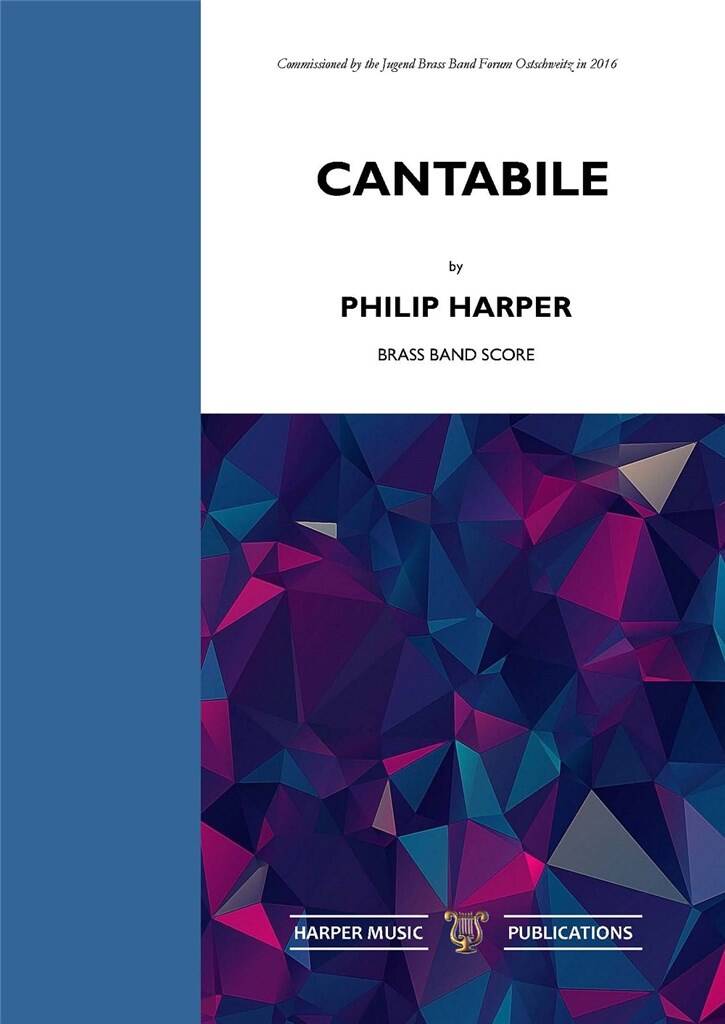
Cantabile - Philip Harper
"As long as we live there is never enough singing." - Martin Luther Philip Harper composed this piece in response to his personal concern about the direction of new music for brass band. His goal with this 5 movementCantabile, was to compose a piece which fully complied with all that is asked of a top-level test in the 21st Century, but also to reconnect with more traditional values such as lyricism in melody and richness of blendedbrass sound. Each of the 5 parts seek to capture this idea.
Estimated dispatch 5-14 working days
-
 £74.99
Cantilena Brass - Philip Sparke
Philip Sparke was commissioned to compose a gentle chorale, a style typical of Philip's writing, and Cantilena was the result. Enthuse your dedicated performers hunger for great music with this new masterpiece.
Estimated dispatch 5-14 working days
-
£89.99
Capriccio - Erik Mast
With Capriccio you can put your tuba soloist in the spotlight. Frank Vantroyen has made an excellent new recording of this song on his CD "Hey, it's Frank!".A real challenge for every ambitious tuba player.
Estimated dispatch 5-14 working days
-
£60.99
Celebration March - Bertrand Moren
This stately march was composed to mark any celebration and more specifically the anniversary of the foundation of a band. The main theme is a wonderful legato melody which is interrupted several times with flowing arpeggios. Following a regal trio melody the main theme returns with a triumphal feel. A great new march for use at any celebration.
Estimated dispatch 5-14 working days
-
 £60.99
Christmas Encounters - Stephen Bulla
Every year it is a challenge to find new music in addition to all of the traditional carols and hymns. Stephen Bulla's Christmas Encounters is a refreshing and surprising Christmas tune, based on Joy to the World. A classic with a twist!
Estimated dispatch 5-14 working days
-
 £109.99
Columbus - Rob Goorhuis
Christopher Columbus was born in Genoa in 1451. His father was a wool merchant. Originally he seemed destined to follow in his father's footsteps, and thus sailed the oceans to countries as far apart as Iceland and Guinea. In 1476 his ship was sunk during a battle off the coast of Portugal. Columbus saved his own life by swimming to shore. In 1484 he conceived the idea of sailing to the Indies via a westward sea route, but it was only in 1492 that he was able to realize this plan. On this first voyage he was in command of three ships: the flag-ship, called the Santa Maria, the Pinta, and the Ni?a. From Spain Columbus sailed via the Canary Islands to the Bahamas, whichhe sighted on October 12th 1492. Without being aware of it Columbus discovered the 'New World' he thought he had landed in the eastern part of Asia. The motif from Dvooak's 9th Symphony 'Aus der neuen Welt' forms a little counterfeit history at this point in the composition. After this first voyage Columbus was to undertake another three long voyages to America. These voyages were certainly not entirely devoid of misfortune. More than once he was faced with shipwreck, mutiny and the destruction of settlements he had founded. After Columbus had left for Spain from Rio Belen in 1503, he beached his ships on the coast of Jamaica. The crew were marooned there and it was only after a year that Columbus succeeded in saving his men and sailing back to Spain with them. In the music the misunderstanding about which continent Columbus discovered in his lifetime resounds, for does this part in the composition not contain Asiatic motifs? Poor Columbus! In 1506 the famous explorer died in Valladolid.
Estimated dispatch 5-14 working days
-
 £45.00
Congestion Charge - Nigel Hess
This is the third movement of Nigel Hess's New London Pictures As with all modern cities, London is over-crowded with motor vehicles. London was the first major city in Europe to adopt aCongestion Charge, and this lighthearted work includes musical images of frustrated rush hour traffic leading to a freer flowing galop. Brass Band Grade 5: 1st Section Duration: 7 minutes.
Estimated dispatch 5-14 working days
-
£60.99
Conzensus - Jan Van der Roost
This stately concert opener was originally written by Jan Van der Roost for a special event in which six respected wind orchestras (two Belgian and four Dutch) of different composition (two symphonic bands, two fanfare bands and two brass bands) were featured during six concerts. Each evening brought forth a performance by a symphonic band, a fanfare, and brass band, so that the audience could experience all three types of ensembles. This was indeed an original concept.The name, ConZEnSus, comes from a combination of the words, 'Concert Cyclus' (concert series) and 'zes' (Dutch for 'six'). This leads to a new word, which refers to 'consensus'. The general tenor of the cycle isthus immediately indicated. The richness of color of the various ensembles is revealed through an open and friendly atmosphere. During all six concerts (over a span of three years), ConZEnSus functioned as a permanent opening number for each orchestra. Thus the same musical story was portrayed in three different packages.
Estimated dispatch 5-14 working days
-
 £60.99
Cornfield Rock - Jacob de Haan
Originally Cornfield Rock was written by Jacob de Haan as a version for male choir. It was based on a text by William Shakespeare on a melody of Thomas Morley (It was a lover and his lass). The original melody however was abandoned completely and in its place Jacob de Haan created a new one in rock style. The title refers to the text: That o're the green corne fields did passe.
Estimated dispatch 5-14 working days
-
 £116.40
Decennium - Eric Swiggers
'Decennium' was composed in 2003 as a commission by the municipality of Berheze for its tenth anniversary. The composition describes the history of this town in the Province of Brabant, consisting of 6 different villages: Heesch, Heeswijk, Dinther, Nistelrode, Loosbroek and Vorstenbosch. The composition starts with a slow introduction, Adagio Misterioso, suggesting the atmosphere in long-ago days when the area consisted mainly of swamps, meres and low woods. (The word 'Bern' is a synonym of 'Born' meaning source or water, whereas 'Hese' is derived from 'Haisjo' meaning brushwood ). Above the dark sounds we hear far away trumpet signals announcing the Middle Ages. After a piercing crescendo, we hear the full sound of festive trumpets. A medieval dance, as was to be heard in the Heeswijk castle, follows. This dance gets a more and more stirring character and finally turns into a merry popular dance ending with a burst of laughter reproduced by descending scales with the muted trombones and trumpets. A slow transition with a quotation from a Gregorian plainsong (Domine Deus) and church bell ringing, referring to the Abbey of Berne, brings us to a romantic Larghetto. This part describes the quiet rural life in a beautiful natural surrounding. The last dying note contrasts with the threatening ostinato, referring to the rise of the industrialization, which provoked quite some resistance with the local people. Once more we hear the 'Domine Deus' but much more powerful this time. When the resistance calms down, the work concludes with an Alla Marcia. The first notes of the main theme could be heard all through the composition and now we hear the complete main theme again. The new town is born. A festive conclusion refers both to the tenth anniversary and the optimism and confidence as to the future.
Estimated dispatch 5-14 working days
 View Music