
Results
-
 £60.99
Lullabye (Goodnight, My Angel) - Billy Joel - Philip Harper
This 1994 song from Billy Joel is probably one of his most beautiful hits ever. It was originally intended as a prelude for another song 'River of Dreams' with lyrics in Latin. Philip Harper has created a magnificent arrangement for either two Flugelhorns or two Cornets.
Estimated dispatch 5-14 working days
-
You're My World - Umberto Bindi, Gino Paoli, Carl Sigman - Len Jenkins
"You're My World" is a ballad originally recorded in 1963 as "Il Mio Mondo" ("My World") by Umberto Bindi, who co-wrote the Italian-language version with Gino Paoli. Although the original Italian version was not a hit, even in Italy, the song came to the attention of UK record producer George Martin, who commissioned an English version to be recorded by his protegee Cilla Black. The English lyrics were written by Carl Sigman. Cilla's recording at Abbey Road Studios was made with Johnny Pearson conducting his orchestra and The Breakaways providing background vocals. Her road manager and future husband Bobby Willis also sang on the track. "You're My World" reached No. 1 in Britain on the chart dated 30 May 1964 and remained there for a total of four weeks, one week more than Cilla's preceding single "Anyone Who Had A Heart" (Also available as a Brass arrangement from Wobbleco Music). Although Cilla returned to the UK Top Ten eight times, "You're My World" was her final No. 1 hit. Two quite different arrangements are available; one for Full Brass Band and one for Brass Quintet with optional Glockenspiel. Both attempt to retain the style of the original recording.
-
 £40.00
Two Aquarelles (Euphonium Feature with Brass Band - Score and Parts)
In the late spring of 1917, the Bradford born composer, Frederick Delius (1856 - 1934) composed two short part-songs at his home in Grez-sur-Loing. The river ran along the bottom of his garden and he called the two miniatures To be sung of a summer night on the water. The First World War was at its height, but one would never guess that from the languid and serene quality of these richly textured nocturnes. The songs were first heard in London on 28 June, sung by the Oriana Madrigal Society, conducted by Charles Kennedy Scott. In 1932 Delius's amanuensis, Eric Fenby, arranged them for string orchestra as Two Aquarelles. While I have taken Fenby's title, my arrangement is a note-for-note transcription of the choral original. It was prepared in early in 1993 for Besses o' th' Barn Band, of which I was Musical Director at the time. In the second song, the prominent tenor solo has been given to the solo euphonium, who should stand apart from the band in performance.- Paul HindmarshDuration: 5.00
Estimated dispatch 7-14 working days
-
 £40.00
Two Aquarelles (Euphonium Feature with Brass Band - Score and Parts) - Delius, Frederick - Hindmarsh, Paul
In the late spring of 1917, the Bradford born composer, Frederick Delius (1856 - 1934) composed two short part-songs at his home in Grez-sur-Loing. The river ran along the bottom of his garden and he called the two miniatures To be sung of a summer night on the water. The First World War was at its height, but one would never guess that from the languid and serene quality of these richly textured nocturnes. The songs were first heard in London on 28 June, sung by the Oriana Madrigal Society, conducted by Charles Kennedy Scott. In 1932 Delius's amanuensis, Eric Fenby, arranged them for string orchestra as Two Aquarelles. While I have taken Fenby's title, my arrangement is a note-for-note transcription of the choral original. It was prepared in early in 1993 for Besses o' th' Barn Band, of which I was Musical Director at the time. In the second song, the prominent tenor solo has been given to the solo euphonium, who should stand apart from the band in performance.- Paul HindmarshDuration: 5.00
Estimated dispatch 7-14 working days
-
 £60.99
Lullabye (Goodnight, My Angel) (Brass Band - Score and Parts) - Joel, Billy - Harper, Philip
This 1994 song of Billy Joel is probably one of his most beautiful hits ever. It was originally intended as a prelude for another song 'River of Dreams' with lyrics in Latin. Philip Harper has created a magnificent arrangement for either two flugelhorns or two cornets.Duration: 4.30
Estimated dispatch 7-14 working days
-
 £119.99
Landscapes - Bertrand Moren
Landscapes is a work structured around two main ideas. On the one hand, the music freely paints some of the superb landscapes I've seen during several of my trips around the world. Listeners should, however, not be influenced by this programmatic framework and are encouraged to build their own 'mind pictures'.On the other hand, Landscapes constitutes a test piece for each section of the brass band. Indeed, each musical landscape highlights a particular register. A small group of soloists is given the opportunity to fully display its skills in dialogue with the rest of the band (the tutti), hence the name 'concerto grosso'. Landscapes also relies on the band's different soloistmusicians when it comes to express highly complex, musically and technically challenging passages.
Estimated dispatch 5-14 working days
-
 £104.99
Scottish Dances - Peter Martin - Menno Haantjes
Scottish Dances is based on three Scottish traditionals: Cock of the North, The Bonnie Bank's O'Loch Lomond and Marie's Wedding. I. Cock of the North's name is used for multiple things or events. For example for a locomotive to a famous, it seems, delicious liqueur, and rallies to snowboard competitions. Furthermore is "Cock O' the North " a nickname of a famous Duke. (The 4th Duke of Gordon). In this composition Cock of the North (a Jig) is a traditional Scottish bagpipe tune, regularly played on tattoos by Pipe Bands. Not infrequently the drummers sing the text. Auntie Mary, had a canary, Up the leg of her trousers While she was sleeping Iwas peeping Up the leg of her trousers. II. " The Bonnie Bank's O'Loch Lomond " is about a sad story that took place during an revolt against the British. In 1745 Bonnie Prince Charlie had to retreat. Two of his men were captured. One was convicted and executed, while the other was released. The spirit of the executed soldier would arrive in Scotland via the 'low road' (underworld) before his companion, who had still a long way to go. You'll take the high road And I'll take the low road And I'll be in Scotland afore ye But me and my true love will never meet again On the Bonnie Bonnie Banks of Loch Lomond III. In a Scottish wedding, after the official ceremonies, there is often danced. This is called a ceilidh. For this we use traditional Scottish music such as "Marie's Wedding '. Mid dance we go back to the church, where a lovely song in honor of the couple sounds. Marie's Wedding has been recorded by Van Morrison (among many others). Step we gaely, on we go, heel for heel and toe for toe Arm and arm and on we go, all for Marie's wedding
Estimated dispatch 5-14 working days
-
 £15.00
Perseverance
DescriptionPerseverance was commissioned by Middleton Band to mark their 140th anniversary in 2016, supported using public funding by the National Lottery through Arts Council England, and featured on Middleton Band's CD of the same name.The title is taken from the original name of the 1876 band, the Middleton Perseverance Drum and Fife Band. According to the band's historical records, the Drum and Fife band was formed by six Middleton youngsters eager to learn music but short of funds. Following a whip round, they visited a music shop in Oldham where they purchased a 'one key flute' for six shillings and sixpence, and ('later on') a drum.This determination to make music despite the odds has been a characteristic of the band ever since; at the end of the second world war the band was again down to six players, who rebuilt the 'Middleton Borough Band' back to twenty-six players. After a period of some considerable success throughout the sixties and seventies culminating in winning the National Third Section title in 1983 the band hit hard times again in the late eighties and was down to only four members in 1987 before again being brought back to life. In recent decades the band has built a strong relationship with the East Lancashire Railway, another organisation which has battled sometimes mighty obstacles in its struggle to survive, and has maintained a thriving and successful youth band.The band's will to survive through adversity is reflected in the music, which builds from a sextet of four brass and two percussion players three times, only to fall back to the sextet twice. In the central slow movement the bass drum plays a 'heartbeat' rhythm as the remaining players remember those lost in the war. The relentless pace of the final section culminates in the band triumphing over the adversity which has curtailed the previous two sections. As a former member of Middleton Band (and one of the team that regained the National Third Section title in 2007) it is my pleasure to dedicate this work to the 'Pop and Ale Boys', Middleton Band.You can read more about the piece here.To view the accompanying video by Andy Marshall, designed to precede the piece, clickhereand find out more about the link between the video and the music here.Recording with Score VideoPerformance NotesIn performance the four brass members of the sextet (soprano, solo horn, solo trombone and solo euphonium) should stand at the sides of the band - soprano and horn behind the cornets, trombone and euphonium behind the trombones. Percussion may stand with them at the conductor's discretion, but only if the band has TWO snare drums and TWO concert bass drums available, as these are also needed at the back of the band in the tutti sections. In the second sextet snare drum should be muffled with a heavy cloth OR have the snares turned off (not both).Percussion and mutesPercussion required:snare drum (muffled with a heavy cloth at one point)concert bass drum, kit bass drum, hi-hat, suspended (crash) cymbal2 x tom-tomswood blockclash cymbals3 x timpanitam-tamglockenspielSoprano cornet, repiano and 2nd cornets, flugel and all trombones require metal straight mutes. Soprano, Solo Cornet 3/4, Repiano 2nd and 3rd cornets require cup mutes. Solo Cornet 1/2, Repiano, 2nd and 3rd cornets require harmon mutes.
Estimated dispatch 7-14 working days
-
 £38.95
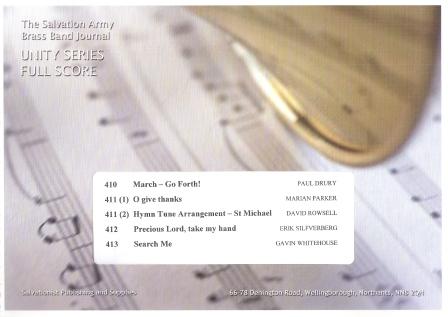
Unity Series Band Journal October 2013 Numbers 410 - 413
No. 410 March - Go Forth! (Paul Drury)This march was written as a tribute to Bandmaster Jack Spowart and the Bo'ness Salvation Army Band. The composer lives in the twon of Bo'ness and has had numerous opportunities to share with the band and the wider corps at various events. This march serves as recognition of the faithful service given in the Lord's name in the town by The Salvation Army for over 100 years. Two tunes are featured, both well-known and instantly recognisable, namely, Forward! be our watchword and We're marching on.No.411 (1) O give thanks (Marian Parker)The composer, Marian Parker, is a new contributor and is the Recruiting Sergeant at Leicester South Corps. This simple, yet rhythmic piece should not pose any technical problems for most bands and features the attractive arrangement of Joanne Pond's contemporary song, 'O give thanks'.No.411 (2) Hymn Tune Arrangement - St Michael (David Rowsell)The hymn tune 'St Michael' was composed in 1551 by French composer Louis Bourgeois and the composer provides a very useful arrangement of this historic hymn.No. 412 Precious Lord, take my hand (Erik Silfverberg O.F.)This well-known Gospel Song is a favourite of many. It has been recorded by many great artists, including Rosetta Tharpe, Elvis Presley and Aretha Franklin. The words were written by Reverend Thomas A. Dorsey, who is often known as the 'Father of Gospel song'.No. 413 Search Me (Gavin Whitehouse)The second new contributor to this journal is Gavin Whitehouse. gavin is the Assistant Music Director for the Greater New York Division and is also the USA Eastern Territorial Songster Leader. This piece combines two songs - one old and one new - which speak of a God who knows us intimately. 'Search me, O God and know my heart today' (associated with the beautiful Maori melody, 'Now is the hour') is woven with a contemporary setting of Psalm 139 by Rebecca St James, the first line of which says, 'You searchme, you know me'.
Estimated dispatch 7-14 working days
-
 £34.95
Carol of the Bells (Brass Band - Score and Parts)
Christmas time is my favourite time of year. I love the festive spirit and all the Christmas music both traditional and modern.This piece is based on the traditional Ukrainian Bell Carol that was composed by the Ukrainian composer Mykola Dmytrovych Leontovych. Throughout the piece you hear a four note ostinato that is the backbone to the music. I have taken those ideas and motifs and have mixed them with some of my own to create this piece of Christmas music.For something different I have given this piece two endings for the conductor to choose. The first ending is at bar 189 (page 18 in the score) where there is the repeated four bar ostinato section in the solo cornets and percussion that is marked "Keep repeating and fade to nothing". This is so the piece can either fade to nothing or for a bit of originality the piece can fade into the next piece during a concert programme.For ending number two you need to cut from bar 189 to 193 (bypassing ending one). And continue to the end. The choice of endings should bring some interesting performances of this wonderful traditional Christmas piece.Paul Lovatt-Cooper
Estimated dispatch 7-14 working days
 View Music