
Results
-
 £40.00
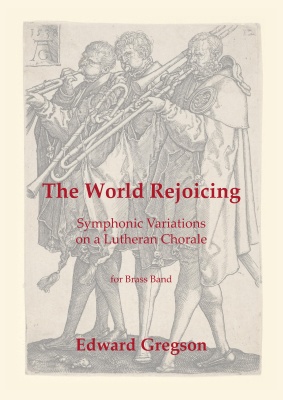
The World Rejoicing (Brass Band - Score only)
The World Rejoicing was commissioned by the National Brass Band Associations of Belgium, Netherlands, Norway, Switzerland, and the British Open, as the test piece for their competitions in 2020/21. Although the work was completed in 2019, the pandemic of 2020 meant that these competitions were postponed until 2021/22. The premiere took place in September 2021 at Symphony Hall, Birmingham, UK.In searching for a common link between the brass band traditions of the various European countries that commissioned this work, I considered the fact that hymns have always played an important role in the relationship that brass bands have with their particular communities; and thus I turned to a well- known Lutheran chorale, Nun danket alle Gott (Now thank we all our God), written around 1636 by Martin Rinkart, with the melody attributed to Johann Cruger. A number of composers have incorporated this chorale into their music, most famously J.S. Bach in his Cantatas no. 79 and 192, and Mendelssohn in the Lobsegang movement of his 2nd Symphony (the harmonisation of which is usually used when this hymn is sung).It seemed fitting therefore for me to return to a compositional form I have used many times before (Variations) and to write a work based on this hymn. I have used it in a similar way to that which I employed in my Variations on Laudate Dominum of 1976 - that is, rather than writing a set of variations using elaborations of the complete tune, I have taken various phrases from the chorale and used them within the context of other musical material, applying an overall symphonic process of continuous variation and development. The structure, or sub-divisions of the work, which is through composed and plays without a break, is as follows:Prelude, Capriccio, La Danza 1, Processional, La Danza 2, Arias and Duets, Fuga Burlesca, Chorale, and Postlude.The work, which is around 16 minutes in length, is also partly autobiographical - in the manner say of Strauss's Ein Heldenleben - in that I have incorporated into the score brief quotations from many of my other major works for brass band. In that respect, The World Rejoicing sums up a particular facet of my life as a composer, and reflects the admiration I have always had for what is surely one of the great amateur music-making traditions in the world.Duration: 16.00
Estimated dispatch 7-14 working days
-
 £99.95
Malcolm Arnold Variations (Score and Parts)
MALCOLM ARNOLD VARIATIONS was commissioned by Philip Biggs and Richard Franklin for the 20th All England Masters International Brass Band Championship held in the Corn Exchange, Cambridge on 25 May 2008. The work is dedicated to Anthony Day, long time carer of Sir Malcolm Arnold in his final years. I first met Malcolm and Anthony in 1990 and remained in constant touch until Malcolm's passing in 2006. Anthony, of course, remains a friend and plays his own role subliminally in this piece. The work is not based on any of Malcolm Arnold's own themes, rather it is a portrait of him (and by association Anthony Day) through my eyes and as a result of my friendship with both parties over some 18 years. If there is any theme as such it is the personalities of the players, the protagonist and his carer placed together by my own efforts coloured and influenced by aspects of Arnold's style and technique without recourse to direct quotation but through allusion and parody. It is of course designed as a brass band test piece but in my eyes is first and foremost a musical challenge. The pyrotechnical elements are there but always secondary to the musical thrust of the work's structure. I have long beforehand submerged myself in Malcolm Arnold's music and ultimately delivered this tribute. Music Directors will be advised to acquaint themselves with the composer's personal music, particularly the film scores, symphonies, concertos and ballets: the solutions towards a successful interpretation of my piece are all in there - and YES, I want, and sanction, this piece to be interpreted, and therein lies the challenge for those of you 'up front'! The challenge for players is that of virtuosity, ensemble and careful attention to where they are individually in relation to their colleagues - a question of balance, taste and insight. With regard to tempi, as is my usual custom, I have indicated all metronome marks with the prefix circa. I would suggest that the fast music is played at these tempos but that the more rubato moments can be allowed some freedom in expression and fluidity of line. With regard to the type of mutes to be employed - this decision I leave to the discretion of players and conductors. Structurally the work is cast as an Introduction, 20 Variations and a Finale. Some variations are self contained, others run into each other as sequences in the same tempo. In other variations, segments are repeated and developed. I could describe the overall concept as a miniature ballet or a condensed film score - there is much drama and character and the repeated elements assist this in driving the action forward. I have deliberately avoided the more extremely dark qualities of Malcolm's own music in this, my celebration of this master-composer, as I have always viewed (and evidenced by my previous Masters scores Tristan Encounters and Chivalry) that the Cambridge contest is a 'sunshine- affair' and firmly believe that Malcolm Arnold would have had it no other way too!
Estimated dispatch 7-14 working days
-
 £49.95
Malcolm Arnold Variations (Score Only)
MALCOLM ARNOLD VARIATIONS was commissioned by Philip Biggs and Richard Franklin for the 20th All England Masters International Brass Band Championship held in the Corn Exchange, Cambridge on 25 May 2008. The work is dedicated to Anthony Day, long time carer of Sir Malcolm Arnold in his final years. I first met Malcolm and Anthony in 1990 and remained in constant touch until Malcolm's passing in 2006. Anthony, of course, remains a friend and plays his own role subliminally in this piece. The work is not based on any of Malcolm Arnold's own themes, rather it is a portrait of him (and by association Anthony Day) through my eyes and as a result of my friendship with both parties over some 18 years. If there is any theme as such it is the personalities of the players, the protagonist and his carer placed together by my own efforts coloured and influenced by aspects of Arnold's style and technique without recourse to direct quotation but through allusion and parody. It is of course designed as a brass band test piece but in my eyes is first and foremost a musical challenge. The pyrotechnical elements are there but always secondary to the musical thrust of the work's structure. I have long beforehand submerged myself in Malcolm Arnold's music and ultimately delivered this tribute. Music Directors will be advised to acquaint themselves with the composer's personal music, particularly the film scores, symphonies, concertos and ballets: the solutions towards a successful interpretation of my piece are all in there - and YES, I want, and sanction, this piece to be interpreted, and therein lies the challenge for those of you 'up front'! The challenge for players is that of virtuosity, ensemble and careful attention to where they are individually in relation to their colleagues - a question of balance, taste and insight. With regard to tempi, as is my usual custom, I have indicated all metronome marks with the prefix circa. I would suggest that the fast music is played at these tempos but that the more rubato moments can be allowed some freedom in expression and fluidity of line. With regard to the type of mutes to be employed - this decision I leave to the discretion of players and conductors. Structurally the work is cast as an Introduction, 20 Variations and a Finale. Some variations are self contained, others run into each other as sequences in the same tempo. In other variations, segments are repeated and developed. I could describe the overall concept as a miniature ballet or a condensed film score - there is much drama and character and the repeated elements assist this in driving the action forward. I have deliberately avoided the more extremely dark qualities of Malcolm's own music in this, my celebration of this master-composer, as I have always viewed (and evidenced by my previous Masters scores Tristan Encounters and Chivalry) that the Cambridge contest is a 'sunshine- affair' and firmly believe that Malcolm Arnold would have had it no other way too!
Estimated dispatch 7-14 working days
-
 £54.95
Fire in the Blood (Brass Band - Score and Parts)
Fire in the Blood was commissioned by Dr Stephen Cobb for the 120th anniversary of the International Staff Band of the Salvation Army. The piece was composed for the celebration concert where the ISB were joined by several other staff bands from around the world to perform independently to a sell-out capacity crowd at Britain's most famous concert hall The Royal Albert Hall. Fire in the Blood received its world premier at the 'ISB 120' concert at the Royal Albert Hall on June 4th 2011.With this piece I wanted to acknowledge music that had an impact on me through my Salvation Army upbringing. When thinking of a title for this piece I had no hesitation than to reflect and re-word the Salvation Army's motto under their famous crest 'Blood and Fire'.When composing Fire in the Blood I wanted to use three songs of worship that have been prevalent in the Salvation Army's services over a number of years. Opening with Richard Phillips' setting of Psalm 95, 'Sing for Joy', the music is vibrant and full of energy, I wanted to capture the spirit of the well known words of Scripture. The music then moves into a more reflective section that includes Howard Davies' emotive song melody 'Lord, you know that we love you' and Laurie Klein's worship song 'I love you Lord'.A re-statement of the opening Psalm setting follows and this, in turn, leads into a dramatic and powerful finale that combines two pivotal statements drawn from the slower, reflective section: I love you lord, and I lift my voice to worship you, O my soul rejoice and Lord, you know that we love you with a final flourish from Psalm 95: Come let us sing joy to the Lord!Paul Lovatt-Cooper
Estimated dispatch 7-14 working days
-
 £24.95
Fire in the Blood (Brass Band - Score only)
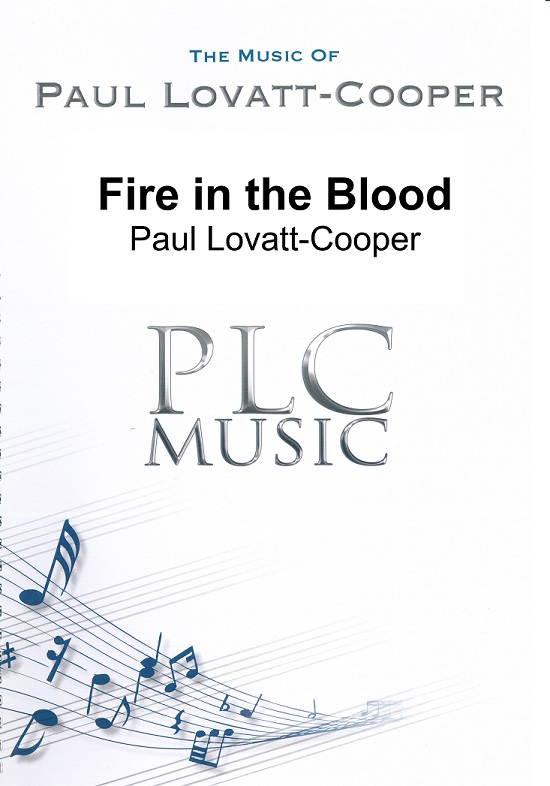
Fire in the Blood was commissioned by Dr Stephen Cobb for the 120th anniversary of the International Staff Band of the Salvation Army. The piece was composed for the celebration concert where the ISB were joined by several other staff bands from around the world to perform independently to a sell-out capacity crowd at Britain's most famous concert hall The Royal Albert Hall. Fire in the Blood received its world premier at the 'ISB 120' concert at the Royal Albert Hall on June 4th 2011.With this piece I wanted to acknowledge music that had an impact on me through my Salvation Army upbringing. When thinking of a title for this piece I had no hesitation than to reflect and re-word the Salvation Army's motto under their famous crest 'Blood and Fire'.When composing Fire in the Blood I wanted to use three songs of worship that have been prevalent in the Salvation Army's services over a number of years. Opening with Richard Phillips' setting of Psalm 95, 'Sing for Joy', the music is vibrant and full of energy, I wanted to capture the spirit of the well known words of Scripture. The music then moves into a more reflective section that includes Howard Davies' emotive song melody 'Lord, you know that we love you' and Laurie Klein's worship song 'I love you Lord'.A re-statement of the opening Psalm setting follows and this, in turn, leads into a dramatic and powerful finale that combines two pivotal statements drawn from the slower, reflective section: I love you lord, and I lift my voice to worship you, O my soul rejoice and Lord, you know that we love you with a final flourish from Psalm 95: Come let us sing joy to the Lord!Paul Lovatt-Cooper
Estimated dispatch 7-14 working days
-
 £30.00
Inchcolm - Terry Johns
The island of Inchcolm was visited by St Columba in 567 and is mentioned in Shakespeare's Macbeth. It lies on the stretch of water beyond my balcony, known locally as "Mortimer's deep", and on short winter days, the ruins of Columba's abbey are shrouded in the mists of the estuary and bring a flavour of mystery and legend to my morning coffee. Music comes easily here amidst the crying of the seabirds, and the horn has given its distinctive voice to history, myth and folklore for centuries. Its sound was born in the wide-open spaces and can paint a broad seascape with ease.
-
 £38.95
Unity Series Band Journal October 2013 Numbers 410 - 413
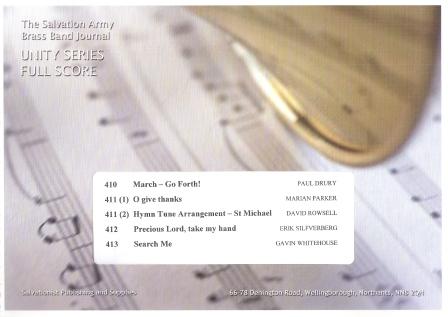
No. 410 March - Go Forth! (Paul Drury)This march was written as a tribute to Bandmaster Jack Spowart and the Bo'ness Salvation Army Band. The composer lives in the twon of Bo'ness and has had numerous opportunities to share with the band and the wider corps at various events. This march serves as recognition of the faithful service given in the Lord's name in the town by The Salvation Army for over 100 years. Two tunes are featured, both well-known and instantly recognisable, namely, Forward! be our watchword and We're marching on.No.411 (1) O give thanks (Marian Parker)The composer, Marian Parker, is a new contributor and is the Recruiting Sergeant at Leicester South Corps. This simple, yet rhythmic piece should not pose any technical problems for most bands and features the attractive arrangement of Joanne Pond's contemporary song, 'O give thanks'.No.411 (2) Hymn Tune Arrangement - St Michael (David Rowsell)The hymn tune 'St Michael' was composed in 1551 by French composer Louis Bourgeois and the composer provides a very useful arrangement of this historic hymn.No. 412 Precious Lord, take my hand (Erik Silfverberg O.F.)This well-known Gospel Song is a favourite of many. It has been recorded by many great artists, including Rosetta Tharpe, Elvis Presley and Aretha Franklin. The words were written by Reverend Thomas A. Dorsey, who is often known as the 'Father of Gospel song'.No. 413 Search Me (Gavin Whitehouse)The second new contributor to this journal is Gavin Whitehouse. gavin is the Assistant Music Director for the Greater New York Division and is also the USA Eastern Territorial Songster Leader. This piece combines two songs - one old and one new - which speak of a God who knows us intimately. 'Search me, O God and know my heart today' (associated with the beautiful Maori melody, 'Now is the hour') is woven with a contemporary setting of Psalm 139 by Rebecca St James, the first line of which says, 'You searchme, you know me'.
Estimated dispatch 7-14 working days
-
£59.95
LORD IS KING, The (Brass Band Set) - Ray Steadman-Allen
Ray Steadman-Allen was for many years the driving force in Salvation Army music. His publication list of both brass and vocal works can be measured literally by the hundred. 'The Lord is King' is arguably his crowning achievement of over twenty major works for brass band. Although described as a suite, the work is more symphonic in conception and scale as well as being formidable to perform. The work is based on the Welsh hymn tune 'Llangollen' to which the hymn 'The Lord is King, I own His power' are associated. The three movements derive inspiration from the lines 'My joy, my toil, my craftman's skill, all have their place, and serve His will' found in verse five of the hymn.
Estimated dispatch 7-14 working days
-
 £74.95
A Tale of Hope (Brass Band - Score and Parts)
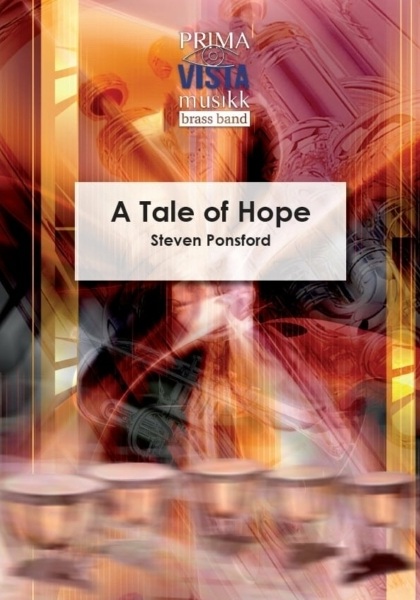
The piece tells the story of Chicago lawyer and Presbyterian church elder Horatio Gates Spafford. In 1873, the Spafford family planned a vacation to England, but last-minute business demands prevented Horatio from sailing with them. Tragedy struck when the ship collided with an iron sailing vessel while crossing the Atlantic, killing 226 people, including all four of Spafford's daughters. His wife, Anna, survived the tragedy, and upon arriving in Cardiff, Wales, she sent a telegram to Spafford that simply read "Saved alone." Shortly afterwards, as Spafford travelled to meet his grieving wife, he was inspired to write the hymn It Is Well with My Soul as his ship passed near where his daughters had died. The hymn was subsequently set to music by fellow American Philip Bliss, with the tune named after the ship on which Spafford's daughters died, Ville du Havre.Composer Steven Ponsford has chosen to portray this story in a substantial composition for brass band. Much of the early music is turbulent, reflecting the long voyage, and then the disaster that claimed Spafford's daughters. After a darker 'Grave' section, the hymn It Is Well With My Soul softly emerges, with the piece ending on a note of optimism and hope.Duration: 11.30
Estimated dispatch 7-14 working days
-
£31.95
A Tale of Hope (Brass Band - Score only)
The piece tells the story of Chicago lawyer and Presbyterian church elder Horatio Gates Spafford. In 1873, the Spafford family planned a vacation to England, but last-minute business demands prevented Horatio from sailing with them. Tragedy struck when the ship collided with an iron sailing vessel while crossing the Atlantic, killing 226 people, including all four of Spafford's daughters. His wife, Anna, survived the tragedy, and upon arriving in Cardiff, Wales, she sent a telegram to Spafford that simply read "Saved alone." Shortly afterwards, as Spafford travelled to meet his grieving wife, he was inspired to write the hymn It Is Well with My Soul as his ship passed near where his daughters had died. The hymn was subsequently set to music by fellow American Philip Bliss, with the tune named after the ship on which Spafford's daughters died, Ville du Havre.Composer Steven Ponsford has chosen to portray this story in a substantial composition for brass band. Much of the early music is turbulent, reflecting the long voyage, and then the disaster that claimed Spafford's daughters. After a darker 'Grave' section, the hymn It Is Well With My Soul softly emerges, with the piece ending on a note of optimism and hope.Duration: 11.30
Estimated dispatch 7-14 working days