
Results
-
 £59.99
A Norwegian Hymn - Axel Fiske - Philip Sparke
British composer Philip Sparke was asked to write this arrangement of Hymn to Frei for the Norwegian Brass Band Frei Hornmusikk . Sparke had already used part of this hymn by a composer well-known in the home region of the band in The Saga of Haakon the Good. In A Norwegian Hymn, three verses of the tune can be heard: the first is performed by various soloists, followed by a quieter second verse, before the third verse brings the piece to a triumphal close. A beautiful piece, which is also excellent to use to work on musicality with bands in lower divisions.
Estimated dispatch 5-14 working days
-
 £54.99
Away in a Manger - Andrew R. Mackereth
In English-speaking countries 'Away in a Manger' is one of the first Christmas songs to be taught to little children. It is a moving song with simple words, which makes it easy to understand. The song is also known as 'Luther's Cradle Hymn'. This suggests that Martin Luther was the author of the lyrics. According to researchers, however, this is a misconception the author is unknown. In England 'Away in a Manger' is sung to a different melody than in the USA, for example. The 'English' melody was composed by W.J. Kirkpatrick. Andrew Mackereth made a touching arrangement of the 'English' melody, which suits the tender lyrics perfectly.
Estimated dispatch 5-14 working days
-
 £54.99
Smile! - Timothy Travis
Undoubtedly, a smile will come to your face whenever you listen to 'Smile', for this little piece is guaranteed to bring mirth and good cheer to each and everyone. What is more, your bandsmen will almost literally lick their lips over this sure-fire favourite to be, containg swinging solos for cornet and euphonium (cued in tenorhorn).
Estimated dispatch 5-14 working days
-
 £76.99
Let's Celebrate - Dagmar Kildevann
Is there something to be celebrated? Then let's play 'Let's Celebrate'! This four-part suite has been based on two birthday songs: the world-famous 'Happy Birthday to you' (which is also sung in many other languages), and the Dutch song 'Lang zal hij/zij leven'. The Fanfare opens in grand style with the motif of 'Lang zal hij leven' and is followed by a cheerful March in which the motifs of both songs can be heard. The third part, Song, forms a moment of contemplation, and the birthday presents are unwrapped by the percussion section in the fourth part, Surprise Party. The yell may be adapted to the occasion. (the sleigh bells caused the composer to note down this somewhat peculiar yell). Of course everybody is expected to join in.
Estimated dispatch 5-14 working days
-
 £89.99
Frida's Whiskers - David Well
David Well composed 'Frida's Whiskers' in commemoration of his own cat, who met an untimely end. Frida (whose real name was 'Godefrida van Coopersburg thoe Nieuwenhuys') was a lively creature, who led a playful and uncomplicated life. She used to sleep in her basket for hours, but when she woke up she upset the entire house and its furnishing. Curtains were inspected from top to bottom and flower pots fell from window-sills just like that! Outside, in the open air she was in her element. She used to frolic, bouncing into the air. After such playful moods she would return to her basket tired but satisfied where, being the cleanly cat that shewas, she subjected her entire body, whiskers included, to a thorough wash.
Estimated dispatch 5-14 working days
-
 £104.99
Like a Child - Andreas Ludwig Schulte
The young have the future. This is the statement made at the beginning of 'Like a Child' by Andreas Ludwig Schulte. The opening radiates strength and ambition, but one is also made to wonder which direction will be chosen, which choices will have to be made.After the introduction the first steps on the path of life are taken, still somewhat unsteadily (the 3/4th time used illustrates this uncertainty). However, the child has now set off and will meet the future with an open mind, unafraid, even though experience will teach it how easily it can be hurt.Fortunately, it is sometimes allowed to be vulnerable and it discovers there will always be someone to offer shelter,support and love. (Adagio) The last part breathes a far greater independence. Youth is able to face the future, it can even take on the whole world!
Estimated dispatch 5-14 working days
-
£104.99
Theme Park Fun! - Wilco Moerman
In Theme Park Fun! your orchestra pays a visit to an amusement park. During your visit, you will experience some spectacular rides and attractions this theme park offers. The uniqueness of Theme Park Fun! is the interplay between music and(moving) images. Animations and illustrations support the visual composition (downloadable after ordering a set, on www.gobelinmusic.com).Part 1: The Entrance & Parade [with animation]The opening of the park is a fact. A day fullof fun and pleasure awaits! You and the other visitors will be confronted with all the rides, attractions and adventures the theme park has to offer. Which ride shall we do first?! There is so much to do and experience on this day in the park! Aparade of colorful floats and park figures is passing by.Let the fun begin!Part 2: The Haunted House [with animation]The only ride in the park that is not related to fun, is the Haunted House. Here visitors will be challengedto visit a house full of ghosts, creepy figures and other ominous things. The clock strikes twelve, there is no turning back. Ghosts are whispering, yelling, screaming... Fortunately it is almost one oclock, so we can leave this creepy placequickly.Part 3: The Swinging Galleon [with illustrations]What a huge pirate ship! Each time you swing back and forth, you will feel that weird feeling in your stomach. When you are thrown completely into the top you will have afantastic view over the park, but you can not enjoy it for long. Before you know the ship swings back the other way.Part 4: The Fairy Tale Ride [with illustrations]After all those exciting and spectacular rides and attractions,it is time for a peaceful tour in The Fairy Tale Ride. Surrounded by a fairytale setting, you will discover fable figures, talking animals and colorful designs. Such a beauty and tranquility. Having had this experience, we are ready again for thebig rides in the park!Part 5: The Bumper Cars [with illustrations]Now its time to crawl behind the wheel of the Bumper Cars! Shall we all chase the conductor?! Before you know you are hit by another visitor or you will bumpagainst someone else. In this tough ride you can prove yourself as a real driver, or perhaps as a really bad one.Part 6: The Roller Coaster [with illustrations]The largest, fastest and scariest ride in the park ... we shoulddefinitely do the Roller Coaster! All together in the train, the over-the-shoulder restraints are lowering... be ready to ride. The train leaves the station and is heading for the big lift hill. It will be very scary when the train reaches the topand the train will be plunged down the first drop! Loops, corkscrews and other spectacular coaster elements will follow... Before you know it, the ride of your life is over. Shall we ride it again?!Part 7: Leaving the Park [withanimation]Unfortunately everything comes to an end. This day in the theme park is over, but we have a lot new experiences to talk about! The memories of all the funny and spectacular rides will come up when we walk through the park to theexit. Just one look over the shoulder, the amusement park figures are waving at us. Hopefully we will come back again soon!
Estimated dispatch 5-14 working days
-
 £115.60
Josefs Julevise - Halvdan Sivertsen - John Philip Hannevik
Halvdan Sivertsen (born 1950) is one of the most popular singer/ songwriters in Norway. He is well know as a first-class storyteller, and he has a strong melodic line in all his music. This Christmas song was first recorded in 1991 and it has become a Norwegian classic. The lyrics tell the story of a couple travelling through time to find a city with bright lights, where they hear people sing about the couple who are about to have their first baby. But still this couple can not find anybody willing to help them, and they are forced to go back 2000 years, to find the stable where they find some shelter. Maybe they should have travelled further ahead in time in the firstplace, to find people willing to open their door to the poor and needing?
Estimated dispatch 5-14 working days
-
 £102.60
Milonga del Angel - Astor Piazzolla - Sverre Stakston Olsrud
This arrangement was made after hearing Astor Piazzolla's 1986 recording of his own work written in 1965.The original instrumentation of bandoneon, violin and string bass is here arranged for three wind soloists with Concert Band.The Eb Cornet is the main soloist (filling the bandoneon role), while the trombone and Solo Bb Cornet shares the violin part as a kind of flirting undertone to the Eb Cornet.It's not possible to make a 100% correct notation of the solo parts, so it's recommended to listen to the record album "Zero Hour" from 1986 to get the best impression of the work.Enjoy "Milonga Del Angel" and imagine a small, dark cafe in Buenos Aires!
Estimated dispatch 5-14 working days
-
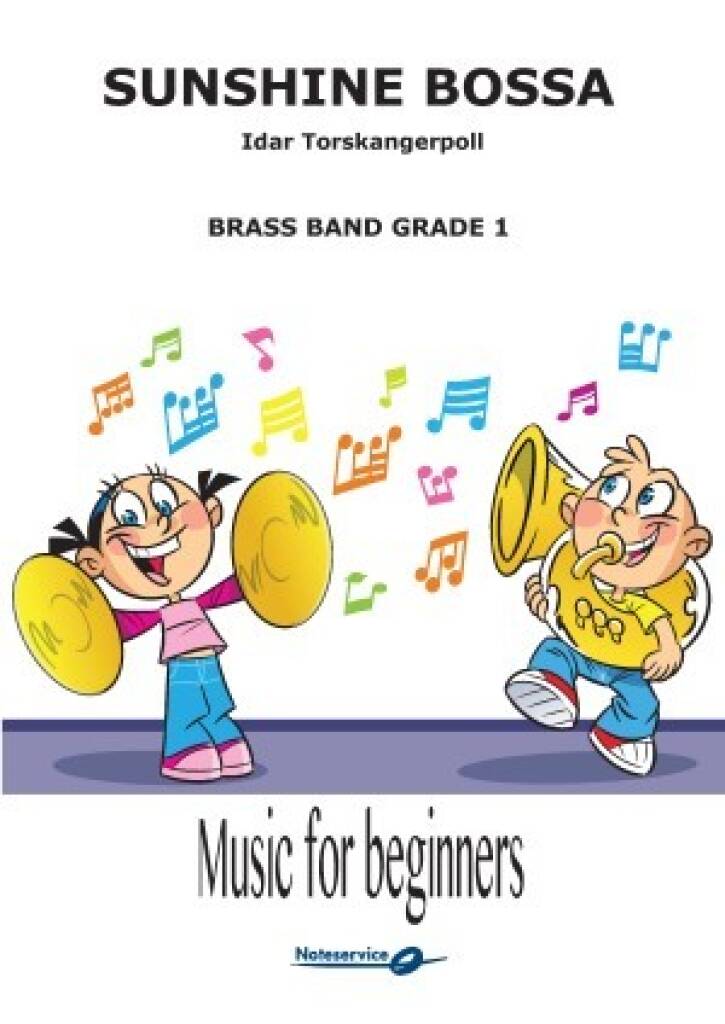 £115.60
Sunshine Bossa - Idar Torskangerpoll
This is a proper happy-tune for young musicians in a school band.It's easy to play and easy to listen to. Repetitive rhythms and patterns make it easy to follow.The instrumentation is adapted to the range of notes often found in beginning bands.
Estimated dispatch 5-14 working days
 View Music