
Results
-
 £44.95
Judd: Finale William Tell Overture
'William Tell' was completed by Rossini in 1829 and was his final stage work. The finale from the opera's overture constitutes one of the most familiar pieces in classical music repertoire having been popularised as the theme from the 60's TV classic 'The Lone Ranger'. This transcription for brass band is by Commissioner Sir Dean Goffin.
Estimated dispatch 7-14 working days
-
 £45.00
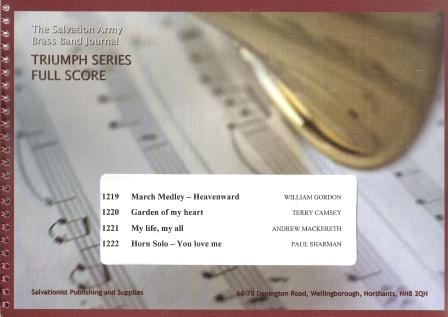
Triumph Series Band Journal November 2011 Numbers 1219-1222
No.1219 March Medley - Heavenward (William Gordon)A variety of songs are used in this up-tempo march medley which potrays the celebration of a life looking forward to an eternity in Heaven. The tunes used are 'When we all get to Heaven', 'When the roll is called up yonder' and 'We shall win'.No.1220 Garden of my heart (Terry Camsey)The publication of this music is, in a small part, a fitting tribute to Major Terry Camsey who was Promoted to Glory in June 2011. The title is taken from the refrain from a much-loved Sidney Cox song; 'Jesus, Jesus, Lily of the valley, Bloom in all thy beauty in the garden of my heart'.No.1221 My life, my all (Andrew Mackereth)This selection attempts to emphasise the personal nature of Christian commitment hence the emphasis given to the words 'my' and 'I' in the songs chosen. The tunes 'Rockingham', 'All I have I am bringing to thee' and 'At thy feet I bow adoring' are included.No.1222 Tenor Horn Solo - You love me (Brian Willetts arr. Paul Sharman)This arrangement was made at the request of David Lynch, Solo Horn player in The International Staff Band. Originally published in April 1993, the song speaks of the fact that, despite the wonder and vastness of God's creation, he still loves each one of us individually.
Estimated dispatch 7-14 working days
-
 £24.95
Christmas Angels (Brass Band - Score and Parts)
This sparkling music features two carols, 'Angels from the realms of Glory' and 'Masters in this Hall'. Both of them have come down the centuries to us from France but their styles are very different. The march seeks to capture both the choral style of the first and the energetic, dance-like style of the second.
Estimated dispatch 7-14 working days
-
 £59.95
Festival Suite (Brass Band - Score and Parts)
This three movement suite for brass band was commissioned by the Solothurnischer Blasmusikverband (SOBV) in Switzerland for their 2009 Festival. The first movement, Energy, is appropriately lively in character. It is dominated by an agitated theme on trombones and cornets, driven by a percussion accompaniment, and complemented by pulsating counterpoint from the rest of the band. The second movement is called Repose and its opening melodious theme on cornets provides a welcome respite from the restlessness and verve of the opening movement. The lyrical nature of the music is sustained throughout. The finale, Suspense, opens with a theme containing more than a hint of foreboding which recurs several times. There are numerous abrupt changes of dynamics, and also a brightening of mood, before everything finishes in a blaze of sound.
Estimated dispatch 7-14 working days
-
 £64.00
Three Spanish Impressions (Score and Parts)
Three Spanish Impressions originally were part of a large, single movement work called " SPAIN" Whilst happy with the content of the work, I realised that it was rather unwieldy and a bit too long, so, with the publishers blessing, created a shorter suite from the existing material.The brooding and repetitive opening movement takes its mood perhaps from the Miles Davis/Gil Evans album "Sketches of Spain", albeit in a less stringent harmonic language. The middle movement is a delicate and fragile waltz, with shades of a romance within, and the finale, a colourful and robust fandango, also contains a lyrical heart!The thematic material, whilst written very much as a pastiche of the music of Spain, is original, and the accent is firmly on melody and musicianship!Alan FernieJune 2007
Estimated dispatch 7-14 working days
-
 £24.00
Three Spanish Impressions (Score Only)
Three Spanish Impressions originally were part of a large, single movement work called " SPAIN" Whilst happy with the content of the work, I realised that it was rather unwieldy and a bit too long, so, with the publishers blessing, created a shorter suite from the existing material.The brooding and repetitive opening movement takes its mood perhaps from the Miles Davis/Gil Evans album "Sketches of Spain", albeit in a less stringent harmonic language. The middle movement is a delicate and fragile waltz, with shades of a romance within, and the finale, a colourful and robust fandango, also contains a lyrical heart!The thematic material, whilst written very much as a pastiche of the music of Spain, is original, and the accent is firmly on melody and musicianship!Alan FernieJune 2007
Estimated dispatch 7-14 working days
-
 £22.13
A Joyous Fanfare (Brass Band) Andrew Wainwright
A Joyous Fanfare is a short majestic concert prelude that captures the essence of celebration and festive spirit. Derived from the original Fanfare of Joy, commissioned by the Burbage Band (Buxton) and conductor Steven Critchlow in 2017, this piece takes inspiration from the beloved carol Joy to the World. Duration: 1.20 minutes Difficulty Level: 3rd Section + This PDF download includes the full score and parts. Sheet music available at www.brassband.co.uk (UK) or https://satradecentral.org (USA) Instrumentation: Soprano Cornet Eb Solo Cornet 1&2 Bb Solo Cornet 3&4 Bb Repiano Cornet Bb 2nd Cornet Bb 3rd Cornet Bb Flugel Horn Bb Solo Horn Eb 1st Horn Eb 2nd Horn Eb 1st Baritone Bb 2nd Baritone Bb 1st Trombone Bb 2nd Trombone Bb Bass Trombone Euphonium Bb Bass Eb Bass Bb Timpani Snare Cymbals
In Stock: Estimated dispatch 1-3 working days
-
 £49.95
Bestowal of a Century - Christopher Bond
Bestowal of a Century (2014) was commissioned by Lowenna Taylor, and funded through her Harry Mortimer Trust award which she was presented with at the 2013 British Open Championship following the completion of her studies at the Royal Welsh College of Music in Cardiff. The 15-minute work received its world premiere at the Cornwall Youth Brass Band Christmas concert in 2014 with solosit, Lowenna, working alongside the band under the baton of Les Neish. The 'Bestowal' refers to the presentation of the Royal Trophy by the then Prince of Wales to the famous West of England Bandsman's Festival in Bugle in 1913. Over the years it has been won by some of the greatest names in brass banding, including Black Dyke and Munn & Feltons - although more recently it has become a wonderful open festival that includes sections for local bands as well as visitors from all over the banding globe. 2014 marked the one-hundredth anniversary of the presentation of the trophy, which is the only brass band trophy to have the official seal of royal patronage. The work, in three distinct sections, opens in a mysterious way, building progressively with interjections from the horn. The composer notes its as though one can imagine different part of the trophy being put together, piece by piece, until the trophy is complete and a climax is reached. Following this, a playful theme is presented which is developed throughout the first section and interacting between soloist and band. The second movement, in complete contrast, is a lyrical melody; heart-wrenching throughout, and sits well both as part of the concerto and also as a stand-alone solo item. The third movement is light-hearted and virtuosic, demonstrating the technical capabilities of the instrument with fast and virtuosic playing, and a cadenza towards the end of the work.
Estimated dispatch 10-14 working days
-
 £15.99
Brass Essentials - An Study Companion (for all valve instruments in treble clef)
This book of 32 studies has been drawn from those Paul Cosh used as a student at the Royal Academy of Music, throughout his years as a professional player and as a teacher at the Guildhall School of Music & Drama.The studies are divided into four main sections: Articulation, Finger Technique, Lyrical & Flexibility and Stamina & Technique and are drawn from those written by Arban, Charlier, Boehme, Brandt, Kopprasch and Sachse. Some of the studies have been re-imagined and edited to include new tempi and expression.There are helpful tips at the start of each section with most of the studies given suggested practice and performance tempi, although these are just a guide. Slow practise of the highly technical passages is vital to adhere to the overriding principle that every note counts.The Brass Essentials Study Companion can also work in conjunction with both the Brass Essentials: Arban Companion and the Brass Essentials: Practice Companion to vary your practice diet.
Estimated dispatch 7-14 working days
-
 £42.95
Little Suite (Brass Band - Score and Parts)
Trevor Duncan (1924 - 2005) was an English composer, particularly noted for his light music compositions. Born in London, and largely self-taught, he originally composed as a side line while working for the BBC. In the UK, he is well known for pieces such as High Heels and the March from A Little Suite, all of which gained fame as television and radio themes.Composed in 1959, and remembered by most for TV's Dr Finlay's Casebook fame, 'A Little Suite', was not necessarily inspired by Scotland, in fact it was more English in inspiration according to the composer. The piece was described by the composer as 'absolute music', and taking the three movements into account, this is not far from the mark.
Estimated dispatch 7-14 working days