
Results
-
 £45.00
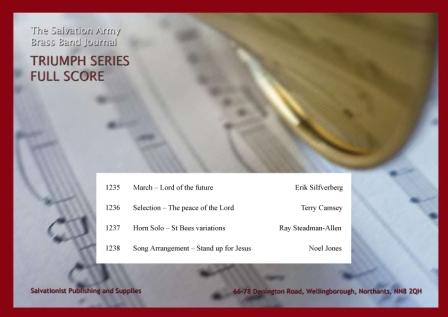
Triumph Series Band Journal March 2013 Numbers 1235 - 1238
No. 1235 March - Lord of the future (Erik Silfverberg)The title of this short, lively march is connected to the tune 'With Christ into the future' which appears in its second half.No. 1236 Selection - The peace of the Lord (Terry Camsey)This selection seeks to portray the peace that is found in Jesus, both in its style and the tunes used; 'Peace, peace, sweet peace', 'O the peace' and 'Brahms' Lullaby'.No. 1237 Horn Solo - St Bees variations (Ray Steadman-Allen)St Bees is a simple melody and this treatment is compatible with its character. Florid and meditative passages conclude with a brisk finale.No. 1238 Song Arrangement - Stand up for Jesus (Noel Jones)The old well-known gospel song appears here in a swing style.
Estimated dispatch 7-14 working days
-
 £59.95
Judd: At the Edge of Time
This work was commissioned for the Camberwell Citadel Salvation Army Band's 1982 tour of the USA, Great Britain and Europe. The title relates to Jesus' promise that he will return as Lord and King enternal. Christians, in faith, await his Second Coming and their faith is reflected in the strong tune of the first movement.The featured tune is that of St Magnus with which the words associated are 'The Lord will come and not be slow.'
Estimated dispatch 7-14 working days
-
 £69.95
Judd: Isaiah 40
Commissioned for the final of the 1996 National Brass Band Championships of Great Britain, Isaiah 40 represents Robert Redhead's only 'test piece' composition to date. The timeless truths contained in Isaiah 40 were written to encourage a people facing very intimidating circumstances. The Jewish people of the 5th Century BC were preparing to make an arduous journey though the desert to return to their ravaged homeland after a lengthy exile in the sophisticated society of Babylon. Both Scripture and music sound out a message of hope, as they view life from an eternal perspective, thus placing change in its proper context. Because 'the Lord is the everlasting God' his word 'stands forever' and 'those who hope in the Lord will renew their strength'. They will not merely get through somehow but 'they will soar on wings like eagles'.
Estimated dispatch 7-14 working days
-
 £44.95
Judd: Turris Fortissima
The geographical position of Plymouth (the composer's home city) means that, at various times in history, the city has been the United Kingdom's first line of defence. A series of forts around the coast bears testimony to this and forts have featured on the city's coat of arms ever since. However, the city's forefathers believed that physical security was worthless without a faith in God's protection and this is reflected in the city motto; Turris fortissima est nomen Jehovah (The name of Jehovah is our strongest tower) (Proverbs 18:10). Written for Enfield Citadel Band's tour of the USA in 2007, the music attempts to portray this assurance with the use of the tune Ein' Fest Burg (A mighty fortress is our God) along with the more contemporary Blessed be the Name of the Lord and Shout to the Lord. There is also an apt reference to Dean Goffin's My Strength, My Tower as the music builds to its dramatic final bars.
Estimated dispatch 7-14 working days
-
 £10.00
Isaiah 40 (Brass Band - Study Score)
Commissioned for the final of the 1996 National Brass Band Championships of Great Britain. The timeless truths contained in Isaiah 40 were written to encourage a people facing very intimidating circumstances. The Jewish people of the 5th Century BC were preparing to make an arduous journey though the desert to return to their ravaged homeland after a lengthy exile in the sophisticated society of Babylon. Both Scripture and music sound out a message of hope, as they view life from an eternal perspective, thus placing change in its proper context. Because 'the Lord is the everlasting God' his word 'stands forever' and 'those who hope in the Lord will renew their strength'. They will not merely get through somehow but 'they will soar on wings like eagles'.
Estimated dispatch 7-14 working days
-
 £61.99
Hard Rock Hallelujah - Mr. Lordi, Mr. Kita, Mr. Amen, Mr. Kalma & Miss Awa - Jan van Kraeydonck
Estimated dispatch 10-14 working days
-
 £34.22
Fawkes (Brass Band) Fendall Hill
Bring explosive drama and striking historical resonance to your ensemble's repertoire with Fawkes by Fendall Hill.Dedicated to Alan Gifford and Sovereign Brass, this compelling work delves into the dark intrigue of November 5, 1605 - the fateful night Guy Fawkes and his conspirators plotted to obliterate the foundation of English royal and political power. While the 36 barrels of gunpowder hidden beneath Parliament never detonated, the looming spectre of what could have been remains one of history's most lingering images. Had a single fuse been lit, the trajectory of future empires and superpowers would have changed forever.Rather than commemorating a physical blast, Fawkes celebrates this iconic 'non-explosive event' with breathtaking musical pyrotechnics.Key Features & Musical HighlightsDramatic Narrative: Captures the suspense, secret plotting, and shadowy tension leading up to the discovery beneath the House of Lords.Virtuosic Display: Packed with fiery technical runs, powerful brass fanfare, and rapid artful passagework designed to emulate brilliant fireworks.Latent Historical Tremors: Features haunting, driving rhythmic motifs that symbolize the sheer kinetic potential of 36 barrels of gunpowder waiting in the dark.Concert Opener or Finale: An exhilarating showpiece guaranteed to captivate audiences and showcase the dynamic range, power, and precision of your ensemble.To view a video of the work featuring Wellington Brass please visit www.youtube.com/watch?v=4fZZzuVrPjgDuration: Approx. 4-5 minutes (adjust based on score specifics)Difficulty Level: 2nd Section +This PDF download includes the full score and parts.Sheet music available at www.brassband.co.uk (UK) or https://satradecentral.org (USA)Instrumentation:Soprano Cornet EbSolo Cornet BbRepiano Cornet Bb2nd Cornet Bb3rd Cornet BbFlugel Horn BbSolo Horn Eb1st Horn Eb2nd Horn Eb1st Baritone Bb2nd Baritone Bb1st Trombone Bb2nd Trombone BbBass TromboneEuphonium BbBass EbBass BbTimpaniPercussion 1-2
In Stock: Estimated dispatch 1-3 working days
-
 £41.83
Kolo (Brass Band) Derek Jenkins
'A kolo,' which translates to round or circle, is a fast and lively traditional folk dance that originated in the Balkans. The music accompanying a kolo dance is characteristically quite repetitive. The primary melodic material is introduced at the beginning, and it continues to appear and reappear throughout the duration of the dance. Several composers, including Antonin Dvorak, have adapted the kolo into concert pieces for orchestra. These are often fast and exhilarating showpieces that portray the virtuosity of the entire ensemble.This work entitled Kolo, by Derek Jenkins, continues this concert adaption tradition, and it follows the basic structure of the traditional dance with the exception of the middle section.The composer writes: 'I was fortunate to spend about two weeks in Zagreb and several days in Dubrovnik during the spring of 2009. Looking out upon the Adriatic Sea atop of Dubrovnik's historic city wall, I was struck by an overwhelming sense of tranquility, and that feeling has become the strongest association I have with my time in Croatia.'In order to depict this musically, I forewent the continuation of the fast and lively character of the middle section of my Kolo and instead replaced it with music that is peaceful and reflective. The melody used in this slow section comes from a folk song, "Oj, mladano mlado mom(ce)," in Bela Bartok and Albert B. Lord's folksong collection Serbo-Croatian Folk Songs. This middle section was my chance to return, if only in my mind, to the Adriatic coast.'The original concert band version was commissioned by Lee Hartman and the Mid America Freedom Band.Sheet music available from:UK - www.brassband.co.ukUSA - www.solidbrassmusic.comDifficulty Level: 3rd Section +Instrumentation:Soprano Cornet EbSolo Cornet BbRepiano Cornet Bb2nd Cornet Bb3rd Cornet BbFlugel Horn BbSolo Horn Eb1st Horn Eb2nd Horn Eb1st Baritone Bb2nd Baritone Bb1st Trombone Bb2nd Trombone BbBass TromboneEuphonium BbBass EbBass BbTimpaniGlockenspielPercussion 1-2
In Stock: Estimated dispatch 1-3 working days
-
 £30.00
The Sword and the Star
DescriptionThe Sword and the Star was written in 2006 for the Middleton Band at the request of their Musical Director, Carl Whiteoak. The inspiration for the work was the band's badge, which features a medieval archer. The town of Middeton's historical link with the symbol of the Archer came from the English victory at the Battle of Flodden in September 1513, where bowmen from Middleton and Heywood under the command of Sir Richard Assheton played a vital part in crushing the invading Scottish army. Sir Richard captured one of the Scottish commanders and presented the prisoner's sword to the St Leonard's church in Middleton in recognition of the town's contribution. As long time Lords of the Manor, the Assheton family crest was for centuries featured in the coat of arms of Middleton council, and when Middleton became part of the Metropolitan Borough of Rochdale the black star from the Assheton crest was used to represent Middleton in the new borough's coat of arms. Hence the title The Sword and the Star, for a piece which attempts to give an impression of the town as it was then and as it is now.The music is in three short sections - a fanfare, a lament and a bright scherzo - and simply aims to contrast the medieval hamlet of Middleton with the bustling urban centre it has now become. The central lament features a Scottish song called "The Flowers of the Forest", written to mourn the loss of so many of Scotland's young men on the field of Flodden; the song returns in a much more positive form at the end of the piece.
Estimated dispatch 7-14 working days
-
£34.95
COVENANTERS, The (Brass Band Set) - Kenneth Downie
In 1638, many members of the Presbyterian Church of Scotland signed a document called the National Covenant. By doing so, they were declaring that they acknowledged only Jesus Christ as the spiritual head of their church, and not any king or queen. This had become necessary because the Stuart kings believed in the Divine Right of Monarchs and saw themselves as head of the church. In the previous year, Charles I had forcibly introduced the Book of Common Prayer, invoking the wrath of the common people who faced the threat of torture, transportation or execution if they did not use the new liturgy and worship at their local church. The net result of this was that many met illegally in the countryside or in barns and large houses. These meetings became known as 'conventides' and many took place in the south-west of the country. Anyone caught attending was at risk of execution by the muskets of the dragoons who were employed in the area for that specific purpose. This music was written to honour the bravery and loyalty of these Christians to their faith, in the face of extreme danger, in the hope that it will inspire us also to be faithful. There are overtones of military threat, secrecy and solidarity. An old pentatonic tune is used, which the composer heard as a boy being sung to the words The Lord's My Shepherd.
Estimated dispatch 7-14 working days
 View Music
 Watch video