
Results
-
 £12.50
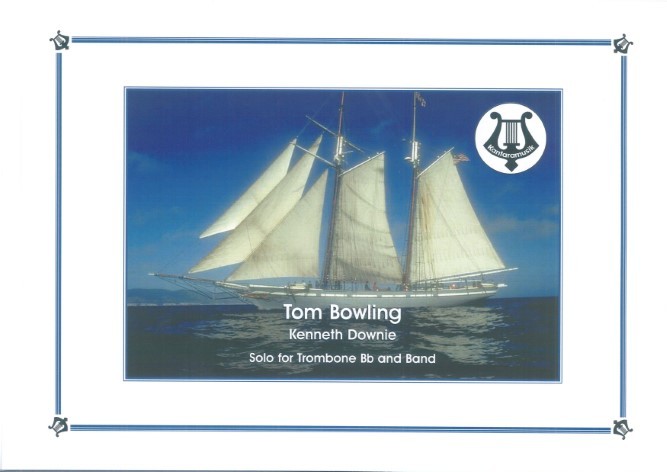
Tom Bowling - Trombone Solo (Brass Band - Score Only) - Downie, Kenneth
This wonderful song is invariably featured in the last night of the BBC Promenade Concert series as it is included in Henry Wood's Fantasia on British Sea Songs. It is played as a cello solo and always provides one of the most sensitive, melancholic moments of the evening. It the trombone soloist rises to the challenge, there will not be a dry eye in the concert hall!
Estimated dispatch 7-14 working days
-
 £76.99
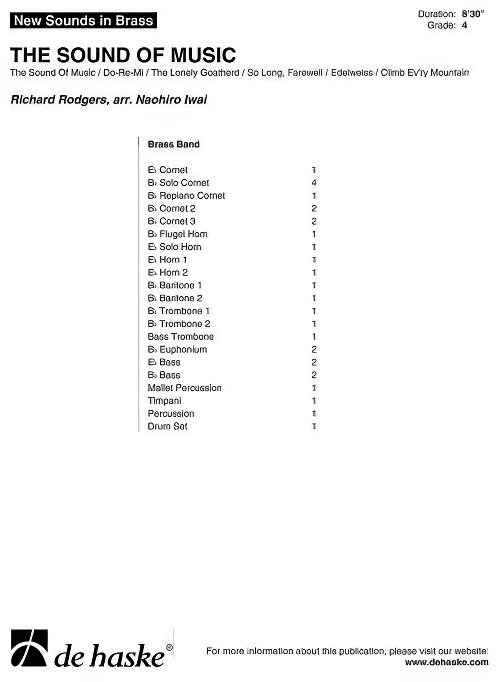
The Sound of Music (Brass Band - Score and Parts) - Hammerstein & Rodgers - Iwai, Naohiro
The musical The Sound of Music represents the last collaborations between the successful duo Rodgers and Hammerstein. It is based on the story about the Austrian Von Trapp family that immigrated to the United States of America. Generations have fallen in love with the musical, made particularily famous through its subsequent cinematic release. Naohiro Iwai combines all the musical's highlights: Do-Re-Mi, The Lonely Goatherd, So Long, Farewell, Edelweiss, and Climb Ev'ry Mountain.Duration: 8:30
Estimated dispatch 7-14 working days
-
 £60.99
Alpine March (Brass Band - Score and Parts) - Moren, Bertrand
Bertrand Moren composed Alpine March for the Hochwaliser Musikfest in Blatten, Switzerland in 2004.The march opens in a festive 6/8 time with lots of dynamic contrast and characteristic 6/8 rhythms. The Trio-section however is written in 2/4 time and is very lyrical. With a da capo this march, written by the winner of last year's European Brass Band Composition Contest, is brought to a thrilling close.Duration: 5.15
Estimated dispatch 7-14 working days
-
 £57.99
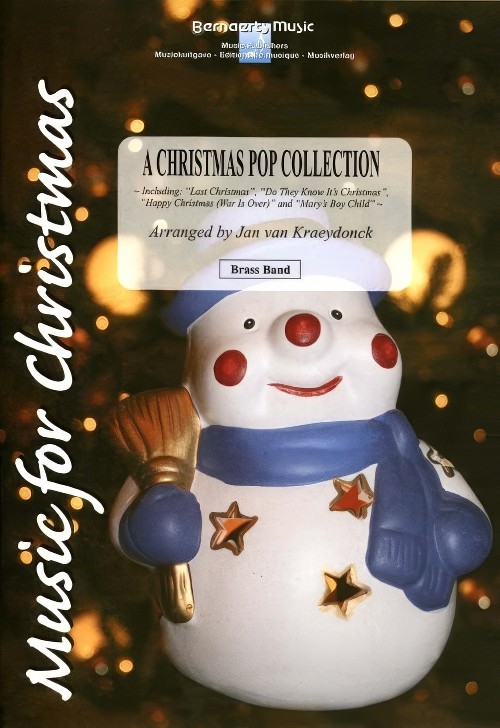
A Christmas Pop Collection (Brass Band - Score and Parts) - Kraeydonck, Jan van
Includes: Last Christmas; Do They Know It's Christmas; Happy Christmas (War Is Over); Mary's Boy Child. Duration: 5.30
Estimated dispatch 7-14 working days
-
 £50.00
Whirlegigg (Brass Band - Score and Parts) - Hesketh, Kenneth
Whirlegigg is the middle English word for a contraption that continuously spins. A great fascination with many inventors of the medieval period was to develop a perpetual motion machine constantly turning and giving off energy. This idea is particularly apt for this piece. A simple ternary structure gives ample opportunity for both boisterous and reflective material with gyrating accompaniment figures never far away. The machine almost stops near the end, but finally musters one last burst of excitement and energy to bring the work to its close. Suitable for 1st Section Bands and above. Duration: 5.00
Estimated dispatch 7-14 working days
-
 £24.95
The Pilgrim's Prayer (Brass Band - Score and Parts) - Rouse, Sydney - Ball, Eric
Introduction - This could hardly be more simple. Inexperienced players may have some little difficulty in intonation, especially as they are starting 'cold', but a useful lesson can be learned in this connection when rehearsing these two bars. Section A - The music is hymn tune-like in character, but it should not become stilted. Close intonation is still a point to study, especially in view of the chromatic nature of some of the harmony. Section B - Aim to secure just balance in the accompanying parts, especially in the second phrase, where the 1st comets may be inclined to treat their moving part as an independent melody rather than part of the 'colour' background. Section C -This is a reprise of the first theme, with a different arrangement. The same comments apply, however. Section D - Here the music becomes more song-like in style, and provides an interesting contrast. The scoring, too, is more varied, and there are a number of points that call for attention. Note that the 1st and 2nd comets and 2nd trombone work as a team throughout; see that the pulsating, syncopated background adds to the movement of the music without giving a jerky effect; the new entries in the fourth and twelfth bars are to be made quite smoothly; and do not allow the texture of the music, especially in the last eight bars of the section, to overshadow the simplicity of the main tune. Section E - Here the first subject appears again. In the arrangement the colour contrasts are quite clear-cut. In order to secure true balance in the fifth and sixth bars, it may be necessary to adjust the amount of tone given by the bass trombone, as this part is not doubled as are the other parts. Section F -This section forms a simple but expressive coda.
Estimated dispatch 7-14 working days
-
£12.50
The Pilgrim's Prayer (Brass Band - Score only) - Rouse, Sydney - Ball, Eric
Introduction - This could hardly be more simple. Inexperienced players may have some little difficulty in intonation, especially as they are starting 'cold', but a useful lesson can be learned in this connection when rehearsing these two bars. Section A - The music is hymn tune-like in character, but it should not become stilted. Close intonation is still a point to study, especially in view of the chromatic nature of some of the harmony. Section B - Aim to secure just balance in the accompanying parts, especially in the second phrase, where the 1st comets may be inclined to treat their moving part as an independent melody rather than part of the 'colour' background. Section C -This is a reprise of the first theme, with a different arrangement. The same comments apply, however. Section D - Here the music becomes more song-like in style, and provides an interesting contrast. The scoring, too, is more varied, and there are a number of points that call for attention. Note that the 1st and 2nd comets and 2nd trombone work as a team throughout; see that the pulsating, syncopated background adds to the movement of the music without giving a jerky effect; the new entries in the fourth and twelfth bars are to be made quite smoothly; and do not allow the texture of the music, especially in the last eight bars of the section, to overshadow the simplicity of the main tune. Section E - Here the first subject appears again. In the arrangement the colour contrasts are quite clear-cut. In order to secure true balance in the fifth and sixth bars, it may be necessary to adjust the amount of tone given by the bass trombone, as this part is not doubled as are the other parts. Section F -This section forms a simple but expressive coda.
Estimated dispatch 7-14 working days
-
£44.95
Themes from The New World Symphony (Brass Band - Score and Parts) - Steadman-Allen, Ray
For three years the Czech composer Dvorak lived and worked in America and this, his ninth and last symphony, contains impressions of that continent. This arrangement for brass band follows the scheme of the original in movement order and theme presentation although a certain amount of 'condensing' of material has naturally been inevitable.
Estimated dispatch 7-14 working days
-
£22.50
Themes from The New World Symphony (Brass Band - Score only) - Steadman-Allen, Ray
For three years the Czech composer Dvorak lived and worked in America and this, his ninth and last symphony, contains impressions of that continent. This arrangement for brass band follows the scheme of the original in movement order and theme presentation although a certain amount of 'condensing' of material has naturally been inevitable.
Estimated dispatch 7-14 working days
-
 £79.99
Sambezi (Trombone Solo with Brass Band - Score and Parts) - Sparke, Philip
Sambezi is the brass band version of the last movement of Philip Sparke's Trombone Concerto. It starts in a joyful and outgoing mood with the soloist playing a carefree samba tune. A jazz-induced central tune explores the higher ranges of the trombone before the samba rhythms set up a 'contest' between the soloist and the band's trombone section. The soloist is the eventual 'winner' and he celebrates by reintroducing the samba melody before bringing the work to a virtuosic close. A real treat for your trombone soloist.Duration: 6:00
Estimated dispatch 7-14 working days
 View Music