
Results
-
 £34.50
The Wanderer - Hymn Tune Arrangement
ABOUT THIS PIECE: Written for the Haydock Band in memory of their late president, Stan Gardner, this is a beautifully simple take on the hymn tune: Stella. The title comes from the words of often sung to this hymn, written by John Lingard: 'Pray for the wanderer, pray for me'. Before the whole hymn is heard, the band play a repeated melody that evokes feelings of movement. There is an interplay between new and old melody, before a rousing rendition of the hymn by forte band. The arrangement concludes with the opening melody disappearing into the distance - a musical representation of the arranger's sentiments written at the top of the score: 'May God bless your onward journey, dear friend'. ENSEMBLE: Standard British Brass Band WHEN YOU BUY THIS PRODUCT, YOU GET: High-quality printed score and parts LEVEL: 1 LISTEN: DURATION: 5-minutesEXAMPLE SCORE: Click here LEVEL GUIDE: Level 1- Accessible to all Level 2 - c. UK third section and higher Level 3 - c. UK second section and higher Level 4 - c. UK first section and higher Level 5 - c. UK championship section level
Estimated dispatch 5-7 working days
-
£51.00
Metropolis
Metropolis was composed for James McLeod, Principal Euphonium of the Leyland Band. Inspired by a tour to Dubai in October 2014, the opening of the piece portrays a journey through the city on the main highway surrounded by the impressive skyline. This then moves into a slower passage reflecting the sun setting as the buildings start to illuminate the night sky. The final section encapsulates the
In Stock: Estimated dispatch 1-3 working days
-
 £25.00
...and the winter moon rises
Description...and the winter moon riseswas inspired by a winter's evening car journey across the Pennines from Manchester to Huddersfield, through the brass band heartland of Saddleworth. There was recent snow on the ground, and the sun had just set. A bright clear moon was rising into a sky coloured with orange from the setting sun, and the moonlight made all the snow and ice sparkle.The work is the fourth movement of a larger 5 movement suite entitled "North!", but can be (and has been) performed in isolation. This work was a finalist in the 2012 Ohio Brass Arts Festival composition competition.Performance NotesThe percussion parts should be playable by three players; the "arco" parts of the vibraphone parts should be played by drawing a cello or double bass bow up the side of the bar. Motors should be left off throughout.Three of the brass players are asked to double on triangles for the first part of the piece; ideally these should be of different sizes giving clearly different sounds. The easiest solution is to tie a triangle to the music stand, rather than try to hold it and then swap instruments later in the piece.Click below to watch a playback preview of the score!
Estimated dispatch 7-14 working days
-
 £19.95
Where is Elvis? for Brass Band - Paul Saggers
Where Is Elvis? takes inspiration from one of the most enduring mysteries in popular culture: the speculation surrounding the death - and possible survival - of Elvis Presley. Written as a theme and variations, the piece begins by presenting an 'Elvis' theme before moving through a series of imagined scenarios, each drawn from well-known conspiracy theories.The journey starts with the story most often told: that Presley died in his bathroom, a reminder of the tension between fame and vulnerability. From there, the music explores the idea of mafia involvement, evoking the shadowy narrativesthat surround celebrity life. The next variation leaps into the fantastical, imagining Elvis abducted by aliens and transported beyond earthly bounds. This is followed by a more domestic theory: Elvis living quietly as a gardener at Graceland, hidden in plain sight. Another variation considers claims that he became a Christian pastor, suggesting a turn toward redemption and spiritual renewal. A reflective section then acknowledges the inevitability of loss while questioning whether cultural memory ever truly fades. The work then revisits the glittering mythology of Las Vegas, acity forever linked to Presley's legend, before moving to the notion of a secret island in the South Pacific - a utopian escape from fame.Finally, the piece closes with the idea that Elvis lives on through the airwaves, his voice continuing to shape the soundscape of popular culture.
-
 £44.95
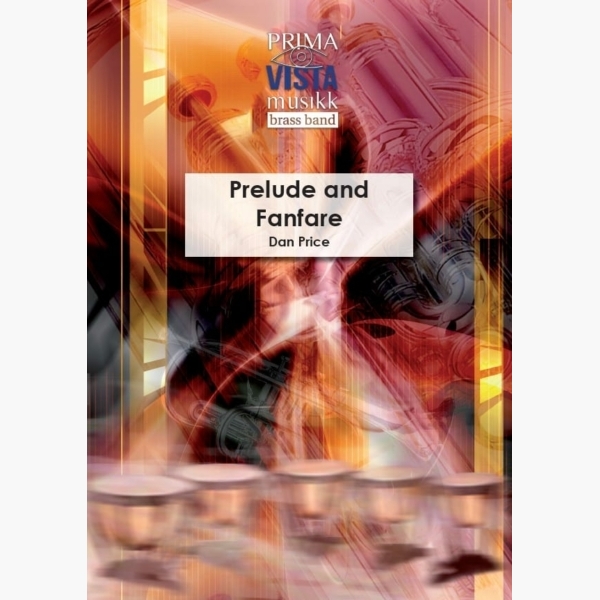
Prelude and Fanfare - Dan Price
Prelude and Fanfare takes its inspiration from a piece of NASA Video footage, where a camera is attached to a piece of debris and jettisoned into space from the space shuttle. The work is a musical reflection of this journey,...
Estimated dispatch 5-7 working days
-
 £48.00
Concerto for Euphonium - Kenneth Downie
An accessible and enjoyable showpiece for soloists of all ages. The concerto's three movements are in a tuneful, melodic style and bravura passages are mixed with others designed to exploit the singing qualities of the instrument. The first movement is a vigorous allegro in which the short, pithy motifs of the opening theme contrast with the broad sweep of the second subject. A short cadenza-like passage yields to a high-spirited episode before a reprise of the opening ends the movement quietly. The second movement opens with a warm, romantic melody which is soon taken up by the soloist. A short animated section gives way to the earlier tutti theme, this time with passionate decoration from the soloist before the music gently unwinds in a tranquil coda. The finale has a bouncy, festive feel. After the first subject runs its course there is a brief journey through a more contrapuntal style, before a spirited presto moves into a compound episode before returning to the opening idea. A jubilant coda brings the work to a conclusion.
Estimated dispatch 7-9 working days
-
 £60.00
Concerto for Euphonium (Parts only) - Kenneth Downie
An accessible and enjoyable showpiece for soloists of all ages. The concerto's three movements are in a tuneful, melodic style and bravura passages are mixed with others designed to exploit the singing qualities of the instrument. The first movement is a vigorous allegro in which the short, pithy motifs of the opening theme contrast with the broad sweep of the second subject. A short cadenza-like passage yields to a high-spirited episode before a reprise of the opening ends the movement quietly. The second movement opens with a warm, romantic melody which is soon taken up by the soloist. A short animated section gives way to the earlier tutti theme, this time with passionate decoration from the soloist before the music gently unwinds in a tranquil coda. The finale has a bouncy, festive feel. After the first subject runs its course there is a brief journey through a more contrapuntal style, before a spirited presto moves into a compound episode before returning to the opening idea. A jubilant coda brings the work to a conclusion.
Estimated dispatch 7-9 working days
-
 £62.00
Montage (Score only) - Peter Graham
Each of the movements of the symphony take as their starting point forms originating in music of the 16th and 17th centuries. The first, an intrada, introduces the main thematic material (based on the interval of a minor third) in its embryonic state. As the piece progresses, this material is developed and manipulated in a variety of ways. The interval of the third remains central to the overall scheme of the work, even unifying the three movements on a tonal plane (I: F (minor); II: A flat (major); III: C flat (minor). The internal structure of the intrada is an arch form: ABCBA, roughly modelled on the first movement of Concerto for Orchestra by Witold Lutoslawski, to whose memory the movement is dedicated. A chaconne follows - the basic material now transformed into expansive solo lines underpinned by a recurring sequence of five chords (again, a third apart). The movement's structure combines both ternary form and golden section principles and the chaconne's continuous cycle of chords may be visualised as circles. The final movement, a rondo, bears the dramatic weight of the entire work, as the underlying tonal tensions surface. A musical journey ensues, making diversions through lyrical territories as well as through more spiky, jazz-flavoured ones. The aural (and visual) montage is perhaps most apparent towards the climax of the piece, where three keys and polyrhythms sound simultaneously in the upper brass, xylophone, horns, and timpani. The climax itself combines the lyrical music heard earlier with the rondo theme, now presented by cornets and trombones in canon. The teleological thrust of the movement (if not the entire work) can be symbolized by the flight of an arrow, as it steers a predetermined course towards its target. Duration: 16:00
Estimated dispatch 7-9 working days
-
 £74.00
Montage (Parts only) - Peter Graham
Each of the movements of the symphony take as their starting point forms originating in music of the 16th and 17th centuries. The first, an intrada, introduces the main thematic material (based on the interval of a minor third) in its embryonic state. As the piece progresses, this material is developed and manipulated in a variety of ways. The interval of the third remains central to the overall scheme of the work, even unifying the three movements on a tonal plane (I: F (minor); II: A flat (major); III: C flat (minor). The internal structure of the intrada is an arch form: ABCBA, roughly modelled on the first movement of Concerto for Orchestra by Witold Lutoslawski, to whose memory the movement is dedicated. A chaconne follows - the basic material now transformed into expansive solo lines underpinned by a recurring sequence of five chords (again, a third apart). The movement's structure combines both ternary form and golden section principles and the chaconne's continuous cycle of chords may be visualised as circles. The final movement, a rondo, bears the dramatic weight of the entire work, as the underlying tonal tensions surface. A musical journey ensues, making diversions through lyrical territories as well as through more spiky, jazz-flavoured ones. The aural (and visual) montage is perhaps most apparent towards the climax of the piece, where three keys and polyrhythms sound simultaneously in the upper brass, xylophone, horns, and timpani. The climax itself combines the lyrical music heard earlier with the rondo theme, now presented by cornets and trombones in canon. The teleological thrust of the movement (if not the entire work) can be symbolized by the flight of an arrow, as it steers a predetermined course towards its target. Duration: 16:00
Estimated dispatch 7-9 working days
-
 £159.99
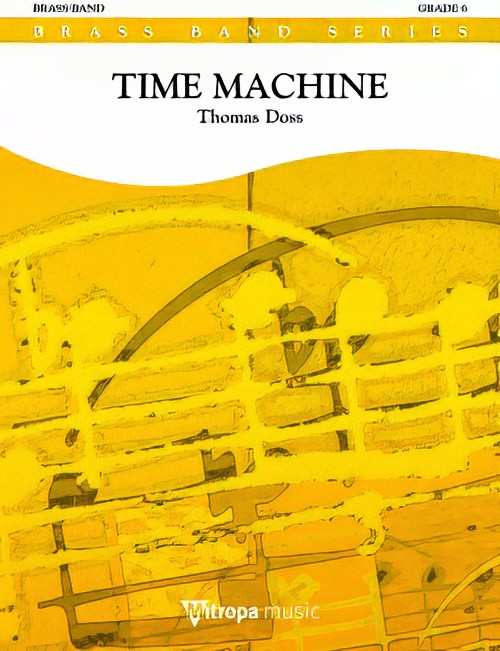
Time Machine (Brass Band - Score and Parts) - Doss, Thomas
Time Machine is a journey through time that begins in the Stone Age. Evolution and the coming of man take place. The journey takes us into the present, in which disorientation and chaos abound. We travel further into the future. An unfamiliar, quiet and surreal landscape lies before us and we wander through it, bewildered as we become aware of the destruction of the environment. Suddenly, and for no reason, memories from our childhood are awoken. Cultures have become completely mixed into one and the evolution of man has run its course. We realise that there is no "afterwards" as before us lies the Stone Age once again... The wheel of time spins blindly on and all is repeated.Duration: 13:30
Estimated dispatch 7-14 working days
 Watch video
 View Music