
Results
-
 £50.00
Dutch Treat - Pi Scheffer/W. Bosman
Paul Yoder is one of the big names in the history of American wind band music. He was a pioneer in teaching the developing youth bands in the USA and by spreading the modern wind band music repertoire throughout Japan. He wrote over 200 works for symphonic band. 'Dutch Treat' was composed in the early seventies and immediately published in 1971 by Molenaar, a personal friend of Paul Yoder. It is an original arrangement of a traditional tune.
Estimated dispatch 10-14 working days
-
 £42.00
Dutch Treat - Paul Yoder/Wim Bouman
Paul Yoder is one of the big names in the history of American wind band music. He was a pioneer in teaching the developing youth bands in the USA and by spreading the modern wind band music repertoire throughout Japan. He wrote over 200 works for symphonic band. 'Dutch Treat' was composed in the early seventies and immediately published in 1971 by Molenaar, a personal friend of Paul Yoder. It is an original arrangement of a traditional tune.
Estimated dispatch 10-14 working days
-
£67.00
Hard to Say I'm Sorry - Peter Cetera & David Forster - Jan Utbult
"Hard to Say I'm Sorry" is one of the greatest hits by US rock band Chicago. It was the first single record from the "Chicago 16"-album (1982). The song went to no. 1 on the Billboard charts and stayed there for two weeks.Produced by David Foster, the song was given a typical early 80's sound with synthesizers and heavy guitars dominating the sound. The album-version of the song included a part two of the song; "Get Away", a up-tempo song featuring the famous horn-section of the band.
Estimated dispatch 7-14 working days
-
 £30.00
Alloy - Chris Wilcox
Alloy was originally commissioned in 2009 by Redbridge Music Service as a performance goal for beginner brass instrumentalists who had received free tuition in schools across the borough. The aim of the piece was to provide an inspirational opportunity for beginner players to perform alongside intermediate and advanced level instrumentalists. Alloy is an 8-minute work for metallic instruments, which is reflected in its title. It is a fusion piece with elements from traditional Indian Raga, Drum & Bass grooves, Jazz, Rock and African rhythms alongside the more 'classical' melodic brass styles. What culminates is a vibrant and exciting contemporary work.
-
 £30.00
Hard Hats and Cornets - Terry Johns
This lively and melodic piece was commissioned by Maltby Colliery Band in 2000. It was written as a feature for solo cornet and the cornet section. For its first broadcast performance on Radio Scotland, from Edinburgh in 2009 Mark O'Keefe played the solo part with the band of COOP Glasgow. This piece makes an impressive encore or opening to a band concert and is also available in a version for ten brass.
-
 £30.00
Wired - Lucy Pankhurst
A fantastically funky piece! So good it was featured on BBC television during the 2010 general election campaign coverage for the North West and at the 2014 International Women's Brass Conference.Originally written in 2009 for Jason Katsikaris and the Leyland Band, Lucy Pankhurst has created a vivacious, energetic work which is strong on percussion and style!It's fast-moving, completely engaging and makes for compulsive toe-tapping and the need to 'get into the groove'! Huge opportunities for the kit player/percussion section to show their wild side and, so as not to be outdone, plenty of other moments for improvisation-esque solos from other quarters.If you can keep up, this is a really great contribution to your concert programme.Look and Listen (performance courtesy of Oslofjord Brass from their appearance at the 2010 Grenland International Brass Festival 2010):
In Stock: Estimated dispatch 3-5 working days
-
Introduction & Allegro Spiritoso - Jean Baptiste Senaille - Len Jenkins
Introduction and Allegro Spiritoso appears in many forms within the music compendium, frequently as a piece demonstrating a solo string, woodwind or brass instrument with Piano or other accompaniment. It was originally composed by the baroque composer Jean Baptiste Senaille, and includes the fast 2/4 movement from one of his 50 or so violin sonatas. It is probably one of his most recognised pieces. This arrangement for a brass quintet with optional Glockenspiel is presented in two formats. One is for Brass Band instruments, the other for Orchestral Brass, both with appropriate Parts to match that genre.
-
 £40.00
Battle of Britain Suite (Score only) - William Walton
It takes a special ability to compose film scores which serve the images perfectly yet translate into first class concert music. William Walton was such a talent as the continuing popularity of his brilliantly evocative film music shows. This suite includes the famous Dog Fight and majestic March - used for the end titles of the film - along with the Siegfried Music which parodies Wagner's horn call. You can practically feel the buzzing of Spitfires in the air! Winwood Music are delighted to make this music available to the brass band world in a fabulous arrangement by Edward Watson which captures the essence of the original while translating it seamlessly to the new idiom. Duration: 12:15
Estimated dispatch 7-9 working days
-
 £50.00
Battle of Britain Suite (Parts only) - William Walton
It takes a special ability to compose film scores which serve the images perfectly yet translate into first class concert music. William Walton was such a talent as the continuing popularity of his brilliantly evocative film music shows. This suite includes the famous Dog Fight and majestic March - used for the end titles of the film - along with the Siegfried Music which parodies Wagner's horn call. You can practically feel the buzzing of Spitfires in the air! Winwood Music are delighted to make this music available to the brass band world in a fabulous arrangement by Edward Watson which captures the essence of the original while translating it seamlessly to the new idiom. Duration: 12:15
Estimated dispatch 7-9 working days
-
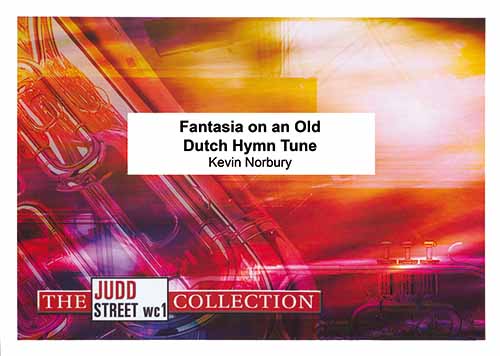 £59.95
Fantasia on an Old Dutch Hymn Tune (Brass Band - Score and Parts)
Kevin Norbury writes:This tune has always been a favourite of mine. It was first published in Holland in 1624 and then appeared in a later collection called David's Psalmen in 1685. In many hymnals it is still known by its original name, Vruechten. In the vast majority of cases, the melody is associated with the lyrics by George Ratcliffe Woodward, an ordained minister of the Church of England, who lived from 1848 to 1934.At no time in this piece do I envisage any heaviness of style. Even in slow movement, whilst predominantly homophonic, the music should flow and be transparent. The music seeks to capture the essence of joy in both the melody and words (S.A.S.B. 234).
Estimated dispatch 7-14 working days