
Results
-
 £59.95
Judd: Celestial Prospect
Selected as 2nd Section test piece for 2003 'Regionals'Wilfred Heaton originally composed Celestial Prospect in the 1940's but, so the story goes, it was rejected by the SA Editorial 'chiefs' as being too modern. The original manuscript was lost for many years, turning up in the 1980's in New York. Heaton re-worked it for the New York Staff Band, and it is now accepted as a classic of the SA 'Festival' genre. Degree of difficulty - 8
Estimated dispatch 7-14 working days
-
 £29.95
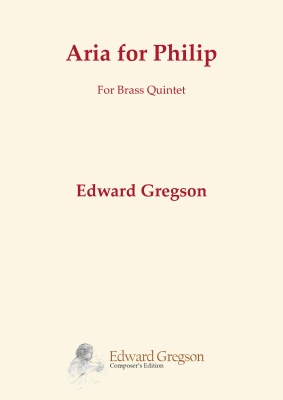
Aria for Philip (Brass Quintet - Score and Parts)
Instrumentation:2 Trumpets in CHorn in FTromboneTubaWritten in memory of Philip Jones, this short work was first performed at his memorial concert held at the Royal Northern College of Music in 2000. Scored for Brass Quintet, it was performed by former members of the Philip Jones Brass Ensemble.My friendship with Philip Jones stretched back to my student days, when my Quintet for Brass was performed during my final year at the Royal Academy of Music. Philip was present at that premiere in 1967, and soon after that his ensemble performed and broadcast the Quintet on a UK Tour, including a performance in the finals of the BBC Young Composer's Competition. I owe him a huge debt of gratitude for promoting a work by a then unknown young composer.I use a brief quote from the opening of my 1967 Brass Quintet in this work, which is generally rather sombre in character, except for the sudden change of mood and tempo in the short final section, when the clouds suddenly lift and the sun shines through.- Edward GregsonDuration: 5.00
Estimated dispatch 7-14 working days
-
 £89.95
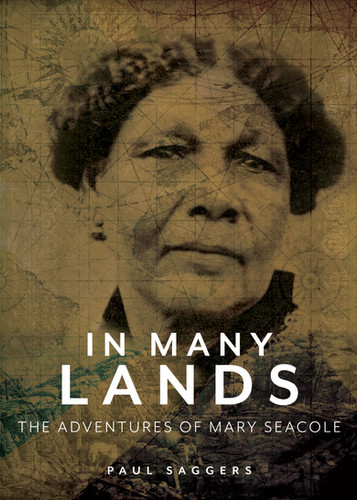
In Many Lands - The Adventures of Mary Seacole - Paul Saggers
In Many Lands - The Adventures of Mary Seacole was commissioned by The Royal Marines Band Service for The National Youth Brass Band of Great Britain. The first performance of the piece was on 16 April 2022 in Huddersfield Town Hall to celebrate the 70th anniversary of the NYBBGB. It was next performed in Birmingham Town Hall (on 28 April 2022) at a joint charity concert of the NYBBGB and The Band of Her Majestyas Royal Marines, Collingwood, for the European Brass Band Association Prelude Concert. The work is a musical account of the life of Mary Seacole who was a British-Jamaican nurse and businesswoman who set up the "British Hotel" behind the lines during the Crimean War. The work takes inspiration from Seacoleas biography Wonderful Adventures of Mrs. Seacole in Many Lands. The work is divided into three movements:
-
 £33.62
Coronation March from 'Le Prophete' (Brass Band) Meyerbeer arr. Rob Bushnell
The Coronation March by the German composer Giacomo Meyerbeer comes from Act 4, Scene 2 of his grand opera, Le Prophete (The Prophet). Set in the 16th century, it is based on the life of John of Leiden, Anabaptist leader and "King of Munster", with the libretto influenced by the works of Voltaire. The 5-act opera deals with love, revenge and tragedy. It was premiered by the Paris Opera at the Salle Le Peletier on 16 April 1849, with audience members including Chopin, Verdi, Delacroix, Charles Dickens and Berlioz.During his life, Meyerbeer was a dominant figure in the world of opera, with Hector Berlioz saying of him 'he has not only the luck to be talented, but the talent to be lucky.' To view a rolling score video of the work please visit www.youtube.com/watch?v=_M4DtUdQzhA Duration: Approx. 3.40 minutes Difficulty Level: 3rd Section + PDF download includes parts and score. Also includes alternative parts for horns in F and lower brass in bass clef. Sheet music available from www.brassband.co.uk Instrumentation: Soprano Cornet Eb Solo Cornet Bb Repiano Cornet Bb 2nd Cornet Bb 3rd Cornet Bb Flugel Horn Bb Solo Horn Eb 1st Horn Eb 2nd Horn Eb 1st Baritone Bb 2nd Baritone Bb 1st Trombone Bb 2nd Trombone Bb Bass Trombone Euphonium Bb Bass Eb Bass BbTimpani Percussion
In Stock: Estimated dispatch 1-3 working days
-
 £33.62
Finale - Suite No.3 (Brass Band) Tchaikovsky arr. Ruben Schmidt
This arrangement by Ruben Schmidt is the exciting polonaise finale from the last movement of Tchaikovsky's thrilling Suite No.3 in G Major for Orchestra. This was first performed in Saint Petersburg on January 12th, 1885, at the fifth symphony concert of the Russian Musical Society, conducted by Hans von Bulow. The suite also was Tchaikovsky's first American success when it was performed by the New York Symphony Society at Carnegie Hall on May 7,1891. First intended as its own symphony, it became the most played and most successful of Tchaikovsky's four suites. The finale of the last movement is an invigorating polonaise dance to finish the suite. Tchaikovsky often enjoyed conducting this final movement as an independent work himself. To view a rolling score video of the work please visit www.youtube.com/watch?v=M-Ht80Lnk-c Duration: 4.00 minutes Difficulty Level: 1st Section + PDF download includes parts and score. Sheet music available here. Instrumentation: Soprano Cornet Eb Solo Cornet Bb Repiano Cornet Bb 2nd Cornet Bb 3rd Cornet Bb Flugel Horn Bb Solo Horn Eb 1st Horn Eb 2nd Horn Eb 1st Baritone Bb 2nd Baritone Bb 1st Trombone Bb 2nd Trombone Bb Bass Trombone Euphonium Bb Bass Eb Bass BbTimpani Percussion (Tambourine, Suspended Cymbal & Bass Drum)
In Stock: Estimated dispatch 1-3 working days
-
 £34.95
Elixir of Youth - Christopher Bond
Elixir of Youth (2013) was written for the 2013 Brass for Heroes charity event where it was premiered on 19th October 2013 at St Paul's Hall in Huddersfield under the baton of Philip Harper. The title of the work reflects the nature of the band that was put together for that premiere performance; an all-star youth band comprising a selection of the country's young brass banding talent, with the term Elixir referring here to the everlasting talent seen in young brass players throughout the United Kingdom's brass bands and bands' and teachers abilities to keep producing such high quality musicians for the banding movement.The work, structured in three sections, is a showcase for band with a heroic opening where fanfare-like gestures in the cornets and trombones juxtapose rapid euphonium and baritone runs, alongside sweeping horns and percussion effects. As the piece progresses, a grove is introduced - just in the tubas at first, accompanied by a hi-hat - before spreading through the band, definitely stuff to tap your toes to! The middle, slower section of the work sees both flugel and cornet solos, with additional inputs from the euphonium and solo horn before a climax and return to the tempo and music of the opening section. A rousing close concludes the work where all of the work's themes are interweaved to create a sense of power, unity and grandeur; an Elixir of Youth.
Estimated dispatch 10-14 working days
-
 £51.00
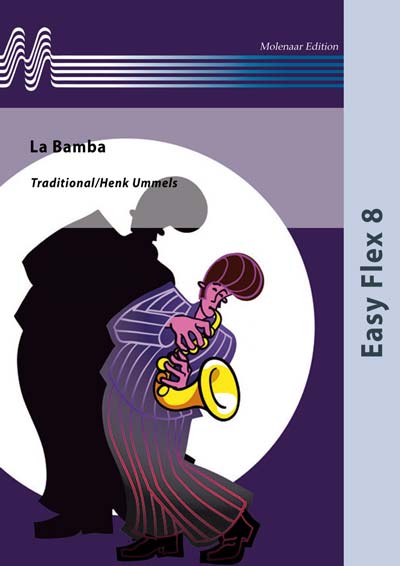
La Bamba - Traditional/Henk Ummels
This single from Ritchie Valens from 1958 is originally a Spanish song from Mexican folklore. Years later it was picked by Rolling Stone magazine as the only non-English song in their 500 Greatest Songs of All Time list at number 345. In 1987 it was covered by the American band Los Lobos, for the film La Bamba, about the life of Ritchie Valens. This arrangement has been made for flexible setting, and is suitable for a developed student band.
Estimated dispatch 10-14 working days
-
£35.00
Alu - Peter Meechan
Alu was commissioned by Pat Herak for his wife Diana, for their 10th wedding anniversary. It was premiered by Diana and the Brass Band of Columbus, USA.It is a simple, reflective piece, which grows from a small idea first heard in the baritone and changes throughout, although the opening material is never far away.The solo part is equally suitable for baritone or euphonium.
Estimated dispatch 12-14 working days
-
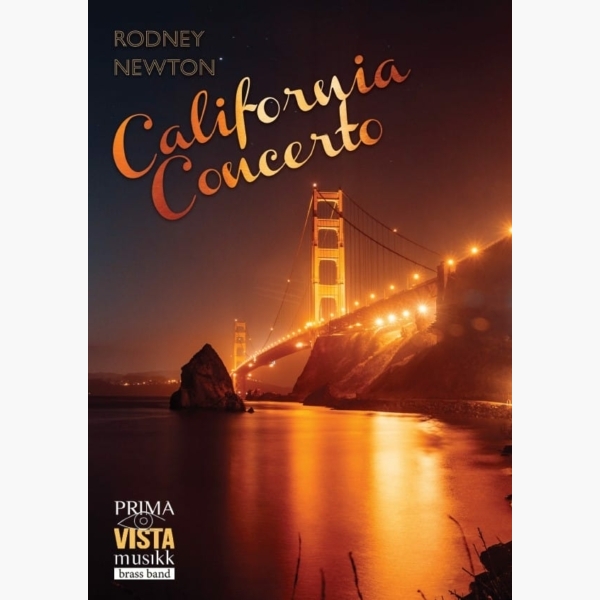 £64.95
California Concerto - Rodney Newton
This work was written in 2007 for Linda Taylor and the Golden State British Brass Band of California, USA. It was first performed by them under the composer's direction at a concert in Fullerton in 2012. It is a concerto...
Estimated dispatch 5-7 working days
-
£29.95
ARMY OF GOD (Brass Band Set) - Emil Soderstrom
This march was awarded first prize in the 1930 American Golden Jubilee National Music Competition and was published the same year in the first edition of the American Festival Series. It was subsequently re-printed in the General Series of 1984. Soderstrom's imaginative use of syncopation and chromatic harmony brought a new, American sound to the Salvation Army march. For example, he took the old Salvation Army fight song Hark, hark my soul written and changes its metre from 6/8 to 4/4 while also syncopating it!
Estimated dispatch 7-14 working days
 View Music