
Results
-
 £79.95
Neverland - Christopher Bond
"All children, except one, grow up" wrote J.M. Barrie about Peter Pan in 1911; the first line and an expression of beautiful melancholy and fantasy, coming to represent one of the best-loved children's stories of the twentieth century. 'Peter & Wendy', as the book was first released, has subsequently been transformed into adaptations for film and stage, with subsequent books based on this iconic tale. In writing this new work for brass band, the composer has taken three of the main themes from J. M. Barrie's book, and used these themes to create new musical material, forming a work in three contrasting sections. I. Journey to Neverland The opening of the work, mysterious in its style, reflects the opening chapters of the story - a leafy London street, still in the dead of night - with the music transforming quickly as it builds in texture and momentum - a Journey to Neverland through the night sky; Second Star to the Right and straight on 'til morning. "Then Peter knew that there was not a moment to lose. 'Come,' he cried imperiously, and soared out at once into the night, followed by John and Michael and Wendy. Mr & Mrs Darling and Nana rushed into the nursery too late. The birds were flown." II. The Windows that Closed The central section of the work takes its inspiration from the sense of longing throughout the book, mainly by Peter Pan, the Darling Children & The Lost Boys. Distant memories of life before Neverland, memories of the Lost Boys' mothers, and regret at what the children have missed. Peter says "Long ago, I thought like you that my mother would always keep the window open for me; so I stayed away for moons and moons and moons, and then flew back; but the window was barred, for mother had forgotten all about me, and there was another little boy sleeping in my bed." III. Aboard the Pirate Ship The final section of the work takes its inspiration from the Pirate Ship, and Peter Pan's ultimate battle with its infamous Captain Hook. "In person, he was cadaverous and blackavized, and his hair was dressed in long curls, which at a distance looked like black candles, and gave a singularly threatening expression to his handsome countenance. His eyes were the blue of the forget-me-not, and of a profound melancholy, save when he was plunging his hook into you, at which time two red spots appeared in them and lit them up horribly."
Estimated dispatch 10-14 working days
-
 £34.95
Fire & the Phoenix, The - Christopher Bond
The Fire & the Phoenix (2015) was commissioned by Brett Baker in early 2015 as the opening track to his solo CD 'Myths & Legends'. Whilst structurally a single-movement work, it is presented so that it can link directly into the next work on the CD, adding to a continuous theme comprising a number of pieces from a number of composers. Opening with huge strident chords in the full band, the representation of the phoenix is instantly reflected; bold, powerful and a bird of great intensity. This makes way for a more mystical section marked 'distant' which reflect the beauty of the Phoenix and it's mythical nature where the trombone soars up into its higher register with a sweeping melody. Soon after, the music takes a sharp turn, becoming dramatic and instantly moving away from the mystical mood created previously. Here, we imagine the Phoenix catching fire, burning intensely with huge flames as it gradually turns into ash. We reach a tonic pedal point in the music, over which chord progressions subtly weave in and out of the texture. Here, we imagine the Phoenix rising from the ashes, with the dynamics gradually increasing to reflect this, slowly taking shape as it is born again. A return to earlier material follows, this time manipulated to reflect the Phoenix in its new form - the same bird; the same animal; but at the same time different. A beautiful chorale-like passage is heard before the music transports us back into a magical land, where delicate rhythmic ideas are juxtaposed against bolder lower chords; both ideas together transporting the listener forward into the next piece.
Estimated dispatch 10-14 working days
-
 £34.95
The Fire and the Phoenix (Trombone Solo)
Trombone Solo with Brass BandThe Fire & the Phoenix (2015) was commissioned by Brett Baker in early 2015 as the opening track to his solo CD 'Myths & Legends'. Whilst structurally a single-movement work, it is presented so that it can link directly into the next work on the CD, adding to a continuous theme comprising a number of pieces from a number of composers.Opening with huge strident chords in the full band, the representation of the phoenix is instantly reflected; bold, powerful and a bird of great intensity. This makes way for a more mystical section marked 'distant' which reflect the beauty of the Phoenix and it's mythical nature where the trombone soars up into its higher register with a sweeping melody.Soon after, the music takes a sharp turn, becoming dramatic and instantly moving away from the mystical mood created previously. Here, we imagine the Phoenix catching fire, burning intensely with huge flames as it gradually turns into ash. We reach a tonic pedal point in the music, over which chord progressions subtly weave in and out of the texture. Here, we imagine the Phoenix rising from the ashes, with the dynamics gradually increasing to reflect this, slowly taking shape as it is born again.A return to earlier material follows, this time manipulated to reflect the Phoenix in its new form - the same bird; the same animal; but at the same time different. A beautiful chorale-like passage is heard before the music transports us back into a magical land, where delicate rhythmic ideas are juxtaposed against bolder lower chords; both ideas together transporting the listener forward into the next piece.
Estimated dispatch 7-14 working days
-
 £49.95
Bestowal of a Century - Christopher Bond
Bestowal of a Century (2014) was commissioned by Lowenna Taylor, and funded through her Harry Mortimer Trust award which she was presented with at the 2013 British Open Championship following the completion of her studies at the Royal Welsh College of Music in Cardiff. The 15-minute work received its world premiere at the Cornwall Youth Brass Band Christmas concert in 2014 with solosit, Lowenna, working alongside the band under the baton of Les Neish. The 'Bestowal' refers to the presentation of the Royal Trophy by the then Prince of Wales to the famous West of England Bandsman's Festival in Bugle in 1913. Over the years it has been won by some of the greatest names in brass banding, including Black Dyke and Munn & Feltons - although more recently it has become a wonderful open festival that includes sections for local bands as well as visitors from all over the banding globe. 2014 marked the one-hundredth anniversary of the presentation of the trophy, which is the only brass band trophy to have the official seal of royal patronage. The work, in three distinct sections, opens in a mysterious way, building progressively with interjections from the horn. The composer notes its as though one can imagine different part of the trophy being put together, piece by piece, until the trophy is complete and a climax is reached. Following this, a playful theme is presented which is developed throughout the first section and interacting between soloist and band. The second movement, in complete contrast, is a lyrical melody; heart-wrenching throughout, and sits well both as part of the concerto and also as a stand-alone solo item. The third movement is light-hearted and virtuosic, demonstrating the technical capabilities of the instrument with fast and virtuosic playing, and a cadenza towards the end of the work.
Estimated dispatch 10-14 working days
-
 £25.00
Zephyrus. March for Brass Band
Recommended - Suitable for all bands The Big Blow, was a formal record attempt to create the largest brass band in the world. It took place at Butlin's Resort, Skegness on 20 January 2007, and it's main goal was to raise money in support of the work of Brass Band Aid, and specifically to provide long-term sponsorship for two children in the village of Adet in Ethiopia. The Music Company (UK) Ltd were one of the Official Partners of The Big Blow, providing the performance piece for the record attempt. Andrew Duncan wrote 'Zephyrus' to mark the occasion. The title takes its name from the Greek God of the West Winds - Zephyrus. Zephyrus is a traditional British brass band march with an interesting African-feel lilt to the trio. This is enhanced by optional percussion instruments including djembi and bongos, which can alternatively be covered by standard drum kit. The Music Company are pleased to continue their support of Brass Band Aid by offering a donation to this worthy charity for every set of this music sold. Includes score & parts
-
 £19.95
Over Ambion Hill - Jonathan Bates
'Over Ambion Hill' is a cornet solo with piano accompaniment composed for the Principal Cornet of the Raty Band, Keir-Luc Evans-Brown. Ratby - as a village -is situated within the Bosworth & Hinckley district of Leicestershire, the former of which notorious for it's setting of the 'Battle of Bosworth Field'in 1485 - the final significant battle of the War of the Roses between the houses of Lancaster and York. The battlefield itself was for many years ajudged to be on the site of Ambion Hill where the current Battle of Bosworth visitor centre is situated, but this was later reassessed as being situated a couple of miles South West of Ambion Hill. The battle is synonymous with the death of Richard III, who's cortege passed Ambion Hill on it's way to Leicester Cathedral upon the rediscovery of his remains in 2015.
In Stock: Estimated dispatch 1-3 working days
-
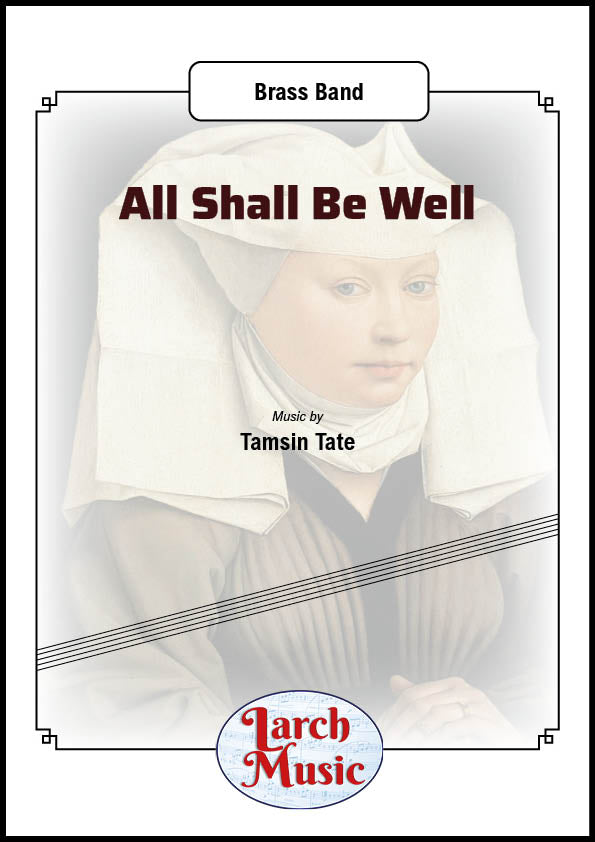 £30.00
All Shall Be Well - Brass Band Sheet Music Full Score & Parts - LM931
COMPOSER: Tamsin TateCOMPOSERS NOTE"All shall be well" was composed during the first lockdown of the Covid crisis, from May 2020.This was a worrying time for many and a time of great anxiety and sadness for some.I have always tried to be practically optimistic in trying times, but still I needed hope.I am lucky to have a faith in God which gives me hope and assurance that things will be better,and I also know that music, particularly playing it, can help express some of these emotions.Certainly, music through the crisis was a wonderful, enjoyable escape for meand one I shared with my family and my band family through our online recordings.Julian of Norwich was an anchoress in the 14th Century.She set herself apart for God and spent a lot of time in prayer.Interestingly, she was the first published woman in the English language.Julian of Norwich is quoted as saying "all shall be well, all shall be well,and all manner of thing shall be well." The paraphrase of this spurred me on to develop this piece for brass band.Hopefully you will also find that the music portrays the worries and trials of this uniquetime through the natural minor key, with the rhythm hinting towards the phrase"All shall be well" and then the dawning transition to the major keyfollowed by a triumphant ending with the whole band joining together.Thanks to Adam Cable and the Martlesham Brass family for support and encouragement always.Thanks also to Alan Fernie and his supportive critique of my initial efforts.LM931 - ISMN : 9790570009312
In Stock: Estimated dispatch 3-5 working days
-
 £35.00
strange geometry
Descriptionstrange geometrywas commissioned by Morgan Griffiths and the Hammonds Saltaire Band for their performance at the Brass in Concert Championships of 2015.As a bit of a space/sci-fi geek, as well as a musician, two events during the summer of 2015 had a particular effect on me. The first was the tragic early death in a plane crash of the famous film composer James Horner. Horner's music, particularly in films like 'Star Trek II: The Wrath of Khan', 'Avatar', 'Apollo 13' and even his debut in Roger Corman's 1980 budget film 'Battle Beyond the Stars', defined for a generation the sound of sci-fi at the cinema. Along with John Williams he created the vocabulary for those who wish to express other-worldly wonder in music and his inventive talent will be much missed in an industry where originality has become something of a dirty word in recent years.The second event was the epic flyby of Pluto by the NASA New Horizons spacecraft. There are many reasons to find this mission inspiring - for example, the scientists and engineers behind it created a craft that has travelled at 37,000 mph for nine years and three billion miles to arrive within seventy-two seconds of the predicted time for the flyby. That they achieved this with such accuracy is an outstanding tribute to humanity's ingenuity and insatiable curiosity. However, the most exciting aspect of the mission was the clear, high resolution pictures of this unthinkably remote and inhospitable world beamed back to mission control. The best previous image of Pluto was an indistinct fuzzy blob - suddenly we could see mountains made of ice, glaciers of methane and carbon monoxide and nitrogen fog - features previously unimagined on a world thought to be a slightly dull ball of cold rock. The BBC's venerable astronomy programme 'The Sky at Night' waxed lyrical about these newly discovered features, referring to "the surprising discoveries of mountains and strange geometry on the surface of this cold distant world".I like to think that Horner would have been as inspired as I have been by this real-life science story, and this piece uses some of the vocabulary of the sci-fi movie soundtrack in a tribute to the memory of a great musician and to the inspirational geeks at NASA who have boldly taken us where no-one has gone before.Note: This work comes with a B4 portrait score. Listen to a preview and follow the music below!
Estimated dispatch 7-14 working days
-
 £25.00
Ring'd with the Azure World
DescriptionRing'd with the Azure World was commissioned by the Harmonia Brass quintet for their final recital at the University of Huddersfield in 2016.He clasps the crag with crooked hands; Close to the sun in lonely lands, Ring'd with the azure world, he stands.The wrinkled sea beneath him crawls; He watches from his mountain walls, And like a thunderbolt he falls.- The Eagle by Alfred, Lord TennysonThe music was inspired by Tennyson's poem reproduced above; it seeks simply to reflect the spirit of the poem. It opens in sparse, lonely mood as the eagle surveys the world beneath. The work quickens in three bursts using metrical modulation to disguise the actual moment of acceleration, reflecting the lazy energy stored in the circling raptor before concluding dramatically in a fall 'like a thunderbolt'. Tennyson's poem, although brief, has inspired much analysis and writing, and is notable for being written in the (then somewhat unfashionable) iambic tetrameter, indicating a foursquare emphasis reflected in the main theme of the music. This is heard first in an octatonic version and later in a purely tonal (if somewhat modal) version. The instrumentation reflects that of Harmonia Brass, a quintet composed of brass band instruments (two B flat cornets, an E flat tenor horn, tenor trombone and E flat tuba). However the music is also available for the more conventional brass quintet of two trumpets, french horn, trombone and tuba.To listen to an audio export preview and follow the music, click play on the video below!Performance Notes1st cornet/trumpet requires a cup mute, ideally with an adjustable cup (the marking "tight" denotes that the cup should be adjusted closer to the bell), and a harmon mute with the tube removed (denoted by "TR" in the score). 2nd cornet/trumpet requires a fibre straight mute and a harmon mute with the tube removed. Tenor horn require a fibre straight mute and a practice mute (any sort) - in the orchestral brass version the french horn requires a stop mute. Trombone requires a cup mute (only). Tuba requires a fibre straight mute and a practice mute (of any sort).Metronome marks should be closely observed - starting either too fast or too slow will have a disproportionate effect on the tempi later in the piece due to the metrically controlled tempo changes.
Estimated dispatch 7-14 working days
-
£73.00
Root Beer Rag - Billy Joel - Svein H. Giske
Root Beer Rag was written for the 1974 album release Streetlife Serenade by American pianist/vocalist/composer Billy Joel.After the success his own recording, several other pianists have performed it both on record and stage. There's also many arrangements of the song made, some of them featuring soloist(s).This arrangement for Brass Band by Svein H. Giske was written to Askoy Brass Band for their participation in the entertainment-competition Siddis Brass in 2016. It's very virtuosic and challenge almost all sections of the band.
Estimated dispatch 7-14 working days
