
Results
-
 £104.99
Scottish Dances - Peter Martin - Menno Haantjes
Scottish Dances is based on three Scottish traditionals: Cock of the North, The Bonnie Bank's O'Loch Lomond and Marie's Wedding. I. Cock of the North's name is used for multiple things or events. For example for a locomotive to a famous, it seems, delicious liqueur, and rallies to snowboard competitions. Furthermore is "Cock O' the North " a nickname of a famous Duke. (The 4th Duke of Gordon). In this composition Cock of the North (a Jig) is a traditional Scottish bagpipe tune, regularly played on tattoos by Pipe Bands. Not infrequently the drummers sing the text. Auntie Mary, had a canary, Up the leg of her trousers While she was sleeping Iwas peeping Up the leg of her trousers. II. " The Bonnie Bank's O'Loch Lomond " is about a sad story that took place during an revolt against the British. In 1745 Bonnie Prince Charlie had to retreat. Two of his men were captured. One was convicted and executed, while the other was released. The spirit of the executed soldier would arrive in Scotland via the 'low road' (underworld) before his companion, who had still a long way to go. You'll take the high road And I'll take the low road And I'll be in Scotland afore ye But me and my true love will never meet again On the Bonnie Bonnie Banks of Loch Lomond III. In a Scottish wedding, after the official ceremonies, there is often danced. This is called a ceilidh. For this we use traditional Scottish music such as "Marie's Wedding '. Mid dance we go back to the church, where a lovely song in honor of the couple sounds. Marie's Wedding has been recorded by Van Morrison (among many others). Step we gaely, on we go, heel for heel and toe for toe Arm and arm and on we go, all for Marie's wedding
Estimated dispatch 5-14 working days
-
 £154.99
Spiriti - Thomas Doss
A Bach chorale stands at the centre of this work (Fur deinen Thron tret ich hiermit).Anton Bruckner was one of Johann Sebastian Bach's great admirers. His work is full of the spirit of that musical genius. For Thomas Doss, it was Bruckner's spirit that always seemed to be with him while working on Spiriti. Bruckner's spirit is captured in this composition by a quote from the chorale of his Fifth Symphony at the end of the piece.The introduction, written in the style of a funeral march, already displays the first fragments of the chorale. Like splinters they are strewn throughout the first Allegro, combining and recombining in turbulent, powerful tuttipassages. As the music becomes more rambunctious, the Bach-like fragments begin to swirl around each other, only to be scattered once more.The middle-section is of a more pensive nature. The Religioso character gives the audience time to reflect. The music is meditative and the quarter-note (or crotchet) elements mimic a soul that is yearning and crying out.The third part of the piece finally leads, by way of minimalist elements and the fragments mentioned earlier, to a magnificent presentation of the Bach chorale. As the church bells ring out, one can almost hear the great masters presiding at the organ.
Estimated dispatch 5-14 working days
-
 £49.00
Salentin - Gauthier Dupertuis
Salentin is Gauthier Dupertuis' tribute to the Valais, the Swiss Canton where he was born. Salentin is a mountain from which there is a spectacular view of Vernayaz, the composer's village of origin.This piece is structured in such a way that all registers of the band are highlighted. It is suitable for performance in parade, but also as a concert march.Salentin is dedicated to the Concert Band of Martigny (Valais/Switzerland) and its conductor, Dany Rossier, who premiered Salentin during a concert on 3rd December, 2023.
Estimated dispatch 5-14 working days
-
 £137.99
Metamorphosis - Jan de Haan
The opening of this three-movement work features an initial appearance of the thematic material that returns in various guises later on in the work. The leitmotiv centres on a minor second.A range of thematic variations is heard in the lively and energetic Metamorphosis One. This movement is interrupted by an atmospheric meno mosso, containing melodic passages that return to the opening theme. Metamorhosis Two is characterised by various changes in tempo and musical character. Seven different soloists transform the thematic material each in their own way. This eventually culminates in a passionate tutti passage.The source of inspiration for Metamorphosis Three isthe so-called BACH-motif, a musical autograph consisting of the notes B flat, A, C and B. This distinctive motif arises from the leitmotiv (here a descending minor second), which continues to evolve through various transpositions and transformations. For the composer, this spectacular last movement is an homage to one of the greatest and most influential composers in the history of music: Johann Sebastian Bach.
Estimated dispatch 5-14 working days
-
 £76.99
A Western Suite - Andreas Ludwig Schulte - David Well
The atmosphere of the Wild West is caught in a striking and most imaginative way by young composer Andreas Schulte in this work. A caravan of gold- and fortuneseekers launch themselves into a big adventure and begin their rush westward. The first movement desciribes these first days of buoyancy and optimism in a crisp march. Near the campfire the pioneers rest themselves, and the music expresses feelings of romance, nostalgia for the past and hopes for the future. A wistful melody very characteristically communicates these feelings. Relaxation takes place in the third movement which is a musical characterization of a rodeo and its attendant festivities.It is obvious that sometimes something goes wrong and this aspect can also be heard. Nevertheless, the valiant rider wins in the end. With a flashback to the beginning, the journey is completed musically, thus giving the composition a dignified finale. Let the mystic Wild West entrance you. (Wagons ho ....!!) De sfeer van het Wilde Westen wordt door de jonge componist Andreas Ludwig Schulte op een uiterst treffende en beeldende wijze geschetst. Een karavaan van goud- en gelukzoekers stort zich in het grote avontuur en begint de grote reis naar het westen. Het eerste gedeelte beschrijft de eerste dagen van opgewektheid en optimisme in een vlotte mars. Bij het kampvuur komen de pioniers tot rust en worden gevoelens van romantiek, heimwee (verleden) en hoop (toekomst) muzikaal weergegeven. Een weemoedige melodie verwoordt die gevoelens op een zeer kenmerkende wijze. De ontspanning vindt plaats in het derde deel waarin een rodeofeest muzikaal wordt verklankt. Met een flashback van het begin wordt de tocht voltooid en de compositie waardig afgesloten. Raak in de ban van het wilde westen!
Estimated dispatch 5-14 working days
-
 £127.30
Mahalageasca - Mahala Rai Banda - Reid Gilje
Mahalageasca is a piece that make you happy both to listen and perform.It's possible to play the piece as a stage entrance piece. Repeat bars 1 to 8 several times. You might let the Drum set and some Percussion start alone. After basses have played their first eight bars, move on to bar nine.It is also possible to perform is as an ancore where you might change positions for the brass players but use the same pattern with Percussion as above.Here's a suggestion for set-up:Backrow sits in front of the conductor (on horn chairs)Soprano and Solo Cornets standing behind them.Trombones sits at the conductors right (on Euphonium/Baritone-chairs)Basses sitting behind the TrombonesFlugelhorn and horns on the left (sitting on the solo cornet chairs)Euphoniums and Baritones behind the horns.Please do not play too loud on mf. A bit press on the start of the slurs often better the emphasis (some marcatos written as well)Bars 96 to 136 is challenging for mallet percussion. They can be played as solo, or two players might share it in a convenient way.
Estimated dispatch 5-14 working days
-
 £134.99
West Wind - Oliver Waespi
West Wind is structured in three parts, each bearing a subtitle drawn from poems of Emily Bronte (1818-1848). Poetry of the Romantic period, Bronte's in particular, often presents a gentle, almost innocent surface, beneath which lies the most elemental and volatile emotional forces capable of erupting at any moment.Accordingly, the opening movement, West-wind, in the glory and pride!, begins with a mellow, warm soundscape, underpinned by lightly pulsating patterns, almost like an aquarelle. Gradually however, the music transitions into far rougher, forward-driven gestures - turbulent, restless, and at times unpredictable, much like the west wind itself.The ensuing Adagio reflects on the poem Stars, in which a fundamental tension between exaltation and regret, another recurring feature of Bronte's poetry, is palpable throughout. Introspective solo and chamber music statements give way to a broad ecstatic sound field involving the full ensemble, before finally receding into a solitary euphonium soliloquy.The final movement, Wild words of an ancient song, takes the form of an extended rondo-scherzo, driven by virtuosic, perpetual motion. The sense of relentless pursuit bears a nod to The Boy on the Moor by the German poet Annette von Droste-Hulshoff, a contemporary of Bronte who explored similar narratives, albeit from a different perspective.Although certain core musical elements recur - pulsating patterns, a chorale, a tone row - the work is guided less by systematic symphonic development than by an intuitive stream of variants. These generate a sequence of metamorphoses that illuminate the material from shifting vantage points, projecting the emotional landscapes of Romantic poetry into the present day.West Wind was commissioned by the Flowers Band and was first performed under Musical Director Paul Holland, at the 2026 European Brass Band Championships in Linz (AT), where they also became European Champions.
Estimated dispatch 5-14 working days
-
 £109.99
Modern Times - Etienne Crausaz
Modern Times is a concert suite from the musical and theatrical show Le Temps de Lyre, written and directed by Nicolas Bussard. The work was commissioned for the 100th anniversary of the Lyre de La Roche, directed by Marc-Olivier Broillet, with the premiere taking place in July 2024 in front of an audience of over 2,000.This suite highlights three of the dozen tableaux in the show. After an introduction evoking a sort of journey back in time, the first tableau (bar 20) illustrates various disasters that have occurred in the village over the years. The sky darkens, the thunder rumbles, the rain lashes down, and violent gusts of wind are unleashed on this corner of the country. The storm finally calms down, giving way to great desolation.The second tableau (bar 117) describes the resilience of the villagers, who summon up all their courage to repair the damage. The music is soft, calm, and hopeful.On the strength of this new beginning, the village can embrace modernity: motor vehicles replace horses, a dam is built, and tourism develops, encouraging a society open to other cultures. The third tableau in this suite illustrates all these advances (bar 177). Musically, this final section pays tribute to George Gershwin and Leonard Bernstein, two of the 20th century's great musicians and composers, who worked during the fascinating period of modern times and well beyond.
Estimated dispatch 5-14 working days
-
 £159.99
Other Lives - Oliver Waespi
Other Lives is works perfectly for a competition but can also be programmed as concert work. The dark chords at the beginning of the piece are derived from "Der Doppelganger", one of Franz Schubert's late songs. After a short development the music begins to accelerate and find its own shape, gradually moving away from the introduction. The entire first part, "Rage", has an intensely agitated character. The ensuing "Reflection" turns back to the initial chord progression, before a series of interspersing solos explore time and space at a slower pace. After another musical surge, the music is brought close to silence and then gives way to the third part, "Redemption".Here, a widely spaced sound field contains a remote allusion to another work by Schubert "Ruckblick". After this farewell, an abstract musical transformation triggers an emotional change, as the initial motifs are now presented in their inversed form in order to create a much brighter harmonic landscape. Moreover, in the last part of the piece, "Renewal", the grim, tense atmosphere of the first part is transformed into a great energy. Other Lives was commissioned by the Valaisia Brass Band.
Estimated dispatch 5-14 working days
-
 £34.80
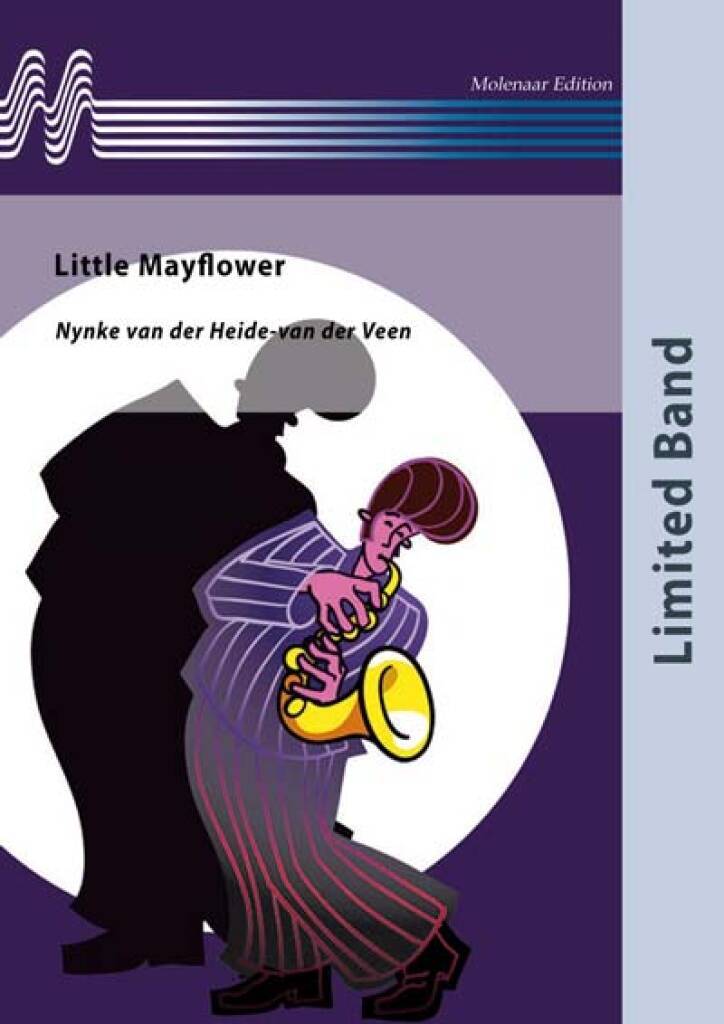
Little Mayflower - Nynke van der Heide-van der Veen
Little Mayflower is an expressive musical work. The lyrical theme is first presented by various groups of instruments. Half way through the little mayflower blooms as the theme is embellished with the three-voice fanfare. A beautiful interlude in your concert programme which the public no doubt will enjoy.
Estimated dispatch 5-14 working days
 View Music