
Results
-
 £59.95
Judd: My Strength My Tower - Contest Version
This music consists of a theme followed by five extensive variations. The theme is the composer's own tune set to the words, 'Thee will I love, my strength, my tower', a hymn by Johann Scheffler translated by John Wesley. A strong modal flavour is characteristic of the theme. Variation 1 This is a light and graceful variation with a good deal of imitative writing. It leads, without a break, into the next variation. Variation 2 Fire and ferocity are asked for in the course of this variation. Variation 3 This variation demonstrates the original approach of the composer. Solo lines for cornet and euphonium are included with their arabesques and arpeggii. Variation 4 Taking the form of a passacaglia, the 'ground' is given out at once by the basses. Fragments of the 'ground', plain or decorated, are combined and used in a number of ways, revealing the composer's mastery of counterpoint. Variation 5 The briskly moving and scintillating final variation abounds in sudden variations of dynamic. The tempo remains constant until an increase is called for in the coda. This 'contest' version has been prepared by Brian Bowen who was asked to re-work the percussion part and introduce a repiano cornet part (Salvation Army band publications do not, in general, have a part for repiano cornet).
Estimated dispatch 7-14 working days
-
 £34.95
Judd: The Covenanters
In 1638, many members of the Presbyterian Church of Scotland signed a document called the National Covenant. By doing so, they were declaring that they acknowledged only Jesus Christ as the spiritual head of their church, and not any king or queen. This had become necessary because the Stuart kings believed in the Divine Right of Monarchs and saw themselves as head of the church. In the previous year, Charles I had forcibly introduced the Book of Common Prayer, invoking the wrath of the common people who faced the threat of torture, transportation or execution if they did not use the new liturgy and worship at their local church. The net result of this was that many met illegally in the countryside or in barns and large houses. These meetings became known as 'conventides' and many took place in the south-west of the country. Anyone caught attending was at risk of execution by the muskets of the dragoons who were employed in the area for that specific purpose. This music was written to honour the bravery and loyalty of these Christians to their faith, in the face of extreme danger, in the hope that it will inspire us also to be faithful. There are overtones of military threat, secrecy and solidarity. An old pentatonic tune is used, which the composer heard as a boy being sung to the words The Lord's My Shepherd.
Estimated dispatch 7-14 working days
-
 £29.95
Judd: The Pilgrim Way
Attempting to recreate the atmosphere of mediaeval pilgrims, this suite comprises three separate, yet linked movements. I. Based on John Bunyan's poem 'He Who Would Valiant Be', the music reminds us of the words 'No foes shall stay his might, though he with giants fight, he will make good his right to be a pilgrim'. II. A transcription of the composer's own setting of 'God be in my head'. III. The original themes in this movement express feelings of joy and excitement of present day pilgrims journeying on the Christian path.
Estimated dispatch 7-14 working days
-
 £99.95
Breath of Souls (Brass Band - Score and Parts)
Breath of Souls was commissioned by Weyland and Yvonne Roberts. It was composed especially for the 100th National Brass band Championships of Great Britain at the Royal Albert hall on October 15th 2011.Weyland has worked in science for many years and has always been fascinated by nature's capacity to grow and rebuild regardless of Mother Nature's catastrophic power. This is evident with the news of tsunami, forest fires, earthquakes and volcanic disasters around the world where animals, plant life and humans have overcome adversity and have demonstrated that unique regenerative quality.Speaking about the piece composer Paul Lovatt-Cooper commented: "With Breath of Souls I wanted to compose a piece of music that was a celebration of life. Not only that, but a piece of music that from the very first notes heard in the percussion and cornets, is bustling with activity, emulating that in life everything that is living has a soul and breathes - nothing stays still and everything keeps moving and growing.Just like life itself Breath of Souls also grows musically with each bar. You will hear many and various motifs and ideas grow and develop as the piece develops."
Estimated dispatch 7-14 working days
-
 £15.00
Breath of Souls (Brass Band - Study Score)
Breath of Souls was commissioned by Weyland and Yvonne Roberts. It was composed especially for the 100th National Brass band Championships of Great Britain at the Royal Albert hall on October 15th 2011.Weyland has worked in science for many years and has always been fascinated by nature's capacity to grow and rebuild regardless of Mother Nature's catastrophic power. This is evident with the news of tsunami, forest fires, earthquakes and volcanic disasters around the world where animals, plant life and humans have overcome adversity and have demonstrated that unique regenerative quality.Speaking about the piece composer Paul Lovatt-Cooper commented: "With Breath of Souls I wanted to compose a piece of music that was a celebration of life. Not only that, but a piece of music that from the very first notes heard in the percussion and cornets, is bustling with activity, emulating that in life everything that is living has a soul and breathes - nothing stays still and everything keeps moving and growing.Just like life itself Breath of Souls also grows musically with each bar. You will hear many and various motifs and ideas grow and develop as the piece develops."
Estimated dispatch 7-14 working days
-
 £45.00
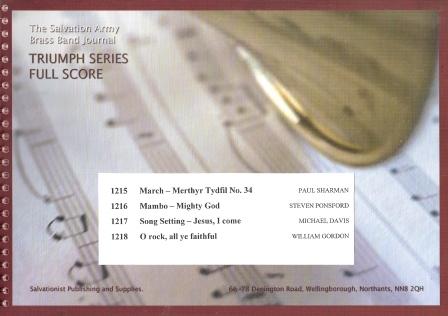
Triumph Series Band Journal July 2011 Numbers 1215 - 1218
No. 1215 March - Merthyr Tydfil No.34 (Paul Sharman)This march was written at the request of Bandmaster Howard Roberts to celebrate the 125th anniversary of Merthyr Tydfil Corps, corps number 34 in The Salvation Army. The tunes used have obvious Welsh connections wit 'Cwm Rhonnda' and 'Aberystwyth' being featured. 'Aberystwyth' was written by Joseph Parry who lived in Merthyr Tydfil for a while.No. 1216 Mambo - Mighty God (Steven Ponsford)Based on words from Isaiah 9, 'Mighty God' is a song of worship and assurance by Chris Bowater and helen and Mark Johnson. This arrangement will afford bands the opportunity to engage the audience into a lively segment of praise.No. 1217 Song Setting - Jesus, I come (Michael Davis)A setting of George C Stebbins' beautiful melody 'Out of my bondage'.No. 1218 O rock, all ye faithful (William Gordon)The Christmas carol 'O come, all ye faithful' is arranged here in a 'rock' style and includes references to other well known Christmas carols.
Estimated dispatch 7-14 working days
-
 £74.95
Aspects of Adiemus (Brass Band - Score and Parts)
Aspects of Adiemus is a collection from one of the world's most popular composers, Karl Jenkins. Adiemus, literally translated, means 'we will draw near' and represents a musical language which can be heard on five award winning albums from the composer.Since Adiemus has risen in popularity around the world, it has become a growing entity meaning many different things to many different people. Vocally, the spread of influence grows wider all the time, taking in Arabic and African sounds as well as "Celtic" and ecclesiastical ones. The percussion too has expanded using Indian, Middle Eastern, Japanese, Chinese and even Australian instrumentation.The evolving nature of Adiemus has meant that it has been difficult to categorise. New age, classical crossover, world music, even pop. Karl sees this as a good sign: "To me, Adiemus transcends labels. The fact that it reaches people of different backgrounds, faiths and cultures gives it a universal appeal which is special. The compositions can be spiritual, religious, meditative - it's open to 'move' people in any away they choose to experience."Ironically, the Adiemus project 'got off the ground' initially due to a television commercial for an airline. Karl Jenkins explains, "I'd been toying with a new idea, completely separate to my work in advertising, but at this time, Jenkins Ratledge were commissioned to come up with the music for an airline commercial. We presented the client with a demonstration tape of one of my completed compositions and they loved it."That composition became known as Adiemus. The music for the airline commercial was aired and immediately drew interest from the public. Karl: "It's ironic that a piece of music not originally intended for a TV commercial should end up on a TV commercial, and that this music became the springboard for the success of the Adiemus project."Expertly arranged by Peter Graham, Aspects of Adiemus features the eponymous 'Adiemus', an uplifting and instantly recognisable opener. 'Chorale - Za Ma Ba' and 'Chorale - Vocalise' are songs of sanctuary, the latter featuring a chamber group from within the band. The vibrant 'Song of the Spirit' is a cornet feature, and the finale, 'Song of the Plains' combines intense rhythmic energy with tribal harmonies. Duration is variable depending on movement selection and optional cuts.Duration: 20.00
Estimated dispatch 7-14 working days
-
 £14.95
Crugybar (Cornet and Piano)
The traditional Welsh tune of Crugybar is most commonly associated with words by Howell Elvet Lewis which appear in the Baptist Hymn Book of 1962; 'The light of the morning is breaking, the shadows are passing away'. The Salvation Army Song Book of 1986 lists two further hymns that can be sung to the tune; 'I stand all bewildered with wonder and gaze on the ocean of love' ( W F Crafts) and 'When Jesus from Calvary called me, unfolding its meaning to me' (Will J Brand). This arrangement was made for Martyn Bryant, the long-serving principal cornetist of Bristol Easton Band of The Salvation Army.
Estimated dispatch 7-14 working days
-
 £24.95
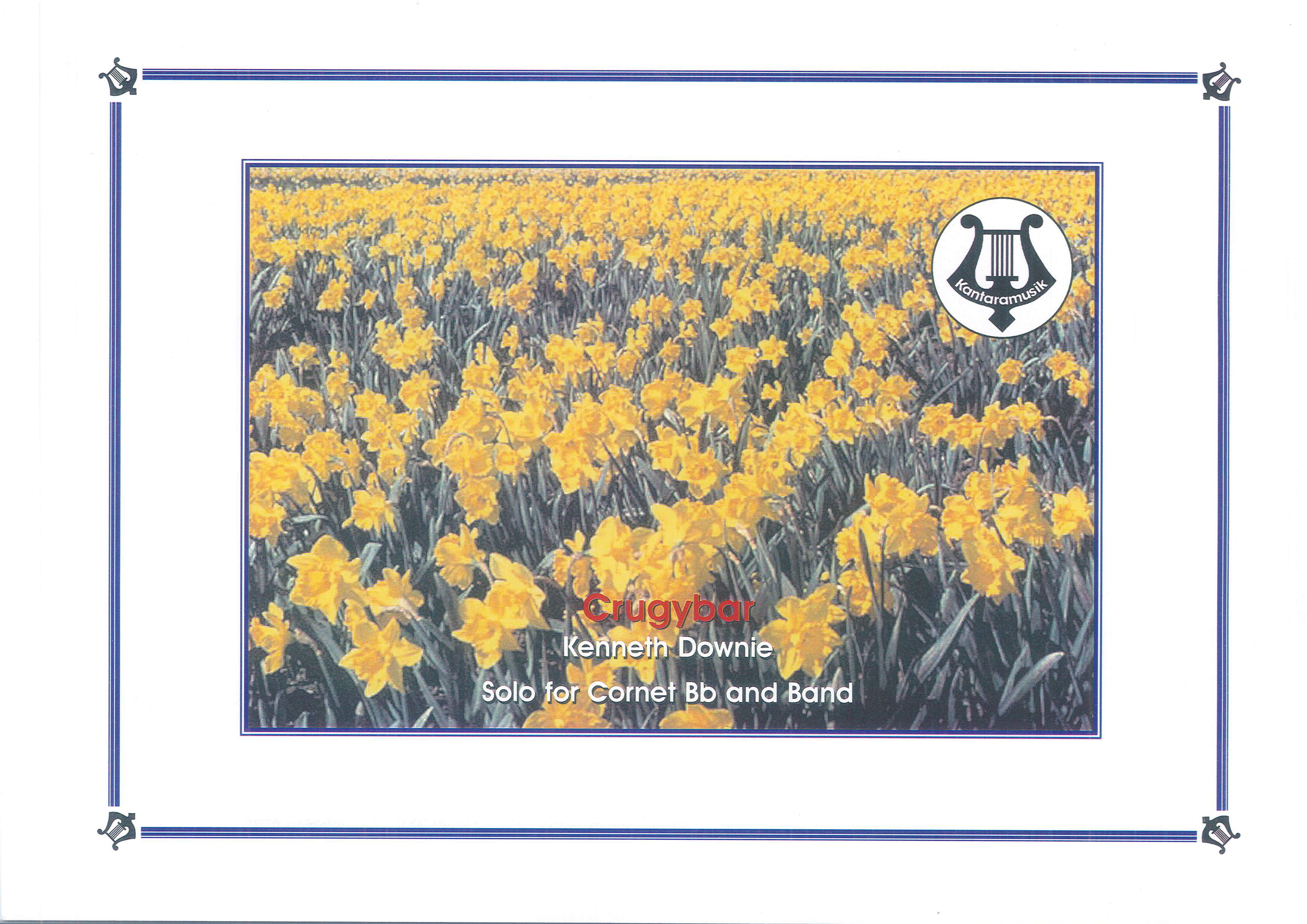
Crugybar (Cornet Solo with Brass Band - Score and Parts)
The traditional Welsh tune of Crugybar is most commonly associated with words by Howell Elvet Lewis which appear in the Baptist Hymn Book of 1962; 'The light of the morning is breaking, the shadows are passing away'. The Salvation Army Song Book of 1986 lists two further hymns that can be sung to the tune; 'I stand all bewildered with wonder and gaze on the ocean of love' ( W F Crafts) and 'When Jesus from Calvary called me, unfolding its meaning to me' (Will J Brand). This arrangement was made for Martyn Bryant, the long-serving principal cornetist of Bristol Easton Band of The Salvation Army.
Estimated dispatch 7-14 working days
-
 £30.00
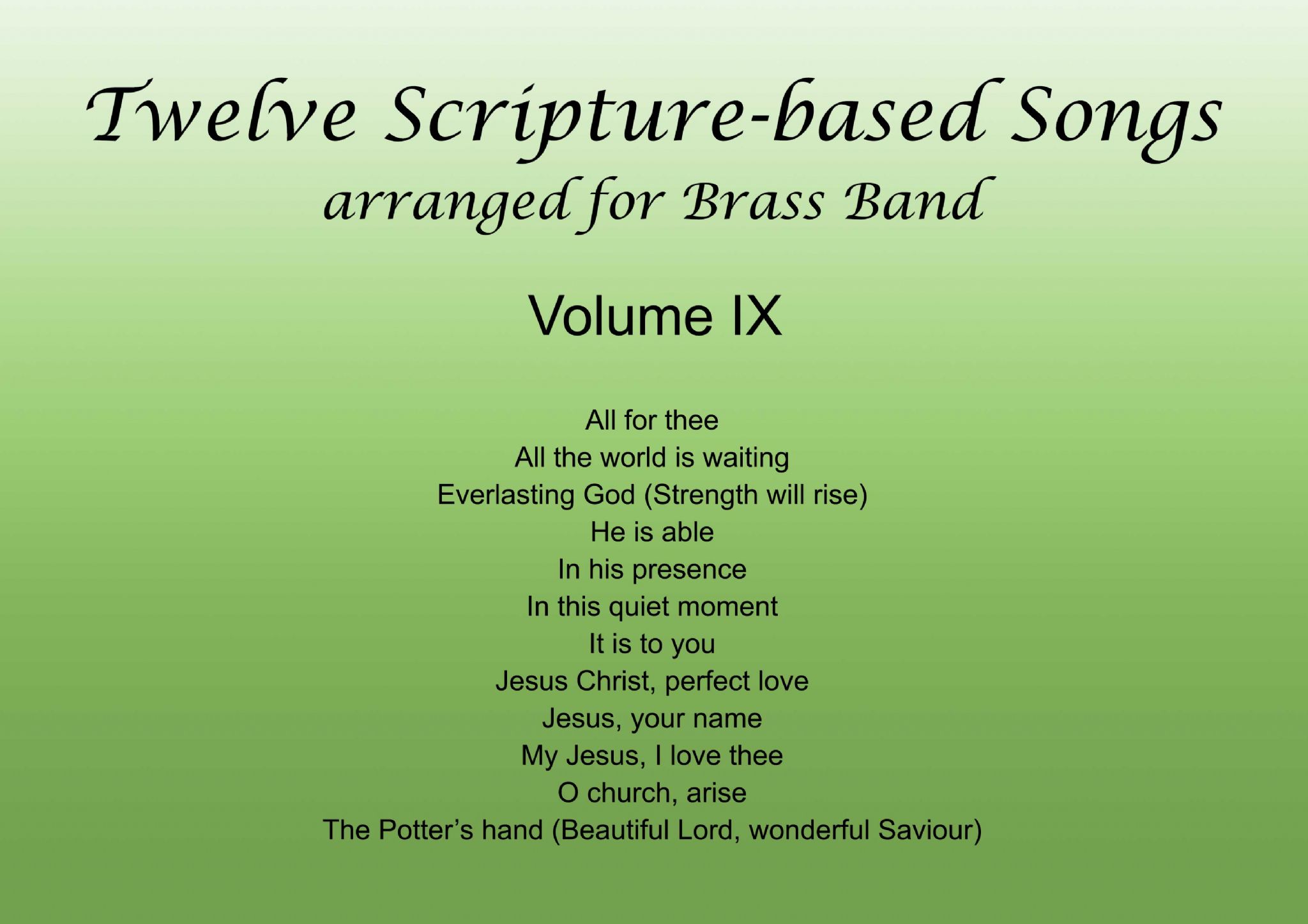
Twelve Scripture-Based Songs Volume IX
Twelve scripture-Based Songs arranged for Brass Band (Volume IX) are packaged and marketed in complete sets which include a full score and a set of master parts. It is intended that these parts be used as 'masters', for the purpose of photocopying a quantity of parts to accommodate the precise instrumentation needs of the band for which this has been purchased.All for theeAll the world is waitingEverlasting God (Strength will rise)He is ableIn his presenceIn this quiet momentIt is to youJesus Christ, perfect loveJesus, your nameMy Jesus, I love theeO church, ariseThe Potter's hand (Beautiful Lord, wonderful Saviour)
Estimated dispatch 7-14 working days