
Results
-
 £198.00
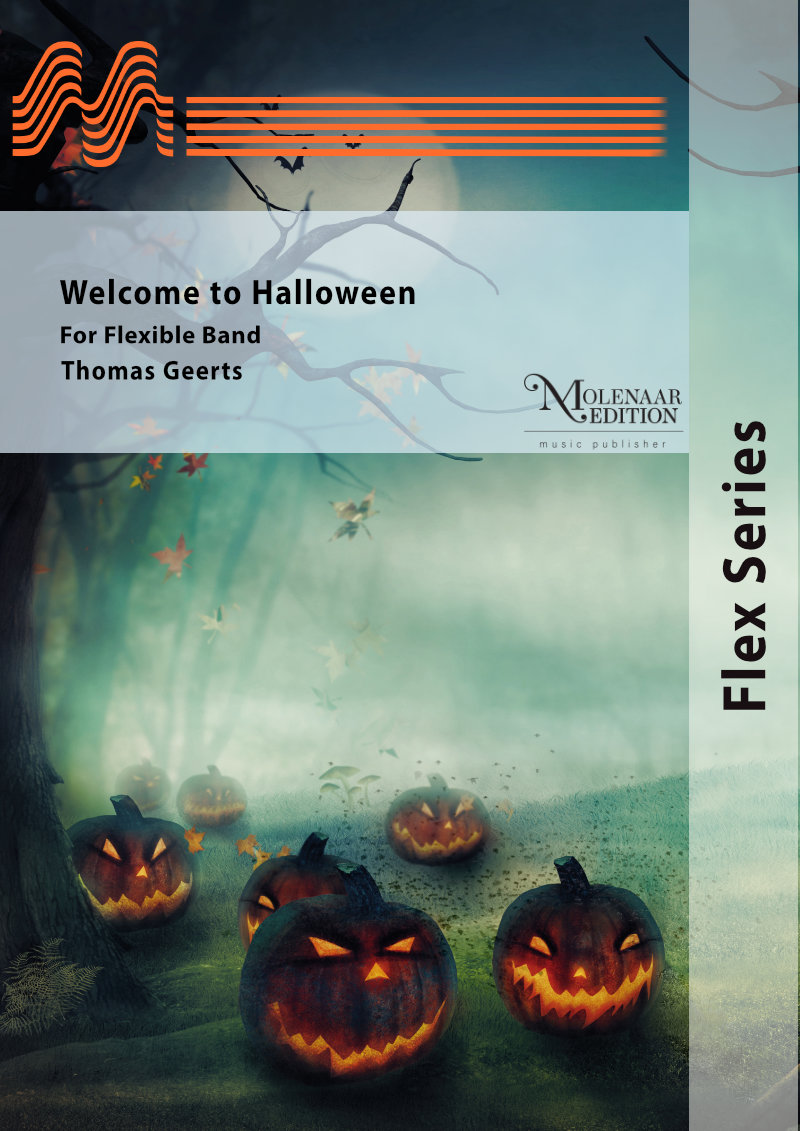
Welcome to Halloween - Thomas Geerts
Welcome to Halloween is a musical theatre piece that consists of 5 pieces of music and a script that guarantees an exciting performance with your advanced student, or training band. All music pieces have been orchestrated in eight parts with at least four percussionists as well. To perform you require not only a band, but also a narrator, an actor and a singer (male or female), a conductor and band members who aside from playing music also have an affinity with drama.
Estimated dispatch 10-14 working days
-
 £18.00
Scarborough Fair
DescriptionScarborough Fair is a traditional English ballad about the Yorkshire town of Scarborough. The song relates the tale of a young man who instructs the listener to tell his former love to perform for him a series of impossible tasks, such as making him a shirt without a seam and then washing it in a dry well, adding that if she completes these tasks he will take her back. Often the song is sung as a duet, with the woman then giving her lover a series of equally impossible tasks, promising to give him his seamless shirt once he has finished.As the versions of the ballad known under the title Scarborough Fair are usually limited to the exchange of these impossible tasks, many suggestions concerning the plot have been proposed, including the theory that it is about the Great Plague of the late Middle Ages. The lyrics of "Scarborough Fair" appear to have something in common with an obscure Scottish ballad, The Elfin Knight which has been traced at least as far back as 1670 and may well be earlier. In this ballad, an elf threatens to abduct a young woman to be his lover unless she can perform an impossible task.As the song spread, it was adapted, modified, and rewritten to the point that dozens of versions existed by the end of the 18th century, although only a few are typically sung nowadays. The references to the traditional English fair, "Scarborough Fair" and the refrain "parsley, sage, rosemary, and thyme" date to 19th century versions. A number of older versions refer to locations other than Scarborough Fair, including Wittingham Fair, Cape Ann, "twixt Berwik and Lyne", etc.The earliest notable recording of it was by Ewan MacColl and Peggy Seeger, a version which heavily influenced Simon and Garfunkel's later more famous version. Amongst many other recordings, the tune was used by the Stone Roses as the basis of their song "Elizabeth my Dear".
Estimated dispatch 7-14 working days
-
 £84.95
Sleepless Cities - Paul Lovatt-Cooper
I have been very fortunate in my life to have visited many wonderful countries and places around the world as a musician, whether it is as a composer, performer, conductor, or soloist. From my experiences, I wanted to compose a...
Estimated dispatch 5-7 working days
-
 £44.95
Walking With Heroes - Paul Lovatt-Cooper
The idea behind the title is that as humans we remember great people living and passed who have touched our lives and have made a big impact on how we lead our lives: people like our loved ones, family members,...
Estimated dispatch 5-7 working days
-
 £30.00
Flanfayre - Stephen Deazley
I was asked by Music for Youth to write a flexibly scored fanfare for the school proms at the Royal Albert Hall and at their National Festival in Birmingham in 2013. At its first performance at the National Festival, over 200 young brass players performed Flanfayre in Birmingham Town Hall, directed by Roger Argente, members of Superbrass and myself. The score is a progressive romp through some increasingly dance-like grooves, borrowing some of its swing from South America, from marches and big band, moving from a really quite straight opening to a "let-go" moment at the end. It is more like a flan full of different flavours, than a fanfare, hence the title. I set myself a challenge to write 100 bars but ended up with 102, which, after the introduction, can be broken down into 10 easily discernible sections each with their own mini-musical narrative. If you have time feel free to teach the audience the clapping groove. I also modelled the slow moving melody of the final section on the following words; "nothing beats a nice big cheesy, nothing beats a nice big cheesy, nothing beats a nice big cheesy, nothing beats a cheesy flan". Feel free to incorporate these too, and perform only under the strict instruction that you have fun ! - Programme Note copyright of Stephen Deazley
-
 £30.00
No Other Option - Jock McKenzie
I seem to have taught a number of students in recent years who have either embarked on medical careers or are studying to do so. Whether it be our beleaguered NHS in general or the working conditions of Junior Doctors in particular, sentiments naturally run high. I was asked & inspired to write a piece for some of these 'medical musicians' to perform in situations of protest or industrial action; situations in which they felt there was "No OtherOption" than to make their feelings known through their chosen path of protest. There is a deliberate irony in the fact that this piece is written in the style of an upbeat and good-humoured folk reel.
-
 £15.00
In the Hall of the Mountain King - Grieg
Performance Notes from Andrew Duncan:This arrangement is fairly difficult for inexperienced players and is without doubt one of the most difficult in the Flexi-Collection Popular Classics Series. But, as it is such a popular piece there is normally a great incentive from the players to learn the piece, despite the difficulties.The accelerando and gradual increases in tempo which are integral to this piece are in themselves very important musical ideas for new players to grasp, and these will be better understood as a result of playing and learning this arrangement.Other features found in this arrangement which may be new to some inexperienced players are the use of tin mutes in the 1st Cornet/Trumpet part, and the falling chromatic notes (accidentals) found in the melody line. Also, the wide range of dynamics, pp - ff , may be new to some players.I have deliberately not suggested any specific metronome markings as this is very much up to the conductor and is dependant on the players' abilities. However, as the arrangement becomes more familiar, the tempo could no doubt be speeded up adding to the excitement of future performances.The Flexi-Collection ApproachFlexible scoring tailored to your needs - A perfect solution for expanding the repertoire of training and junior brass bands. The Flexi-Collection currently offers two series - Popular Classics and World Tour. Based on four-part harmony, these collections provide groups with the advantage of complete flexibility when they may not be balanced. If players or instruments are missing, the show can still go on!The Flexi-Collection - Popular Classics Series, encapsulates all that is great about the wonderful range of musical styles produced by Holst, Elgar, Handel, Verdi, Tchaikovsky, Grieg, Bizet and Parry.The thoughtful scoring and arranging by Andrew Duncan now means that groups of all abilities have access to a truly flexible set of music for their needs. With world parts, rudimentary theory, terminology translations and large format typesetting, The Flexi-Collection ticks all the boxes when it comes to bringing interesting music to the training and junior band/brass group environment.Available individually or as part of the money-saving Flexi-Collection Popular ClassicsAlbum.Scored for Brass Band and supplied with additional Easy Bb, Easy Eb and world parts - The Flexi-Collection offers flexibility in every sense of the word.
In Stock: Estimated dispatch 3-5 working days
-
 £15.00
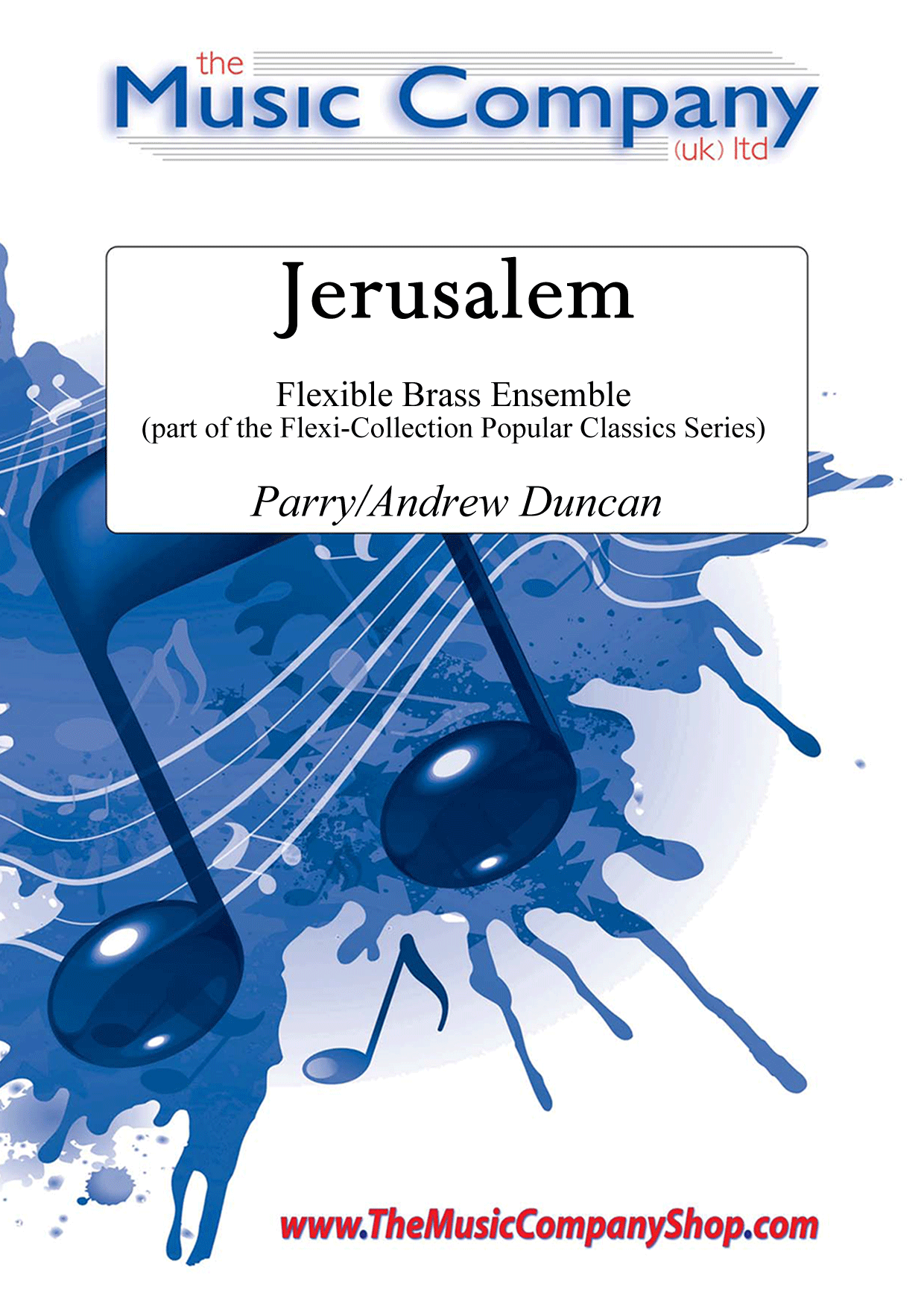
Jerusalem - Parry
Programme Notes from Andrew Duncan:This is one of the more difficult arrangements in the Flexi-Collection Popular Classics Series, and as such will be best attempted after the easier ones have been mastered.The arrangement can be played all the way through as a solo piece or with a number of players playing the 1st Cornet/Trumpet part.The percussion part is very minimal in this arrangement (only 3 notes forthe suspended cymbal) and is an optional part.The Flexi-Collection ApproachFlexible scoring tailored to your needs - A perfect solution for expanding the repertoire of training and junior brass bands. The Flexi-Collection currently offers two series - Popular Classics and World Tour. Based on four-part harmony, these collections provide groups with the advantage of complete flexibility when they may not be balanced. If players or instruments are missing, the show can still go on!The Flexi-Collection - Popular Classics Series, encapsulates all that is great about the wonderful range of musical styles produced by Holst, Elgar, Handel, Verdi, Tchaikovsky, Grieg, Bizet and Parry.The thoughtful scoring and arranging by Andrew Duncan now means that groups of all abilities have access to a truly flexible set of music for their needs. With world parts, rudimentary theory, terminology translations and large format typesetting, The Flexi-Collection ticks all the boxes when it comes to bringing interesting music to the training and junior band/brass group environment.Available individually or as part of the money-saving Flexi-Collection Popular ClassicsAlbum.Scored for Brass Band and supplied with additional Easy Bb, Easy Eb and world parts - The Flexi-Collection offers flexibility in every sense of the word.
In Stock: Estimated dispatch 3-5 working days
-
 £30.00
Man In His Labour Rejoiceth (Band Parts Only) - John Ireland
This beautiful piece written by John Ireland, with words by Robert Bridges, has now been reborn.Originally commissioned by the National Coal Board in 1947 it is believed to have been performed on May 1st 1948 at the the Haringey Stadium, involving 9 bands and 8 colliery bands. Since the original brass band parts (which bring the piece to life in its full glory) were lost over time, the John Ireland Trust committed to a project to ensure the music was not lost forever.Andrew Duncan was commissioned with the honour of recreating the brass band set to bring the full performance of band and choir back to the public's enjoyment. His attention to detail and widespread knowledge of Ireland's writing style have now enabled 'Man in his Labour Rejoiceth' to be fully recreated and appreciated in its original written form, offering bands a remarkable opportunity to perform an historically significant concert work.Choir parts are sold separately and are available from The Music Company (UK) Ltd (please call 0845 68 08452 for more details) or Stainer & Bell Ltd (Catalogue Ref: 20303)
In Stock: Estimated dispatch 3-5 working days
-
£36.30
My Little Welsh Home - Traditional
A beautiful arrangement by Tim Paton of a Welsh song by W S Gwynne Williams. Created in memory of his mother, Tim has produced a wonderful version for brass band and has also included an optional vocal solo or unison choir line.Comments from the arranger:I have arranged [My Little Welsh Home] in memory of my mother. [She] was born, Doreen Davies, on 27th November 1918, in Haverfordwest, Pembrokeshire, a small town in South West Wales. She had a beautiful voice, and met my father, Bill Paton, during World War II, whilst she was singing in a troop concert at the County Theatre in her home town, and my father was the MC.Throughout her life, my mother and father entertained, and she was singing right up until the final months of her life. She spent many years in Weston-super-Mare, Somerset, a seaside town in South West England, and it was here that she passed away on 20th September 2004. During the last several months of her life, she often referred to the song My Little Welsh Home:Here are the words.I am dreaming of the mountains of my homeOf the mountains where in childhood I would roamI have dwelt 'neath southern skiesWhere the summer never diesBut my heart is in the mountains of my homeI can see the little homestead on the hillI can hear the magic music of the RhyllThere is nothing to compareWith the love that once was thereIn the lonely little homestead on the hillI can see the quiet churchyard down belowWhere the mountain breezes wander to and froAnd when God my soul will keepIt is there I want to sleepWith those dear old folks that loved me long agoLooking at the words, I can see why it meant so much to her. Haverfordwest is at the foot of the Preseli Mountains, and her home and church were at the top of a hill. My mothers' ashes were taken back to her own little Welsh home, and laid to rest in the grounds of the church where she had been Christened, Confirmed and Married.Look and Listen (Score-reading digital sound-sample):
In Stock: Estimated dispatch 3-5 working days
 View Music