
Results
-
 £38.95
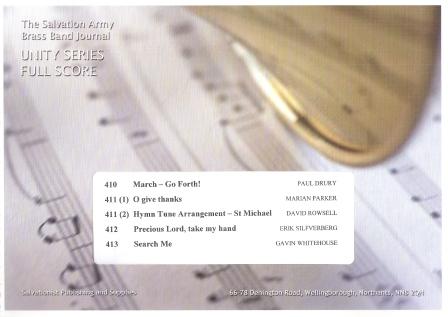
Unity Series Band Journal October 2013 Numbers 410 - 413
No. 410 March - Go Forth! (Paul Drury)This march was written as a tribute to Bandmaster Jack Spowart and the Bo'ness Salvation Army Band. The composer lives in the twon of Bo'ness and has had numerous opportunities to share with the band and the wider corps at various events. This march serves as recognition of the faithful service given in the Lord's name in the town by The Salvation Army for over 100 years. Two tunes are featured, both well-known and instantly recognisable, namely, Forward! be our watchword and We're marching on.No.411 (1) O give thanks (Marian Parker)The composer, Marian Parker, is a new contributor and is the Recruiting Sergeant at Leicester South Corps. This simple, yet rhythmic piece should not pose any technical problems for most bands and features the attractive arrangement of Joanne Pond's contemporary song, 'O give thanks'.No.411 (2) Hymn Tune Arrangement - St Michael (David Rowsell)The hymn tune 'St Michael' was composed in 1551 by French composer Louis Bourgeois and the composer provides a very useful arrangement of this historic hymn.No. 412 Precious Lord, take my hand (Erik Silfverberg O.F.)This well-known Gospel Song is a favourite of many. It has been recorded by many great artists, including Rosetta Tharpe, Elvis Presley and Aretha Franklin. The words were written by Reverend Thomas A. Dorsey, who is often known as the 'Father of Gospel song'.No. 413 Search Me (Gavin Whitehouse)The second new contributor to this journal is Gavin Whitehouse. gavin is the Assistant Music Director for the Greater New York Division and is also the USA Eastern Territorial Songster Leader. This piece combines two songs - one old and one new - which speak of a God who knows us intimately. 'Search me, O God and know my heart today' (associated with the beautiful Maori melody, 'Now is the hour') is woven with a contemporary setting of Psalm 139 by Rebecca St James, the first line of which says, 'You searchme, you know me'.
Estimated dispatch 7-14 working days
-
 £29.95
When The Saints - Traditional - Paul Duffy
The precise origins of the folk song When the Saints Go Marching In or The Saints is unknown but it is believed to originate from Belgium and is thought to have been used originally as a hymn tune. Since the...
Estimated dispatch 5-7 working days
-
 £65.00
Royal Fireworks, Music from the (Brass Band - Score and Parts) - Handel, George Frideric - Blakeson, Don
Handel's Music For The Royal Fireworks was composed in 1749 to celebrate the signing of the Treaty of Aix-la-Chapelle and the end of the War of the Austrian Succession. The site chosen was the fashionable upper part of St. James Park, which was becoming known at that time as Green Park. The Green Park 'Machine', which housed the pyrotechnics was an elaborate affair adorned with "statues and other figures, festoons of flowers, and other lustres". It was announced that there would be some 10,000 rockets and other devices to be let off, all culminating in a grand, burning sun with 'Vivat Rex' at its centre. There were also rumours that the event was to be accompanied by an impressively large band of military music and mention was made of "40 trumpets, 20 french horns, 16 hautboys (oboes), 16 bassoons, 8 pairs of kettle drums, 12 side drums, a proper number of flutes and fifes; with 100 cannon to go off singly at intervals". It is unlikely that Handel had ever conceived such forces and it was merely the promoter's hyberbole, not least because it was unlikely that there were sufficient numbers of extra military musicians available that could read music, as most played from memory. It is also likely that Handel, and his publisher, were conscious that future performances would be hindered by such forces. The autographed score lists the instrumentation as 9 trumpets, 9 french horns, 24 hautboys, 12 bassoons, 3 pairs of kettle drums and up to 4 side drums. The work is in five movements, although Handel's original score did not indicate in which order they should be played. However, in this score they are arranged to be played as follows: Overture; Bour?e; La Paix; Minuets; La R?jouissance. Duration: 19:00
Estimated dispatch 7-14 working days
-
 £94.95
An Age of Kings (Mezzo-Soprano Solo with Brass Band and optional choir - Score and Parts) - Gregson, Edward
The origins of this work date back to 1988, when I was commissioned by the Royal Shakespeare Company to write the music for The Plantagenets trilogy, directed by Adrian Noble in Stratford-upon-Avon. These plays take us from the death of Henry V to the death of Richard III. Later, in 1991, I wrote the music for Henry IV parts 1 and 2, again in Stratford. All of these plays are concerned with the struggle for the throne, and they portray one of the most turbulent periods in the history of the British monarchy.Much of the music used in these productions was adapted into two large symphonic suites for wind band - The Sword and the Crown (1991) and The Kings Go Forth (1996). An Age of Kings is a new version for brass band incorporating music from both the symphonic suites for wind band. It was specially composed for a recording made by the Black Dyke Band, conducted by Nicholas Childs, in 2004.An Age of Kings is music on a large-scale canvas, scored for augmented brass band, with the addition of harp, piano, mezzo-soprano solo, male chorus, as well as two off-stage trumpets. The music is also organized on a large-scale structure, in three movements, which play without a break - "Church and State", "At the Welsh Court", and "Battle Music and Hymn of Thanksgiving".The first movement, "Church and State", opens with a brief fanfare for two antiphonal trumpets (off-stage), but this only acts as a preface to a Requiem aeternam (the death of Henry V) before changing mood to the English army on the march to France; this subsides into a French victory march, but with the English army music returning in counterpoint. A brief reminder of the Requiem music leads to the triumphal music for Richard Plantagenet, Duke of York, father of Edward IV and Richard III (the opening fanfare transformed). However, the mood changes dramatically once again, with the horrors of war being portrayed in the darkly-drawn Dies Irae and Dance of Death, leading to the final section of the first movement, a funeral march for Henry VI.The second movement, "At the Welsh Court", takes music from the Welsh Court in Henry IV part 1 with a simple Welsh folk tune sung by mezzo-soprano to the inevitable accompaniment of a harp. This love song is interrupted by distant fanfares, forewarning of battles to come. However, the folk song returns with variation in the musical fabric. The movement ends as it began with off-stage horn and gentle percussion.The final movement, "Battle Music and Hymn of Thanksgiving", starts with two sets of antiphonally placed timpani, drums and tam-tam, portraying the 'war machine' and savagery of battle. Trumpet fanfares and horn calls herald an heroic battle theme which, by the end of the movement, transforms itself into a triumphant hymn for Henry IV's defeat of the rebellious forces.- Edward GregsonDuration - 22'00"Optional TTBB available separately.
Estimated dispatch 7-14 working days
-
 £84.99
Pacific Dreams (Brass Band - Score and Parts) - De Haan, Jacob
Pacific Dreams describes the experience of Miguel, a travelling composer from Spain who, feeling somewhat alienated from his homeland, is wandering through an area of Sydney known as The Rocks. At a small outdoor market in a typical street of this old colonial neighbourhood, he discovers a print of William DeShazos painting "Pacific Dreams" Portrayed in the painting is the surf of one of the exotic islands in the Pacific. Next, with the impressive Sydney Harbour Bridge looming over the narrow streets of The Rocks, he envisions sultry Pacific beaches. Suddenly a theme he once composed about the lakes in Japan comes to him. Is it the Asian influences present in cosmopolitan Sydney that bring this theme to mind? Or perhaps the waters around Sydney, over which he could sail to Tahiti? He is uncertain. Could this same theme be used to create a new composition about his feelings for the metropolis Sydney? How then to work his Pacific Dreams into the mix? Miguel is certainly no fan of Hawaiian music. Maybe he could use the vocabularies of islands like Hawaii and Tahiti, their beautiful vowel combinations being sung ad libitum by a mixed choir.With these ideas and his newly purchased print of "Pacific Dreams", he boards the Metro at Circular Quay. He has a final glimpse of the harbour and the Sydney Opera House as the train races into the ground. On to the hotel! To work! He must compose! Maestoso : Miguel is impressed as he gazes upon the Sydney Harbour Bridge. And yet, he wants to go away from this city. Away, to an exotic island in the Pacific.Steady Rock : In the Rocks, musicians are playing at a square. Miguel basks in the atmosphere but at the same time he is fantasising about Hawaii and Tahiti. Andante Lamentoso : In his hotel room, Miguel is feeling sad and lonely in this big city. He takes comfort in his "Pacific Dreams". Allegro : Miguel boards the boat that takes him from Darling Harbour to Circular Quay. In his mind he is travelling on to Hawaii. Or is it home, where the bolero is playing? He is pulled back to reality by the skyline of Sydney.Duration: 9.15
Estimated dispatch 7-14 working days
-
 £42.95
Blue Jeans (Trombone Solo with Brass Band - Score and Parts) - Wiffin, Rob
In 2008 the trombonist, Chris Jeans, was invited to be a featured soloist at a British Trombone Society event. He contacted Stan Kitchen at Studio Music Company to see if he had any new material for trombone. Stan then got in touch with me, as I had already written a piece for another trombone player, Brett Baker. This piece, Shout! was programmed for the same event so we needed to find something new for Chris.The title 'Blue Jeans' came to my mind, thus linking a blues-style piece with the obvious reference to Chris's surname. I spoke to Chris and he liked the sound of it so then I had to go away and write a solo to match the title!I managed to get a version with piano accompaniment done in time for Chris to perform at the trombone event and have now had a chance to complete the band version.Chris is a great chap, a good friend and a wonderful trombone player so I hope people enjoy listening to this solo that bears his name.- Rob WiffinDuration: 3.30
Estimated dispatch 7-14 working days
-
 £33.00
Los Canarios (Brass Band - Score and Parts) - Sanz, Gaspar - Powell, David
Originally written by "The Master of the Spanish Baroque Guitar" Gaspar Sanz in the late 17th century, David Powell's brilliant updated arrangement regularly features on Superbrass programmes as an encore item. It's got a really great catchy tune that completely permeates the brain cells. It also has an open middle section that allows for the drummer and/or perc section to let their hair down and go ape.... Guaranteed to get your audience's feet tapping and hands clapping. Duration: 3.00. Suitable for 3rd Section Bands and above.
Estimated dispatch 7-14 working days
-
 £34.95
Song of the Night Sky (Cornet Solo with Brass Band - Score and Parts) - Bond, Christopher
Orpheus is known as the most talented music player of the ancient times. It is said that god Apollo was his father, from whom took his extreme talent in music, and the Muse Calliope was his mother. Tragedy struck when his wife, Eurydice stepped on a viper which in turn bit her, injecting its fatal venom. Nothing could stop his cries of anguish and sheer pain and sorrow upon realizing his beautiful Eurydice was dead. Orpheus decided to go into the Underworld to get his wife back. Apollo, his father, would talk to Hades, the god of the Underworld to accept him and hear his plea. And so Orpheus set off into the Underworld and was warned that for no reason must he look back while his wife was still in the dark, for that would undo everything he hoped for. As Orpheus was reaching the exit of the Underworld, he could hear the footfalls of his wife approaching him. As his was approaching the exit, his heart was beating faster and faster. The moment he stepped on the world of the living, he turned his head to hug his wife. Unfortunately, he got only a glimpse of Eurydice before she was once again drawn back into the underworld. When Orpheus turned his head, Eurydice was still in the dark, she hadn't seen the sun and, was drowned back to the dark world of the dead. Waves of anguish and despair swept over him and shuddering with grief he approached the Underworld again but this time, he was denied entry, the gates were standing shut and god Hermes, sent by Zeus, wouldn't let him in. His songs were no more joyful but extremely sad. His only comfort was to lay on a huge rock and feel the caress of the breeze, his only vision were the open skies. Song of the Night Sky was recorded by Tom Hutchinson and the Cory Band in June 2015, featuring on his debut solo album.Duration: 4.15
Estimated dispatch 7-14 working days
-
 £28.95
La Chica sin Nombre (Trombone Solo with Brass Band - Score and Parts) - Wiffin, Rob
A vibrant, rhythmic solo for trombone and bandLa Chica sin Nombre was written in March 2020 at the request of Brett Baker. He wanted something in Latin style so I chose to go for a Mambo-type dance piece. In obtaining the right percussion sound I would always ask for Conga drums and Mambo Bell/Timbales rather than drum kit. The piece needs to be played with an appropriate feel for Latin music. It should sound light and easy to play but has a few tricky moments- especially the cadenza-like sections from F to H. The virtuosic section at letter G can be cut if required.- Rob WiffinDuration: 4.15
Estimated dispatch 7-14 working days
-
 £32.95
Nurserytime (Brass Band - Score and Parts) - Wiffin, Rob
This selection of well-known nursery rhymes and children's songs was made for the 2006 Party at the Palace. It includes Here we go round the Mulberry Bush, Incy Wincy Spider, Half a Pound of Tuppenny Rice, Three Blind Mice, Singing Polly Wolly Doodle, Old MacDonald had a Farm, One Man Went to Mow a Meadow, and Oh Dear What Can the Matter Be amongst others (Ring-a-ring a-roses, Hickory-dickory dock, Row, row, row your boat, Skip to my Lou)Duration: 5.00
Estimated dispatch 7-14 working days
 View Music