
Results
-
 £29.95
Ghost of Christmas Yet To Come, The - Jonathan Bates
DURATION: 3'00". DIFFICULTY: 2nd+. Composed for Strata Brass in 2020 as part of their COVID-19 induced, virtually recorded 'A Christmas Carol' (a new suite for brass bandlasting around 30 minutes in total), 'The Ghost of Christmas Yet To Come' is a jagged and virtuosic solo for Euphonium portraying what Ebenezer Scrooge sees when he is shown how his Christmases in the future will occur by the Ghost of Christmas Yet To Come. Having already been shown how is mean and uncaring ways have impacted his life this far by the previous two visions, this 3rd and final vision is enough to force Scrooge to become a changed man and embrace the Christmas spirit with all his heart. Throughout this solo, you may hear small references to Camille Saint-Saens' 'Danse Macabre'. .
In Stock: Estimated dispatch 1-3 working days
-
 £73.00
Davos - Anton Weeren
"Davos", The Power of Decadence, is a dazzling opening work for brass band. This composition takes its title from the famous Swiss town, known for its ski slopes and as the venue for the annual World Economic Forum. The piece begins with grandiose signals that overwhelm to the point of irony in the blinding effect of grandeur, magnificence, and opulence. You hear how carefree excess leads to decadence, where boundaries are pushed further and further and decency can easily be lost sight of.
Estimated dispatch 10-14 working days
-
 £74.00
The Lady Caliph - Ennio Morricone/Andrew Pearce
The Lady Caliph is Ennio Morricone's main theme of the 70's Italian drama film La Califfa directed by Alberto Bevilacqua, entered into the 1971 Cannes Film Festival. After Andrew Pearce arranged and transcribed this beautiful theme for cello & chamber orchestra for the film 'If I were you' (2012), it seemed a perfect choice for expressive euphonium solo and Band.
Estimated dispatch 10-14 working days
-
 £25.00
Canzona XIII
DescriptionCanzona XIII, also known as Canzon Septimi Octavi Toni a 12, was first published in 1597 as part of a collection entitled 'Symphoniae Sacrae' - this collection was a mixture of instrumental and choral pieces, and also included the famous Sonata Pian'e Forte, probably his best known work.Gabrieli was born in Venice sometime between 1554 and 1557 and studied with the renowned Dutch composer Orlando di Lassus. He also studied with his uncle, Andrea Gabrieli, and eventually succeeded him as the organist and composer at St Mark's Basilica in Venice. Already renowned as a musical centre, Venice became a magnet for composers wishing to study with Gabrieli after 'Symphoniae Sacrae' was published.Like many of his works, this Canzona was written to take advantage of the unique layout of St Mark's, which had galleries on three sides where the musicians could be placed to create novel spatial effects - utterly new and exciting for sixteenth century listeners. Canzona XIII has three different antiphonal 'choirs' and in this arrangement the band is split into three groups to reflect Gabrieli's innovative idea. Ideally the three groups should be clearly separated so the the antiphonal effect comes across clearly, although this will of course depend on the performance space. On no account should the band remain in its normal seated formation!As Gabrieli didn't have any percussionists (and percussion was widely thought inappropriate for music performed in church anyway) there are no percussion parts in this music.This arrangement was first performed by the Coppull and Standish Band conducted by Andrew Baker in 2009.You can follow a preview of the score while listening to an audio export of the music below!
Estimated dispatch 7-14 working days
-
 £25.00
Prelude 1946
For seventy years, the North West Area Brass Bands Association has been representing bands in the North West of England and surrounding areas. Their members come from Cheshire, Derbyshire, Greater Manchester, Isle of Man, Lancashire, North Wales, Staffordshire and Yorkshire. Prelude 1946 was commissioned to mark this special land-mark year. Taking inspiration from John Williams 1988 Olympic Spirit, the work opens with a heraldic fanfare before moving into its stately main theme, which gradually builds into a triumphant climax. An ideal concert opener for those of you who want to start off a concert with some American-style flair. Duration: 00:03:45 Grade : 3
Estimated dispatch 5-7 working days
-
 £44.83
City of David (Brass Band) Philip Rayment
This engaging major Christmas work features three carols or songs associated with the place of Christ's birth: Once In Royal David's City, O Little Town of Bethlehem (Forest Green) and How Far Is It To Bethlehem? During Old Testament times, the city of Jerusalem had been considered the 'City of David', as the political and spiritual capital of Israel. However, after Christ's birth, that name was given to the town of Bethlehem - a quiet farming village in the countryside. This new designation is first mentioned in the Gospel of Luke: ''For unto you is born this day in the City of David a Saviour, which is Christ the Lord.' (Luke 2:11) A variety of moods are used to express:- The crowds of people arriving in Bethlehem to be taxed, overtaking the town, leaving no room for a young, pregnant Mary and her husband.- The stillness of the countryside on the eve of Christ's birth.- The excitement of worshippers celebrating the birth of a Saviour. To view performances of the work please visit: Canadian Staff Band: www.youtube.com/watch?v=0UC-j9jBsx4 Five Lakes Silver Band: www.youtube.com/watch?v=aCn4JjQCe9A Duration: 7.30 minutes approx. Difficulty Level: 2nd Section + PDF download includes parts and score. Sheet music available here. Instrumentation: Soprano Cornet Eb Solo Cornet Bb 1st Cornet Bb 2nd Cornet Bb Flugel Horn Bb Solo Horn Eb 1st Horn Eb 2nd Horn Eb 1st Baritone Bb 2nd Baritone Bb 1st Trombone Bb 2nd Trombone Bb Bass Trombone Euphonium Bb Bass Eb Bass BbTimpani Percussion 1-3
In Stock: Estimated dispatch 1-3 working days
-
 £30.00
Black Bottom Stomp - Jelly Roll Morton
Ferdinand Joseph LaMothe, professionally known as Jelly Roll Morton, was an American ragtime and early jazz pianist, bandleader and composer who started his career in New Orleans, Louisiana. Widely recognised as a pivotal figure in early jazz, Morton is perhaps most notable as jazz's first arranger, proving that a genre rooted in improvisation could retain its essential spirit and characteristics when notated. His composition "Jelly Roll Blues" was the first published jazz composition in 1915. Morton is also notable for writing such standards as "King Porter Stomp", "Wolverine Blues", "Black Bottom Stomp", and "I Thought I Heard Buddy Bolden Say". Notorious for his arrogance and self-promotion, Morton claimed to have invented jazz outright in 1902, much to the derision of fellow musicians and the critics. At the age of fourteen, Morton began working as a piano player in a brothel (or, as it was referred to back then, a sporting house). In that atmosphere, he often sang smutty lyrics and took the nickname "Jelly Roll". While working there, he was living with his religious, church-going great-grandmother; who he convinced that he worked as a night watchman in a barrel factory. After Morton's grandmother found out that he was playing jazz in a local brothel, she kicked him out of her house and told him that "devil music" would surely bring about his downfall. Born in downtown New Orleans, Louisiana, his exact birth date differs depending to whichever source you want to believe; his half-sisters claimed he was born in September 1885, but his World War 1 draft card showed September 1884 and his California death certificate listed his birth as September 1889. He died in 1941 in Los Angeles.
-
The Tricorn - Len Jenkins - Len Jenkins
The Tricorn is a style of three-cornered hat from Europe in the 18th century, generally referred to as a 'cocked hat' in Britain and popular in America at the time of the War of Independence. It may still be seen on ceremonial occasions as part of the town-cryer's dress in England and features in a popular German song for children 'Mein Hut, der hat drei Ecken'. However, in the case of this music, the reference is to the cornet section and the requirement for triple-tonguing on the Eb Soprano cornet. Whilst ostensibly a concert march in style, its jaunty rhythm makes you want to stride along and it may therefore be used as a 'road march' as well. Pressure on the Soprano cornetist as a soloist is reduced by adding the Solo Cornets to the melody line in the 'road march' version. With this in mind, we supply the music in both A4 (concert) and A5 (march-card) sizes as a package.
-
 £34.95
Judd: Stand Strong
This march was written for the North York Temple Band, Toronto, for their tour of the UK in 2012. Inspired by St Paul's words to the Ephesians to 'put on the full armour of God, so that when the day of evil comes, you may be able to stand your ground' (Ephesians 6:13 NIV), the music features three songs of warfare. The first song (S.A.S.B. 989) forms the introduction to the piece and is presented by Percussion and two muted Cornets. The image here is of a distant army approaching with banners aloft. The volume of the music increases as the army approaches:We'll shout aloud throughout the landThe praises of our God,We'll fight beneath our flag unfurled,Kept by his precious blood.
Estimated dispatch 7-14 working days
-
 £70.00
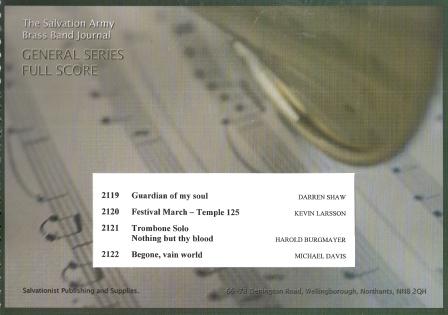
General Series Band Journal April 2013 Numbers 2119-2122
No.2119 Guardian of my soul (Darren Shaw)This arrangement combines the composer's own song 'I worship you', with the well-known hymn 'O Jesus, I have promised' (S.A.S.B. 862), both of which contain the phrase, 'Guardian of my soul', within their lyrics.No.2120 Festival March - Temple 125 (Kevin Larsson)This march was written for the 125th anniversary of Bromley Temple, which is where the composer grew up and still considers his 'home corps'. This arrangement uses two songs that are closely associated with Bromley, the first being 'Jesus is all I need' (STTL Vol.1, part 1) by Hans Knutzen, who was a soldier of the corps and a member of the 'Bill Booth Revival Machine'. The second song is 'He came to give us life (T.B. 662) from the Gowans and Larsson musical, 'Jesus Folk', which was premiered using a cast from Bromley Temple.No.2121 Trombone Solo - Nothing but thy blood (Harold Burmayer)Donna Peterson's recent melody, set to the time-honoured words of Richard Slater, provides a vehicle for solo trombone with band accompaniment.No.2122 Begone, vain world (Michael Davis)A setting of the hymn tune of the same title, with which we associate the words, 'I want, dear Lord, a heart that's true and clean'.
Estimated dispatch 7-14 working days
 View Music