
Results
-
Bad Moon Rising - John Fogerty - Len Jenkins
"Bad Moon Rising" is a song written by John Fogerty and performed by Creedence Clearwater Revival. It was the lead single from their album Green River and was released in April 1969, four months before the album. It reached No. 1 on the UK Singles Chart for three weeks in September 1969 and has been recorded by at least 20 different artists, in styles ranging from folk to reggae to psychedelic rock. The last line of the chorus, "there's a bad moon on the rise", is sometimes misheard as "there's a bathroom on the right" and Fogerty occasionally sings the misheard lyric in concert. The song has become notably popular in Argentina as a football chant and in the 2014 FIFA World Cup, a modified version, titled "Brasil, decime que se siente" ("Brazil, Tell Me How It Feels") was sung with Spanish lyrics that taunted Brazil, their traditional rival. It went viral and became very popular (in Argentina).
-
 £70.00
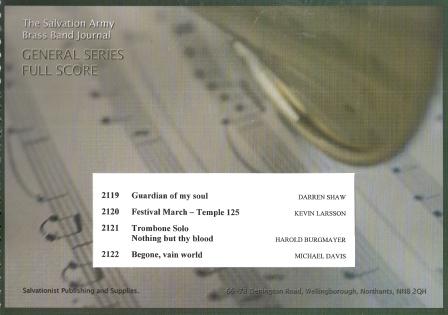
General Series Band Journal April 2013 Numbers 2119-2122
No.2119 Guardian of my soul (Darren Shaw)This arrangement combines the composer's own song 'I worship you', with the well-known hymn 'O Jesus, I have promised' (S.A.S.B. 862), both of which contain the phrase, 'Guardian of my soul', within their lyrics.No.2120 Festival March - Temple 125 (Kevin Larsson)This march was written for the 125th anniversary of Bromley Temple, which is where the composer grew up and still considers his 'home corps'. This arrangement uses two songs that are closely associated with Bromley, the first being 'Jesus is all I need' (STTL Vol.1, part 1) by Hans Knutzen, who was a soldier of the corps and a member of the 'Bill Booth Revival Machine'. The second song is 'He came to give us life (T.B. 662) from the Gowans and Larsson musical, 'Jesus Folk', which was premiered using a cast from Bromley Temple.No.2121 Trombone Solo - Nothing but thy blood (Harold Burmayer)Donna Peterson's recent melody, set to the time-honoured words of Richard Slater, provides a vehicle for solo trombone with band accompaniment.No.2122 Begone, vain world (Michael Davis)A setting of the hymn tune of the same title, with which we associate the words, 'I want, dear Lord, a heart that's true and clean'.
Estimated dispatch 7-14 working days
-
£86.00
Minnen fran Holmen - Jerker Johansson
The first theme played by the solo clarinet was written by Jerker Johansson the summer 1997, when he was composing in Swedish folk music style for an intended radio programme in which his father should participate reading poems in local dialect. Unfortunately, the project was discontinued. In the spring 2015 Mr. Johansson however started to work on the theme again, this time adding a song theme of broader character. Holmen is the name of the homestead where Mr. Johansson's father Arne grew up. It is beautifully located in the parish of Skarv, situated east of Skara, one of the oldest towns in Sweden. At Holmen, the composer spent his childhood summers and his recollections are filled with many bright moments and happy memories. The piece was premiered May 22, 2015 by the Goteborg Wind Orchestra conducted by the composer.
Publisher Closed for Holidays. Est Delivery 13-14th Aug
-
 £36.30
Down By The Salley Gardens
A new brass band release for 2023 which also welcomes Fiona Neary as a new member of our ever-growing family of writers!This traditional Irish folk tune has been beautifully arranged for brass band, offering a tranquil moment to your programme with a memorable jaunty jig section to keep your listeners on their toes!Every concert needs that 'Aaahhhh' element, and Down By The Salley Gardens certainly brings all the qualities required to meet that need.This original traditional Irish melody has been referred to by a variety of titles: 'Mourne Shore', 'Moorlough Shore' and 'The Maids of Mourne Shore', and is believed to have dated back to the 17th-18th century.In 1889, William Butler Yeats had his poem 'Down By The Salley Gardens' published in The Wanderings of Oisin and Other Poems. The verse was then later set to the Irish melody by Herbert Hughes in 1909. Since this combining, the music has become synonymous with the poem and naturally adopted the poem's title.Due to the beauty of the melody and the emotive words of the associated poem, both elements of this work has been embraced by a variety of artistes, including recordings by The Corrs and Sinead O'Connor; John Ireland (1879-1962) set the words to an original melody in his song cycle Songs Sacred and Profane, written in 1929-31; there is a vocal setting by the poet and composer Ivor Gurney, which was published in 1938; and Benjamin Britten published a setting of the poem in 1943.
In Stock: Estimated dispatch 3-5 working days
-
£35.00
The Witch of the Westmerlands - Harper, P
Arranged for the Leyland Band's 2010 Brass in Concert programme. This is a sumptuous, lyrical setting of Scottish folk singer-songwriter Archie Fischer's originally up-beat song, with solos for baritone and cornet. The words tell the story of an ancient knight wounded in battle and dying on the battlefield who is healed by a mysterious old lady appearing from across the moors and swiftly vanishing again.The original version was sung by, amongst others, Barbara Dickson who has said she is a big fan of Philip's sensitive arrangement.Listen to Cory BandCourtesy of World of Brass
In Stock: Estimated dispatch 1-3 working days
-
 £110.00
Diversions After Benjamin Britten (Brass Band - Score and Parts)
Suite by Lucy Pankhurst, Simon Dobson, Paul McGhee and Gavin HigginsHaving devised a collective centenary tribute for Michael Tippett at the 2006 RNCM Festival of Brass (Variations on a Theme of Michael Tippett by five eminent composers of brass band music, PHM002), I commissioned this companion piece as a Benjamin Britten tribute for the 2013 festival. In the late 1970s, while researching a book about the English composer, and Britten's first teacher, Frank Bridge (1879 - 1941), I came across a copy of the printed score of Benjamin Britten's Variations on a Theme of Frank Bridge (Op.10) for string orchestra, in which Britten had written descriptive titles for each of the variations suggesting appropriate character traits of his much loved mentor and guide. The character variations are cast in march, song and dance forms.Taking inspiration from Britten's youthful tribute, I invited four award-winning composers, who have all made significant contributions to the brass band medium, to create their own personal reflections on four aspects of Britten's character and music, designed to form a suite of Diversions after Benjamin Britten, but which can also be played separately.Lucy Pankhurst's hauntingly lyrical Prelude: His Depth refers to the emotional and symbolic subtexts that underpin Britten's operas, taking its musical cue from Britten's many arrangements of folk songs. The flugel horn takes a prominent role throughout.Simon Dobson's breathless Scherzo: His Vitality reminds us with its rapid passage work and leaping bass 'groove' that Britten loved tennis and fast cars in his younger days.Paul McGhee's evocative interpretation of the March: His Sympathy represents Benjamin Britten's pacifism, as the composer writes: 'We view the music through the eyes of a pacifist. Whilst war and violence surround us, we do not engage in it and though it continues to happen around us. With the use of muted effects in most of the band throughout the piece, the flugel horn is the lone voice of reason, standing firm against the mechanical and destructive society in which it is forced to live. As the machine of war continues around the lone voice, the voice is gradually dismissed and mocked as the war machine rumbles on into the distance.'In an extended finale, entitled Toccata: His Skill, Gavin Higgins celebrates Benjamin Britten's consummate creativity. For the RNCM Festival of Brass premiere, the four contrasting movements were framed and connected by Britten's Fanfare for St. Edmundsbury for three trumpets, with the trumpet soloists spaced round the hall. I am grateful to the Britten Estate and publishers Boosey & Hawkes for giving permission for the elements of Britten's fanfare to be incorporated in the collective work.- Paul HindmarshDuration: 19.30
Estimated dispatch 7-14 working days
-
£45.00
Diversions After Benjamin Britten (Brass Band - Score only)
Suite by Lucy Pankhurst, Simon Dobson, Paul McGhee and Gavin HigginsHaving devised a collective centenary tribute for Michael Tippett at the 2006 RNCM Festival of Brass (Variations on a Theme of Michael Tippett by five eminent composers of brass band music, PHM002), I commissioned this companion piece as a Benjamin Britten tribute for the 2013 festival. In the late 1970s, while researching a book about the English composer, and Britten's first teacher, Frank Bridge (1879 - 1941), I came across a copy of the printed score of Benjamin Britten's Variations on a Theme of Frank Bridge (Op.10) for string orchestra, in which Britten had written descriptive titles for each of the variations suggesting appropriate character traits of his much loved mentor and guide. The character variations are cast in march, song and dance forms.Taking inspiration from Britten's youthful tribute, I invited four award-winning composers, who have all made significant contributions to the brass band medium, to create their own personal reflections on four aspects of Britten's character and music, designed to form a suite of Diversions after Benjamin Britten, but which can also be played separately.Lucy Pankhurst's hauntingly lyrical Prelude: His Depth refers to the emotional and symbolic subtexts that underpin Britten's operas, taking its musical cue from Britten's many arrangements of folk songs. The flugel horn takes a prominent role throughout.Simon Dobson's breathless Scherzo: His Vitality reminds us with its rapid passage work and leaping bass 'groove' that Britten loved tennis and fast cars in his younger days.Paul McGhee's evocative interpretation of the March: His Sympathy represents Benjamin Britten's pacifism, as the composer writes: 'We view the music through the eyes of a pacifist. Whilst war and violence surround us, we do not engage in it and though it continues to happen around us. With the use of muted effects in most of the band throughout the piece, the flugel horn is the lone voice of reason, standing firm against the mechanical and destructive society in which it is forced to live. As the machine of war continues around the lone voice, the voice is gradually dismissed and mocked as the war machine rumbles on into the distance.'In an extended finale, entitled Toccata: His Skill, Gavin Higgins celebrates Benjamin Britten's consummate creativity. For the RNCM Festival of Brass premiere, the four contrasting movements were framed and connected by Britten's Fanfare for St. Edmundsbury for three trumpets, with the trumpet soloists spaced round the hall. I am grateful to the Britten Estate and publishers Boosey & Hawkes for giving permission for the elements of Britten's fanfare to be incorporated in the collective work.- Paul HindmarshDuration: 19.30
Estimated dispatch 7-14 working days
-
 £14.95
Danny Boy (Brass Quartet)
Danny Boy or Londonderry Air is probably the most famous of all Ireland's folk songs. It is unclear when or who wrote the melody line but the words most commonly sung to the tune were penned by Englishman Frederick Weatherly in Somerset around the turn of the 20th Century.The true meanings of the lyrics are unclear and Weatherly never divulged their significance but it is most commonly believed that it is a message from a parent to a son traveling to war.The song has been covered in a wide variety of styles including recordings by Glenn Miller, Judy Garland, Johnny Cash, Cher, Eric Clapton and Charlotte Church to name but a few.This simple but effective arrangement will bring a touch of Ireland to any audience.
Estimated dispatch 7-14 working days
-
 £35.00
The Witch of the Westmerlands (Score and Parts)
Arranged for the Leyland Band's 2010 Brass in Concert programme. This is a sumptuous, lyrical setting of Scottish folk singer-songwriter Archie Fischer's originally up-beat song, with solos for baritone and cornet. The words tell the story of an ancient knight wounded in battle and dying on the battlefield who is healed by a mysterious old lady appearing from across the moors and swiftly vanishing again.The original version was sung by, amongst others, Barbara Dickson who has said she is a big fan of Philip's sensitive arrangement.
Estimated dispatch 7-14 working days
-
 £40.76
Allegro Spirito from Symphony No.2 (Brass Band) Borodin arr. Harold Burgmayer
Alexander Borodin's Second Symphony in B minor dates from the years 1869-76, a time when he was also working on his enduring opera Prince Igor. Flavors of the exotic and outdoor celebration seemed to have spilled over from the opera in this brilliant sonata movement. Borodin seldom quotes Russian folk tunes, but his graceful melodic lines are permeated with the spirit of his native song, supported by iridescent harmonies and bright colors. This arrangement for brass band was premiered by The Salvation Army's New York Staff Band, with Ronald Waiksnoris conducting, at Alice Tully Hall in New York City on 11 April 2001. This complete transcription of the Finale movement of Borodin's Second Symphony has an approximate duration of 6.40 minutes. To alternatively utilize the piece as an opener, a cut from bar 173 to 272 is indicated with Coda signs, reducing the piece to 4.30 seconds. To view a rolling score video of the work please visit www.youtube.com/watch?v=x4SqSXLopRo Difficulty Level: 2nd Section + PDF download includes parts and score. Sheet music available at www.brassband.co.uk (UK) or www.cimarronmusic.com (USA) Instrumentation: Soprano Cornet Eb Solo Cornet Bb Repiano Cornet Bb 2nd Cornet Bb 3rd Cornet Bb Flugel Horn Bb Solo Horn Eb 1st Horn Eb 2nd Horn Eb 1st Baritone Bb 2nd Baritone Bb 1st Trombone Bb 2nd Trombone Bb Bass Trombone Euphonium Bb Bass Eb Bass Bb Timpani Percussion 1-3
In Stock: Estimated dispatch 1-3 working days
 View Music