
Results
-
 £49.99
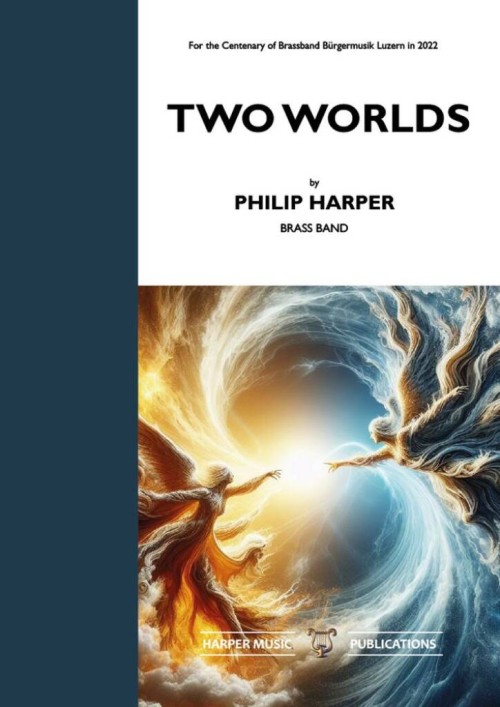
Two Worlds (Brass Band - Score only) - Harper, Philip
A powerful musical journey through time, Two Worlds explores the enduring force of storytelling. In an imaginary encounter, the Egyptian Pharaoh Tutankhamun and the American President Lincoln - in reality, separated by 5,000 years - meet to discuss the myths, truths and beliefs that shaped their respective civilizations. From the divine sun gods of Ancient Egypt to America's dream of equality, this evocative work blends fantasy and history with bold, cinematic music. At once dramatic and thought-provoking, Two Worlds reminds us that the stories we believe in can unite or divide, destroy or inspire.Commissioned for the centenary of the Swiss Brassband Burgermusik Luzern, in 2022.Duration: 18.30
Estimated dispatch 7-14 working days
-
 £32.95
Dragon Prelude (Brass Band - Score and Parts) - Wiffin, Rob
This concert prelude is both abridged and expanded from a selection of Welsh songs Here be Dragons which was commissioned by the Band of the Welsh Guards for their Centenary celebrations in 2016. The work was first performed at the Kneller Hall Summer Concert, 20 July 2016. It contains the following:Rhyfelgyrch Gwyr Harlech - Men of HarlechSosban Fach - Little SaucepanAr Lan y Mor - Down by the Sea (plus Suo Gan - Lullaby)Hen Ferchetan - Old MaidHen Wlad fy Nhadau - Land of my FathersDuration: 4.45
Estimated dispatch 7-14 working days
-
 £57.00
A Glorious Fanfare (Brass Band - Score and Parts) - Cesarini, Franco
Franco Cesarini was commissioned to write A Glorious Fanfare by the Band Association of the Zug Canton in Switzerland (Zuger Blasmusikverband), to celebrate the centenary of the Association (1922-2022). The composition is the third in a trilogy of scintillating concert opening pieces (which make up opus 38), together with A Triumphant Fanfare and A Joyful Fanfare. A majestic fanfare entrusted to the trumpets introduces the piece. Subsequently a cantabile variant of the same theme is presented leading to a finale with rich and impressive sounds. An ideal opening piece that will delight your audience! Duration: 3.30
Estimated dispatch 7-14 working days
-
 £60.99
Sparkling Overture (Brass Band - Score and Parts) - Jeanbourquin, Marc
Sparkling Overture was written to celebrate the centenary of the Swiss brass band La Musique Militaire de Rougemont. This energetic and dynamic piece opens with a festive and resolutely positive fanfare. The much more tranquil and lilting second theme is a magnificent chorale which is then followed by a brilliant return of the first motif. Used as a theme tune, this piece will be ideal as a contrasting, joyful and sparkling concert opening.Duration: 3.00
Estimated dispatch 7-14 working days
-
 £36.95
Here Be Dragons (Brass Band - Score and Parts) - Wiffin, Rob
This arrangement of Welsh songs was commissioned by the Band of the Welsh Guards for their Centenary celebrations in 2016. It contains the following:Sosban Fach - Little SaucepanAr Lan y Mr - Down by the Sea (plus Suo Gn - Lullaby)Dafydd y Garreg Wen - David of the White RockHen Ferchetan - Old MaidHela'r Ysgyfarnog - Hunting the Hare (plus Ar Hyd y Nos - All through the Night)Migldi Magldi Hen Wlad fy Nhadau - Land of my Fathers (plus Rhyfelgyrch Gw?r Harlech - Men of Harlech)Duration: 6.30
Estimated dispatch 7-14 working days
-
 £60.99
Moon River Cha Cha (Brass Band - Score and Parts) - Mancini, Henry - Harper, Philip
Moon River Cha Cha was arranged to be part of Cory Band's winning set from Brass in Concert 2016 which was entitled; 'The Remarkable Life of Roald Dahl'. The centenary of Dahl's birth in Wales was celebrated in 2016, and this piece comes from the 1961 film Breakfast at Tiffany's which starred Dahl's first wife, Patricia Neal. The easy-listening style of the music portrays the glamour and glitz of Roald Dahl's immediate post-war life in the USA.Duration: 2.30
Estimated dispatch 7-14 working days
-
 £26.95
Flanders' Poppies (Brass Band - Score and Parts) - Wiffin, Rob
A setting of the well-known Great War poem In Flanders Fields, written during the First World War by Canadian physician Lieutenant Colonel John McCrae (1872-1918). I first set some of the words to music for the Royal British Legion Festival of Remembrance during my time in the RAF but returned to them in 2014, setting the whole poem to mark the centenary of the commencement of the Great War.- Rob WiffinDuration: 3.30
Estimated dispatch 7-14 working days
-
 £54.95
Songs of the Great War (Brass Band - Score and Parts) - Wiffin, Rob
A Medley of Popular Songs, 1914 - 1918Music of the Great War is a five year project to use music of the period to educate and engage schools, colleges, town bands, and the wider public across the UK and the world to learn in a positive way about the events, the experience of the troops involved from all sides, and how music played its part.This year, to commemorate the centenary of the Great War a specially arranged medley Songs of the Great War has been created. The medley has been arranged for bands to rehearse and eventually perform on the 11 November 2015. It brings together some of the most popular tunes played, sung and performed by the men and women of the time - in the trenches and on the various home fronts.With the support of many countries and organisations, on the 11 November the medley will be first played in New Zealand and Australia. It will ripple east across the world being performed in countries like India and Pakistan before hitting Europe and onwards to include performances in Canada and the Caribbean. This could become one of the most played pieces of music in a 24-hour period.In Britain, there will be performances across the country, including some at key events and sites involving a wide range of military and non-military personnel.The medley includes:It's a Long Way to TipperaryYour King and Country Want YouGood Bye-eeOh! It's a Lovely WarHello! Hello! Who's Your Lady FriendTake Me Back to Dear Old BlightyMademoiselle from ArmentieresThere's a Long, Long Trail A-windingIf You Were the Only Girl in the WorldPack Up Your Troubles (In Your Old Kit Bag)Old Soldiers Never Die/Last Post
Estimated dispatch 7-14 working days
-
 £49.99
Occasional Overture (Brass Band - Score and Parts) - Britten, Benjamin - Hindmarsh, Paul
Benjamin Britten composed his Occasional Overture Op.38, for the opening of the BBC Third Programme on 29th September 1946, when it was performed by the BBC Symphony Orchestra under Sir Adrian Boult. It was not heard again until 1982, when the composer's Executors decided that it should be revived. Given the dominance of brass and woodwind in this concise but exciting work, versions for brass band and wind band have been prepared for Britten's centenary year. Suitable for Championship Section Bands. Duration: 8.00
Estimated dispatch 7-14 working days
-
 £110.00
Diversions after Benjamin Britten (Brass Band - Score and Parts)
Suite by Lucy Pankhurst, Simon Dobson, Paul McGhee and Gavin HigginsHaving devised a collective centenary tribute for Michael Tippett at the 2006 RNCM Festival of Brass (Variations on a Theme of Michael Tippett by five eminent composers of brass band music, PHM002), I commissioned this companion piece as a Benjamin Britten tribute for the 2013 festival. In the late 1970s, while researching a book about the English composer, and Britten's first teacher, Frank Bridge (1879 - 1941), I came across a copy of the printed score of Benjamin Britten's Variations on a Theme of Frank Bridge (Op.10) for string orchestra, in which Britten had written descriptive titles for each of the variations suggesting appropriate character traits of his much loved mentor and guide. The character variations are cast in march, song and dance forms.Taking inspiration from Britten's youthful tribute, I invited four award-winning composers, who have all made significant contributions to the brass band medium, to create their own personal reflections on four aspects of Britten's character and music, designed to form a suite of Diversions after Benjamin Britten, but which can also be played separately.Lucy Pankhurst's hauntingly lyrical Prelude: His Depth refers to the emotional and symbolic subtexts that underpin Britten's operas, taking its musical cue from Britten's many arrangements of folk songs. The flugel horn takes a prominent role throughout.Simon Dobson's breathless Scherzo: His Vitality reminds us with its rapid passage work and leaping bass 'groove' that Britten loved tennis and fast cars in his younger days.Paul McGhee's evocative interpretation of the March: His Sympathy represents Benjamin Britten's pacifism, as the composer writes: 'We view the music through the eyes of a pacifist. Whilst war and violence surround us, we do not engage in it and though it continues to happen around us. With the use of muted effects in most of the band throughout the piece, the flugel horn is the lone voice of reason, standing firm against the mechanical and destructive society in which it is forced to live. As the machine of war continues around the lone voice, the voice is gradually dismissed and mocked as the war machine rumbles on into the distance.'In an extended finale, entitled Toccata: His Skill, Gavin Higgins celebrates Benjamin Britten's consummate creativity. For the RNCM Festival of Brass premiere, the four contrasting movements were framed and connected by Britten's Fanfare for St. Edmundsbury for three trumpets, with the trumpet soloists spaced round the hall. I am grateful to the Britten Estate and publishers Boosey & Hawkes for giving permission for the elements of Britten's fanfare to be incorporated in the collective work.- Paul HindmarshDuration: 19.30
Estimated dispatch 7-14 working days
 View Music