
Results
-
£125.00
New London Pictures - Nigel Hess
New London Pictures represents elements of London in the 21st Century. The Millennium Bridge describes the pedestrian's journey across this wonderful new landmark bridge over the Thames, starting at the imposing Tate Modern, crossing the busy river, and onwards to St. Paul's Cathedral with its bells ringing out over the great city. London Eye is an incredibly large ferris wheel situated on the South Bank of the River Thames. This movement depicts a 'flight' on this riverside wheel, at the top of which the panoramic view of London is breath-taking and the expanse of the music is a suitable depiction of the view. As with all modern cities, London is over-crowded with motor vehicles. London is the first major city in Europe to adopt a Congestion Charge, and this piece (with its stop and go traffic lights) is both racy and comical. Here are Londoners attempting to go about their business in the face of overwhelming odds.....Brass Band Grades 4/5: Premier Youth and 2nd SectionDuration: 15 minutes
In Stock: Estimated dispatch 1-3 working days
-
 £120.00
New London Pictures (Brass Band - Score and Parts)
New London Pictures represents elements of London in the 21st Century. The Millennium Bridge describes the pedestrians journey across this wonderful new landmark bridge over the Thames, starting at the imposing Tate Modern, crossing the busy river, and onwards to St. Pauls Cathedral with its bells ringing out over the great city. London Eye is an incredibly large ferris wheel situated on the South Bank of the River Thames. This movement depicts a flight on this riverside wheel, at the top of which the panoramic view of London is breath-taking and the expanse of the music is a suitable depiction of the view. As with all modern cities, London is over-crowded with motor vehicles. London is the first major city in Europe to adopt a Congestion Charge, and this piece (with its stop and go traffic lights) is both racy and comical. Here are Londoners attempting to go about their business in the face of overwhelming odds..... Suitable for Premier Youth/2nd Section Bands and above. Duration: 15.00
Estimated dispatch 7-14 working days
-
 £125.00
New London Pictures (Brass Band - Score and Parts) - Hess, Nigel - Littlemore, Phillip
New London Pictures represents elements of London in the 21st Century. The Millennium Bridge describes the pedestrian's journey across this wonderful new landmark bridge over the Thames, starting at the imposing Tate Modern, crossing the busy river, and onwards to St. Paul's Cathedral with its bells ringing out over the great city. London Eye is an incredibly large ferris wheel situated on the South Bank of the River Thames. This movement depicts a 'flight' on this riverside wheel, at the top of which the panoramic view of London is breath-taking and the expanse of the music is a suitable depiction of the view. As with all modern cities, London is over-crowded with motor vehicles. London is the first major city in Europe to adopt a Congestion Charge, and this piece (with its stop and go traffic lights) is both racy and comical. Here are Londoners attempting to go about their business in the face of overwhelming odds..... Suitable for Premier Youth/2nd Section Bands and above. Duration: 15.00
Estimated dispatch 7-14 working days
-
 £74.99
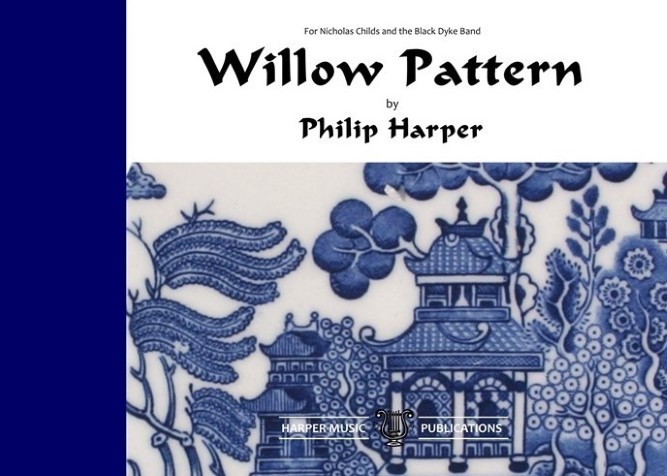
Willow Pattern (Brass Band - Score and Parts) - Harper, Philip
Composed in 2009 for Nicholas Childs and the Black Dyke BandThis piece tells the Willow Pattern legend through music. Several leitmotifs are used both for the different characters and also for some of the important emotions in the tale. Additionally, Knoon-se's part is mainly played by the flugel horn, Chang by the euphonium, the Mandarin by the Eb Bass and the Duke Ta-jin by the trombone.The Willow Pattern Legend:Once, in ancient China, there lived a wealthy and powerful Mandarin who had a beautiful daughter, Knoon-se. She had fallen in love with Chang, a humble accountant, which angered her father who imprisoned her in the Pavilion by the river with only the exotic birds for company. She learnt that the Mandarin planned to marry her to the pompous Duke Ta-jin and that the wedding would take place on the day the blossom fell from the willow tree, so she sent Chang a message: "Gather thy blossom, ere it be stolen". The Duke arrived by sea amid great fanfare when the tree was heavy with bud, and nights of magnificent banquets followed. After one such occasion when the Mandarin slept, Chang crept over the crooked fence and tiptoed into the Pavilion to rescue Knoon-se, but as they escaped the alarm was raised. They fled over the bridge with the Mandarin close on their heels brandishing his whip. They managed to escape by boat to a secluded island where they lived happily for a time. Meanwhile, the Mandarin learned of their refuge and, intent on revenge, he ordered his soldiers to kill them. As Knoon-se and Chang slept at night, the men set fire to the pagoda in which they lived and the lovers perished in the flames. However, the Gods, moved by the lovers' plight, transformed their souls into two turtle-doves which rose from the charred remains, soaring above the Earth, symbolising eternal happiness.Willow Pattern is dedicated to the memory of Jean Harper who passed away as I was completing the piece and who was a great collector of porcelain and china-ware.Duration: 12:00
Estimated dispatch 7-14 working days
-
 £69.99
South Down Pictures (Brass Band - Score and Parts) - Sparke, Philip
South Down Pictures was commissioned by Millenium Brass 2000, an organisation comprising three brass bands from the county of Sussex, England.The bands (Patcham Silver, Hangleton and Brighton Silver) had got together to organise many events to mark the new millennium and these culminated in a concert in Hove Town Hall on July 9th 2000 when all three bands combined to give the first performance of South Down Pictures. The composer spent much of his childhood amongst the South Downs, a range of hills in Sussex which runs parallel to the sea.Opening with a strong unison passage, interrupted briefly by faster figures based on the interval of a fifth, South Down Pictures develops with an often-passionate legato melody. Reaching a climax, this is then followed by the main vivo section of the work, whose main theme is based on the earlier 'fifth' figures. A bridge passage leads to a short chorale figure and a rhythmic climax which dissolves into a plaintive cornet solo over staccato chords. This theme is taken up by the whole band and leads back to a recapitulation of the main theme and earlier material. The cornet tune returns triumphantly in the major key before the opening unison passage reappears to provide a stirring coda.Duration: 5:30
Estimated dispatch 7-14 working days
-
 £76.99
Tango for Joe (Trombone Solo with Brass Band - Score and Parts) - Sparke, Philip
Tango for Joe was written for Joe Alessi, principal trombone of the New York Philharmonic. He gave the official premiere with the Brass Band of Battle Creek on 3rd December 2022 at the W K Kellogg Auditorium in Battle Creek, Michigan.Opening with an (optional) unaccompanied recitative for the soloist, Tango for Joe then develops into a slow and sensuous tango, exploring the lyrical properties of the trombone. The opening of this theme is then taken up by the full band but is soon interrupted by a highly decorated version of the melody by the soloist. A further cadenza-like passage then leads to a faster 'tango nuevo' which makes up the majority of the work.A long introduction by the band builds to the first entry of the soloist, who plays the main tango melody over a rhythmic accompaniment. This is taken up briefly by the band but the soloist enters again with his own variation on the theme. After a bridge passage featuring a brief 'question and answer' exchange between the instruments, the soloist then plays a new version of the opening slow tango theme over rhythmic interpolations. After a climax, the soloist presents a long and elaborate cadenza accompanied only by a solo cajon or drum kit. This eventually leads to a repeat of the main theme and , after a short second cadenza, the piece ends with a flourish for band and soloist.Duration: 8.45
Estimated dispatch 7-14 working days
-
 £54.99
Fanfare for an Occasion (Brass Band - Score and Parts) - Sparke, Philip
Fanfare for an Occasion was written to celebrate the 20th anniversary of the founding of Anglo Music Press, the publishing company dedicated to the works of British composer, Philip Sparke. It is a bright and festive work in which the main theme starts on the tenor instruments of the band before appearing as canonical imitation by all sections in turn. A short, repeated bridge passage leads to a second theme on the horns that is taken up by the full band and leads back to a return of the main theme and a repeat of the second subject, which brings the fanfare to a brilliant close. Duration: 2.00
Estimated dispatch 7-14 working days
-
 £42.95
CU CHULLAIN (Brass Band) - Jenkins, Karl - Small, Tony
from Adiemus iv - The Eternal Knot. Adiemus is an extended choral-type series of works based on European classical tradition, but where the vocal sound is more akin to 'ethnic' or 'world' music. Karl Jenkins ingeniously invented the language used in the entire Adiemus project. Cu Chullain is a movement from ADIEMS iv - The Eternal Knot. Cu Chullain (pronounced 'Koo Kullan') is the foremost hero of the Ulster Cycle, a collection of prose and verse romances which forms one of the major cycles of Irish literature. The epitome of Celtic valour, Cu Chullain is portrayed as the ideal chieftain and defender of his tribe. Possessing extraoridinary powers which he uses solely for the benefit of his people, he forms a bridge between the world of the gods and that of humas. Duration: 4:20 approx
Estimated dispatch 7-14 working days
-
 £30.00
Varushkin
Whilst at the RNCM, Thomas Pitfield asked me to write a set of variations on a Russian folk tune, (the same one used by Tchaikovsky in his Serenade for Strings). Pianist Heather Slade-Lipkin said that it sounded like it should be played by a band!! So here it is! A pretty tune, and a good programme filler."The variations are divided into two sections with an interconnecting bridge. Tim Paton subjects his theme to a number of transions, which includes a 'grand waltz' and comic effects". Rodney Newton
In Stock: Estimated dispatch 3-5 working days
-
 £84.99
Pacific Dreams - Jacob de Haan
Pacific Dreams describes the experience of Miguel, a traveling composer from Spain who, feeling somewhat alienated from his homeland, is wandering through an area of Sydney known as The Rocks. At a small outdoor market in a typical street of this oldcolonial neighbourhood, he discovers a print of William DeShazos painting "Pacific Dreams" Portrayed in the painting is the surf of one of the exotic islands in the Pacific. Next, with the impressive Sydney Harbour Bridge looming over the narrowstreets of The Rocks, he envisions sultry Pacific beaches. Suddenly a theme he once composed about the lakes in Japan comes to him. Is it the Asian influences present in cosmopolitan Sydney that bring this theme to mind? Or perhaps the waters aroundSydney, over which he could sail to Tahiti? He is uncertain. Could this same theme be used to create a new composition about his feelings for the metropolis Sydney? How then to work his Pacific Dreams into the mix? Miguel is certainly no fan ofHawaiian music. Mayby he could use the vocabularies of islands like Hawaii and Tahiti, their beautiful vowel combinations being sung ad libitum by a mixed choir.With these ideas and his newly purchased print of "Pacific Dreams", he boards the Metroat Circular Quay. He has a final glimpse of the harbour and the Sydney Opera House as the train races into the ground. On to the hotel! To work! He must compose!Maestoso : Miguel is impressed as he gazes upon the Sydney Harbour Bridge. And yet, hewants to go away from this city. Away, to an exotic island in the Pacific.Steady Rock : In the Rocks, musicians are playing at a square. Miguel basks in the atmosphere but at the same time he is fantasizing about Hawaii and Tahiti.Andante Lamentoso :In his hotel room, Miguel is feeling sad and lonely in this big city. He takes comfort in his "Pacific Dreams".Allegro : Miguel boards the boat that takes him from Darling Harbour to Circular Quay. In his mind he is traveling on to Hawaii. Or is ithome, where the bolero is playing? He is pulled back to reality by the skyline of Sydney.
Estimated dispatch 5-14 working days
 View Music