
Results
-
 £12.50
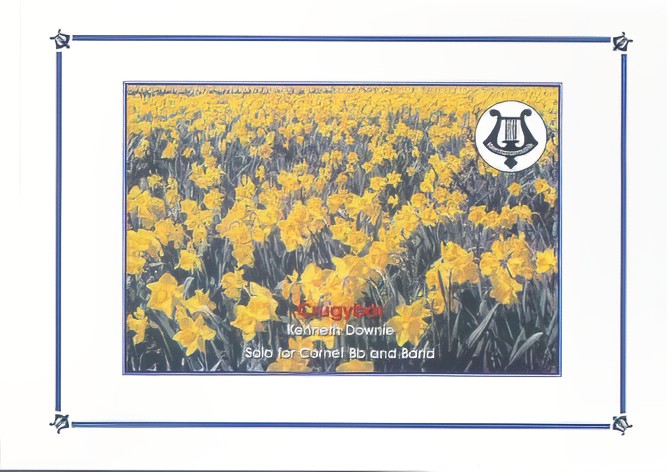
Crugybar - Cornet Solo (Brass Band - Score Only) - Downie, Kenneth
The traditional Welsh tune of Crugybar is most commonly associated with words by Howell Elvet Lewis which appear in the Baptist Hymn Book of 1962; 'The light of the morning is breaking, the shadows are passing away'. The Salvation Army Song Book of 1986 lists two further hymns that can be sung to the tune; 'I stand all bewildered with wonder and gaze on the ocean of love' ( W F Crafts) and 'When Jesus from Calvary called me, unfolding its meaning to me' (Will J Brand). This arrangement was made for Martyn Bryant, the long-serving principal cornetist of Bristol Easton Band of The Salvation Army.
Estimated dispatch 7-14 working days
-
 £45.00
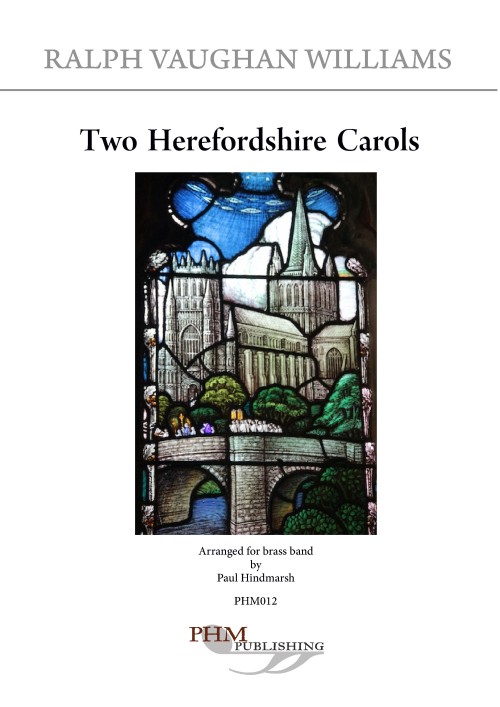
Two Herefordshire Carols (Brass Band - Score and Parts) - Vaughan Williams, Ralph - Hindmarsh, Paul
The two traditional tunes that comprise this straightforward setting were sung to Ralph Vaughan Williams (1872-1958) by Mrs. Esther Smith of Dilwyn, near Hereford, during one of the great composer's folk song collecting tours of England in the early years of the twentieth century. They were included in Twelve Traditional Carols from Herefordshire, edited by E.M. Leather and Vaughan Williams. The words to which Mrs. Smith sung the first tune were probably drawn from eighteenth century evangelical sources. The editors replaced these with six of the 16 verses of a traditional seventeenth century carol text, Joseph and Mary.The second melody, which appears as the centre piece of this arrangement, was sung to a carol that tells of a farmer who ploughed on Christmas Day. It is in fact a translation of a German traditional carol Gelobet seist du Jesu Christ that was published in Goodly Psalmes and Spiritualle Songes (1546) translated by Miles Coverdale. Vaughan Williams used the title Coverdale's Carol.The brass band settings follow the settings made by Vaughan Williams in 1920 for the Oxford Book of Carols. Since his simple harmonic approach is similar in both settings, three verses of his haunting version of Coverdale's Carol have been folded inside four verses of the slightly more animated treatment of Joseph and Mary. The harmonisations of Vaughan Williams have been given some brass band colour, with some verses taken by soloists from the ensemble. The accompaniment figuration that embellishes the second verse of Joseph and Mary has been used to open and close this arrangement and to bind the verses together.- Paul HindmarshDuration: 5.00
Estimated dispatch 7-14 working days
-
 £34.95
The Covenanters (Brass Band - Score and Parts) - Downie, Kenneth
In 1638, many members of the Presbyterian Church of Scotland signed a document called the National Covenant. By doing so, they were declaring that they acknowledged only Jesus Christ as the spiritual head of their church, and not any king or queen. This had become necessary because the Stuart kings believed in the Divine Right of Monarchs and saw themselves as head of the church. In the previous year, Charles I had forcibly introduced the Book of Common Prayer, invoking the wrath of the common people who faced the threat of torture, transportation or execution if they did not use the new liturgy and worship at their local church. The net result of this was that many met illegally in the countryside or in barns and large houses. These meetings became known as 'conventides' and many took place in the south-west of the country. Anyone caught attending was at risk of execution by the muskets of the dragoons who were employed in the area for that specific purpose. This music was written to honour the bravery and loyalty of these Christians to their faith, in the face of extreme danger, in the hope that it will inspire us also to be faithful. There are overtones of military threat, secrecy and solidarity. An old pentatonic tune is used, which the composer heard as a boy being sung to the words The Lord's My Shepherd.
Estimated dispatch 7-14 working days
-
£17.50
The Covenanters (Brass Band - Score only) - Downie, Kenneth
In 1638, many members of the Presbyterian Church of Scotland signed a document called the National Covenant. By doing so, they were declaring that they acknowledged only Jesus Christ as the spiritual head of their church, and not any king or queen. This had become necessary because the Stuart kings believed in the Divine Right of Monarchs and saw themselves as head of the church. In the previous year, Charles I had forcibly introduced the Book of Common Prayer, invoking the wrath of the common people who faced the threat of torture, transportation or execution if they did not use the new liturgy and worship at their local church. The net result of this was that many met illegally in the countryside or in barns and large houses. These meetings became known as 'conventides' and many took place in the south-west of the country. Anyone caught attending was at risk of execution by the muskets of the dragoons who were employed in the area for that specific purpose. This music was written to honour the bravery and loyalty of these Christians to their faith, in the face of extreme danger, in the hope that it will inspire us also to be faithful. There are overtones of military threat, secrecy and solidarity. An old pentatonic tune is used, which the composer heard as a boy being sung to the words The Lord's My Shepherd.
Estimated dispatch 7-14 working days
-
£42.95
WHEREVER YOU ARE (Brass Band) - Mealor, Paul - Stubbs, Duncan
Commissioned by Gareth Malone for Series Four of BBC TV's 'The Choir' and first performed by Malone and The Military Wives Choir as part of The Royal British Legion's Festival of Remembrance at the Royal Albert Hall on 12 November 2011, in the presence of Her Majesty The Queen. The text is taken from poems, letters and prayers written by the Military Wives, selected and adapted by Paul Mealor, and a passage from the Book of John. Selling a staggering 556,000 copies in the week leading up to Christmas, more than the rest of the Top 12 combined, Wherever You Are became the UK's Official Christmas No. 1 of 2011. A wind band version is also available. A contribution from the sales of the sheet music will be donated to the two nominated charities: The Royal British Legion and SSAFA Forces Help.
Estimated dispatch 7-14 working days
-
 £35.00
Nimrod (from Enigma Variations) (Brass Band - Score and Parts) - Elgar, Edward - Littlemore, Phillip
Elgar wrote his Enigma Variations between 1898 and 1899. It is without a doubt Elgar's best-known large scale composition, and is dedicated to 'my friends within', as each variation is an affectionate portrayal of one of his circle of close acquaintances. The ninth variation, Nimrod, is dedicated to Augustus J. Jaeger, Elgar's publisher at Novello & Co. and also his editor and close friend. The name of the variation refers to 'the mighty hunter before the Lord' and can be found in the Book of Genesis. The name J?ger is German for hunter. Often used for solemn occasions, it is the most poignant and beautiful pieces of British music. Duration: 4:00
Estimated dispatch 7-14 working days
-
 £99.99
Compostela (Brass Band - Score and Parts) - Deleruyelle, Thierry
The Way of St. JamesFour roads lead to Santiago, so begins the Book of the Pilgrim. Written in the 12th century, the Codex Calixtinus opened the way for pilgrimage from most cities in Europe and North Africa to Santiago de Compostela, in Spain. Compostela - The Way of St James describes the pilgrims' journey. After a slow introduction, a brilliant theme announces the start of the journey. The arrival in Spain is indicated by incantatory chants and majestic chords. Finally, the music softens as the pilgrims venerate St James.Duration: 11.00
Estimated dispatch 7-14 working days
-
 £35.00
Gloria in Excelsis Deo (Brass Band - Score and Parts) - McKenzie, Jock
This carol was written by James Montgomery. It was first published in a local newspaper - the Sheffield Iris on Christmas Eve in 1816. Originally sung to a number of melodies, the music most associated with this carol is a French melody 'Iris'. The refrain 'Gloria in Excelsis Deo' was added in the version published in 'The Oxford Book of Carols' (1928), thus establishing the most widely recognised version of this carol. Duration: 4.00
Estimated dispatch 7-14 working days
-
 £118.99
Abaddon (The Dark Angel) (Brass Band - Score and Parts) - Houben, Kevin
Abaddon was commissioned by the NLBB (Noord-Limburgse Brassband - North Limburg Brass Band) from Belgium. Abaddon is the demon reigning over the underworld. In the New Testament - in the Book of Revelation by John (9:11) - he is called the angel of the bottomless pit. The work Abaddon lives up to its name. Technically and physically, it holds an enormous challenge for every band in the champions division. The composition has a traditional form structure (fast-slow-fast), and it consists of ornamentations around the letters IVAN, after Ivan Meylemans, the conductor who since 2001 has obtained great successes with the NLBB, and who in this case has also been essential in taming the demon in Abaddon.Suitable for Championship Section BandsDuration: 14:15
Estimated dispatch 7-14 working days
-
 £19.99
All Tuned Up - A4 Size Parts
120 Famous Tunes for All Occasions for Flexible Ensembles of Brass and WoodwindAll Tuned Up is designed to cater for ensembles for occasions throughout the year. Tunes are drawn from genres including Classical, Hymns, Folk and Patriotic amongst many others to form a comprehensive book that will cover a wide variety of events such as Weddings, Funerals, Graduation Ceremonies, Parties, Proms, Remembrance, Street Playing and Thanksgiving.Playable by as few as five players but also designed to work for full brass band or wind band, it features flexible parts in a wide variety of transpositions. These excellent arrangements have been expertly created by Andrew Wainwright, David E. Jones, Dean H. Jones and Steven Ponsford.The general harmonic format of All Tuned Up is in five parts, although additional notes have been included to thicken the harmony where more players are available. Therefore, the book will work equally well with larger groups, including full brass bands and wind bands.The following parts are available (in both A4 and Marchcard sizes):Part 1 in Bb: Cornet/Trumpet, Clarinet, Flugel Horn, Soprano SaxophonePart 1 in C: Piccolo, Flute, OboePart 1 in Eb (optional part): Soprano Cornet/Eb Trumpet, Eb ClarinetPart 2 in Bb: Cornet/Trumpet, Clarinet, Flugel HornPart 2 in Eb: Tenor Horn, Alto Saxophone, Alto ClarinetPart 2 in F: French Horn, Cor AnglaisPart 3 in Bb: Baritone TC, Trombone TC, Euphonium TC, Tenor SaxophonePart 3 in C BC: Baritone BC, Trombone BC, Euphonium BCPart 3 in Eb: Tenor Horn, Alto Saxophone, Alto ClarinetPart 3 in F: French Horn, Cor AnglaisPart 4 in Bb: Euphonium TC, Baritone TC, Tenor SaxophonePart 4 in C BC: Euphonium BC, Baritone BC, BassoonPart 5 in Bb: Bb Bass, Bass ClarinetPart 5 in C BC: Tuba, Bassoon, String BassPart 5 in Eb: Eb Bass, Baritone SaxophonePercussion (optional part)
Estimated dispatch 7-14 working days
 View Music