
Results
-
 £38.95
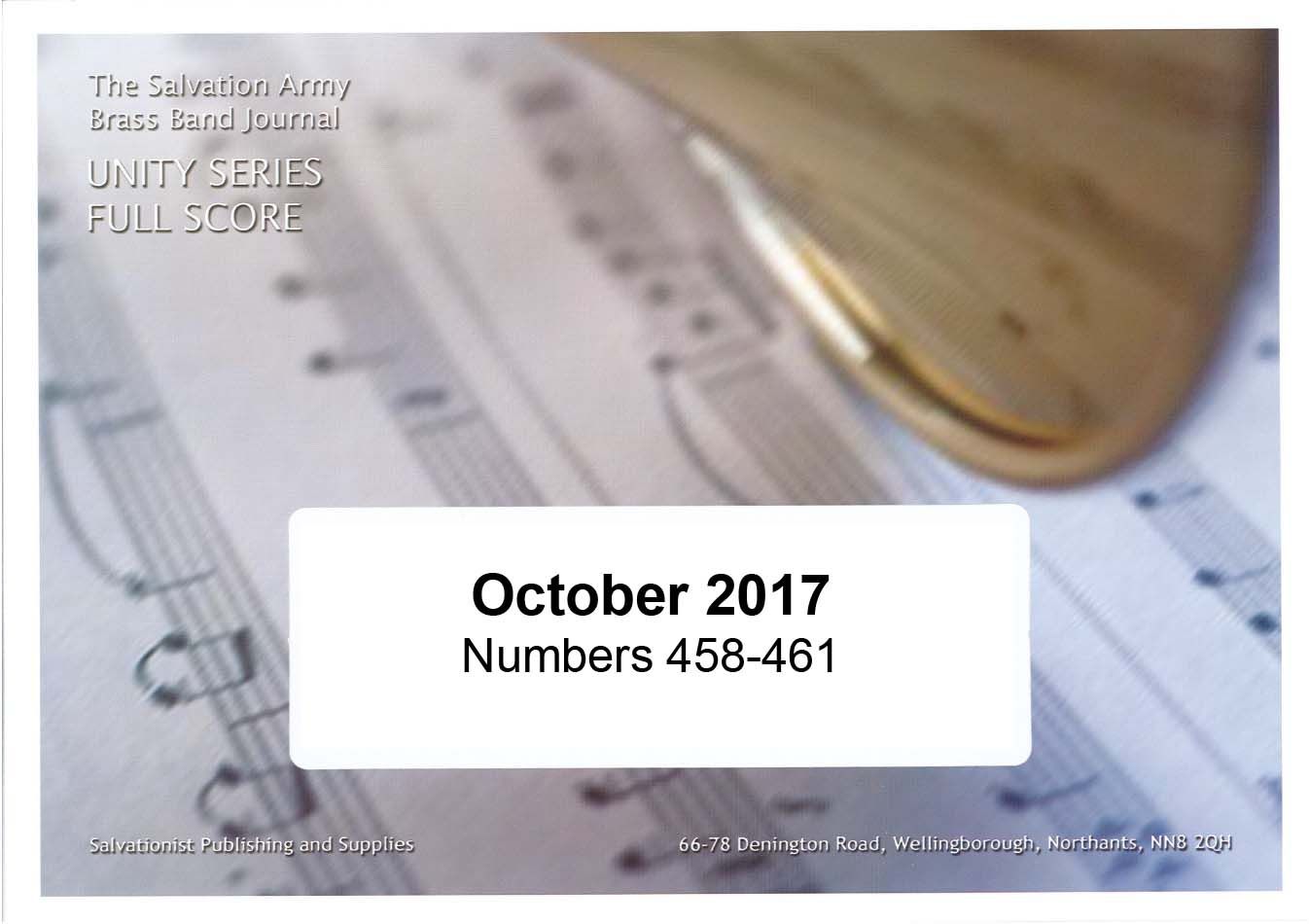
Unity Series Band Journal October 2017 Numbers 458-461
March Medley I Believe (Noel Jones)This potpourri of songs brings the strong assurance of faith and hope together in an attractive and enjoyable manner. The tunes featured are 'I believe we shall win', 'I believe God answers prayer', 'I believe in God the Father' and 'I believe in the word of God'.Horn Solo - Promises (Jorgen Ljserdorn)This is a brass setting of a song by Captain Matthew Spencer with the same title. The contemporary setting is simple in design and should prove to be popular amongst many who feature this journal.Suite Like a melody (Steve Forman)Major Stephen Foreman has written a short suite which will bring an easy yet attractive addition to most band's repertoire. I am praying (Jared Proellocks)A contemporary setting of the much loved chorus 'I am praying blessed Saviour' written by a young Salvationist from the Australian Southern Territory.
Estimated dispatch 7-14 working days
-
 £59.95
Judd: At the Edge of Time
This work was commissioned for the Camberwell Citadel Salvation Army Band's 1982 tour of the USA, Great Britain and Europe. The title relates to Jesus' promise that he will return as Lord and King enternal. Christians, in faith, await his Second Coming and their faith is reflected in the strong tune of the first movement.The featured tune is that of St Magnus with which the words associated are 'The Lord will come and not be slow.'
Estimated dispatch 7-14 working days
-
 £34.95
Of Wind and Weeping (Flugel Horn Solo)
Flugel Horn Solo with Brass BandThe relationship between Achilles and Patroclus is a key element of the myths associated with the Trojan war.. Its exact nature has been a subject of dispute in both the classical period and modern times. In the Iliad, the two heroes have a deep and meaningful friendship. Achilles is tender towards Patroclus, while he is callous and arrogant towards others.Of Wind & Weeping (2015) is a flugel solo, with the soloist representing Greek warrior Achilles and the pain he faces following the death of Patroclus. For a brief moment, Achilles' character shifts from a strong and unbreakable warrior to an emotional and vulnerable character. The solo should be played with expression and feeling, a character who is mourning a loved one with mixed feelings of sadness, shock and vengeance.The work was written in early 2015 for flugel soloist David James and Tongwynlais Temperance Band, with whom he is a member.
Estimated dispatch 7-14 working days
-
 £44.95
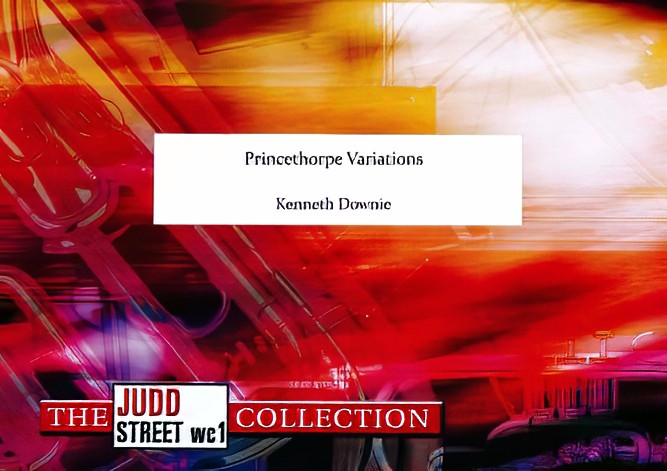
Princethorpe Variations (Brass Band - Score and Parts) - Downie, Kenneth
Colourful harmony, rhythmic flair and melodic invention are the hallmarks of this excellent set of variations by Kenneth Downie, based on the well known church tune, Princethorpe.This major work demonstrates the well-known characteristics of the composer: colourful harmony, rhythmic flair and melodic invention, all encapsulated in scoring which is engulfing both to players and listeners alike. Following a presentation of the theme there are five variations culminating in what can be described as either a finale or coda.Theme. The composer shows his originality in the harmonic sense of this introduction. Perhaps it could be suggested that over-indulgence of rubato may be a temptation to be avoided.Sections A to F. Relentless rhythmic drive is of paramount importance in this first variation. Conscientious observance of dynamics is of course an essential requirement in conveying the exciting quality of the music; there are moments of sudden contrast of which all will need to be aware. Moving between the time-signatures of 5/4 and 6/4 these sections are built from strong easily-identifiable fragments of the theme. These is a significant increase in temp at letter F which will further the exciting impact of the music.Sections G & H. In a pastorale style this short, gentle variation affords a contrast in style between the previous and succeeding ones. The gentle undulating character of the melodic lines is governed by the Allegretto grazioso directive.Sections I to M. Commencing two bars before letter I the music is now exuberant and the tempo and style is that of a march in compound time. In this exhilarating movement there are moments of contrast and indeed of delicacy which are a foil to the more energetic moments. Rhythmic control will be essential to maintain a consistent tempo. As elsewhere in the work, the percussion section will contribute much to the success of the performance there are bars where this section alone is heard and there are important entries for glockenspiel.Sections N & O. With emotional content this Adagio variation has the first two notes of the melody as its melodic impetus. Apart from just over two bars at O (where there is an interpolatory phrase from Cornets and Trombones), the melodic line is entrusted to the plaintive sounds of the horn section. Cornets and Trombones provide a change of tone colour at the beginning of section O. Under a poco rall, this very expressive variation is concluded; there is an important link supplied by Eb Bass.Sections P & Q. A lively march-tempo is launched immediately and these sections are in the nature of an introduction to the final variations. There is a quickening of pace at Q which assists the generation of excitement which should be an essential part of the performance. Solo Cornets introduce a melodic line at Q which anticipates the compound time of the following section.Sections R & S. The Solo Cornet theme of the previous section is now a contrapuntal line accompanying the theme tune. With an elongation of the notes in the melody, the conductor will need to call on the sustaining powers of the band and at no time should the interesting accompanying lines be allowed to detract from the sonorous presentation of the basic theme.Sections T, U & V. Following a poco rit, the finale begins at letter T with the directive, molto vivace. There is much detail to be rehearsed, not least being the dynamic contrasts which are encountered. As throughout the work, the listener should have no difficulty in identifying the thematic sources of the composer's music.
Estimated dispatch 7-14 working days
-
£22.50
Princethorpe Variations (Brass Band - Score only) - Downie, Kenneth
Colourful harmony, rhythmic flair and melodic invention are the hallmarks of this excellent set of variations by Kenneth Downie, based on the well known church tune, Princethorpe.This major work demonstrates the well-known characteristics of the composer: colourful harmony, rhythmic flair and melodic invention, all encapsulated in scoring which is engulfing both to players and listeners alike. Following a presentation of the theme there are five variations culminating in what can be described as either a finale or coda.Theme. The composer shows his originality in the harmonic sense of this introduction. Perhaps it could be suggested that over-indulgence of rubato may be a temptation to be avoided.Sections A to F. Relentless rhythmic drive is of paramount importance in this first variation. Conscientious observance of dynamics is of course an essential requirement in conveying the exciting quality of the music; there are moments of sudden contrast of which all will need to be aware. Moving between the time-signatures of 5/4 and 6/4 these sections are built from strong easily-identifiable fragments of the theme. These is a significant increase in temp at letter F which will further the exciting impact of the music.Sections G & H. In a pastorale style this short, gentle variation affords a contrast in style between the previous and succeeding ones. The gentle undulating character of the melodic lines is governed by the Allegretto grazioso directive.Sections I to M. Commencing two bars before letter I the music is now exuberant and the tempo and style is that of a march in compound time. In this exhilarating movement there are moments of contrast and indeed of delicacy which are a foil to the more energetic moments. Rhythmic control will be essential to maintain a consistent tempo. As elsewhere in the work, the percussion section will contribute much to the success of the performance there are bars where this section alone is heard and there are important entries for glockenspiel.Sections N & O. With emotional content this Adagio variation has the first two notes of the melody as its melodic impetus. Apart from just over two bars at O (where there is an interpolatory phrase from Cornets and Trombones), the melodic line is entrusted to the plaintive sounds of the horn section. Cornets and Trombones provide a change of tone colour at the beginning of section O. Under a poco rall, this very expressive variation is concluded; there is an important link supplied by Eb Bass.Sections P & Q. A lively march-tempo is launched immediately and these sections are in the nature of an introduction to the final variations. There is a quickening of pace at Q which assists the generation of excitement which should be an essential part of the performance. Solo Cornets introduce a melodic line at Q which anticipates the compound time of the following section.Sections R & S. The Solo Cornet theme of the previous section is now a contrapuntal line accompanying the theme tune. With an elongation of the notes in the melody, the conductor will need to call on the sustaining powers of the band and at no time should the interesting accompanying lines be allowed to detract from the sonorous presentation of the basic theme.Sections T, U & V. Following a poco rit, the finale begins at letter T with the directive, molto vivace. There is much detail to be rehearsed, not least being the dynamic contrasts which are encountered. As throughout the work, the listener should have no difficulty in identifying the thematic sources of the composer's music.
Estimated dispatch 7-14 working days
-
 £104.99
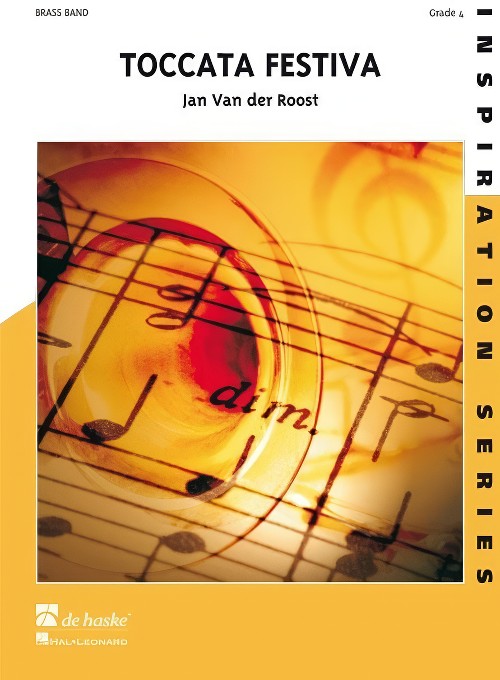
Toccata Festiva (Brass Band - Score and Parts) - Van der Roost, Jan
Toccata Festiva was commissioned in 1994 by the Dutch Brass Band Championships. The wind band version was made a year later by the composer himself. Historically speaking, the toccata is considered to be one of the first independent instrumental forms for keyboard instruments. Originally the toccata was typically more or less improvised, later this musical form was given a more regulated structure. Both elements are used in the Toccata Festiva: on the one hand the different themes are developed freely, on the other, the piece has an orderly structure. It is in a three part form (quick-slow-quick) and includes both strong rhythmical figures and broad melodic lines. Part of the composition is written in a more or less archaic tone idiom, referring to the period from which the toccata form originates (16th century).Duration: 13:30
Estimated dispatch 7-14 working days
-
 £59.95
John O'Gaunt (Overture) (Brass Band - Score and Parts) - Vinter, Gilbert
Concert Overture for Brass BandIn the year 1340 in the town of Ghent, a son was born to Edward III King of England and his Queen Phillipa. The boy, afterwards known as John O'Gaunt (Ghent) grew up to be a warrior and before he was 20 he was fighting in France beside his brother, the Black Prince. For many years he was occupied with the wars in France and Spain and was seldom in England. His first two marriages brought him great riches and position, but the love of his life was Catherine Swynford, who bore him four children. Whilst he was away , his Palace of Savoy was burnt to the ground by the mob during the Peasant's Revolt. Finally in 1394 he returned home and married Catherine, for whom he felt a strong affection since her first marriage in St. Clement Danes Church in the Strand, many years before. The Beaufort children were thus legitimised and from them sprang a long line of English Kings and Queens.Duration: 9:30Recorded on Polyphonic QPRL068D Triumphant Rhapsody
Estimated dispatch 7-14 working days
-
£29.95
John O'Gaunt (Overture) (Brass Band - Score only) - Vinter, Gilbert
Concert Overture for Brass BandIn the year 1340 in the town of Ghent, a son was born to Edward III King of England and his Queen Phillipa. The boy, afterwards known as John O'Gaunt (Ghent) grew up to be a warrior and before he was 20 he was fighting in France beside his brother, the Black Prince. For many years he was occupied with the wars in France and Spain and was seldom in England. His first two marriages brought him great riches and position, but the love of his life was Catherine Swynford, who bore him four children. Whilst he was away , his Palace of Savoy was burnt to the ground by the mob during the Peasant's Revolt. Finally in 1394 he returned home and married Catherine, for whom he felt a strong affection since her first marriage in St. Clement Danes Church in the Strand, many years before. The Beaufort children were thus legitimised and from them sprang a long line of English Kings and Queens.Duration: 9:30Recorded on Polyphonic QPRL068D Triumphant Rhapsody
Estimated dispatch 7-14 working days
 View Music