
Results
-
 £59.95
Judd: The Holy War
Inspired by John Bunyan's allegory of the same name, the composer paints a sound picture of spiritual warfare between the forces of good and evil. Martin Luther's Reformation chorale Ein feste Burg (A Mighty Fortress is our God) serves as the rallying point for 'good' forces led by Mansoul. This brilliant score, A Salvation Army epic, serves as an example of marvellous invention, colourful scoring and compact formal symmetry.
Estimated dispatch 7-14 working days
-
 £24.95
Judd: The Invincible Army
When the New York Staff Band toured England in 1960 they featured much new music written for them by Erik Leidzen, including this march. The trio section is in the unusual key (brass band pitch) of Db major, a major third away from the opening key of F major, rather than the more predictable subdominant of Bb major. This presents a technical and mental challenge to the players but provides a particularly brilliant sonority when played in tune!
Estimated dispatch 7-14 working days
-
 £57.99
Hymn to the Fallen (Brass Band - Score and Parts)
Saving Private Ryan is certainly one of Steven Spielberg's most powerful films. The brilliant John Williams score creates part of this power. Hymn to the Fallen one of the most powerful and emotional melodies which appears during the closing credits, evokes a feeling of hope and strength amid the overall tone of reverence. Philip Sparke has transcribed this moving work for brass band using John Williams original orchestral score as the source.Duration: 6:00American Grade 4Recorded on Anglo AR 015-3 The Bandwagon
Estimated dispatch 7-14 working days
-
 £104.99
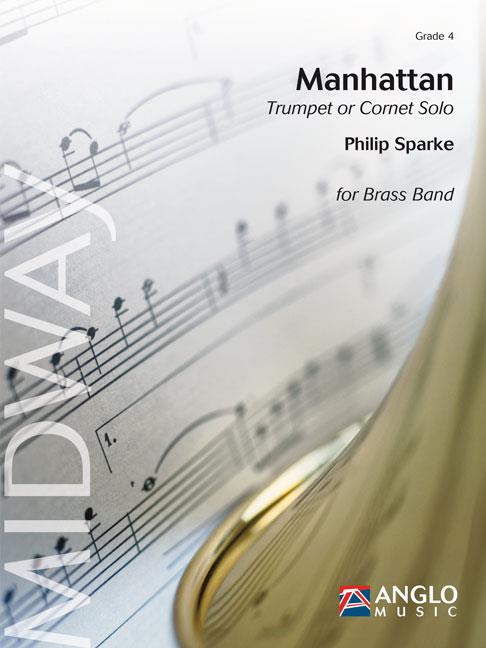
Manhattan (Cornet Solo with Brass Band - Score and Parts)
Cornet or Trumpet Solo with Brass BandManhattan was commissioned by the United States Army Band for their solo cornet player Woodrow English and first performed by them in Carnegie Hall, New York, in November 2003. The two-movement work demonstrates both the lyrical and technical abilities of this outstanding player. The 'theme' is a weekend in New York and the opening bluesy movement, Saturday Serenade, describes the city on a Saturday night. While writing Sunday Scherzo, the composer pictured an early morning jog in Central Park. This vivaciously rhythmic second movement ends with an even quicker coda bringing the work to a brilliant close. Each movement can also be played individually when a shorter solo is required.Duration: 9:30
Estimated dispatch 7-14 working days
-
 £37.95
Benvenuto Cellini (Brass Band - Score only)
Berliozs opera Benvenuto Cellini was first produced in Paris in 1838 but was withdrawn as a failure, and it was not until the production in Dresden in 1888 that it was finally acclaimed by the Germans as a triumph. Adapted from certain episodes recorded in the memoirs of Benvenuto Cellini, Tuscan sculptor and goldsmith, the story, laid in Rome during the mid-sixteenth century, is not strictly historical. The short opening Allegro, marked deciso con impeto, is conceived in the most brilliant Berlioz manner, utilising full instrumentation. In the Larghetto we meet at once the first of the opera themes " the Cardinals aria (from the last act) introduced in the bass, quasi pizzicato. A second melody leads to a resumption of the Allegro, the contrasting second subject in the tenor horns being an adaptation of Teresas aria (Act I). Towards the end the Cardinal theme is re-introduced by trombones, fortissimo against an energetic cornet and euphonium passage (senza stringendo " without hurry, says the score). After a unison passage storming skywards, there is a sudden, dramatic three-bar silent pause broken by Eb basses alone, again stating the Cardinal theme. A simple molto crescendo on the dominant, begun piano, leads to the long, resounding chord.
Estimated dispatch 7-14 working days
-
 £82.95
Benvenuto Cellini (Brass Band - Score and Parts)
Berliozs opera Benvenuto Cellini was first produced in Paris in 1838 but was withdrawn as a failure, and it was not until the production in Dresden in 1888 that it was finally acclaimed by the Germans as a triumph. Adapted from certain episodes recorded in the memoirs of Benvenuto Cellini, Tuscan sculptor and goldsmith, the story, laid in Rome during the mid-sixteenth century, is not strictly historical. The short opening Allegro, marked deciso con impeto, is conceived in the most brilliant Berlioz manner, utilising full instrumentation. In the Larghetto we meet at once the first of the opera themes " the Cardinals aria (from the last act) introduced in the bass, quasi pizzicato. A second melody leads to a resumption of the Allegro, the contrasting second subject in the tenor horns being an adaptation of Teresas aria (Act I). Towards the end the Cardinal theme is re-introduced by trombones, fortissimo against an energetic cornet and euphonium passage (senza stringendo " without hurry, says the score). After a unison passage storming skywards, there is a sudden, dramatic three-bar silent pause broken by Eb basses alone, again stating the Cardinal theme. A simple molto crescendo on the dominant, begun piano, leads to the long, resounding chord.
Estimated dispatch 7-14 working days
-
 £40.00
Blue-Sleeve Step (Score and Parts)
This is a big band style number which is modelled on Barrie Gott's brilliant Lightwalk. It begins with a walking bass before horns state the highly whistleable tune for the first time. The full band quickly joins and there is an extended solo break for cornet. A tiptoeing tuba solo precedes the final key change which propels the piece to its infectiously foot-tapping conclusion.
Estimated dispatch 7-14 working days
-
 £59.50
El Camino Real (A Latin Fantasy)
El Camino Real (literally "The Royal Road" or "The King's Highway") was commissioned by, and is dedicated to, the 581st Air Force Band (AFRES) and its Commander, Lt. Col. Ray E. Toler. Composed during the latter half of 1984 and completed in early '85, it bears the subtitle: "A Latin Fantasy."The music is based on a series of chord progressions common to countless generations of Spanish flamenco (and other) guitarists, whose fiery style and brilliant playing have captivated millions of music lovers throughout the world. These progressions and the resulting key relationships have become practically synonymous with what we feel to be the true Spanish idiom. Together with the folk melodies they have underscored, in part derived by a procedure known to musicians as the "melodizing of harmony," they have created a vast body of what most people would consider authentic Spanish music.The first section of the music is based upon the dance form known as the Jota, while the second, contrasting section is derived from the Fandango, but here altered considerably in both time and tempo from its usual form. Overall, the music follows a traditional three-part pattern: fast-slow-fast.The first public performance of El Camino Real took place on April 15th, 1985 in Sarasota, Florida, with the 581st Air Force Band under the direction of Lt. Col. Ray E. Toler.This arrangement for brass band has been made by Frode Rydland.
Estimated dispatch 7-14 working days
-
 £19.50
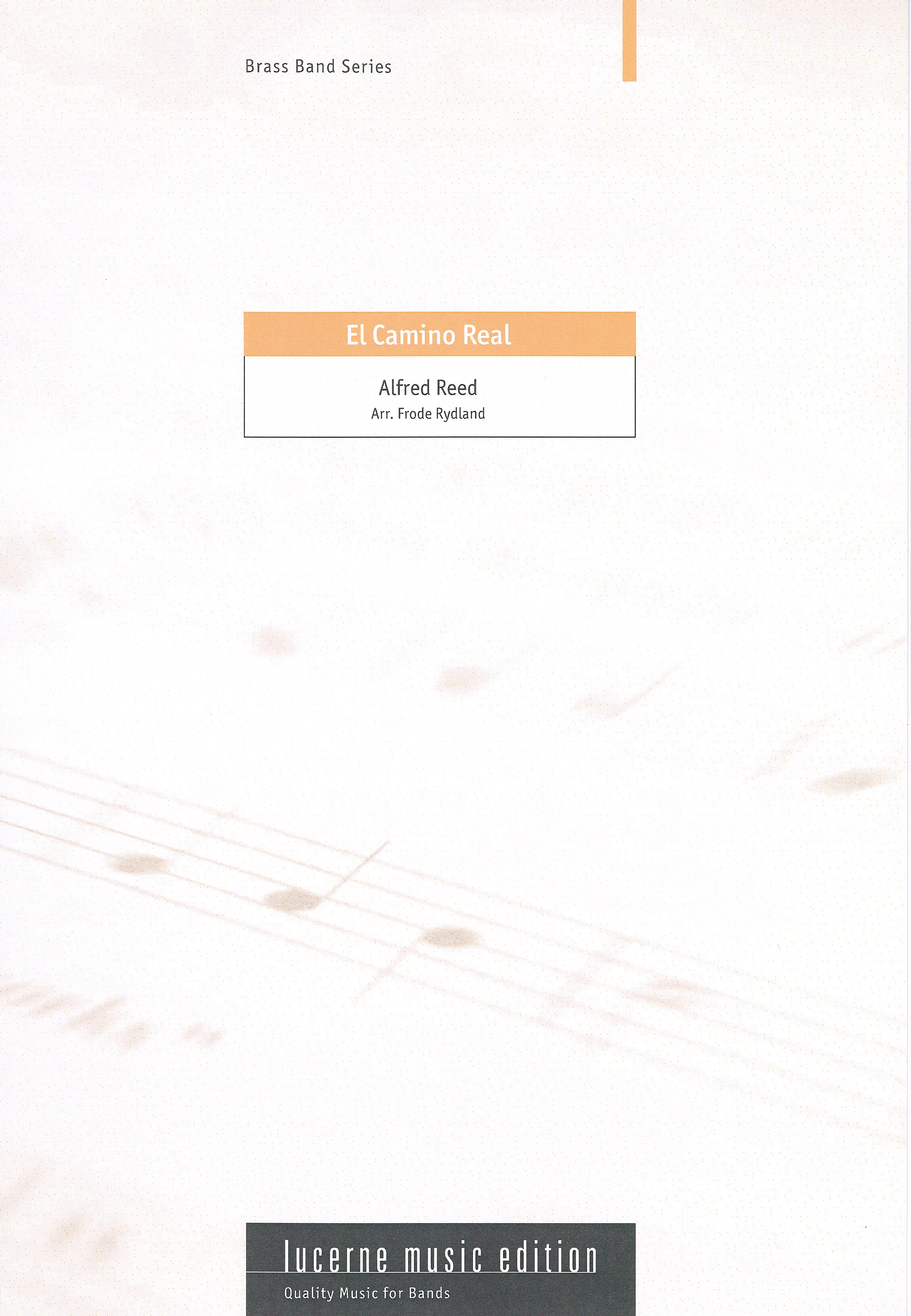
El Camino Real (Score Only)
El Camino Real (literally "The Royal Road" or "The King's Highway") was commissioned by, and is dedicated to, the 581st Air Force Band (AFRES) and its Commander, Lt. Col. Ray E. Toler. Composed during the latter half of 1984 and completed in early '85, it bears the subtitle: "A Latin Fantasy."The music is based on a series of chord progressions common to countless generations of Spanish flamenco (and other) guitarists, whose fiery style and brilliant playing have captivated millions of music lovers throughout the world. These progressions and the resulting key relationships have become practically synonymous with what we feel to be the true Spanish idiom. Together with the folk melodies they have underscored, in part derived by a procedure known to musicians as the "melodizing of harmony," they have created a vast body of what most people would consider authentic Spanish music.The first section of the music is based upon the dance form known as the Jota, while the second, contrasting section is derived from the Fandango, but here altered considerably in both time and tempo from its usual form. Overall, the music follows a traditional three-part pattern: fast-slow-fast.The first public performance of El Camino Real took place on April 15th, 1985 in Sarasota, Florida, with the 581st Air Force Band under the direction of Lt. Col. Ray E. Toler.This arrangement for brass band has been made by Frode Rydland.
Estimated dispatch 7-14 working days
-
 £89.95
Revelation (Score and Parts)
Symphony for Double Brass on a theme of Purcell 1995 marked the tercentenary of Purcell's death, and my new score Revelation has been written as a tribute to his music and the ornate and confident spirit of his age. There are five major sections: 1 Prologue 2 Variations on a ground bass I 3 Fugue 4 Variations on a ground bass II 5 Epilogue and Resurrection The score uses many features of the Baroque Concerto Grosso, and arranges players in two equal groups from which soloists emerge to play in a variety ofvirtuoso ensembles. It quotes freely from Purcell's own piece Three Parts on a Ground in which he has composed a brilliant sequence of variations over a repeating six-note bass figure. This original motif can be heard most clearly beneath the duet for Cornet 5 and Soprano at the beginning of the 2nd section. There is, of course, a religious dimension to Revelation as the title suggests, and the score is prefaced by lines by the 17th century poet John Donne. His Holy Sonnet paraphrases the Book of Revelation in which the dead are raised at the sounds of the last trumpet. Donne's trumpets are themselves placed stereophonically ". . . At the round Earth's imagined corners" and it is this feature that today's players represent as they move around the performing area. Their final apocalyptic fanfares can be heard at the close of the score, as Purcell's music re-enters in a lasting tribute to England's first composer of genius. Philip Wilby September 1995 At the round Earth imagined corners, blow your trumpets, angels, and arise, arise from death, you numberless infinities Of souls, and to your scattered bodies go. All whom the flood did, and fire shall o 'erthrow All whom war, dearth, age, agues, tyrannies, Despair, law, chance hath slain, and you whose eyes Shall Behold God, and never taste death woe. John Donne after Revelation Ch. 11 v.15
Estimated dispatch 7-14 working days