
Results
-
 £33.43
Les Chasseresses from 'Sylvia' (Brass Band) Delibes arr. Rob Bushnell
Clement Philibert Leo Delibes was a French composer, best known for his ballets and operas, including works such as Lakme (with its famous "Flower Duet"), Coppelia and Sylvia (both key works in the development of modern ballet). The latter started as a play, Aminta, by the Italian poet Torquato Tasso, which Delibes set to music. It was then adapted for the Paris Opera with rehearsals starting in August 1875. The premiere took place on 14 June 1876 and was the first ballet to be shown at the newly-built Opera Garnier. Whilst the scenery and costumes were created by top artists and designers (Cheret and Lacoste), it was Delibes's music that shown thrown, being said to have saved the production, preventing the ballet from drifting into obscurity.Sylvia is said to be one of the first modern ballets, with Tchaikovsky remarking to composer Sergei Taneyev upon its ingenuity: "... the first ballet, where the music constitutes not only the main, but the only interest. What charm, what elegance, what richness of melody, rhythm, harmony." Although Swan Lake, a contemporary to Sylvia, is considered one of the best ballets there is, Tchaikovsky preferred Sylvia to his own work, saying Swan Lake was "poor stuff in comparison". Tchaikovsky said to Taneyev, "I was ashamed. If I had known this music early then, of course, I would not have written Swan Lake". The music to Sylvia, rather than setting only the mood, also sets the action and is noted for its use of leitmotifs - Delibes was an admirer of Wagner - and more dominant use of brass and wind. The most famous piece from this ballet is the Pizzicati in the third act.Act I of the ballet takes place in sacred wood, where creatures are worshipping before Eros when Sylvia arrives with her huntresses to mock the god of love. Aminta, a lowly shepherd and infatuated with Sylvia, protects the deity and Sylvia is wounded by Eros's arrow. The hunter Orion kidnaps Sylvia, whilst Eros revives Aminta. Act II takes place in Orion's Island cave, where Sylvia tries to bribe Orion with jewels and wine. Unsuccessful, she appeals to Eros for help, who arrives and takes her to the temple of Diana (where the final act takes place). Orion and Aminta fight, Sylvia and Orion cause the goddess of the hunt, Diana, to be outraged, smiting Orion and denying the love of Aminta and Sylvia. Eros shows Diana a vision, which changes her mind and the couple finally come together.This brilliant and lively fanfare that introduces the huntresses in the first act is arranged here for the UK-style brass band, with alternative parts for horns in F and bass-clef lower brass. The piece has been lowered by a tone compared to the original.A recording of the original composition can be found here https://youtu.be/6yoGrUH38PI?si=0L0bFa1qXnYNvkR3Duration: Approx. 3.10 minutesDifficulty Level: 1st Section +This PDF download includes the full score and parts. Includes alternative parts for soloist in Eb, horns in F and lower brass in bass clef.Sheet music available at www.brassband.co.uk (UK) or https://satradecentral.org (USA)Instrumentation:Soprano Cornet EbSolo Cornet BbRepiano Cornet Bb2nd Cornet Bb3rd Cornet BbFlugel Horn BbSolo Horn Eb1st Horn Eb2nd Horn Eb1st Baritone Bb2nd Baritone Bb1st Trombone Bb2nd Trombone BbBass TromboneEuphonium BbBass EbBass BbTimpaniPercussion - Triangle, Cymbal & Bass Drum
In Stock: Estimated dispatch 1-3 working days
-
£225.00
Prillar&Halling - for Solo Clarinet and Wind Band - Stig Nordhagen
"Prillar" has it's origin from Norwegian folklorist music. It's a way of calling and singing the cattle home from the fields. Halling is a wellknown folk dance from the valleys in the eastern part of Norway.In this work, the clarinet use the prillar to get the other musicians to join in.The melodic material in Prillar and Halling hasn't got all the sound of Norwegian folklore exclusively. You can also hear folkloric music from other nations. The idea is to show the similarities between these and also the small differences there are between folkloristic elements from a large area. The piece also contains the folk tune "Adam in paradise", from south of Norway. At the end, the tunes are stacked on top of each other, and the similarities of origin turns out.- Stig Nordhagen -
Estimated dispatch 7-14 working days
-
 £64.95
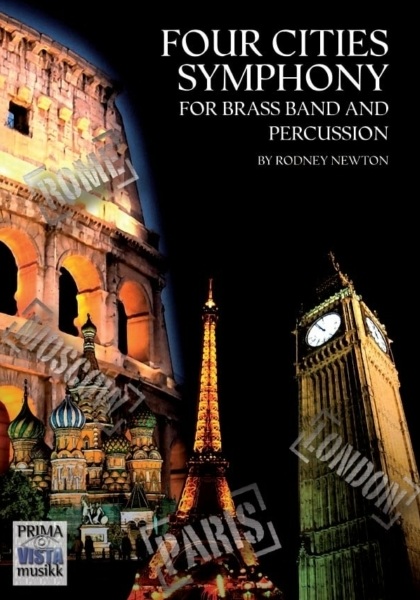
Four Cities Symphony (Brass Band - Score and Parts)
This piece was commissioned by the National Contesting Council as the 4th section test piece for the 2008 Regional Brass Band Championships of Great Britain.This symphony (the composer's 12th) has four movements played without a break. The first centres on two aspects of the city of London: its history and pageantry and its role as a busy modern metropolis.The second movement depicts Paris, its street cafes and boulevards and riverside walks, in the form of a romantic waltz.The third movement is constructed around the Gregorian chants of the Lord's Prayer (Pater noster, qui es in caelis) and the Creed (Credo in unum Deum) in an evocation of the city of Rome. After a powerful climax, mysterious tramping footsteps are heard as the ghosts or a Roman legion march through the city by night. The vision fades and the pater noster is heard once again before the movement is brought to a close with the ancient Ambrosian chant, Christus Vincit, Christus Regnet, Christus Imperat.The final movement is an evocation of the city of Moscow, with its great historic buildings, its turbulent history and its fiery traditional music. At the outset a rather dour folk-like melody is heard which is transformed into a lively Cossack dance.This work is dedicated to Howard Wilson, former principal euphonium of City of Coventry Band who, in 1972, introduced the composer to top section brass band contesting.Duration: 11.00
Estimated dispatch 7-14 working days
-
 £75.00
Cantata for brass band and percussion. Composed by Andrew Duncan
Cantata was commissioned by The Fodens Band who gave the first performance in 2014. Cantata was used as the test piece for the Scottish Open in 2014 and was played by the Whitburn Band as their own choice piece at the European Brass Band Championships in 2016. Cantata is in three movements and fully explores the textures, technique and musicality of a top section brass band and its soloists. Composer: Andrew Duncan Difficulty: Championship Section Duration: 16 mins Score and parts Publisher: The Music Company Released: 2014
-
 £30.00
Deus in Adjutorium
DescriptionMonteverdi's Vespro della Beata Vergine (Vespers for the Blessed Virgin) is a musical setting by Claudio Monteverdi of the evening vespers on Marian feasts, scored for soloists, choirs, and orchestra. It is an ambitious work in scope, style and scoring, and has a duration of around 90 minutes. Published in Venice with a dedication to Pope Paul V dated 1 September 1610 as Sanctissimae Virgini Missa senis vocibus ac Vesperae pluribus decantandae, cum nonnullis sacris concentibus, ad Sacella sive Principum Cubicula accommodata ("Mass for the Most Holy Virgin for six voices, and Vespers for several voices with some sacred songs, suitable for chapels and ducal chambers"), it is mercifully regularly shortened to Monteverdi's Vespers of 1610.Monteverdi was born and spent the first part of his working life in Cremona before moving to Mantua (where he composed the Vespers) and finally attaining one of the top jobs in Italian renaissance music as Maestro di Capella at the Basilica di San Marco in Venice. He is most famous for his vocal music, notably his madrigals and the earliest surviving opera, Orfeo.Watch a preview video of the brass band score below:
Estimated dispatch 7-14 working days
-
 £44.95
Starburst and Canyons - Paul Lovatt-Cooper
The annual RNCM Festival of Brass features a number of the country's top bands and is a platform for modern compositions. Starburst and Canyons was composed for Dr Nicholas Childs and the Black Dyke Band to perform at the festival...
Estimated dispatch 5-7 working days
-
 £64.95
Four Cities Symphony (Brass Band - Score and Parts) - Newton, Rodney
This piece was commissioned by the National Contesting Council as the 4th section test piece for the 2008 Regional Brass Band Championships of Great Britain.This symphony (the composer's 12th) has four movements played without a break. The first centres on two aspects of the city of London: its history and pageantry and its role as a busy modern metropolis.The second movement depicts Paris, its street cafes and boulevards and riverside walks, in the form of a romantic waltz.The third movement is constructed around the Gregorian chants of the Lord's Prayer (Pater noster, qui es in caelis) and the Creed (Credo in unum Deum) in an evocation of the city of Rome. After a powerful climax, mysterious tramping footsteps are heard as the ghosts or a Roman legion march through the city by night. The vision fades and the pater noster is heard once again before the movement is brought to a close with the ancient Ambrosian chant, Christus Vincit, Christus Regnet, Christus Imperat.The final movement is an evocation of the city of Moscow, with its great historic buildings, its turbulent history and its fiery traditional music. At the outset a rather dour folk-like melody is heard which is transformed into a lively Cossack dance.This work is dedicated to Howard Wilson, former principal euphonium of City of Coventry Band who, in 1972, introduced the composer to top section brass band contesting.Duration: 11.00
Estimated dispatch 7-14 working days
-
 £42.95
WHEREVER YOU ARE (Brass Band) - Mealor, Paul - Stubbs, Duncan
Commissioned by Gareth Malone for Series Four of BBC TV's 'The Choir' and first performed by Malone and The Military Wives Choir as part of The Royal British Legion's Festival of Remembrance at the Royal Albert Hall on 12 November 2011, in the presence of Her Majesty The Queen. The text is taken from poems, letters and prayers written by the Military Wives, selected and adapted by Paul Mealor, and a passage from the Book of John. Selling a staggering 556,000 copies in the week leading up to Christmas, more than the rest of the Top 12 combined, Wherever You Are became the UK's Official Christmas No. 1 of 2011. A wind band version is also available. A contribution from the sales of the sheet music will be donated to the two nominated charities: The Royal British Legion and SSAFA Forces Help.
Estimated dispatch 7-14 working days
-
 £89.95
Christmastime (Brass Band - Score and Parts) - Holmlund, Andreas
Christmastime was written at the request of Windcorp Brass Band (one of the top contesting bands in Sweden) for their annual Christmas concert. Taking the form of an overture, this music contains passing references to many well-known festive songs, and features Hark! The Herald Angels Sing, The First Nowell, Have Yourself a Merry Little Christmas and O Come, All Ye Faithful
Estimated dispatch 7-14 working days
-
 £54.99
All You Need Is Love (Brass Band - Score and Parts) - Lennon & McCartney - Oud, Thijs
The Beatles remain the biggest-selling British group of all time with their countless hits and timeless classics written by John Lennon and Paul McCartney. All You Need Is Love is one such song that recently made it into the top 40 pop songs of all time. In this arrangement Thijs Oud has utilised all the original Beatles elements whilst, at the end, integrating 'snippets' of many more of their hits. Perfect for all concert programmes this will also make an excellent finale to your events.
Estimated dispatch 7-14 working days
 View Music