
Results
-
 £54.99
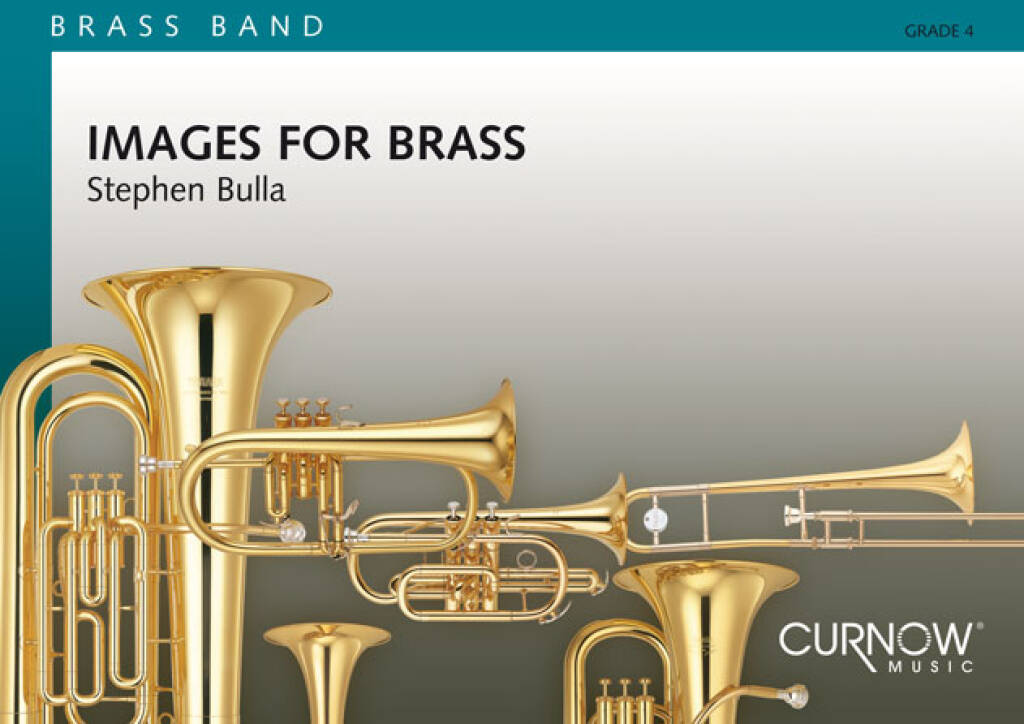
Images for Brass - Stephen Bulla
Stephen Bullas highly descriptive work was written to commemorate the 50th anniversary of the Battle of Iwo Jima, which took place between the 19th February and 26th March 1945.Casualties on both the American and Japanese sides were horrendously high before the famous image of the raising of the flag on top of Mount Suribachi signalled the end of one of the most significant and terrifying Pacific conflicts of the SecondWorld War.The work received its first performance by the brass choir of the U.S. Marine Band at the National Cathedral in Washington D.C. and is divided into four programmatic sections.The first portrays the sense of anticipation before conflict (Prologue), before the arduous journey to the scene of the battle (Approach by Sea) is followed by introspection and prayer featuring the hymn tune Melita (Chorale Prayer), andfinally, the hostile confrontation itself (Engagement).There are frequent references to the Marines Hymn and the US National Anthem, particularly in the closing bars, depicting the ultimate raising of the American flag.
Estimated dispatch 5-14 working days
-
£87.10
Ghostbusters - Ray Parker Jr. - Idar Torskangerpoll
The title song from the 1984 movie "Ghostbusters" is one of the greatest successes of 80s pop music. Written and performed by Ray Parker, Jr., the song was nominated for a Grammy as best original song. This easy but catchy pop song, typical of the80s, reached the top of the charts both in the US and the UK. This Young Band arrangement is also playable for bands with limited instrumentation. Sure to be a hit at your next show! Also published for Concert Band (Item number 9790261702607).
Estimated dispatch 5-14 working days
-
£54.99
All You Need Is Love - John Lennon - Thijs Oud
The Beatles remain the biggest-selling British group of all time with their countless hits and timeless classics written by John Lennon and Paul McCartney.All You Need Is Love is one such song that recently made it into the top 40 pop songs of all time. In this arrangement Thijs Oud has utilised all the original Beatles elements whilst, at the end, integrating 'snippets' of many more of their hits.Perfect for all concert programmes this will also make an excellent finale to your events.
Estimated dispatch 5-14 working days
-
 £49.00
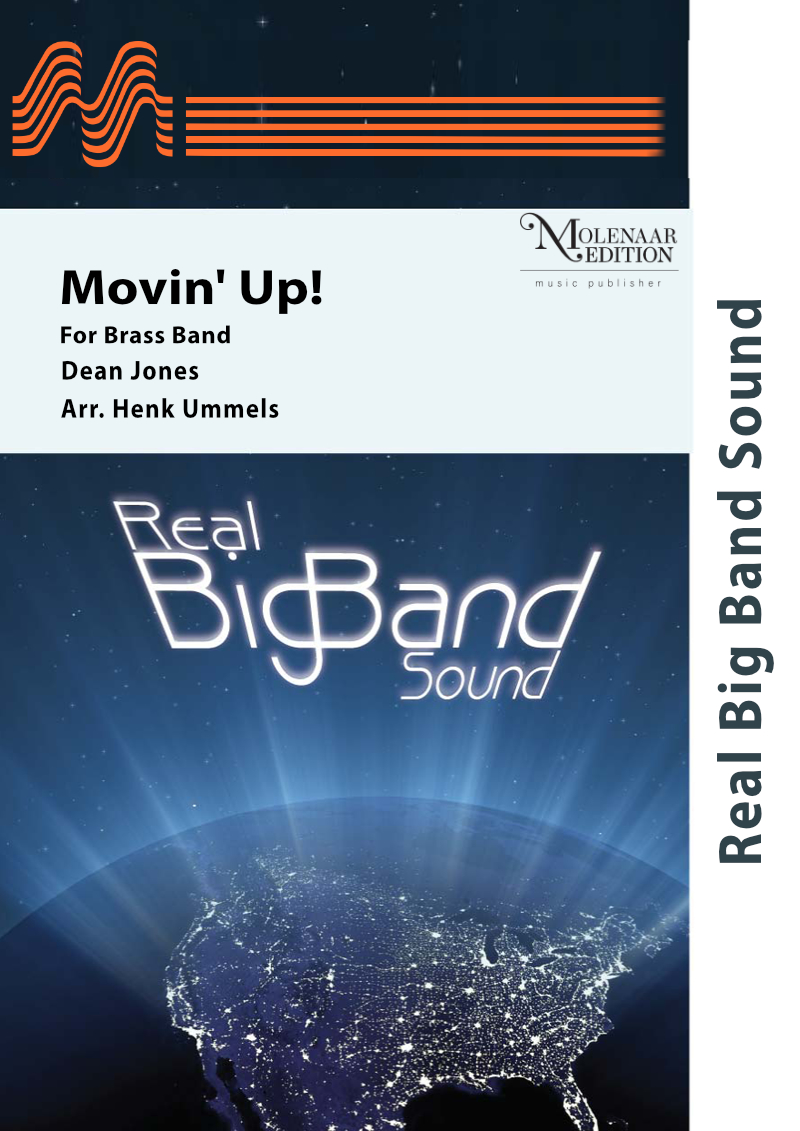
Movin' Up! - Dean Jones
The beat just rolls on! Movin' Up! is very much a sequel to Dean Jones' previous work Hangin' On! There are the usual sounds you'd expect from a swing band piece: vibrant sounding from the trumpets and trombones and then a layered harmonious texture from the horns and baritones. There's also scope for some top class solo work too around the band. There is one twist at the end... the pace is slowed down, the 'top button and bow tie loosened', but the scene is set and concluded with exciting brass sounds.
Estimated dispatch 10-14 working days
-
 £34.95
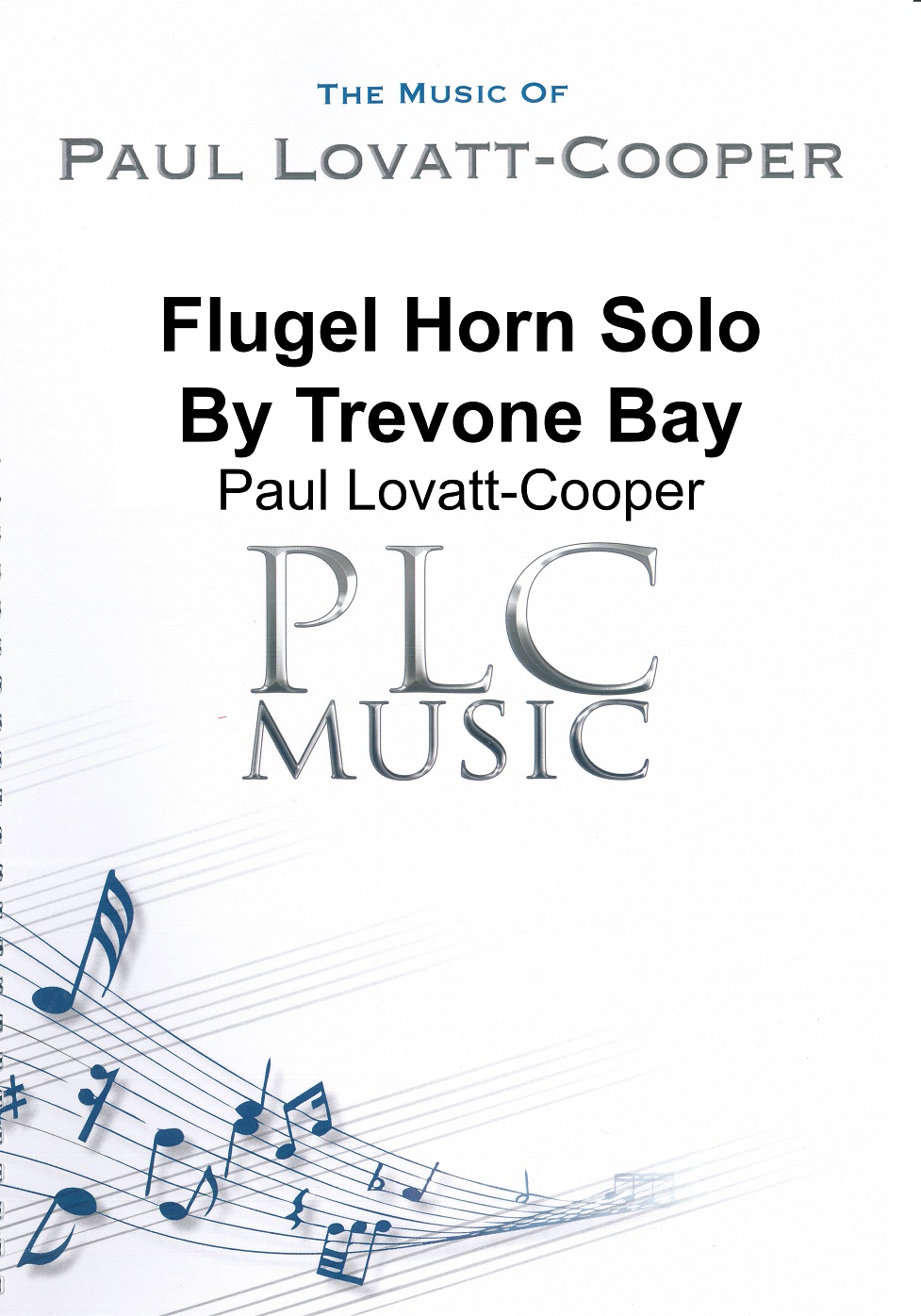
By Trevone Bay (Flugel Horn Solo with Brass Band - Score and Parts))
By Trevone Bay was composed for Flugel Soloist Zoe Hancock and the Black Dyke Band to celebrate both their Double Champion Victory at the British Open and National Championships 2014 and Zoe's unique achievement in winning the Best Soloist Award in both contests - an accomplishment never done before. The world premier was performed by Zoe and the band at Birmingham's Symphony Hall on February 8th 2015.By Trevone Bay is a lovely lyrical slow melody that utilises the full range and colour of the flugel horn. Starting with an atmospheric opening the soloist performs the main theme, which repeats with more colour in the accompanying parts and solo line. After introducing a second theme from the ensemble, the solo cornets perform the main melody with the soloist enjoying a lyrical counter melody. The piece develops with a tranquil middle section from the soloist that builds for the second theme to return, performed by the ensemble while the soloist soars over the top. Ending as it starts, the piece dies away to leave the soloist performing the opening melodic phrase to a tranquil close.As for the title: Trevone Bay is a beautiful tiny bay in Cornwall, close to Zoe's home town of Roche. Its tranquil waters lead out to the Celtic Sea and provide a picturesque landscape. The views there can be enjoyed all year round but they are particularly beautiful at sunset.
Estimated dispatch 7-14 working days
-
 £32.00
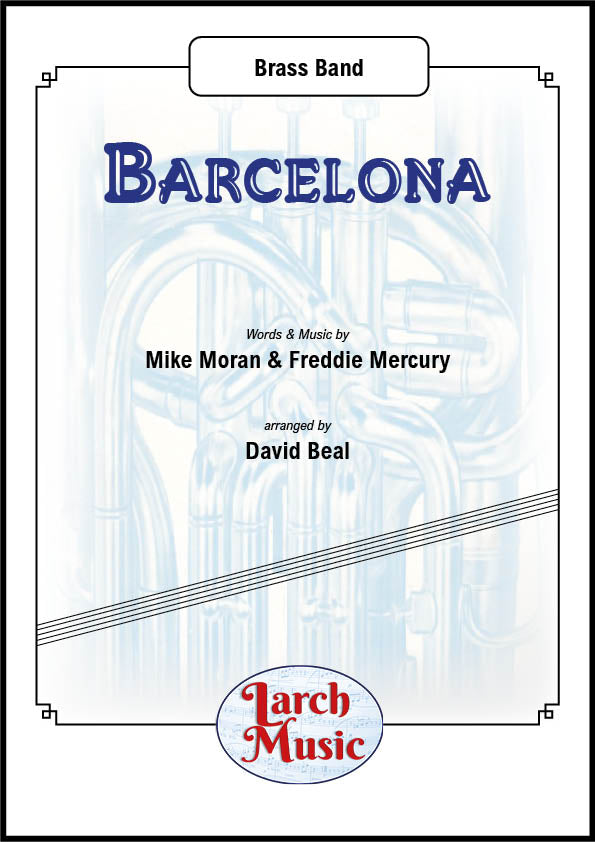
Barcelona - Vocal Duet or Cornet & Euphonium - Brass Band Sheet Music Full Score & Parts - LMAM054
COMPOSER: Mike Moran & Freddie MercuryARRANGER: David Beal"Barcelona" is a single released by Queen vocalist Freddie Mercury and operatic soprano Montserrat Caballe. A part of their collaborative album Barcelona, it also appeared on Queen's Greatest Hits III. The song reflects Mercury's love of opera with his high notes and Caballe's operatic vocals, backed by a full orchestra. Originally released in 1987, it was one of the biggest hits of Mercury's solo career, reaching number eight in the UK singles chart. After Mercury's death in 1991, it was featured at the 1992 Summer Olympics. The single was re-issued on 20 July 1992, after which the track climbed even higher, peaking at number two in the UK, the Netherlands and New Zealand. In 2004, BBC Radio 2 listed Barcelona at number 41 in its Sold On Song Top 100.Scored here for British Brass Band.
In Stock: Estimated dispatch 3-5 working days
-
 £33.33
Les Chasseresses from 'Sylvia' (Brass Band) Delibes arr. Rob Bushnell
Clement Philibert Leo Delibes was a French composer, best known for his ballets and operas, including works such as Lakme (with its famous "Flower Duet"), Coppelia and Sylvia (both key works in the development of modern ballet). The latter started as a play, Aminta, by the Italian poet Torquato Tasso, which Delibes set to music. It was then adapted for the Paris Opera with rehearsals starting in August 1875. The premiere took place on 14 June 1876 and was the first ballet to be shown at the newly-built Opera Garnier. Whilst the scenery and costumes were created by top artists and designers (Cheret and Lacoste), it was Delibes's music that shown thrown, being said to have saved the production, preventing the ballet from drifting into obscurity.Sylvia is said to be one of the first modern ballets, with Tchaikovsky remarking to composer Sergei Taneyev upon its ingenuity: "... the first ballet, where the music constitutes not only the main, but the only interest. What charm, what elegance, what richness of melody, rhythm, harmony." Although Swan Lake, a contemporary to Sylvia, is considered one of the best ballets there is, Tchaikovsky preferred Sylvia to his own work, saying Swan Lake was "poor stuff in comparison". Tchaikovsky said to Taneyev, "I was ashamed. If I had known this music early then, of course, I would not have written Swan Lake". The music to Sylvia, rather than setting only the mood, also sets the action and is noted for its use of leitmotifs - Delibes was an admirer of Wagner - and more dominant use of brass and wind. The most famous piece from this ballet is the Pizzicati in the third act.Act I of the ballet takes place in sacred wood, where creatures are worshipping before Eros when Sylvia arrives with her huntresses to mock the god of love. Aminta, a lowly shepherd and infatuated with Sylvia, protects the deity and Sylvia is wounded by Eros's arrow. The hunter Orion kidnaps Sylvia, whilst Eros revives Aminta. Act II takes place in Orion's Island cave, where Sylvia tries to bribe Orion with jewels and wine. Unsuccessful, she appeals to Eros for help, who arrives and takes her to the temple of Diana (where the final act takes place). Orion and Aminta fight, Sylvia and Orion cause the goddess of the hunt, Diana, to be outraged, smiting Orion and denying the love of Aminta and Sylvia. Eros shows Diana a vision, which changes her mind and the couple finally come together.This brilliant and lively fanfare that introduces the huntresses in the first act is arranged here for the UK-style brass band, with alternative parts for horns in F and bass-clef lower brass. The piece has been lowered by a tone compared to the original. A recording of the original composition can be found here https://youtu.be/6yoGrUH38PI?si=0L0bFa1qXnYNvkR3 Duration: Approx. 3.10 minutes Difficulty Level: 1st Section + This PDF download includes the full score and parts. Includes alternative parts for soloist in Eb, horns in F and lower brass in bass clef. Sheet music available at www.brassband.co.uk (UK) or www.cimarronmusic.com (USA) Instrumentation: Soprano Cornet Eb Solo Cornet Bb Repiano Cornet Bb 2nd Cornet Bb 3rd Cornet Bb Flugel Horn Bb Solo Horn Eb 1st Horn Eb 2nd Horn Eb 1st Baritone Bb 2nd Baritone Bb 1st Trombone Bb 2nd Trombone Bb Bass Trombone Euphonium Bb Bass Eb Bass Bb Timpani Percussion - Triangle, Cymbal & Bass Drum
In Stock: Estimated dispatch 1-3 working days
-
£120.00
Rhapsody in Black (Bra) - Andi Cook
The primary inspiration for this work comes from the composer's first encounter with the genre of Symphonic Metal - the opening track of the 2004 Nightwish album 'Once', entitled Dark chest of Wonders. The combination of full orchestra, operatically trained female vocals and the raw power of a Scandinavian metal band was a potent mix that instantly had me hooked.That same dark and powerful sound is one that a brass band can generate, and I've tried to capture that in this composition. Heavy Rock/Metal as a genre is arguably fifty years old now, but symphonic metal is a newer concept, and I feel possibly the one that can bridge the gap between two musical styles very dear to me.Composer Gilbert Vinter had explored through music the connotations that different colours held for him, and his movement Purple from 'Spectrum' gave me an idea for the structure of 'Rhapsody in Black'. Andi Cook explored the different connotations of one colour within his own life, black being an easy choice due to the personal dichotomy of the black leather jacket he wore to the rock club on Friday night and the black suit jacket and tie he wore to the concert hall the next day.To avoid repetition the word 'black' is omitted from the five movement titles, each of which is a different episode. '...as Thunder' is a furious argument between two people - the top and bottom of the band - set against the backdrop of a storm, with lightning flashing outside while barbs, insults, sarcasm, tears and even violence is traded inside. Following that '...Satin and Pearls' is an old black-and-white movie with a wistful character to it as if we're looking back a screen icon with fondness long after their career or even their life has ended. '...as the Raven's Wing.' is deliberately gothic and funereal, hinting at Edgar Allen Poe's similarly named poem, with undertones of death and afterlife. The shift into F/C Minor (band pitch) represents the descent - alive - into the grave that Poe had a paranoid fear of his entire life. Family and friends standing around grieving, oblivious as we're lowered into the earth despite frantic attempts to make ourselves heard. '...and Chrome' is an unashamed motorcycle reference with all its born-to-be-wild, open air, high speed and freedom overtones. In a deliberate contrast to what went before it continues several of the same motifs though this time in the major key. Lastly, we reprise the second movement with '...as the Night Sky' which is simply the feeling of walking home under the summer stars, with someone important - who that is, is left to the listener, but a walk under the stars is always that bit special.There's an old saying that very few things are black and white. I hope this work will prove that even black alone isn't quite as simple as it's often made out....'Rhapsody in Black' is dedicated to the composer's friend and mentor John Roberts, who shares his love of both brass and rock.
Estimated dispatch 7-14 working days
-
 £75.00
Cantata for brass band and percussion. Andrew Duncan
Recommended for - Championship bands Cantata was commissioned by The Fodens Band who gave the first performance in 2014. Cantata was used as the test piece for the Scottish Open in 2014 and was played by the Whitburn Band as their own choice piece at the European Brass Band Championships in 2016. Cantata is in three movements and fully explores the textures, technique and musicality of a top section brass band and its soloists. Includes score & parts
-
 £30.00
Deus in Adjutorium
DescriptionMonteverdi's Vespro della Beata Vergine (Vespers for the Blessed Virgin) is a musical setting by Claudio Monteverdi of the evening vespers on Marian feasts, scored for soloists, choirs, and orchestra. It is an ambitious work in scope, style and scoring, and has a duration of around 90 minutes. Published in Venice with a dedication to Pope Paul V dated 1 September 1610 as Sanctissimae Virgini Missa senis vocibus ac Vesperae pluribus decantandae, cum nonnullis sacris concentibus, ad Sacella sive Principum Cubicula accommodata ("Mass for the Most Holy Virgin for six voices, and Vespers for several voices with some sacred songs, suitable for chapels and ducal chambers"), it is mercifully regularly shortened to Monteverdi's Vespers of 1610.Monteverdi was born and spent the first part of his working life in Cremona before moving to Mantua (where he composed the Vespers) and finally attaining one of the top jobs in Italian renaissance music as Maestro di Capella at the Basilica di San Marco in Venice. He is most famous for his vocal music, notably his madrigals and the earliest surviving opera, Orfeo.Watch a preview video of the brass band score below:
Estimated dispatch 7-14 working days
 View Music
