
Results
-
 £55.00
Firefly - Simon Dobson
Firefly was composed by award-winning composer Simon Dobson (b.1981) to provide an entertaining up-tempoconcert work for community and youth bands. Composed in funk-rock style, and is based on the groove beat with which it opens. Dobson says, "Firefly was written as a break from my more serious music and as a 'hat tip' to the various types of beat orientated music I listen to." It was first performed by Oslofjord Brass in Norway and in its wind version by Harmonie Shostakovich, Switzerland. Duration: 5-6 minutes. INSTRUMENTATION:1 EflatSop. Cornet, Solo Cornets (4), Bflat Rep. Cornet (1), 2nd Bflat, Cornets (2), 3rd Bflat Cornets (2);Flugel horn, Solo Eflat Horn, 1st Eflat Horn, 2nd Eflat Horn; 1st Bflat Bar., 1 2nd Bflat Bar., 1st Trombone, 2ndTrombone, Bass Trombone; Bflat Euphoniums (2); Eflat Tubas (2); Bflat Tubas (2); 2 percussion
Estimated dispatch 5-14 working days
-
 £78.20
The Rocketeer - James Horner - Roland Smeets
Before Titanic,James Horner was not above composing scores for cartoonish family films, and many of those that brought him on their production board owe him greatly. The Rocketeer entails the story of a young pilot during World War II who happens upon a rocket pack that allows him to fly. The film is based on the tradition of old film serials that left theater-goers hanging with "To be continued," and aside from modern production, it is old fashioned and innocent fun. Horner's score begins and ends with the brilliant "Main Title," which is so moving it was used in previews for later films that did not yet have finished scores. Most of th Rocketeersoundtrack elicits the adventure and lifting spirit of the film and reveals how Horner incorporates rich instrumentals in the tiniest crevices. Even when the film involves danger, as in "Jenny's Rescue," the composer takes care when it is hardly even required. Instead of some "duh-duh-duhs," he brings on a full, stunning orchestra and when he overdoes it, it is in a jolly way -- he never exhausts his medium. That is what separates him from inferior composers, and what makes a nice film like The Rocketeer extra nice. It is a soundtrack worth listening to.
Estimated dispatch 5-14 working days
-
 £54.99
Jamaica - Timothy Travis
Jamaica is an island in the Caribbean. In 1494 it was discovered by Christopher Columbus, who used it as private property until 1509. After some skirmishes it fell under British rule and the sugar trade on the island flourished. After the abolition of slavery in 1834 it was only granted Home Rule in 1944, but it remained a member of the British Commonwealth of Nations. Whereas the export of cane sugar used to be Jamaica's main export product for many years, nowadays music has taken over this role. At first American music used to be very popular on the island. Later, however, Jamaican musicians started to experiment and thus in the end created their ownmusical style called Reggae. Well-known Reggae musicians are Bob Marley and Peter Tosh. The most important instruments used in Reggae are the bass and the drums. Together they form the base for the style: the riddim. A bass drum accent on the second and fourth beat are characteristic of a typically reggae drum beat. To this syncopic patterns are often added. The rhythm guitarist plays chords in a characteristic Reggae rhythm, not on, but between the beats.
Estimated dispatch 5-14 working days
-
 £164.99
Diamond Concerto - Philip Sparke
Diamond Concerto was commissioned by Musikverein Morschied from Germany - Dr. Eric Grandjean, conductor - for a special concert featuring Steven Mead as guest soloist. Together they gave the world premiere on 28th April 2012 in the town theatre of Idar-Oberstein.The commission is a highlight in the 30-year friendship between composer and soloist, which has included many mutual CD projects and concerts and, now, a concerto. Sparke had Steven Mead's special euphonium sound in his head throughout the composition process and made free use of the variety of styles which the world-renowned virtuoso has made his own during his highly successful solo career.The village ofMorschied lies to the west of Frankfurt am Main in the area known as the German Road of Precious Stones, which is famous for its thriving gem industry. Because of this it was decided to give the commission a local connection by choosing the title, Diamond Concerto. Each of the three movements is named after a famous diamond:1 EARTH STARis rather stern in mood, opening with a free fantasy for the soloist over a static chord from the band. This leads to an Allegro Moderato in minor mode where small motives are gradually repeated and developed by both band and soloist.2 OCEAN DREAMuses a varied quote from the composer's Music for Battle Creek, including a melting slow melody that was originally written with Steven Mead in mind.3 BLUE HEARTwas written, at Steven Mead's suggestion, in bebop style and takes the form of a jazz waltz. The quasi-improvisatory central section features a call-and-response passage for the soloist and upper woodwinds.Soloist: Difficulty 6Diamond Concerto is available for euphonium and piano (AMP 374-401) as well as for euphonium and concert band (AMP 354-010).
Estimated dispatch 5-14 working days
-
 £60.99
Angels from the Realms of Glory - Roland Kernen
The title of this clever arrangement reveals the Christmas song it is based on. The melody can be traced back to a French folksong from the 18th century which is now known around the world. In France it is called Les anges dans nos campagnes, in Germany it is most widely known as Engel auf den Feldern singen and in England it was originally called Angels From the Realms of Glory but it often known as Angels We Have Heard on High. Everyone will rejoice upon hearing the 'Gloria in excelsis Deo' refrain!
Estimated dispatch 5-14 working days
-
 £95.00
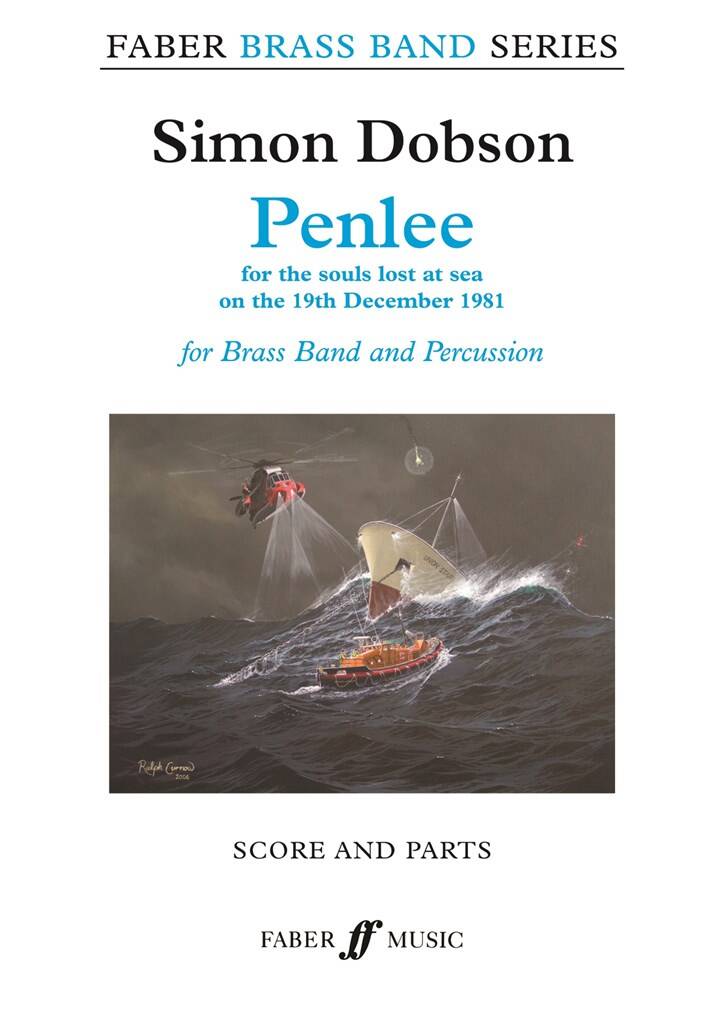
Penlee - Simon Dobson
To some, the tragic story of the Penlee lifeboat, Solomon Browne, would need no introduction, and to some the pain felt is still very much a reality. The composer, born just a few weeks before that fateful night on the19th December 1981, has created this work as a musical homage to the bravery of the souls who lost their lives and has dedicated it to their memory. Penlee was commissioned by the Cornwall Youth BrassBand using funds bequeathed by Michael Pickett. The first performance was given by the Cornish Youth Brass Band, conducted by Ian Porthouse, at St. Michael's Church, Newquay, on 30th December 2008.Penleehas been voted into the Classic FM Hall of Fame 2011 at No.106. Not only is it the first time a brass work has been featured in the Hall of Fame, but it was also thehighest new entry. The work has subsequently been recorded by the Leyland Band, conducted by Jason Katsikaris, on the CD entitled Penlee.Brass Band Grade 4: Advanced Youth and 3rd Section Duration: 13 minutes
Estimated dispatch 5-14 working days
-
 £119.50
La Muerte del Angel - Astor Piazzolla - Svein H. Giske
La muerte del angel was composed by Astor Piazzolla as incidental music for the 1962 play Tango del angel by Alberto Rodriguez Munoz.In the play an angel heals the spirits of the residents of a shabby Buenos Aires neighborhood, but is ultimately killed in a knife fight.This is one of the distinctive pieces with which Piazzolla shook the conservative world of tango. With it's harsh dissonances, mood swings and high energy level, it was in sharp contrast to the traditional tangoes.La muerte del angel was frequently played by Piazzolla in concerts, and he recorded it on at least fourteen different occasions.This arrangement was written to Eikanger-Bjorsvik Musikklag for their performance at Siddis Brass 2007.-Svein H. Giske-
Estimated dispatch 5-14 working days
-
£54.99
God rest ye merry Gentlemen - Andrew R. Mackereth
'God rest ye merry, Gentlemen' is an ancient English carol. It was first published in 1833, but it can be traced as far back as the 15th century, which makes it one of the oldest carols known. 'God rest ye merry' is a Middle English salutation. In this manner, people wished one another greatness and might. In modern English, the first line of this carol would read 'May God keep you mighty, gentlemen'. Andrew R. Mackereth has not kept to the original words in his up-tempo arrangement of the carol. It is still clearly recognizable, but the arranger has taken a good many liberties. Sometimes a particular note is held longer, at times motifs follow oneanother in various parts. If you listen carefully, you may even be able to detect a motif from another well-known song.
Estimated dispatch 5-14 working days
-
 £122.10
Den store dagen - Benny Borg - Bjørn Morten Kjærnes
This beautiful song contains a huge contrast between the hopeful and the disappointing. A mother has her birthday and is waiting her children to celebrate it. Each verse starts optimistically, but the short chorus is characterized by the disappointment, that everyone calls, and cannot come. This has been tried recreated musically, mostly in the last two choruses, as it dawns on her that she will not receive a visit. It's a beautiful tune, but with a serious message that it's easy to take someone for granted.One of the elements Hjorring Brass Band (DK) came up with after rehearsal, was that they really liked the change between the ballad parts with even eights and the swing parts. This also gives the piece a sense of "parlando" character, which tells a story, and is therefore important to focus. It is not quite simple, as the melody also in those parts with even eights has some triplet rhythms. Therefore, this is a topic you can work on very consciously.If you have heard the Wind Band version, you can notice that both keys and modulation are different in the Brass Band arrangement to sound better for this instrumentation.Regarding instrumentation, Flugelhorn, Solo Horn and Euphonium have important roles, in addition to Solo Cornet.It is also possible to use a vocal soloist, but then you have to soften the melody voices, especially, where small variations in the melody have been made for the wind instruments.
Estimated dispatch 5-14 working days
-
 £115.60
S.O.S. - Björn Ulvaeus - Bjørn Morten Kjærnes
When the publisher asked me to make an arrangement of an ABBA tune, S.O.S. was the first song I thought of. Its introduction and melody are well suited to play for Wind Band. Admittedly, the key had to be shifted to make it sound good for this instrumentation. To me, this is nostalgia, while for others, the Mamma Mia movie/show will be what they associate with this wonderful song. Apart from a few medleys, few of ABBA's songs are available to Wind Band. So, it was very fun to work on this classic.The arrangement is made quite simply to fit many sizes of Bands. Technically, it is also relatively simple both in range and rhythm. As you can see, there are many ways to adjust this arrangement to your own ensemble. Bring out melody lines and the bassline, and a lot is done. If needed, simplify to make it sound nice.Bjorn Morten Kjaernes
Estimated dispatch 5-14 working days
 View Music