
Results
-
 £30.00
La Musica Notturna Delle Strade di Madrid
DescriptionLuigi Boccherini was born in Lucca, Italy, into a musical family. His father, a cellist and double-bass player, sent him to study in Rome at a young age. In 1757 they both went to Vienna, where the court employed them as musicians in the Burgtheater. In 1761 Boccherini went to Madrid, entering the employ of Prince Luis Antonio of Spain, younger brother of King Charles III. There he flourished under royal patronage, until one day when the King expressed his disapproval at a passage in a new trio, and ordered Boccherini to change it. The composer, no doubt irritated with this intrusion into his art, doubled the passage instead, which led to his immediate dismissal. Then he accompanied Don Luis to Arenas de San Pedro, a little town in the Gredos mountains, where Boccherini wrote many of his most famous works. Although neglected after his death and throughout the 19th and early 20th century (he was known mockingly as 'Haydn's Wife' for a time), Boccherini's music has been rediscovered in recent decades.La Musica Notturna delle Strade di Madrid('Night Music of the Streets of Madrid') is a string quintet of seven short movements composed during Boccherini's exile in Arenas, no doubt to remind him and his prince of happier times. The music is reminiscent of "the gaiety and bustle of Spain's capital, recalling the sound of the city's church bells ringing for evening prayer, the popular dances that were the delight of its young people, and the blind beggars singing their typical songs". This arrangement excludes the first and last two movements, comprising the middle four:Il Tamburo di Soldati(The Soldier's Drum)Minuetto dei Ciechi(The Minuet of the Blind Beggars)Il Rosario(The Rosary)Passe Calle(The Passacaglia of the Street Singers)The music was featured in the Russell Crowe filmMaster and Commander: The Far Side of the World(2003) set during the Napoleonic Wars and featuring the adventures of the Royal Navy ship HMS Surprise and her captain Jack Aubrey as they pursue the French ship Acheron into the Pacific Ocean.You can listen to an audio preview while following the score in the video below!Duration approximately 5'00".
Estimated dispatch 7-14 working days
-
£132.00
Myte - Torstein Aagaard-Nilsen
Commissioned by Radoy Brass for their 20 years anniversary.This version was first performed by Manger Skulemusikklag in 2005.The Work is devided into Five Scenes:1. Sverdet (The Sword) 3:452. Advarsel - fra en vis mann (Warning - from a Wise Man) 2:303. Dragen (The Dragon) 3:004. Advarsel II - fra syngende fugler (Warning II - from singing birds) 1:355. Gull - forbannelsen (Gold - The Curse) 2:50Total durata 13:30This work is based on five scenes from the tale about "Sigurd Favnesbane" (Sigurd the dragonslayer). Moods and atmospheres in the piece represent my way of retelling the old myth.1. The SwordThe dwarf blacksmith Regin is hammering and sharpening the edges of the magical sword Gram. After three attempts the sword is finally sharp enough to kill a dragon. 2. Warning - from a Wise manRichard Wagners opera Sigfried is based on the same story. In the opera the hero get warned by a wise man. He tells the secret of how to survive an attack of the dragon by hiding in a hole in the pathway and then kill the dragon with the sword as the dragon passes on its way to the river to drink water.3. DragonThe Dragon (Favne) guards a fantastic treasure, but he is also the brother of the blacksmith Regin. Favne get killed and his blood flows slowly while he laments (trombone/bass trombone).4. Warning II - from singing birdsWhile frying the heart, Sigurd burns his thumb and put it into his mouth to cool it down. Then he swallow a drop of fresh magic dragon blood which transfers the ability to understand the birdlanguage. The birds sing warnings to Sigurd telling him that Regin will betray him and later kill him. Sigurd then kills Regin instead.5. Gold - the CurseSigurd takes the gold treasure and escapes on the horseback of Grane. But his robbery of the gold lead him into trouble: The gold is banned and a curse will hit everyone whotakes it...Myth is a programmatic work where the story is quite clearly illustrated throughout the piece:In the first movement you can hear the blacksmith working with hammer on ambolt while the heat is intense from the glows. The dwarf has got his own theme i lower brass (bar 4-5). The hero Sigurd has his own identifying chord (2 bars before F). The chord is also a symbol of the sword.In the second movement the warning from the wise man is expressed in the lyric bass line.The airblow in instruments illustrate the dragon Favne on his way out of his cave, and later the blood flows slowly. The dragon takes his last deep breath after a painful duet in trombones. The birds sing their motifs (lightly, but not cheerful though), until Sigurd cuts the head off Regin and it hits the ground.The last movement describes the atmosphere andstate of mind as the curse infects the obsessed thief.
Estimated dispatch 7-14 working days
-
 £30.00
Leviathan - Paul Denegri
Leviathan began its evolution as a workshop work inspired by the poem written by Heathcote Williams entitled; Whale Nation. At the time of this workshop the tentet brass repertoire existed of extremely well written original or arranged works of a lighter nature but there was a shortage of works with a greater emotional depth and edge, hence Leviathan's early conception as an atmospheric and emotive work. The workshop piece explored whale sound and song and was a 25-minute work in two parts. After many years of the workshop sketches sitting dormant the new work Leviathan is a much shorter and concise work. It contains only one of the original melodic themes of the workshop work. Leviathan is driven and underpinned by melodic and rhythmic elements. It is a programmed work following the awe inspiring majestic might and beauty of whales through to a hunt scene, the chase and the ultimate demise of earth's largest mammal.
-
 £30.25
Zephyrus - Andrew Duncan
The Big Blow', was a formal record attempt to create the largest brass band in the world. It took place at Butlin's Resort, Skegness on 20 January 27 and in addition to the fun generated by the event itself, it's main goal was to raise money in support of the work of Brass Band Aid, and specifically to provide long-term sponsorship for two children in the village of Adet, Ethiopia.The Music Company (UK) Ltd were one of the Official Partners of The Big Blow, providing the performance piece for the record attempt. As Editorial Director of the company, Andrew Duncan wrote 'Zephyrus' to mark the occasion.Originally presented at the event as 'March - The Big Blow', the published re-titling of 'Zephyrus' provides a more subtle alternative, taking its name from the Greek God of the West Winds.'Zephyrus' is a traditional British brass band march with an interesting African-feel lilt to the trio. This is enhanced by optional percussion instruments including djembi and bongos, which can also be covered by standard drum kit. A positive, upbeat concert march to reflect the sentiment behind 'The Big Blow' record attempt.There were 443 participants in total, including:Soprano Cornets x 12Cornets x 152Flugels x 19Tenor Horns x 68Baritones x 32Euphoniums x 32Trombones x 55Eb Basses x 35Bb Basses x 17Percussionists x 21The Music Company are pleased to continue their support of Brass Band Aid by offering a donation to this worthy charity for every set of this music sold.
In Stock: Estimated dispatch 3-5 working days
-
 £29.88
Fanfare from La Peri(Brass Band) Dukas arr. Rob Bushnell
La Peri is a one-act ballet by the French composer Paul Dukas, best known for The Sorcerer's Apprentice (L'apprenti sorcier) as in the 1940 Disney film Fantasia. Dukas was commissioned to write La Peri by the Ballets Russes, producing a Poeme danse en un tableau ('dance poem in one scene') in 1911; this become his last published work. With Natalia Trouhanova due to play the Peri and Vaslav Nijinsky to play Iskender (the name of Alexander the Great in Persian, who is scouting around Iran in search of the Flower of Immortality), the production was ultimately cancelled because Serge Diaghilev feel Trouhanova was not a skilled enough dancer to be partnered to Nijinsky. Trouhanova later hired Ivan Clustine to choreograph the music, with the ballet premiering at the Theatre du Chatelet in Paris on 22 April 1912.The brilliant fanfare that precedes the ballet is often performed separately and is the arrangement available here. Arranged for British-style brass band, it has optional percussion parts as well as alternative parts for horns in F and bass-clef lower brass. The piece has been lowered by a tone compared to the original. A recording of the original composition can be found here: www.youtube.com/watch?v=7EDekMos1ok. Duration: Approx. 2 minutes Difficulty Level: 2nd Section + Duration: 4 or 5 minutes (depending on tempo and without any cuts) PDF download includes parts and score. Sheet music available at www.brassband.co.uk (UK) or https://satradecentral.org (USA) Instrumentation: Soprano Cornet Eb Solo Cornet Bb Repiano Cornet Bb 2nd Cornet Bb 3rd Cornet Bb Flugel Horn Bb Solo Horn Eb 1st Horn Eb 2nd Horn Eb 1st Baritone Bb 2nd Baritone Bb 1st Trombone Bb 2nd Trombone Bb Bass Trombone Euphonium Bb Bass Eb Bass Bb Timpani Percussion 1 - Snare Drum Percussion 2 - Bass Drum & Cymbal
In Stock: Estimated dispatch 1-3 working days
-
 £63.51
Temperamental (Brass Band) Fendall Hill
This work by Fendall Hill was the set test for the 2021 National Brass Band Championships of New Zealand, B Grade. The composer writes: 'J.S. Bach (1685-1750) is deemed by many to be the 'Ulimate Composer'. He added an incredible proportion to the DNA of western music, and his influence is heard in the music of today. Like many artists, he was not overly recognised as a composer during his lifetime, and it took an 1829 performance of the St Matthew Passion by Mendelssohn to ignite a recognition of his place in the music world, a place he has maintained ever since. This piece starts with a similar spark of rediscovery of the music of Bach. It contains arrangements of various works, interspersed with composition based on Bach's chord structures, sections in the style of Bach, and original sections inspired by the moods created along the way. The first section explores the Toccata, and great organ works. This leads into an exploration of his choral works, and a finale based on the Preludes. The word 'Tempered' has different meanings, and all seem to apply to the music of Bach, and these appeal to the musical, engineering and spiritual aspects of my personal life. His music reaches to the humanity and divinity, it has strength, structure and order that creates frameworks in which incredible complexity reigns; and the complexity leads to a wildness, a kind of craziness that represents a range of human moods, and can change without warning. The same piece of music affects people in very different ways. I don't know if it's Bach's music, or us, but it can seem out of control and under control at the same time - the combination is highly temperamental. To view a follow-the-score video of the work please visit: https://youtu.be/zpNxITUqXZU Sheet music available from: UK - www.brassband.co.uk USA - www.solidbrassmusic.com Difficulty Level: 1st Section + Instrumentation: Soprano Cornet Eb Solo Cornet 1&2 Bb Solo Cornet 3&4 Bb 2nd Cornet Bb 3rd Cornet Bb Flugel Horn Bb Solo Horn Eb 1st Horn Eb 2nd Horn Eb 1st Baritone Bb 2nd Baritone Bb 1st Trombone Bb 2nd Trombone Bb Bass Trombone Euphonium Bb Bass Eb Bass Bb Timpani Percussion 1-4
In Stock: Estimated dispatch 1-3 working days
-
 £74.95
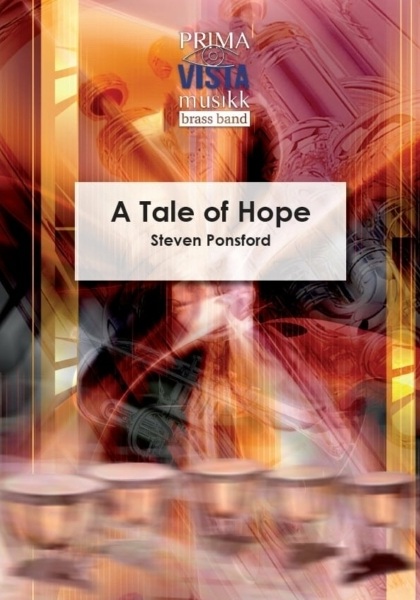
A Tale of Hope (Brass Band - Score and Parts)
The piece tells the story of Chicago lawyer and Presbyterian church elder Horatio Gates Spafford. In 1873, the Spafford family planned a vacation to England, but last-minute business demands prevented Horatio from sailing with them. Tragedy struck when the ship collided with an iron sailing vessel while crossing the Atlantic, killing 226 people, including all four of Spafford's daughters. His wife, Anna, survived the tragedy, and upon arriving in Cardiff, Wales, she sent a telegram to Spafford that simply read "Saved alone." Shortly afterwards, as Spafford travelled to meet his grieving wife, he was inspired to write the hymn It Is Well with My Soul as his ship passed near where his daughters had died. The hymn was subsequently set to music by fellow American Philip Bliss, with the tune named after the ship on which Spafford's daughters died, Ville du Havre.Composer Steven Ponsford has chosen to portray this story in a substantial composition for brass band. Much of the early music is turbulent, reflecting the long voyage, and then the disaster that claimed Spafford's daughters. After a darker 'Grave' section, the hymn It Is Well With My Soul softly emerges, with the piece ending on a note of optimism and hope.Duration: 11.30
Estimated dispatch 7-14 working days
-
£31.95
A Tale of Hope (Brass Band - Score only)
The piece tells the story of Chicago lawyer and Presbyterian church elder Horatio Gates Spafford. In 1873, the Spafford family planned a vacation to England, but last-minute business demands prevented Horatio from sailing with them. Tragedy struck when the ship collided with an iron sailing vessel while crossing the Atlantic, killing 226 people, including all four of Spafford's daughters. His wife, Anna, survived the tragedy, and upon arriving in Cardiff, Wales, she sent a telegram to Spafford that simply read "Saved alone." Shortly afterwards, as Spafford travelled to meet his grieving wife, he was inspired to write the hymn It Is Well with My Soul as his ship passed near where his daughters had died. The hymn was subsequently set to music by fellow American Philip Bliss, with the tune named after the ship on which Spafford's daughters died, Ville du Havre.Composer Steven Ponsford has chosen to portray this story in a substantial composition for brass band. Much of the early music is turbulent, reflecting the long voyage, and then the disaster that claimed Spafford's daughters. After a darker 'Grave' section, the hymn It Is Well With My Soul softly emerges, with the piece ending on a note of optimism and hope.Duration: 11.30
Estimated dispatch 7-14 working days
-
 £77.00
General Series Brass Band Journal, Numbers 2242 - 2245, April 2024
2242: Fanfare Prelude - Faithful in every way (Simon Gash)Lord, I come before your throne of grace (S.A.S.B. 378) has become a popular song for Sunday worship. These words of great assurance are married to a strong tune which, unlike many contemporary worship songs, suits the brass band idiom well. Although this piece will work without Percussion, the Snare Drum part, which underpins a lot of the piece, will help drive the music forward.2243: The wonders of thy grace (Norman Bearcroft)Herbert Booth's song Within my heart, O Lord, fulfil (S.A.S.B. 211) was the inspiration behind Lieut-Colonel Norman Bearcroft's three-verse setting of the hymn tune Wareham, with the title being taken from the lyrics of verse two.2244: Trombone Solo - I will wait (Andrew Mackereth)Major Leonard Ballantine has an astonishing gift for contemporary song writing. This song is a brilliant example of this, taking the idea of Jesus waiting patiently for us to accept the fullness of his offer of love.This arrangement was made at the request of Andrew Justice, former Principal Trombonist of The International Staff Band. For many years, Andrew has used this song with piano accompaniment. In making this arrangement, the composers aim was to capture the transparency you can create in piano playing.2245: The battle cry! (David Edmonds)Inspired by Lorne Barry's Trinity (F.S. 599), this piece would be well suited as a concert opener but would work in many settings as a contribution to worship. Its main feature is the driving rhythmic pattern in the Bass and Percussion sections. The music needs to be played with confidence and purpose. As the title suggests, it is a strong, inspiring battle cry, corralling the troops. This is a setting of the song by Stuart Townend and Keith Getty, O Church, arise (S.A.S.B. 819), which has become popular in recent years, not only within The Salvation Army, but also the wider Christian church.
Estimated dispatch 7-14 working days
-
 £77.00
General Series Brass Band Journal, Numbers 2238 - 2241, December 2023
2238: Fanfare and allegro on the Doxology (Steve Kellner)The Doxology, set to the tune Old Hundredth (T.B. 31), is used widely around the world by Christian denominations, including Salvationists. This concert opener is based on the short but powerful hymn of praise to the Triune God.2239: To the endless day (Kenneth Downie)This is a meditation on the hymn tune Ruth (T.B. 191), written by Samuel Smith. It is a particular favourite of Don Jenkins, whose late wife was also called Ruth. This music is dedicated to Don, a distinguished trombone soloist and former Band master of Bristol Easton Corps Band.The music is always associated with the hymn by William Walsham How, whose words begin 'Summer suns are flowing over land and sea' (S.A.S.B. 59) with the title coming from the end of the final verse.2240: Euphonium Solo - He giveth more grace (Ray Steadman-Allen)This 1996 arrangement of Blacklands (T.B. 527), the composers own hymn tune written in 1963, is being published posthumously. The hymn tune sets the words 'He giveth more grace as our burdens grow greater' (S.A.S.B. 30) with an emphasis on the generosity of God.2241: The Calvary effect (Ian Clarke)Around AC 30, on a hill often refered to as Mount Calvary, an event took place that was to change the world forever. The Calvary effect is a reflection, in musical form, on that event and what it still means to people today. If features two tunes: first, in a quiet reflective mood, we hear the highly emotive Healing Stream, associated with the words 'Jesus, keep me near the cross; There is a precious fountain' (S.A.S.B. 178). This then makes way for the chorus; 'Lord, make Cavalry real to me' (S.A.S.B. 182), which is at times indistinct and almost lost in its surroundings, reflecting the sentiments of the chorus. A return to the main tune follows, this time in a positive, passionate setting. The music finishes with a triumphant 'Hallelujah!'.
Estimated dispatch 7-14 working days