
Results
-
 £58.60
BREEZIN' DOWN BROADWAY! (Brass Band) - Richards, Goff
Medium - Includes: Another Opening, Another Show; There's No Business Like Show Business: Get Me To The Church On Time; Oklahoma!; That's Entertainment; Seventy Six Trombones.
Estimated dispatch 7-14 working days
-
 £99.99
Sparkling Brass - Philip Sparke
Sparkling Brass was commissioned by Osaka Concert Brass, one of Japan's top brass bands, and premiered by them on 27th December 2018 during a concert which celebrated their 10th Anniversary. The work opens in lively mood with fanfare-style figures from the lower band which are answered by the cornets. This interplay intensifies until the mood calms suddenly to introduce a chorale which leads to a duet-cadenza for cornet and euphonium. The rhythmic mood of the opening soon returns and leads to the main theme of the work, a modal caccia which features various section of the band. A short bridge passage leads to a change of key and a new cantabile theme which isintroduced by euphoniums and baritone. This is taken up by the full band after another change of key and leads back to the caccia theme. A transformed version of the opening fanfare returns to close the work.
Estimated dispatch 5-14 working days
-
 £134.99
West Wind - Oliver Waespi
West Wind is structured in three parts, each bearing a subtitle drawn from poems of Emily Bronte (1818-1848). Poetry of the Romantic period, Bronte's in particular, often presents a gentle, almost innocent surface, beneath which lies the most elemental and volatile emotional forces capable of erupting at any moment.Accordingly, the opening movement, West-wind, in the glory and pride!, begins with a mellow, warm soundscape, underpinned by lightly pulsating patterns, almost like an aquarelle. Gradually however, the music transitions into far rougher, forward-driven gestures - turbulent, restless, and at times unpredictable, much like the west wind itself.The ensuing Adagio reflects on the poem Stars, in which a fundamental tension between exaltation and regret, another recurring feature of Bronte's poetry, is palpable throughout. Introspective solo and chamber music statements give way to a broad ecstatic sound field involving the full ensemble, before finally receding into a solitary euphonium soliloquy.The final movement, Wild words of an ancient song, takes the form of an extended rondo-scherzo, driven by virtuosic, perpetual motion. The sense of relentless pursuit bears a nod to The Boy on the Moor by the German poet Annette von Droste-Hulshoff, a contemporary of Bronte who explored similar narratives, albeit from a different perspective.Although certain core musical elements recur - pulsating patterns, a chorale, a tone row - the work is guided less by systematic symphonic development than by an intuitive stream of variants. These generate a sequence of metamorphoses that illuminate the material from shifting vantage points, projecting the emotional landscapes of Romantic poetry into the present day.West Wind was commissioned by the Flowers Band and was first performed under Musical Director Paul Holland, at the 2026 European Brass Band Championships in Linz (AT), where they also became European Champions.
Estimated dispatch 5-14 working days
-
 £84.99
Christmas Brass - Richard Peaslee
Christmas Brass is a fantasy on six carols, originally commissioned by Mark Freeh for the Manhattan Brass Choir. Duration: 16:30The well-known tune, O Come, O Come Emmanuel, a hymn originally based on a plainsong melody, is here set in 5/4 meter. Modal harmonies are combined with big band style as the piece gains momentum, greatly accentuating the mood of the words, "Rejoice! Rejoice! Emmanuel." The opening 5/4 statement of the theme returns, and the piece ends quietly.In Beautiful Savior (also known by the title Fairest Lord Jesus), a hushed beginning featuring horns, euphoniums, and a muted trumpet, leads through a key change to a satisfying, chorale-likeclosing passage.In Away in a Manger, Peaslee sets two tunes, Cradle Song and Away in a Manger. Following a straightforward presentation of each melody, Peaslee plays them against one another. The music swells to a full climax followed by a hushed ending.Peaslee employs a gentle hand in It Came Upon a Midnight Clear, using flugelhorn solos and duets in a jazz-waltz style.In Silent Night, the traditional carol gets an untraditional harmonization, propelled forward by give-and-take between the two groups of brass instruments in the brass choir: trumpets and trombones versus horns, euphoniums, and tuba.Hark! The Herald Angels Sing begins with a humorous blast of discordant harmonies as multiple carols are sounded at the same time. An up-tempo 4/4 announcement of the melody in the trombone is followed by a metrical modulation in 6/8-3/4 time. An additional metrical modulation bring the music back into 4/4, but at a slower tempo and in a pronounced jazz style. Tempo I returns, and the set of six pieces closes with a big ending.Instrumentation: 4 Trumpets, 2 Horns in F, 4 Trombones, 2 Euphoniums, Tuba, Guitar, Bass, Percussion
Estimated dispatch 5-14 working days
-
 £85.00
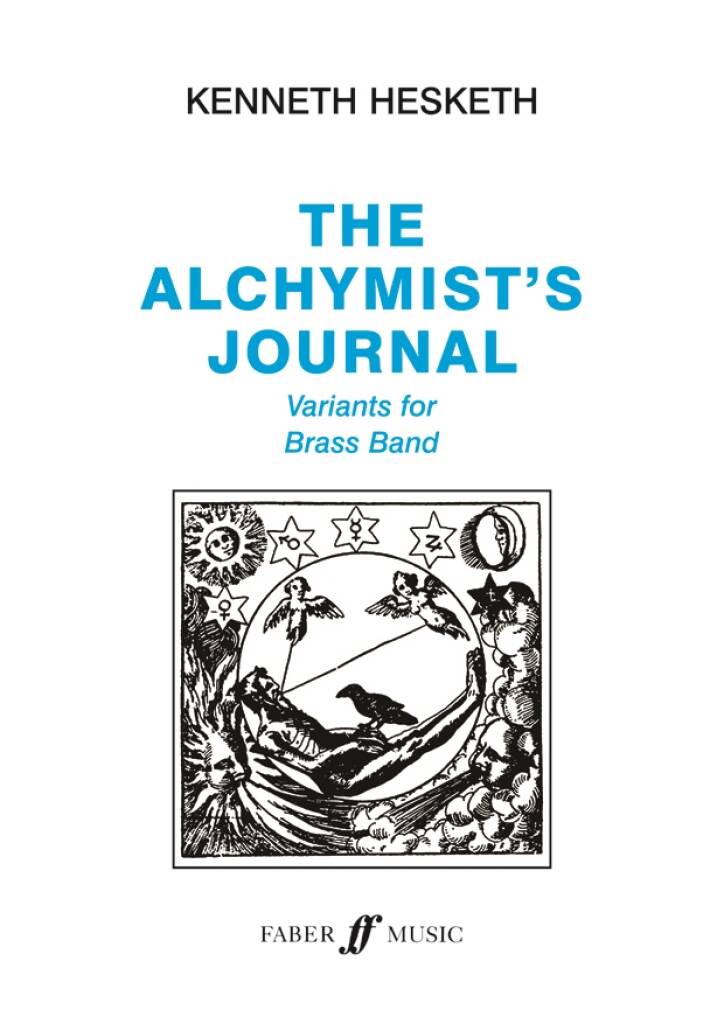
Alchymist's Journal. - Kenneth Hesketh
'The Alchymist's Journal' gets its title from the book of the same name by American author Evan S. Connell. The book fictionalises a number of famous Alchemist's writings, each one developing another's thoughts thuscontinuing one idea but changing it subtly to provide a new view point or way of thinking. This process is, in fact, alchemical as one idea transmutes into another. This idea is parallel to the processes at work within thesevariants. The whole work is constructed from 6 notes (C, A, B flat, E flat, F sharp, E) and is presented in nine different sections, each individual in mood but still based upon the original pitches. This is not a thematic setofvariations, as the themes are developed one at a time from small segments of the six notes. For example, the opening theme is the complete number of pitches, the second theme uses three notes transposed then repeated at theoriginal level, and so on. Harmonically, the six notes can be divided into two triads, A minor and E flat minor - each key beginning and ending the piece respectively. Whilst this is essentially abstract music with noprogramme there is an introduction, menacing scherzo, slow reflective section followed by a recap of the scherzo and final coda. 'The Alchymist's Journal' was commissioned by the Brass Band Heritage Trust at the suggestionof Paul Hindmarsh, to whom the work is dedicated.
Estimated dispatch 5-14 working days
-
 £76.99
On the Movieset - John Emerson Blackstone
Glitter and glamour, good-looking people, a lot of Bling Bling and fast cars images like these will cross our minds when we think of the movie world. However, reality proves to be different : as a rule, a tremendous amount of work will have been done on the set before a film is ready to be shown on the big screen. A visit to an actual movie set inspired John Emerson Blackstone to write a composition bearing the same name. He had both seen a number of characteristic attributes and heard the typical phrases used in film making, and he incorporated them into 'On the Movie Set' . In the first part, 'The Clapboard', a 'director's assistant' is supposed to shout "Quieton the set'" and "Action!", as is done before a real scene is shot. Subsequently, in order to create the right atmosphere, the clacking of a 'Clapboard' should be heard. During a romantic scene we should be transported to another world by means of sweet sounds in the background, so romantic music is of course heard in the next part, 'Love Scene'. At the end of a long working day 'It's a wrap' is called on the set to inform everyone that the filming on that day is completed. Now there is only one more thing left to dream of : an Oscar..... Perf. Note: The use of the right props will add to the performance and appreciation of 'On the Movie Set'. A red carpet and a glamorous reception should give your audience the feeling they are attending a real 'opening night'!
Estimated dispatch 5-14 working days
-
£104.99
Theme Park Fun! - Wilco Moerman
In Theme Park Fun! your orchestra pays a visit to an amusement park. During your visit, you will experience some spectacular rides and attractions this theme park offers. The uniqueness of Theme Park Fun! is the interplay between music and(moving) images. Animations and illustrations support the visual composition (downloadable after ordering a set, on www.gobelinmusic.com).Part 1: The Entrance & Parade [with animation]The opening of the park is a fact. A day fullof fun and pleasure awaits! You and the other visitors will be confronted with all the rides, attractions and adventures the theme park has to offer. Which ride shall we do first?! There is so much to do and experience on this day in the park! Aparade of colorful floats and park figures is passing by.Let the fun begin!Part 2: The Haunted House [with animation]The only ride in the park that is not related to fun, is the Haunted House. Here visitors will be challengedto visit a house full of ghosts, creepy figures and other ominous things. The clock strikes twelve, there is no turning back. Ghosts are whispering, yelling, screaming... Fortunately it is almost one oclock, so we can leave this creepy placequickly.Part 3: The Swinging Galleon [with illustrations]What a huge pirate ship! Each time you swing back and forth, you will feel that weird feeling in your stomach. When you are thrown completely into the top you will have afantastic view over the park, but you can not enjoy it for long. Before you know the ship swings back the other way.Part 4: The Fairy Tale Ride [with illustrations]After all those exciting and spectacular rides and attractions,it is time for a peaceful tour in The Fairy Tale Ride. Surrounded by a fairytale setting, you will discover fable figures, talking animals and colorful designs. Such a beauty and tranquility. Having had this experience, we are ready again for thebig rides in the park!Part 5: The Bumper Cars [with illustrations]Now its time to crawl behind the wheel of the Bumper Cars! Shall we all chase the conductor?! Before you know you are hit by another visitor or you will bumpagainst someone else. In this tough ride you can prove yourself as a real driver, or perhaps as a really bad one.Part 6: The Roller Coaster [with illustrations]The largest, fastest and scariest ride in the park ... we shoulddefinitely do the Roller Coaster! All together in the train, the over-the-shoulder restraints are lowering... be ready to ride. The train leaves the station and is heading for the big lift hill. It will be very scary when the train reaches the topand the train will be plunged down the first drop! Loops, corkscrews and other spectacular coaster elements will follow... Before you know it, the ride of your life is over. Shall we ride it again?!Part 7: Leaving the Park [withanimation]Unfortunately everything comes to an end. This day in the theme park is over, but we have a lot new experiences to talk about! The memories of all the funny and spectacular rides will come up when we walk through the park to theexit. Just one look over the shoulder, the amusement park figures are waving at us. Hopefully we will come back again soon!
Estimated dispatch 5-14 working days
-
 £59.99
Aria - Philip Sparke
Aria was commissioned by and written for the remarkable Tenor Horn player, Sheona White. The work opens with an accompanied recitative, which leads to a change of key where the main melody is presented. This, in turn, serves as an introduction to another melodic idea, marked calmato. The band takes up this theme and then takes centre stage with a passionate repeat of the main theme, which is completed by the soloist. A Cornet then plays the calmato theme against which the soloist plays a counter melody. This leads to a return of the opening recitative which brings the work to a peaceful close. A fantastic new addition to the solo repertoire for this much neglectedsolo instrument.
Estimated dispatch 5-14 working days
-
 £89.95
Tuba Concerto (Score and Parts)
This work was commissioned by the Besses o' th' Barn Band with funds provided by the Arts Council of Great Britain. It was written for, and is dedicated to, John Fletcher, who gave the first performance in Middleton Civic Hall, near Manchester, on 24 April, 1976, with Besses o' th' Barn Band conducted by the composer. Another interesting feature about the premire was that it was recorded by BBC Television for an Omnibus programme with Andr Previn as presenter. The concerto exists in three versions: with brass band (1976), orchestra (1978) and wind band (1984).The concerto is in three movements, following the usual, quick-slow-quick pattern: Allegro deciso,Lento e mesto, Allegro giocoso. The first movement has a sonata form shell with two contrasting themes, the first one being rhythmic in character, the second lyrical. There is a reference made in passing to the Vaughan Williams Tuba Concerto, but this merges into the other material in the development section.The second movement begins with a chorale, but after the entry of the tuba it leads to a cantabile theme, softly unfolded by the soloist. The opening chorale passage returns, this time briefly on muted brass, and leads to a middle section which is more chromatic in style and soon builds to a powerful climax, where the opening cantabile theme triumphantly returns. The music subsides, returning to the opening chorale and ending peacefully.The finale is light and breezy in style, and is cast in rondo form. After a brief introduction the tuba announces the main rondo theme, which is dance-like and a little jaunty. There are two episodes: the first a broad sweeping tune, the second a slowish waltz and a little jazz-like. After a virtuoso cadenza reference is made to the very opening of the concerto before the work ends with a triumphal flourish.The Tuba Concerto has established itself as one of the main works in the solo tuba repertoire. It has been performed and broadcast in over 40 countries all over the world. There are currently six commercial recordings of the concerto in its various versions.resolution in C major, pointed by a simple but expansive melody towards which the piece has been heading, and ending in a blaze of joyful colour.
Estimated dispatch 7-14 working days
-
 £32.00
The Cistercians
DescriptionThe Cistercianswas written during December 2003 and January 2004 as an entry for Morecambe Band's Centenary New Music Competition, which it went on to win. The first two performances were at the final of this competition, part of the band's 100th Anniversary Concert at The Dome in Morecambe on 9 July 2004.The music was inspired by visits to three of Britain's great Cistercian Abbeys; Valle Crucis, Fountains and Rievaulx. The Cistercian Order was founded at Citeaux in France in the 11th Century and was based on the principles of austerity, humility and piety. Cistercian Abbeys were deliberately sited in remote, difficult areas. Despite this many of them, especially Rievaulx, became immense centres of commerce and power, with ever more complex administration and hierarchies.In a way the music reflects this; all the material in the piece is derived from two simple motifs played by flugel and solo horn in the opening bars and becomes more complex and further removed from the original material as the piece develops. After a tranquil opening section a fugal chorale develops over a medieval-style "tenor" - a stretched out version of one of the original motifs. A burst of semiquavers leads into a faster, folk-dance type section - our medieval abbey has become a bustling trade centre - before rhythmic quaver pulses in the horns and cornets accompany powerful chords in the low brass; this is another "tenor" derived from the opening motifs. A short development section, including the folk dance "hocketing" round the band and a slightly disjointed 10/8 section leads to a restatement of the fugal chorale from the beginning before a frenetic coda brings the work to a triumphant conclusion.Performance Notes:Percussion instruments required are Bass Drum, Suspended Crash Cymbal, Glockenspiel, 2 x Tom-toms, Snare Drum, Tambourine, Tam-Tam, 2 x Timpani (G-C, C-F), Triangle, Wood Block. All cornets will require metal stratight mutes and all except soprano require cup mutes. All trombones require cup and metal straight mutes.You can follow a preview of the score in the video below.
Estimated dispatch 7-14 working days
 View Music