
Results
-
 £59.95
Swedish Festival Music (Brass Band - Score and Parts)
This three-movement suite was commissioned by the Swedish Brass Band Association as the test piece for the Championship Section of their 2008 National Contest. The first movement is inspired by the magnificent Swedish hymn 'How Great Thou Art'. Indeed the influence of that hymn can be traced in all three movements. The declamatory style of the opening gives way to other, more reflective expressions of awe and wonder. A more animated section develops before a final, triumphant statement of the 'How Great' idea returns to finish the movement. The slow second movement features another much-loved Swedish hymn. The music provides plenty of scope for expressive playing, and a feeling of intimacy should be created by the use of several short solo passages. The third movement Allegro brings a totally different, dance-like mood with frequent references to a reel from the region of Uppland. This eventually brings a return to the opening subject and a final, triumphant reference to 'How Great Thou Art'.
Estimated dispatch 7-14 working days
-
 £14.95
What Child is This? (Greensleeves) (Cornet and Piano)
Another Christmas arrangement of the traditional English tune 'Greensleeves'. It takes the form of a solo for Bb cornet, intentionally written to be well within the ability range of most players, yet providing plenty of scope for musical lyricism.
Estimated dispatch 7-14 working days
-
 £24.95
What Child is This? (Greensleeves) (Cornet Solo with Brass Band - Score and Parts)
Another Christmas arrangement of the traditional English tune 'Greensleeves'. It takes the form of a solo for Bb cornet, intentionally written to be well within the ability range of most players, yet providing plenty of scope for musical lyricism.
Estimated dispatch 7-14 working days
-
 £10.00
Swedish Festival Music (Study Score)
This three-movement suite was commissioned by the Swedish Brass Band Association as the test piece for the Championship Section of their 2008 National Contest. The first movement is inspired by the magnificent Swedish hymn 'How Great Thou Art'. Indeed the influence of that hymn can be traced in all three movements. The declamatory style of the opening gives way to other, more reflective expressions of awe and wonder. A more animated section develops before a final, triumphant statement of the 'How Great' idea returns to finish the movement. The slow second movement features another much-loved Swedish hymn. The music provides plenty of scope for expressive playing, and a feeling of intimacy should be created by the use of several short solo passages. The third movement Allegro brings a totally different, dance-like mood with frequent references to a reel from the region of Uppland. This eventually brings a return to the opening subject and a final, triumphant reference to 'How Great Thou Art'.
Estimated dispatch 7-14 working days
-
 £9.95
£9.95First Quartet (Brass Quartet - Score and Parts)
My first Brass Quartet was written in 1968, immediately after I finished my studies at the Royal Academy of Music, and was in response to a request from my then publisher, R Smith & Co, to write some chamber music for brass band instruments. It is scored for two cornets, horn and euphonium. In the same year I also wrote another quartet (No. 2) which is scored for the more unusual combination of two horns, baritone, and tuba. The First Quartet is really a miniature in terms of length, lasting less than six minutes. However, it packs a lot of punch in its two connected movements, a Prelude and a Capriccio. The Prelude is lyrical in style and opens with a rising figure (covering a major seventh) on euphonium answered by muted cornets. These ideas form the material for the movement which is arch shape in structure. The opening returns, immediately followed by a transition passage which leads directly into the turbulent Capriccio. This is rather Bartokian in style (I was very influenced by Bartok in my student days and had closely studied his six string quartets), in the manner of a Hungarian dance in 5/8 time. The constantly changing metric patterns give the music a rather disruptive quality, but also an opportunity for the players to show their virtuoso abilities. - Edward Gregson
Estimated dispatch 7-14 working days
-
 £94.99
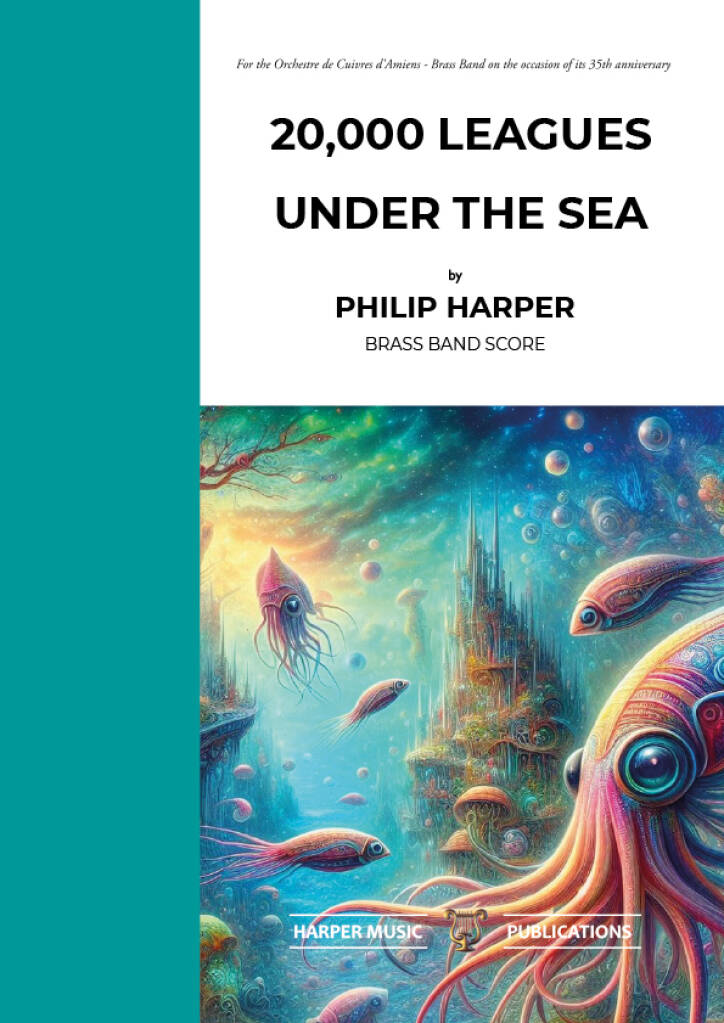
20,000 Leagues under the Sea - Philip Harper
Frenchman Jules Verne was a pioneer in science fiction during the late 19th Century, penning some classic stories such as Journey to the Centre of the Earth and Around the World in 80 Days - both of which have already been the subject of brass band test-pieces. It was therefore natural for me to choose Verne's 1869 watery magnum opus as the subject for this piece to which there are five sections, as well as an introduction and a finale.I. THE NAUTILUS. After a mysterious introduction we are introduced to The Nautilus - a fantastical submarine.II. THE CORAL KINGDOM. We visit awe-inspiring underwater coral formations.III. SQUID ATTACK. The Nautilus is attacked by a school of giant squid, or 'devilfish'.IV. CAPTAIN NEMO. Captain Nemo is a loner and an eccentric. Some say he is a madman. Soloists of the band help to uncover the character of this enigmatic but powerful figure.V. MAELSTROM. The Nautilus is dragged into the ocean's deadliest whirlpool but Captain Nemo lives to fight another day.
Estimated dispatch 5-14 working days
-
 £119.99
Bellum et Pax - Stijn Roels
Bellum et Pax is a composition describing the two ancient concepts of 'war' and 'peace.' While this piece appears to be one single movement, it consists of four sections that flow into one another. Mysterious and threatening tones lead the way into an epic battle between the chaos of war and enlightenment of peace. Peace triumphs, but menacing bass notes at the end symbolize the constant presence and threat of war and violence in the world.
Estimated dispatch 5-14 working days
-
 £60.99
I'm Still Standing - Elton John - Sven Van Calster
I'm still standing is another way of saying "You haven't beaten me yet" and is an ode to stamina. This world famous song by Elton John has been arranged by newcomer Sven Van Calster. The stirring rhythm and the infectious famous melody enable this piece to be played at any concert, irrespective of the level of your orchestra. Always a topper!
Estimated dispatch 5-14 working days
-
 £109.99
Columbus - Rob Goorhuis
Christopher Columbus was born in Genoa in 1451. His father was a wool merchant. Originally he seemed destined to follow in his father's footsteps, and thus sailed the oceans to countries as far apart as Iceland and Guinea. In 1476 his ship was sunk during a battle off the coast of Portugal. Columbus saved his own life by swimming to shore. In 1484 he conceived the idea of sailing to the Indies via a westward sea route, but it was only in 1492 that he was able to realize this plan. On this first voyage he was in command of three ships: the flag-ship, called the Santa Maria, the Pinta, and the Ni?a. From Spain Columbus sailed via the Canary Islands to the Bahamas, whichhe sighted on October 12th 1492. Without being aware of it Columbus discovered the 'New World' he thought he had landed in the eastern part of Asia. The motif from Dvooak's 9th Symphony 'Aus der neuen Welt' forms a little counterfeit history at this point in the composition. After this first voyage Columbus was to undertake another three long voyages to America. These voyages were certainly not entirely devoid of misfortune. More than once he was faced with shipwreck, mutiny and the destruction of settlements he had founded. After Columbus had left for Spain from Rio Belen in 1503, he beached his ships on the coast of Jamaica. The crew were marooned there and it was only after a year that Columbus succeeded in saving his men and sailing back to Spain with them. In the music the misunderstanding about which continent Columbus discovered in his lifetime resounds, for does this part in the composition not contain Asiatic motifs? Poor Columbus! In 1506 the famous explorer died in Valladolid.
Estimated dispatch 5-14 working days
-
 £95.50
The Best of Michael Jackson - Michael Jackson - Henk Ummels
By popular demand, there is now in The Best Of series for 5 part flexible setting, a selection of some of the best songs of Michael Jackson. Henk Ummels has selected and made a balanced and very playable selection out of Jackson's wide repertoire. The Best of Michael Jackson includes the smash hits; Beat it, Smooth Criminal, Heal The World, Another Part Of Me and Don't Stop 'till You Get Enough.
Estimated dispatch 5-14 working days
 View Music