
Results
-
 £104.99
Arkansas (Brass Band - Score and Parts)
This concert work, the latest of Jacob de Haan works based on American states, is a suite in three movements, based on a well-known folk tune from Arkansas. In the course of this varied work the folk song appears in its complete form and in fragments, in major and in minor, as a ballad in a lyrical orchestration, as a blues, accompanied by a jazzy rhythm and at the end again in its pure form. In the process, all instrumental groups of the brass band get their chance to shine!Duration: 9:30
Estimated dispatch 7-14 working days
-
 £37.35
Nicaea - Band Warm-up (Brass Band) John Bacchus Dykes arr. Steve Kellner
This warm-up is designed to help players and conductors hear and improve section, group, and full band intonation, rhythmic precision, and balance in an efficient and musically satisfying way. The tune Nicaea was selected because of its easy-to-hear triads and intervals, and the harmonisation used throughout is purposely simple and consistent, so that the players can become very familiar with potential intonation trouble spots. Likewise, discrepancies in precision and balance will easily be heard. Keys have been carefully selected to expose specific intonation problems within the sections and groups, like the overlap between Eb and Bb instruments in the horns/baritones and later in euphoniums/basses, and 5th position tuning in the trombones. The format in sections 2 through 5 is consistent, beginning with a single section of the band playing in unison, then expanding into two-part and four-part harmony. After eight bars that section is joined by another section or sections to form a common multi-section group used in brass band scoring, such as the 'mellow choir', 'low brass', 'tuba-euphonium choir', and 'bright choir'. Section 6 features the two largest groupings, the 'all but cornets' and 'high brass'. Section 7 brings the whole band together for a majestic and powerful finish. To view a rolling score video please visit https://www.youtube.com/watch?v=RR3zQhsNTuc Duration: Approx. 5.10 minutes Difficulty Level: 4th Section + Sheet music available from www.brassband.co.uk Instrumentation: Soprano Cornet Eb Solo Cornet Bb Repiano Cornet Bb 2nd Cornet Bb 3rd Cornet Bb Flugel Horn Bb Solo Horn Eb 1st Horn Eb 2nd Horn Eb 1st Baritone Bb 2nd Baritone Bb 1st Trombone Bb 2nd Trombone Bb Bass Trombone Euphonium Bb Bass Eb Bass Bb Percussion 1-2
In Stock: Estimated dispatch 1-3 working days
-
£59.95
FESTIVITY (Brass Band Set) - Leslie Condon
This is a celebrational and witty composition that has all the hallmarks of Condon's innovative style. Originally written for brass quintet and first performed by chosen soloists in 1972, it was scored for brass band a few years later. Acrobatic energy, dignity and solemnity are all aspects of this work. The majestic hymn tune 'Gopsal' is the theme with which the words 'Rejoice, the Lord is King' are associated.
Estimated dispatch 7-14 working days
-
 £30.00
Down By The Salley Gardens
A new brass band release for 2023 which also welcomes Fiona Neary as a new member of our ever-growing family of writers!This traditional Irish folk tune has been beautifully arranged for brass band, offering a tranquil moment to your programme with a memorable jaunty jig section to keep your listeners on their toes!Every concert needs that 'Aaahhhh' element, and Down By The Salley Gardens certainly brings all the qualities required to meet that need.This original traditional Irish melody has been referred to by a variety of titles: 'Mourne Shore', 'Moorlough Shore' and 'The Maids of Mourne Shore', and is believed to have dated back to the 17th-18th century.In 1889, William Butler Yeats had his poem 'Down By The Salley Gardens' published in The Wanderings of Oisin and Other Poems. The verse was then later set to the Irish melody by Herbert Hughes in 1909. Since this combining, the music has become synonymous with the poem and naturally adopted the poem's title.Due to the beauty of the melody and the emotive words of the associated poem, both elements of this work has been embraced by a variety of artistes, including recordings by The Corrs and Sinead O'Connor; John Ireland (1879-1962) set the words to an original melody in his song cycle Songs Sacred and Profane, written in 1929-31; there is a vocal setting by the poet and composer Ivor Gurney, which was published in 1938; and Benjamin Britten published a setting of the poem in 1943.
In Stock: Estimated dispatch 3-5 working days
-
 £77.00
General Series Brass Band Journal, Numbers 2246 - 2249, August 2024
2246: Christmas Prelude - David's City (Noel Jones)In 2 Samuel 5, we read of David's anointing as King of Israel at the age of thirty, a reign that lasted for forty years. Bethlehem was known as 'David's city' because he was born there and worked as a shepherd on the nearby hills. Verses 1, 2 and 5 of Once in Royal David's City (C.C. 68) are featured in this Christmas Prelude. There are also brief references to the carols O come, all ye faithful and O little town of Bethlehem between verses.2247: Cornet and Euphonium Duet - This Kingdom (Stephen Bulla)Geoff Bullock's song, This Kingdom, has been made well known by the American gospel singer Ron Kenoly. Stephen Bulla wrote this duet for a Brass Spectacular concert held in Basel, Switzerland, in May 2019.2248: Wonder (Stephen Gibson)When we stop to consider the mystery of God's love for each one of us, its enormity can only cause us to wonder. The opening bars of this music create an atmosphere, using a rolling accompaniment underneath sustained, music and chromatic Cornets, setting the style for the entire piece. Occasional references to Albert E. Webber's chorus Can you wonder? are heard throughout.2249: O to love thee! (Michael Davis)This piece takes its title from the first verse of Francis Bottome's words, Precious Jesus, O to love thee! The introduction establishes the baroque form of a prelude which leads into the tune Glory to the lamb (T.B. 327). Following a brief interlude, the melody is passed through several sections of the band, with delicate countermelodies in the Flugel and Horns. The majestic ending eventually comes to rest on the final tonic chord.
Estimated dispatch 7-14 working days
-
 £44.95
Glorified (Brass Band - Score and Parts)
Glorified was composed for the Canadian Staff Band's 50th Anniversary celebrations. This work is based on two tunes, Lord, be glorified (T.B. 738), a significant song at Canada's Territorial Music School over the years, and Great is thy faithfulness (T.B. 641). This song celebrates and signifies God's faithfulness to all associated with the Canadian Staff Band, and the commitment shown by its members through the years.The first half of the work harkens back to those members of the band who tragically perished in the early days on RMS Empress of Ireland, which was en route to England for the 1914 International Congress when it was struck by another vessel and sank. The rhythmic ostinatos heard represent the passing of time over the years. After the somewhat dark introduction, the music settles into a reflective rendition of In my life, Lord, be glorified (S.A.S.B. 593), before bursting into a rhythmic and jagged mixed-metre section. A yearning elegy pays tribute to those who lost their lives.The second half of the piece is celebratory in nature and commemorates the reformation of the band and the rich history which has ensued in the subsequent years. The rhythmic energy found in this section builds to a majestic presentation of the tune Lord, be glorified, which leads into the return of Great is thy faithfulness but in an optimistic fashion.
Estimated dispatch 7-14 working days
-
 £70.00
General Series Band Journal August 2016 Numbers 2158 - 2161
No. 2158 Prelude - My God and King! (Paul Sharman)Based on the hymn tune 'Luckington', this music is a paean of praise to the Lord of all creation.No. 2159 A Christmas overture (Kevin Larsson)An exciting collection of well-known Christmas carols, originally written as a concert opener.No. 2160 March - A voice from above (Eiliv Herikstad)This march refers to a number of Christmas carols. It starts with four bars of 'Hark! the herald angels sing' followed by fragments of 'Joy to the world!' before James R. Murray's 'Den himmelske lovsang' is presented in full. 'Come children, come quickly' requires legato playing from the lower band.No. 2161 In God we trust (Ralph Pearce)Although the title derives from the United States of America's much-neglected motto, the music is a journey through to total trust in God and our Lord Jesus Christ. The tunes featured are 'In thee, O Lord, do I put my trust' leading to 'Trust in God'. Increasingly calm music leads to the more recent song 'In Christ alone, I placed my trust'. The music ends with a brief reference to 'In Thee, O Lord, do I put my trust' now in a mood of calm assurance.
Estimated dispatch 7-14 working days
-
 £59.95
Judd: Festivity
This is a celebrational and witty composition that has all the hallmarks of Condon's innovative style. Originally written for brass quintet and first performed by chosen soloists in 1972, it was scored for brass band a few years later. Acrobatic energy, dignity and solemnity are all aspects of this work. The majestic hymn tune 'Gopsal' is the theme with which the words 'Rejoice, the Lord is King' are associated.
Estimated dispatch 7-14 working days
-
£225.00
Prillar&Halling - for Solo Clarinet and Wind Band - Stig Nordhagen
"Prillar" has it's origin from Norwegian folklorist music. It's a way of calling and singing the cattle home from the fields. Halling is a wellknown folk dance from the valleys in the eastern part of Norway.In this work, the clarinet use the prillar to get the other musicians to join in.The melodic material in Prillar and Halling hasn't got all the sound of Norwegian folklore exclusively. You can also hear folkloric music from other nations. The idea is to show the similarities between these and also the small differences there are between folkloristic elements from a large area. The piece also contains the folk tune "Adam in paradise", from south of Norway. At the end, the tunes are stacked on top of each other, and the similarities of origin turns out.- Stig Nordhagen -
Estimated dispatch 7-14 working days
-
 £85.00
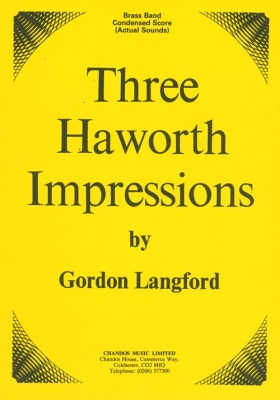
Three Haworth Impressions (Brass Band - Score and Parts)
A wonderful three movement suite which conjures up fabulous musical imagery of the lands of northern England. Well worth including as a concert item in your next programme, but this great original composition should really should be set again as a test-piece soon - rewarding musically for audience and bandsmen alike.Includes:TOP WITHENS - A GENERAL EVOCATION OF THE ATMOSPHERE OF WUTHERING HEIGHTS The sinister opening motif symbolises the influence of the evil Heathcliffe, Soon this motif experiences several changes of character in order to portray emotions other than those of hatred and jealousy. The overall mood is, however, one of gloom and foreboding.THE THREE BELLS This is a reference to the pseudonyms adopted by Ann, Charlotte and Emily Bronte. The music begins with three "bell"-notes; Ab for Acton Bell, Cb for Currer Bell and Eb for Ellis Bell, and these three notes form the basis of a wistful waltz tune. Again the mood is rather sombre -- save for a brighter middle section -- and the opening motif from "Top Withens" is to be heard, again symbolising the frustrations and ill-fortune by which their lives were plagued.THE WORTH VALLEY RAILWAY The Brontes were not the only people in Haworth and not all is desperation and gloom. The third impression is a celebration of the victory of the people of Haworth in their fight to retain their railway. The nine-eight rhythm of a slow train is prominent, and our once-sombre motif is transformed into a triumphant fanfare.Duration: 12.00Please note that there are only 3 solo cornet parts included in this set
Estimated dispatch 7-14 working days