
Results
-
 £44.95
TRUMPETS OF THE ANGELS - 2016 Edition (Gregson) (Brass Band - Score only) - Gregson, Edward
The Trumpets of the Angels is a large-scale work, scored for seven solo trumpets (or cornets), brass band and percussion (deploying 'dark' instruments such as three tam-tams, bass drum and two sets of timpani). The genesis of the work is a quotation from the Book of Revelation ... and I saw the seven angels which stood before God; and to them were given seven trumpets.Thus the idea behind the work is highly dramatic and I have tried to achieve this by the spatial deployment of seven solo trumpets around the band. Trumpet 7 remains separate from the band throughout and, indeed, has the most dramatic and extended cadenza, representing the words of the seventh angel ... and time shall be no more.The work opens with a four-note motif announced by off-stage horns and baritones and answered by fanfare figures on four solo trumpets. In turn, each then play cadenzas before joining together, independently playing their own music. This leads to a sung Kyrie Eleison with accompanying solos for Flugel Horn and Baritone, after which we hear the entry of solo trumpets 5 and 6 with music that is more urgent and rhythmic, describing the Horsemen of the Apocalypse.The music reaches another climax, more intense this time, with the horns and baritones (now on-stage) again sounding the transformed motif, before subsiding into what might be described as a lament of humanity - slow, yearning music, which builds from low to high, from soft to loud, with a melody that is both simple and poignant. At its climax, Trumpet 7 makes a dramatic entry, playing the opening four-note motif, but expanded to almost three octaves. This cadenza (to the partial accompaniment of 3 tam-tams, representing the Holy Trinity) introduces new material and foreshadows the ensuing Scherzo, introduced by antiphonal timpani before the band enters with music that is fast and foreboding. Despite the somewhat desolate and 'unstable' mood of this music, it slowly moves towards an optimistic conclusion, transforming the 'humanity' music into an affirmative and triumphant statement.The original version of The Trumpets of the Angels was commissioned by the Fodens Band for their centenary concert at The Bridgewater Hall, Manchester, in 2000, and contained an important part for organ. In 2015 I was asked by Nicholas Childs to create a New Performing Edition for the Black Dyke Band; without organ, and including newly composed material. This New Performing Edition was given its first performance at the European Brass Band Festival in Lille in April 2016. The work is dedicated In tribute to Olivier Messiaen.- Edward Gregson
Estimated dispatch 7-14 working days
-
 £94.99
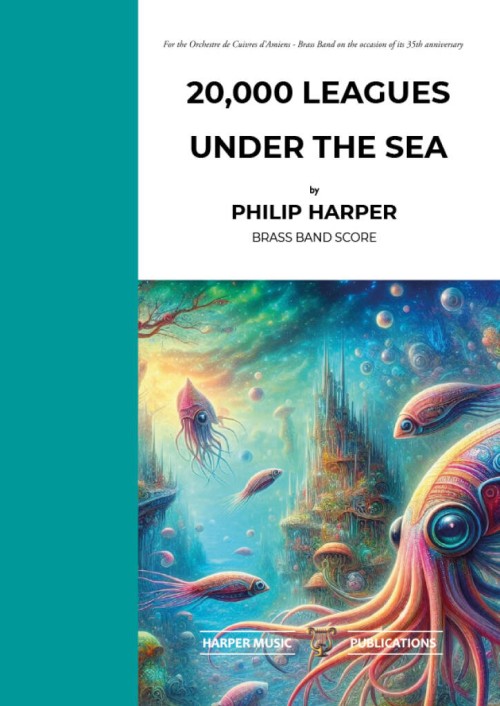
20,000 Leagues Under the Sea (Brass Band - Score and Parts) - Harper, Philip
Frenchman Jules Verne was a pioneer in science fiction during the late 19th Century, penning some classic stories such as Journey to the Centre of the Earth and Around the World in 80 Days - both of which have already been the subject of brass band test-pieces. It was therefore natural for me to choose Verne's 1869 watery magnum opus as the subject for this piece to which there are five sections, as well as an introduction and a finale.THE NAUTILUS. After a mysterious introduction we are introduced to The Nautilus - a fantastical submarine.THE CORAL KINGDOM. We visit awe-inspiring underwater coral formations.SQUID ATTACK. The Nautilus is attacked by a school of giant squid, or 'devilfish'.CAPTAIN NEMO. Captain Nemo is a loner and an eccentric. Some say he is a madman. Soloists of the band help to uncover the character of this enigmatic but powerful figure.MAELSTROM. The Nautilus is dragged into the ocean's deadliest whirlpool but Captain Nemo lives to fight another day.Duration: 12.30
Estimated dispatch 7-14 working days
-
£43.99
20,000 Leagues Under the Sea (Brass Band - Score only) - Harper, Philip
Frenchman Jules Verne was a pioneer in science fiction during the late 19th Century, penning some classic stories such as Journey to the Centre of the Earth and Around the World in 80 Days - both of which have already been the subject of brass band test-pieces. It was therefore natural for me to choose Verne's 1869 watery magnum opus as the subject for this piece to which there are five sections, as well as an introduction and a finale.THE NAUTILUS. After a mysterious introduction we are introduced to The Nautilus - a fantastical submarine.THE CORAL KINGDOM. We visit awe-inspiring underwater coral formations.SQUID ATTACK. The Nautilus is attacked by a school of giant squid, or 'devilfish'.CAPTAIN NEMO. Captain Nemo is a loner and an eccentric. Some say he is a madman. Soloists of the band help to uncover the character of this enigmatic but powerful figure.MAELSTROM. The Nautilus is dragged into the ocean's deadliest whirlpool but Captain Nemo lives to fight another day.Duration: 12.30
Estimated dispatch 7-14 working days
-
 £68.80
When the Lights Go Down (Brass Band - Score and Parts) - Houben, Kevin
Kevin Houben created with When the Lights Go Down, a wonderful chorale that can be a moment of reflection in any concert program. The resigned, magnificent melodies at the beginning of this composition slowly build up to a highlight with an increasing orchestration. The piece starts with a suggestive Adagio Meditativo, after which the main theme is immediately announced. A central bridge section takes the listener along through the different spheres at which the melodic and rhythmic drums embellish the chorale melodies. Thematic elements from the introduction brings the piece to a quiet and peaceful end. The sheer simplicity with which this work is written, makes it a resplendent, magnificent concert piece. 'When the Lights Go Down', refers to a moment when time stand still for a while, stillness within and around yourself.Duration: 9.00
Estimated dispatch 7-14 working days
-
 £59.70
Troldtog (March of the Trolls) (Brass Band - Score and Parts) - Grieg, Edvard - Smith, Sandy
Edvard Grieg (1843--1907) is best known for his eternally popular Piano Concerto in A Minor, as well as more than 150 songs and 66 lyric pieces. March of the Trolls is from his Lyric Pieces, Op. 54. Trolls are a constant theme in Norwegian folklore and can be viewed as the equivalent of our "boogie man." Far to the north in Norway where the winter storms whip the weather-beaten coasts, you will find dark forests with moonlit lakes, deep fjords surrounded by mighty snowcapped mountains, and long rivers and cold streams cascading down the mountain sides. This is where you might find the irritable, short-tempered trolls coming out of their hiding places after sunset, marching to wreck havoc on unsuspecting Norwegian households. Wait and see what your audience will do when the Trolls march up and down the aisles of your next concert!
Estimated dispatch 7-14 working days
-
 £118.99
Abaddon (The Dark Angel) (Brass Band - Score and Parts) - Houben, Kevin
Abaddon was commissioned by the NLBB (Noord-Limburgse Brassband - North Limburg Brass Band) from Belgium. Abaddon is the demon reigning over the underworld. In the New Testament - in the Book of Revelation by John (9:11) - he is called the angel of the bottomless pit. The work Abaddon lives up to its name. Technically and physically, it holds an enormous challenge for every band in the champions division. The composition has a traditional form structure (fast-slow-fast), and it consists of ornamentations around the letters IVAN, after Ivan Meylemans, the conductor who since 2001 has obtained great successes with the NLBB, and who in this case has also been essential in taming the demon in Abaddon.Suitable for Championship Section BandsDuration: 14:15
Estimated dispatch 7-14 working days
-
£44.95
Joy Through The Ages (Brass Band - Score and Parts) - Evans, Howard J.
This work was written for the 125th anniversary of Boscombe Band, celebrated in November 2011, and is the title track of the band' album released in the same year. The music is celebratory in nature and is dedicated to all those who have served in the band during its 125 year history. The theme of the work is a song by Charles Hutchison Gabriel which was the favourite of the band's librarian, Gerald Whittingham, who was 'promoted to Glory' after a long battle with a brain tumour. The title comes from the last verse, 'When with the ransomed in Glory, his face I at last shall see, 'twill be my joy through the ages, to sing of his love for me'.
Estimated dispatch 7-14 working days
-
£22.50
Joy Through The Ages (Brass Band - Score only) - Evans, Howard J.
This work was written for the 125th anniversary of Boscombe Band, celebrated in November 2011, and is the title track of the band' album released in the same year. The music is celebratory in nature and is dedicated to all those who have served in the band during its 125 year history. The theme of the work is a song by Charles Hutchison Gabriel which was the favourite of the band's librarian, Gerald Whittingham, who was 'promoted to Glory' after a long battle with a brain tumour. The title comes from the last verse, 'When with the ransomed in Glory, his face I at last shall see, 'twill be my joy through the ages, to sing of his love for me'.
Estimated dispatch 7-14 working days
-
 £29.95
Before The Cross (Cornet Solo with Brass Band - Score and Parts) - Gregson, Edward
Written at the request of David Daws for his solo album The Sound of David Daws, this meditation for cornet and brass band uses the composer's own song Before the cross (originally published in The Musical Salvationist, April 1965), the first lines of which are Before the cross I stand in fear and wonder, and see that all my sirs on Thee are laid. The song was written at an early stage of the composer's career, just before commencing study at The Royal Academy of Music, London. After a brief introduction the melody is heard twice, first played by the soloist, then on Euphonium and Flugel Horn with the soloist adding ornate counterpoint before taking up the melody once again, this time leading to a quiet and reflective conclusion.
Estimated dispatch 7-14 working days
-
£59.95
Rejoice, the Lord is King (Brass Band - Score and Parts) - Downie, Kenneth
The title of this work comes from the first line of Charles Wesley's hymn 'Rejoice, the Lord is King! Your Lord and King adore' which is set to Handel's majestic tune, Gopsal. The Handelian influence shows in more than the use of the tune itself as the opening pays homage to the Coronation Anthem 'Zadok the Priest' after which the free variations flow in quick succession. This major work was written for The International Staff Band which gave the first performance at the Epic Brass Gala Concert which followed the 2001 National Brass Band Championships.
Estimated dispatch 7-14 working days
 View Music