Searching for Wind Band Music? Visit the Wind Band Music Shop
We've found 1000 matches for your search. Order by

Results

  • £35.00

    Star Carol (Brass Band - Score and Parts) - Rutter, John - Harper, Philip

    Referred to by the BBC as "the most celebrated and successful composer of carols alive today," John Rutter's melodic and appealing music has always been synonymous with the warmest of Christmas glows. Suitable for 4th Section Bands and above

    Estimated dispatch 7-14 working days

     PDF View Music

  • £98.00

    KirkFeld (Trombone Solo with Brass Band - Score and Parts) - Kirkhope, Grant - McKenzie, Jock

    Written for Ian Bousfield and the International Trombone Festival 2017. Grant Kirkhope is a BAFTA nominated British composer who has created the soundtrack for video games that have sold in excess of 30 million copies. From "GoldenEye" to "Banjo-Kazooie", "Viva Pi?ata" to "Donkey Kong", "Kingdoms of Amalur: Reckoning" to "Civilization: Beyond Earth" and "Perfect Dark" to "Castle of Illusion starring Mickey Mouse". He has also recently scored the feature film "The King's Daughter" starring Pierce Brosnan and William Hurt and is currently working on "Yooka Laylee" and "Dropzone". Grant's score for "Viva Pi?ata" was nominated by BAFTA in the Original Score category in its 2007 awards. Grant is represented by the prestigious Gorfaine/Schwartz Agency by Cheryl Tiano and Kevin Korn. Grant has a degree in music from the Royal Northern College of Music, Manchester, where he majored in classical trumpet, is a green card holder and now lives in Agoura Hills, LA with his wife and two children. "Ian and I first met when we were around 15 years old. We both played in our county orchestra, the North Yorkshire Schools Symphony Orchestra (I was a trumpet player). I think we hit it off straight away, as we were definitely a couple of cheeky kids, if you know what I mean! We both ended up playing in Rowntree Mackintosh Brass Band for a while too which Ian's Dad, Trevor conducted. We bumped into each other again when we both went for the Shell/LSO Scholarship. I got to the area finals in Manchester so I was pretty pleased with myself but then I saw Ian and I knew it was all over! Of course Ian went on to win and the rest is history. I saw him again when I was attending the Royal Northern College of Music around 1983 by which time Ian had just got the principal chair at the Halle Orchestra. Then I guess 30 something years went by as we both went about our lives and lost touch. We re-kindled our friendship due to his wife really. She emailed me to say it was Ian's 50th birthday and she was collecting stories from all his friends over the years. After that we got back in touch and then one day on Facebook I got a message from him in typical dry Yorkshire fashion "now then Grant, I had a listen to your music and I think it's good, how about writing a piece for me ?" I was a little bit unsure at first but of course I loved Ian's playing and of course I said yes. Over a Skype call in 2016, he asked me what I thought I'd write. I said since I live in LA I'd like to write a "Hollywood" trombone piece. Imagine if John Williams had written a piece for solo trombone, that's what I'd like to write - well I'd certainly like to try" - Grant Kirkhope

    Estimated dispatch 7-14 working days
  • £134.99

    Sinfonietta: The Town Beneath the Cliff (Brass Band - Score and Parts) - Sparke, Philip

    Sinfonietta: The Town Beneath the Cliff was commissioned by Holmestrand Ungdomskorps from Vestfold in Norway. The work is in four movements: a spectacular fanfare followed by a moto perpetuo-like toccata. The third movement Hymn is a beautiful piece of music allowing the band to show its musicality and sound. The last movement Scherzo Finale opens with a short phrase from Holmestrand's own town song, Holmestrandsangen, which comes again in full at the end of the piece, accompanied by a florid passage based on the opening theme.Duration: 13.45

    Estimated dispatch 7-14 working days

     PDF View Music

  • £34.95

    Glory, Hallelujah (Brass Band - Score and Parts) - Larsson, Kevin

    This bright and fun setting of the classic Salvation Army song 'Glory, Hallelujah!', which first appeared in 1899, stylistically embraces music associated with Hollywood. Behind all the 'razzmatazz', the direct message is always clear: 'The devil and me we don't agree, Glory, Hallelujah! I hate him and he hates me Glory, Hallelujah!'

    Estimated dispatch 7-14 working days
  • £17.50

    Glory, Hallelujah (Brass Band - Score only) - Larsson, Kevin

    This bright and fun setting of the classic Salvation Army song 'Glory, Hallelujah!', which first appeared in 1899, stylistically embraces music associated with Hollywood. Behind all the 'razzmatazz', the direct message is always clear: 'The devil and me we don't agree, Glory, Hallelujah! I hate him and he hates me Glory, Hallelujah!'

    Estimated dispatch 7-14 working days
  • £72.99

    Balkan Dance (Brass Band - Score and Parts) - Crausaz, Etienne

    The Balkans region has always been a source of musical inspiration for composers throughout the centuries. Strong rhythms and often-abundant musical climaxes are two important characteristics of this rich and varied musical style. Etienne Crausaz took some of these elements and mixed it with elements of rock, turning this Balkan Dance into an exuberant and spectacular piece of music, during which no one can remain seated! Duration: 3.30

    Estimated dispatch 7-14 working days

     PDF View Music

  • £74.99

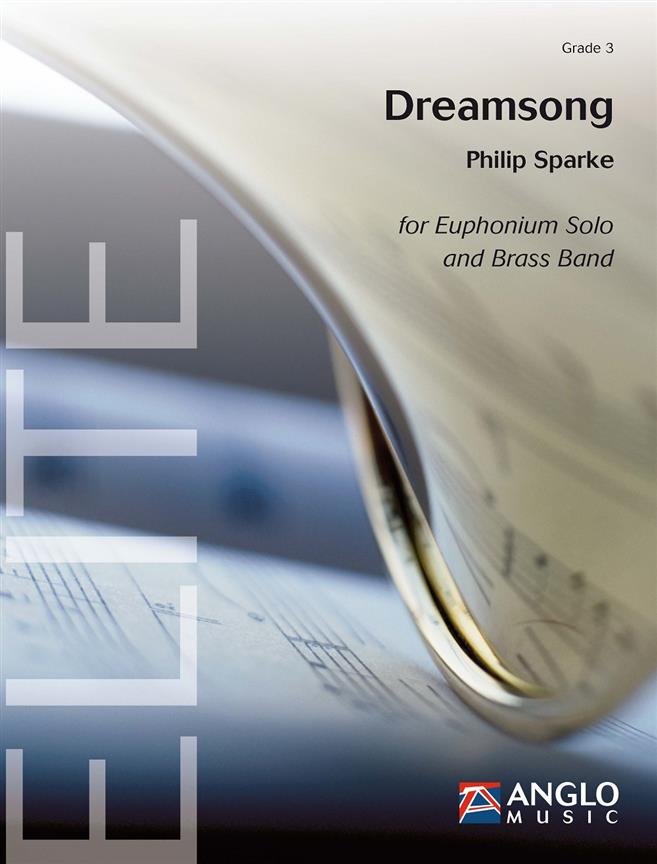
    Dreamsong (Euphonium Solo with Brass Band - Score and Parts) - Sparke, Philip

    Dreamsong was commissioned by Geir Ulseth and the Nidaros Brass Band from Trondheim, Norway. After a short introduction, the soloist introduces a rather nostalgic melody, accompanied by the lower brass parts. A fast central section is then played by the band, which leads to a climax. Eventually, the main melody played by the solo cornet and flugel horn returns, overlaid with an ornamented counter-melody from the soloist, who then closes the piece with a short cadenza.Duration: 4.30

    Estimated dispatch 7-14 working days

     PDF View Music

  • £89.95

    Four Etudes (Brass Band - Score and Parts) - Gregson, Edward

    This work was written during August and September 2016. In it, I wanted primarily to explore the elements of timbre, rhythm, texture and colour. The first three tudes (or studies) are based on a set of piano pieces I composed in 1982, whilst the last, the longest of the set, was composed specially. My reference point was the Four tudes for orchestra of 1928 by Stravinsky, a work I have always admired, and of which the first three also happen to be based on a set of earlier pieces, in his case for string quartet, with the last being a re-arrangement of a work for pianola. I have also borrowed the titles he gave to the individual studies as they seemed to fit the mood of my pieces.However, the exception is the final study, where instead of the exuberant mood of his colourful portrayal of Madrid, mine was influenced by the terrible human tragedy that was unfolding in Aleppo at the time I was writing it, and thus reflects the violence and barbarism of those events; yet towards the end it does offer a glimmer of hope for humanity with a return to the Canticle (Song) of the first study, and concludes quietly with the chords and bells that began the work. The titles of the tudes are Canticle, Dance, Excentrique, and Aleppo. Like Stravinsky's, the set is relatively short, lasting around 8 minutes.The Four tudes were commissioned by Black Dyke Band and were written specially for the recording marking the conclusion of my year as Composer-in-Residence. The concert premiere will be given by Black Dyke Band, conducted by the composer, at the RNCM Festival of Brass in January 2017.- Edward GregsonDuration: 8.00

    Estimated dispatch 7-14 working days

     PDF View Music

  • £37.95

    Four Etudes (Brass Band - Score only) - Gregson, Edward

    This work was written during August and September 2016. In it, I wanted primarily to explore the elements of timbre, rhythm, texture and colour. The first three tudes (or studies) are based on a set of piano pieces I composed in 1982, whilst the last, the longest of the set, was composed specially. My reference point was the Four tudes for orchestra of 1928 by Stravinsky, a work I have always admired, and of which the first three also happen to be based on a set of earlier pieces, in his case for string quartet, with the last being a re-arrangement of a work for pianola. I have also borrowed the titles he gave to the individual studies as they seemed to fit the mood of my pieces.However, the exception is the final study, where instead of the exuberant mood of his colourful portrayal of Madrid, mine was influenced by the terrible human tragedy that was unfolding in Aleppo at the time I was writing it, and thus reflects the violence and barbarism of those events; yet towards the end it does offer a glimmer of hope for humanity with a return to the Canticle (Song) of the first study, and concludes quietly with the chords and bells that began the work. The titles of the tudes are Canticle, Dance, Excentrique, and Aleppo. Like Stravinsky's, the set is relatively short, lasting around 8 minutes.The Four tudes were commissioned by Black Dyke Band and were written specially for the recording marking the conclusion of my year as Composer-in-Residence. The concert premiere will be given by Black Dyke Band, conducted by the composer, at the RNCM Festival of Brass in January 2017.- Edward GregsonDuration: 8.00

    Estimated dispatch 7-14 working days

     PDF View Music

  • £107.95

    Cornet Concerto (Brass Band - Score and Parts) - Gregson, Edward

    The Cornet Concerto was commissioned by Black Dyke Band for their principal cornet, Richard Marshall, and was premiered at the European Brass Band Festival's Gala Concert in Lille, France, on 30 April 2016 by the same performers, conducted by Nicholas Childs.It is challenging work, both musically and technically, and one that exploits the wide range of the instrument's capabilities. Lasting for some 17 minutes, it is in the usual three movements: Sonata, Intermezzo (subtitled 'Of More Distant Memories') and Rondo.The first movement presents four main ideas:Cadenzas (which recur throughout the movement, and indeed appear at the end of the work); a fast and rhythmically energetic motive; Bugle calls (echoing the ancestor of the cornet), and a lyrical and expressive melody, full of yearning. These four ideas are juxtaposed within the broad shape of a Sonata form structure, although here the word 'Sonata' is used in its original meaning of 'sounding together'.The second movement is music in search of a theme, which eventually comes at the end of the movement. In the middle section there are brief quotations, albeit mostly hidden, from three cornet solos written by the Swedish/American composer Erik Leidzen for the Salvation Army in the 1940s and 50s; these are solos I loved as a teenager, and my use of them is by way of tribute, not imitation - a sort of memory bank, just as the main theme of the movement, when it eventually comes, is reminiscent of the tune from my earlier work for brass band, 'Of Distant Memories'.The final Rondo, the shortest of the three movements, is a lively and 'fleet-of foot' Scherzo, its main theme full of cascading arpeggios, but with a contrasting lyrical second theme intertwined in the structure. There is much interplay between soloist and band in the development of the music, but eventually a brief reprise of the opening cadenzas leads to an exciting and climactic coda.Click here for the piano reduction

    Estimated dispatch 7-14 working days

     PDF View Music