
Results
-
 £24.50
Keep The Rhythm Going - Neil Brownless
Keep the Rhythm Going was written for Abingdon Concert Band during the 2020 Coronavirus pandemic as a tribute to musicians around the world who found ways to play together virtually in order to 'keep the rhythm going'. This exciting piece will be a great opener for any concert or contest programme and is available for both brass band and wind band. When performing the wind band arrangement the Cor Anglais, Eb Clarinet and Alto Clarinet parts are optional and can be omitted without affecting the music. The premiere performance can be viewed here: https://youtu.be/b6f7zRzxI7k The piece was premiered virtually on 19th November 2020 by 109 musicians from around the world from the following musical organisations:Abingdon Concert BandAbbey Brass BandAbergavenny Borough BandAbingdon and District Music SocietyAlnwick PlayhouseConcert BandAlnwick Symphonic Wind EnsembleAnything Goes Swing BandAshby Concert BandAylesbury Concert BandAylesbury Symphony OrchestraBacchus Wind OrchestraBanbury Symphony OrchestraBicester Concert BandBisham Concert BandBlaina Town BandBoobs and BrassBourne Concert Band of WokingBrass for AfricaBucks WindBurford OrchestraCastleton BrassCity of Cardiff Melingriffith Brass Band OrganisationCoquet Concert BandCorpo Bandistico G. Puccini - DLF BolognaDarlington Clarinet EnsembleDidcot Concert OrchestraDragon's Big BandDurham Miners' Association Brass BandEast Grinstead Concert BandGoring & Streatley Concert BandHalifax Concert BandHenley Symphony OrchestraJazz ColossusBig BandJupiter BrassKidlington Concert BrassLangtree SinfoniaNantwich Concert BandThe British Police Symphony OrchestraNew Buckenham Silver BandNottingham Concert BandNottingham Daytime OrchestraNottingham Symphonic WindsPaddock OrchestraPeebles Concert BandPotterspury Big BandReading Concert BandRoyal College of MusicRoyal Welsh College of Music & DramaSalvation Army West Midlands Fellowship BandSalvo BrassSaxophone SundaeSevenoaks and Tonbridge Concert BandShirley BandSlinfold Concert BandSouth Norfolk Youth Symphonic BandStockport Silver BandSuper BoneTewkesbury CamerataThame Concert BandThe Band of The Royal British Legion, LeistonVale Symphonic Wind BandTowcester Studio BandUniversity of Nottingham BlowsocThe University of Trinidad and TobegoWadhurst Brass BandWest Forest SinfoniaWeston BrassWindsor & Maidenhead Symphony OrchestraYorkshire Wind OrchestraYoung Musicians Symphony Orchestra...and some freelancers.
In Stock: Estimated dispatch 1-3 working days
-
£24.50
RONDO from "ABDELAZAR" - Henry Purcell - Wilfried Weiland
Used as the opening theme from Britten's 'Young Person's Guide to the Orchestra', The RONDO is part of the ABELAZAR-Suite which the English composer Henry Purcell wrote for the drama of the same name by Aphra Behn in 1695. This is a 6-piece arrangement for 2 cornets/trumpets, horn/flugel , baritone/trombone, euphonium and bass with timpani and drumset accompaniment.
In Stock: Estimated dispatch 1-3 working days
-
 £105.20
Jupiter Hymn from The Planets - Gustav Holst - Ingebjørg Vilhelmsen
Gustav Holst (1874-1934) was a British composer. His most famous work is the orchestra suite "The Planets". "Jupiter Hymn" is an excerpt from the fourth movement named "Jupiter". This Young Band arrangement is a good choice to showcase the horn-section of the band. The clarinet-parts in the beginning of the piece may be omitted if the band not require doublings of the brass parts.
Estimated dispatch 5-14 working days
-
 £54.99
X-mas for Three - David Well
David Well composed 'X-mas for Three' for three young pupils of his, who wished to give a Christmas concert. He arranged six well-known Christmas songs for them, and their first performance was a great success. This was reason for the composer to adapt the piece for 'orchestra' by adding percussion. The title has stayed the same, and the work can still be played by as few as three musicians, but as the saying goes: "The more, the merrier"! 'X-mas for Three' consists of the following parts : 1. Oh du frohliche 2. Kling, Glockchen, kling 3. Gloria in excelsis deo 4. Joy to the world! 5. The first Noel 6. We wish you a MerryChristmas
Estimated dispatch 5-14 working days
-
 £78.20
The Rocketeer - James Horner - Roland Smeets
Before Titanic,James Horner was not above composing scores for cartoonish family films, and many of those that brought him on their production board owe him greatly. The Rocketeer entails the story of a young pilot during World War II who happens upon a rocket pack that allows him to fly. The film is based on the tradition of old film serials that left theater-goers hanging with "To be continued," and aside from modern production, it is old fashioned and innocent fun. Horner's score begins and ends with the brilliant "Main Title," which is so moving it was used in previews for later films that did not yet have finished scores. Most of th Rocketeersoundtrack elicits the adventure and lifting spirit of the film and reveals how Horner incorporates rich instrumentals in the tiniest crevices. Even when the film involves danger, as in "Jenny's Rescue," the composer takes care when it is hardly even required. Instead of some "duh-duh-duhs," he brings on a full, stunning orchestra and when he overdoes it, it is in a jolly way -- he never exhausts his medium. That is what separates him from inferior composers, and what makes a nice film like The Rocketeer extra nice. It is a soundtrack worth listening to.
Estimated dispatch 5-14 working days
-
 £45.00
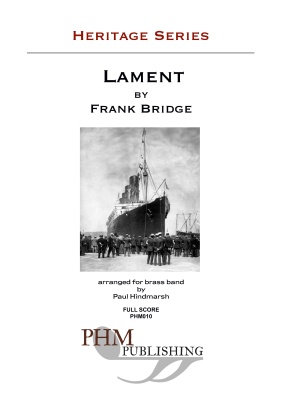
Lament (Brass Band - Score and Parts)
The English composer Frank Bridge (1879 - 1941) did not take an active part in the First World War. However, he was devastated by the slaughter on the western and the eastern fronts, especially the loss of so many of his musicians friends and colleagues. Writing in 1963, his former pupil Benjamin Britten confessed that 'a lot of my feelings about the First World War which people seemed to see in the War Requiem came from Bridge. He had written a piano sonata in memory of a friend killed in France and though he didn't encourage me to take a stand for the sake of a stand, he did make me argue and argue and argue. His own pacifism was not aggressive, but typically gentle'.Bridge composed this Lament for string orchestra on 14 June 1915, in memory of Catherine Crompton, who drowned when the Cunard liner Lusitania was torpedoed by a German submarine on 7 May, 1915. According to figures researched by Liverpool historian Kevin Roach (www.lusitania.net), 1201 men, women and children lost their lives out of the 1962 people aboard. Ninety-four children died, including Catherine, her twin brother Paul and four other siblings. Paul Crompton, Snr. (44), a British businessman working in Philadelphia, his wife Gladys (40) and the family nanny were also drowned. How Bridge's dedication came about is uncertain. The music critic Edwin Evans, who knew Bridge well, has written that the Catherine was a young friend. It is also possible that he came across the family photograph which was published in many newspapers in the wake of the tragedy. By that time, Bridge was greatly distressed by the war as a whole. It seems perfectly in keeping with his pacifist leanings and the strength of his reaction, that this poignant and deeply touching 'war memorial' should mourn a child who he did not know, rather than one of the thousands of young men who fell in battle.Through the musical tears of this melancholy lullaby, Bridge may have regarded the death of young Catherine Crompton as symbolic of the loss of so many innocent lives in wartime. His response to this personal tragedy was characteristically spontaneous and utterly sincere. It is one of his most effective miniatures, poignant yet restrained in its lyrical beauty, with a compelling directness and simplicity of construction.This brass band transcription is pitched one tone lower than the original for string orchestra.- Paul HindmarshDuration: 5.00
Estimated dispatch 7-14 working days
-
 £95.00
A Wartime Sketchbook (Brass Band - Score and Parts)
Early in 1941 William Walton, 39, received his call-up papers. He was by then one of the most eminent of British composers and was exempted from military service on condition that he provided music for films deemed to be of 'national importance'. Scoring Lawrence Olivier's Shakespeare epic Henry V in 1943 was the most substantial of these wartime projects. His role in patriotic films from 1941 and 42 like The Foreman went to France, Next of Kin, Went the day Well and The First of the Few was to provide appropriate title music and some underscoring at key moments. Walton extracted the most substantial portions of the latter as the popular Spitfire Prelude and Fugue for orchestra. The remaining music remained unpublished until 1990, when Christopher Palmer assembled the highlights into A Wartime Sketchbook. I was intrigued to hear these examples of Walton's wartime music and having discovered that they would fit naturally and idiomatically onto the brass band, I arranged six of the numbers into a suite for Besses o' th' Barn Band, which I was conducting at the time.In 1995 the brass band suite was recorded by the famous Black Dyke Mills Band as part of an all Walton album which I produced for the ASV label (ASV CD WHL 2093). This award- winning CD also included Walton's First Shoot, in the edition by Elgar Howarth, my transcription of movements from Music for Children and two substantial brass versions by Edward Watson of the suite from Henry V (with narrator) and the March and Siegfried Music from The Battle of Britain music.Prologue: This is the stirring title music from Went the day Well, a screen play by Graham Greene about a German airborne invasion of an English village. The main theme leads toBicycle Chase: Characteristic musical high-jinks for J.B.Priestley's The Foreman went to France.Refugees: From the same film, this is a poignant accompaniment to the long march of refugees. As Ernest Irving, the film's musical director, put it, "this really makes your feet sore and your knees sag."Young Siegfrieds: This lively movement comes from the music that Walton composed for The Battle of Britain in 1968, with the assistance of Malcolm Arnold, but which the film's producer rejected. It portrays first the Berliners, cheerfully ignoring the black-out and then, in the trio, the Young Siegfrieds of the Luftwaffe, courtesy of a parody of Siegfried's horn call from Wagner's opera.Romance: A soldier and a Dutch refugee snatch a few tender moments together in Next of Kin.Epilogue: At the end of The Foreman went to France, the French look forward with hope and optimism to eventual liberation.- Paul HindmarshDuration: 14.00
Estimated dispatch 7-14 working days
-
£40.00
A Wartime Sketchbook (Brass Band - Score only)
Early in 1941 William Walton, 39, received his call-up papers. He was by then one of the most eminent of British composers and was exempted from military service on condition that he provided music for films deemed to be of 'national importance'. Scoring Lawrence Olivier's Shakespeare epic Henry V in 1943 was the most substantial of these wartime projects. His role in patriotic films from 1941 and 42 like The Foreman went to France, Next of Kin, Went the day Well and The First of the Few was to provide appropriate title music and some underscoring at key moments. Walton extracted the most substantial portions of the latter as the popular Spitfire Prelude and Fugue for orchestra. The remaining music remained unpublished until 1990, when Christopher Palmer assembled the highlights into A Wartime Sketchbook. I was intrigued to hear these examples of Walton's wartime music and having discovered that they would fit naturally and idiomatically onto the brass band, I arranged six of the numbers into a suite for Besses o' th' Barn Band, which I was conducting at the time.In 1995 the brass band suite was recorded by the famous Black Dyke Mills Band as part of an all Walton album which I produced for the ASV label (ASV CD WHL 2093). This award- winning CD also included Walton's First Shoot, in the edition by Elgar Howarth, my transcription of movements from Music for Children and two substantial brass versions by Edward Watson of the suite from Henry V (with narrator) and the March and Siegfried Music from The Battle of Britain music.Prologue: This is the stirring title music from Went the day Well, a screen play by Graham Greene about a German airborne invasion of an English village. The main theme leads toBicycle Chase: Characteristic musical high-jinks for J.B.Priestley's The Foreman went to France.Refugees: From the same film, this is a poignant accompaniment to the long march of refugees. As Ernest Irving, the film's musical director, put it, "this really makes your feet sore and your knees sag."Young Siegfrieds: This lively movement comes from the music that Walton composed for The Battle of Britain in 1968, with the assistance of Malcolm Arnold, but which the film's producer rejected. It portrays first the Berliners, cheerfully ignoring the black-out and then, in the trio, the Young Siegfrieds of the Luftwaffe, courtesy of a parody of Siegfried's horn call from Wagner's opera.Romance: A soldier and a Dutch refugee snatch a few tender moments together in Next of Kin.Epilogue: At the end of The Foreman went to France, the French look forward with hope and optimism to eventual liberation.- Paul HindmarshDuration: 14.00
Estimated dispatch 7-14 working days
-
£44.00
Don't Sit Under the Apple Tree - Stept-Brown-Tobias - Bjorn Morten Kjaernes
"Don't Sit Under the Apple Tree (With Anyone Else but Me)" is a popular song that was made famous by Glenn Miller and by the Andrews Sisters during World War II. Its lyrics are the words of two young lovers who pledge their fidelity while one of them is away serving in the war. Originally titled "Anywhere the Bluebird Goes", the melody was written by Sam H. Stept as an updated version of the nineteenth-century English folk song "Long, Long Ago". Lew Brown and Charles Tobias wrote the lyrics and the song debuted in the 1939 Broadway musical Yokel Boy. After the United States entered the war in December 1941, Brown and Tobias modified the lyrics to their current form, with the chorus ending with "...'till I come marching home".In 1942 the song was featured in the film Private Buckaroo as a performance by the Andrews Sisters with the Harry James orchestra and featuring a tap dancing routine by The Jivin' Jacks and Jills. It was featured in the films Twelve O'Clock High (1949), With a Song in My Heart (1952), Kiss Them for Me (1957), A Carol for Another Christmas (1964), In Dreams (1999) and The Master (2012). It also featured in the mini-series The Pacific. You can use the song both on musical concerts, movie concerts or just as a happy jazz tune on your next concert. On the sections (like from bar 25), please work carefully to make a good balance with all parts, and that each chord is balanced. With 4-part harmonies sometimes you need to hold back certain notes to make the accord sound good. If you want to open up for a longer improvisation, you can repeat 65 to 81, but then change the part 2 in bar 80 from Eb to a D on the repeat. The accord will be an F6 instead of F7 (on beat 3 and 4 in bar 80) Have fun and enjoy!
Estimated dispatch 7-14 working days
-
£59.95
RHAPSODY ON A THEME BY PURCELL (Brass Band Set) - Kevin Norbury
The theme is the rondo refrain from 'Abdelazer' famously used by Benjamin Britten in his 'The Young Person's Guide to the Orchestra'. The composer, while keeping a spirit of fun, pays subtle tribute to both Purcell and Britten in this set of linked variations.
Estimated dispatch 7-14 working days
 View Music
 Listen to MP3