
Results
-
 £37.35
World War III (Brass Band) Joe Galuszka
This descriptive work for brass band by Joe Galuszka depicts the horrors of war. War is all around us. Every day, another life is lost. Myanmar, Sudan, Ethiopia, Ukraine, Colombia, Afghanistan, Somalia, Syria and Yemen. As time goes on, more and more countries are brought to the end of what is a diplomatic struggle - in where war seems to be the only option. 'War! Terror! Panic! captures the tumultuous and relentless nature of war. With driving rhythms, aggressive brass fanfares, and thundering percussion, the listener is immersed in the chaos of battle. Dissonance and clashing harmonies depict the discord that pervades war and takes us on a journey through the terror and panic that comes with the brutality of conflict. Remembrance (For Those That We Have Lost) provides a poignant and reflective interlude, allowing the audience to contemplate the human cost of war. Mournful melodies and expressive solos for trombone, euphonium and glockenspiel, convey the depth of sorrow and loss, serving as a powerful reminder of the toll war takes on individuals and communities. The final movement, Hymn for Peace and Hope is a testament to the enduring human spirit and the yearning for harmony - dissonance and conflict gradually give way to consonance and resolution. We celebrate the human capacity for unity and the triumph of peace over strife, as we imagine a world at piece. To listen to an audio demo of the work please visit https://on.soundcloud.com/Udt1AWRThgwuWnQv5 Duration: Approx. 5.00 mins Difficulty Level: 2nd Section + PDF download includes parts and score. Sheet music available from www.brassband.co.uk (UK) or https://satradecentral.org (USA) Instrumentation: Soprano Cornet Eb Solo Cornet Bb Repiano Cornet Bb 2nd Cornet Bb 3rd Cornet Bb Flugel Horn Bb Solo Horn Eb 1st Horn Eb 2nd Horn Eb 1st Baritone Bb 2nd Baritone Bb 1st Trombone Bb 2nd Trombone Bb Bass Trombone Euphonium Bb Bass Eb Bass Bb Timpani Percussion 1-3
In Stock: Estimated dispatch 1-3 working days
-
 £67.24
Armistice at Flanders Fields (Brass Band) Dwayne Bloomfield
This poignant and powerful work for brass band by Dwayne Bloomfield describes the day peace was announced to end World War I. The piece was written in 2023 to be played by bands around the world to mark Armistice Day. The composer writes: 'Unless you were there, it's impossible to imagine what it must have been like the day peace was announced ending World War I. The feelings soldiers experienced, who after years of fighting and suffering, to know it was over and they would return home to see family and loved ones again. This piece tries to tell their story. The work begins by approaching the front, distant artillery and battle sounds heard while the carnage and loss of lives was already known to the world. The band builds as we enter the thick of battle, the death and destruction, the conditions faced and the loss of hope of ever surviving. The next section, in 7/8 time, reflects the two sides fighting - both sides attacking and defending with mostly little result, but for the loss of more lives. Two euphoniums then depict the news and hope of peace talks. However, fighting did continue right up to the very end and on the last day there would be another 2,738 casualties. The Canadians were still battling to capture the town of Mons that morning. A song is sung in reflection of the estimated 5.5 million allied soldiers who lost their lives during World War I, then a clock ticks down the final minutes. The last three known casualties are depicted with French soldier Augustin Trebuchon, killed at 10:45am by a single shot as he rushed down the trenches to spread the news of coming peace; Canadian George Lawrence Price killed by a sniper round at 10:58am at the battle of Mons, and lastly a machine gun burst that killed American Henry Gunther, who is believed to have fallen on the 11th hour. Bells then toll ringing around the world announcing the end of the war. After years of war, it must have been jubilation for the families at home knowing their loved ones would be returning to them. The band builds with a hymn for peace as a final tribute to those who fought, before the piece resides with one of the most dreaded sounds at that time, the knock on the door from a telegram delivery boy or better known then as the Angels of Death. It wasn't just the 2,738 families from the casualties of the last day who would receive such a knock, but many more who expected their loved ones to be returning home would instead find out they were instead killed in the last weeks. So close. Driving around the battlefields today one comes across many intersections in the countryside which have cemetery signposts pointing in every direction. While the last post sounds in ceremonies today, this last bugle call instead depicts the horrors, devastation and death the soldiers faced during the war and right up the 11th hour of the 11th day of the 11th month, Armistice at Flanders Fields.' To view a video of Dallas Brass Band performing the work please visit https://www.youtube.com/watch?v=ljfyVz3cMgk Duration: Approx. 15.00 minutes Difficulty Level: 2nd Section + PDF download includes parts and score. Sheet music available from www.brassband.co.uk Instrumentation: Soprano Cornet Eb Solo Cornet Bb Repiano Cornet Bb 2nd Cornet Bb 3rd Cornet Bb Flugel Horn Bb Solo Horn Eb 1st Horn Eb 2nd Horn Eb 1st Baritone Bb 2nd Baritone Bb 1st Trombone Bb 2nd Trombone Bb Bass Trombone Euphonium Bb Bass Eb Bass Bb Percussion 1-3
In Stock: Estimated dispatch 1-3 working days
-
 £67.24
Letters from Flanders (Brass Band) Andrew Batterham
This descriptive work by Australian composer Andrew Batterham portrays the experiences of his maternal grandfather, Corporal Reginald Littlejohns, (4th Australian Machine Gun Battalion) in the First World War. Reginald left Melbourne for Europe in May 1916 then served in Flanders through to the end of the war. He returned in April 1919, having sent hundreds of letters home during his service. His honest, articulate, and highly descriptive prose served as inspiration for this piece. Each of the 5 movements portrays a different aspect of Reginald's war, with a quote from his letters included. The first movement was premiered by the Box Hill City Band, conducted by Matt van Emmerik, in Melbourne. Daniel van Bergen conducted Booroondara Brass performing most of the work in April 2019, and Box Hill premiered the complete version in November 2019 conducted by Simon Brown. The work is comprised of the following movements: i. The World at War ii. Over the Sea iii. Passchendaele iv. Homecoming Parade v. Elegy Length: c.12.00 minutes PDF download includes score and parts. Sheet music available from www.brassband.co.uk Difficulty Level: 1st Section + Instrumentation: Soprano Cornet Eb Solo Cornet Bb Repiano Cornet Bb 2nd Cornet Bb 3rd Cornet Bb Flugel Horn Bb Solo Horn Eb 1st Horn Eb 2nd Horn Eb 1st Baritone Bb 2nd Baritone Bb 1st Trombone Bb 2nd Trombone Bb Bass Trombone Euphonium Bb Bass Eb Bass Bb Percussion 1-3
In Stock: Estimated dispatch 1-3 working days
-
 £41.09
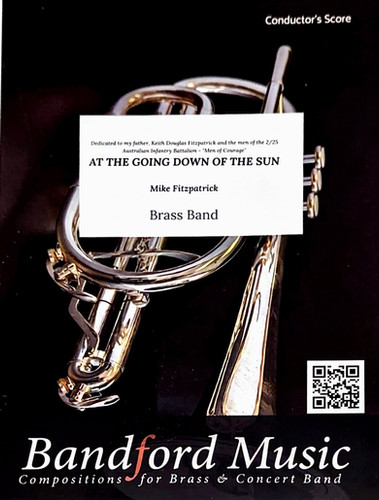
At the Going Down of the Sun (Brass Band) Mike Fitzpatrick
At The Going Down Of The Sun is a deeply moving musical tribute dedicated to the courage, resilience, and ultimate sacrifice of those who have defended the nation of Australia. Inspired by the heroic legacy of the 2/25th Battalion and their storied defense of the Kokoda Track during World War II, this composition serves as a solemn reminder of the immense gratitude owed to its fallen heroes. This piece is born from a legacy of service. It was composed in honor of Keith Fitzpatrick, who enlisted in the AIF on November 28, 1941. Keith served two tours in New Guinea, spending 359 days on the treacherous Kokoda Track. Keith Fitzpatrick lived to celebrate his 100th birthday in 2023, leaving behind a profound legacy through his wife of 67 years, Valda, and three generations of descendants. At The Going Down Of The Sun captures this spirit of endurance and devotion. It is an ideal addition to any program focused on: Anzac Day & Remembrance Day services Military Commemorations Historical Tributes To view a rolling score video of the work please visit www.youtube.com/watch?v=ydO9PKOKTpk Duration: 7.00 minutes Difficulty Level: 3rd Section + This PDF download includes the full score and parts. Sheet music available at www.brassband.co.uk (UK) or https://satradecentral.org (USA) Instrumentation: Soprano Cornet Eb Solo Cornet 1&2 Bb Solo Cornet 3&4 Bb Repiano Cornet Bb 2nd Cornet Bb 3rd Cornet Bb Flugel Horn Bb Solo Horn Eb 1st Horn Eb 2nd Horn Eb 1st Baritone Bb 2nd Baritone Bb 1st Trombone Bb 2nd Trombone Bb Bass Trombone Euphonium Bb Bass Eb Bass Bb Percussion Tubular Bells
In Stock: Estimated dispatch 1-3 working days
-
 £54.95
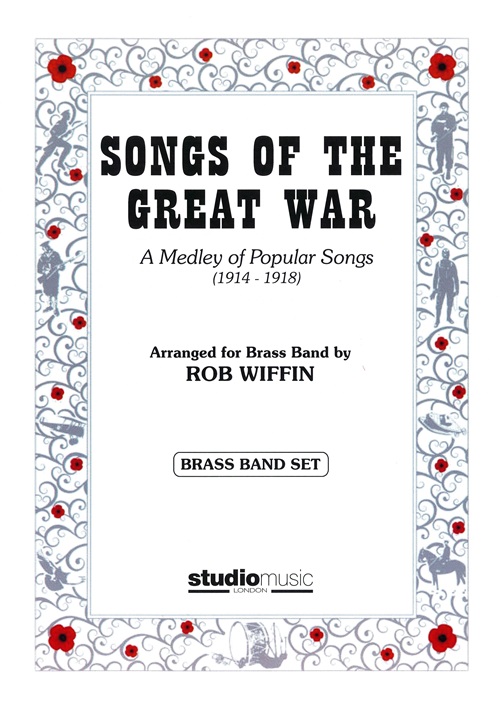
Songs of the Great War (Brass Band - Score and Parts) - Wiffin, Rob
A Medley of Popular Songs, 1914 - 1918Music of the Great War is a five year project to use music of the period to educate and engage schools, colleges, town bands, and the wider public across the UK and the world to learn in a positive way about the events, the experience of the troops involved from all sides, and how music played its part.This year, to commemorate the centenary of the Great War a specially arranged medley Songs of the Great War has been created. The medley has been arranged for bands to rehearse and eventually perform on the 11 November 2015. It brings together some of the most popular tunes played, sung and performed by the men and women of the time - in the trenches and on the various home fronts.With the support of many countries and organisations, on the 11 November the medley will be first played in New Zealand and Australia. It will ripple east across the world being performed in countries like India and Pakistan before hitting Europe and onwards to include performances in Canada and the Caribbean. This could become one of the most played pieces of music in a 24-hour period.In Britain, there will be performances across the country, including some at key events and sites involving a wide range of military and non-military personnel.The medley includes:It's a Long Way to TipperaryYour King and Country Want YouGood Bye-eeOh! It's a Lovely WarHello! Hello! Who's Your Lady FriendTake Me Back to Dear Old BlightyMademoiselle from ArmentieresThere's a Long, Long Trail A-windingIf You Were the Only Girl in the WorldPack Up Your Troubles (In Your Old Kit Bag)Old Soldiers Never Die/Last Post
Estimated dispatch 7-14 working days
-
£24.50
Codebreakers - Len Jenkins
A great march, dedicated to the memory of those who worked at Bletchley Park, Milton Keynes, England, in World War 2. They were under the brilliant leadership of Alan Turing and were responsible for breaking the secret military codes used by the Enemy Forces (German in particular). The composer, Len Jenkins, lives close to Bletchley Park, went to school even closer, and attended Training Courses actually in 'The Park'. The march has memorable themes and is toe tapping for the audience.
In Stock: Estimated dispatch 1-3 working days
-
£24.50
Hut Six - Len Jenkins
A great march (perfect for contests such as whit Fridays) dedicated to the memory of those who worked at Bletchley Park, Milton Keynes, England, in World War 2. They were under the brilliant leadership of Alan Turing and were responsible for breaking the secret military codes used by the Enemy Forces (German in particular). The composer, Len Jenkins, lives close to Bletchley Park, went to school even closer, and attended Training Courses actually in 'The Park'. The march has memorable themes and is toe tapping for the audience.
In Stock: Estimated dispatch 1-3 working days
-
£29.95
Rhapsody in Brass (Score Only)
Rhapsody in Brass is in three movements and was written for the British Open Championships in 1949, held at Belle Vue in Manchester. The contest winners were Fairey Aviation Works Band under the baton of Harry Mortimer. Eric Ball came second with Ransome & Marles and Stanley Boddington 3rd with Munn and Felton Band. Rhapsody in Brass had the unusual distinction of being written as a test piece by a Salvation Army composer. Eric Ball's Resurgam was the only other piece to achieve that dual personality in that era.Dean Goffin was born in 1916 in Wellington, New Zealand, son of Henry Goffin, a Salvation Army officer and composer. At 19 he was appointed Bandmaster of the Wellington South Band and when World War II started, he enlisted in the New Zealand Armed Forces where he became Bandmaster of the 20th Infantry Battalion and later the 4th Brigade Band. During the time he served with them in the Middle East and Europe, he composed and arranged numerous pieces among which Rhapsody in Brass and the march Bel Hamid, later adapted for Salvation Army use and renamed Anthem of the Free.After the war, Dean kept on composing and his work was featured by the Wellington South Band. Later he transferred to Timaru for another job and became Bandmaster there. He was studying music at the time and as he wanted to take part in a competition for devotional selections for Salvation Army use, he sent some of his compositions to the International Headquarters. When Rhapsody for Brass was chosen as the test-piece for the British Open Championships, people at the Salvation Army started asking questions about the lack of publications of his work. It was discovered that the pieces submitted for the competition didn't meet the exact criteria. Among these pieces was one of his most appealing works The Light of the World which was published a year later, in 1950, the same year as he completed his Bachelor of Music studies at Otagu University.After entering the Salvation Army Training College in Wellington with his wife, Marjorie, Dean was in 1956 appointed National Bandmaster in the British Territory. Later he became National Secretary for Bands and Songster Brigades and in this period he organised the yearly festival in the Royal Albert Hall and was responsible for the national music schools in the UK. Dean returned to his home country in 1966 and to mark the centenary of the Salvation Army in New Zealand he was knighted by the Queen in 1983. Sir Dean Goffin died on 23 January 1984.
Estimated dispatch 7-14 working days
-
 £89.95
Revelation (Score and Parts)
Symphony for Double Brass on a theme of Purcell 1995 marked the tercentenary of Purcell's death, and my new score Revelation has been written as a tribute to his music and the ornate and confident spirit of his age. There are five major sections: 1 Prologue 2 Variations on a ground bass I 3 Fugue 4 Variations on a ground bass II 5 Epilogue and Resurrection The score uses many features of the Baroque Concerto Grosso, and arranges players in two equal groups from which soloists emerge to play in a variety ofvirtuoso ensembles. It quotes freely from Purcell's own piece Three Parts on a Ground in which he has composed a brilliant sequence of variations over a repeating six-note bass figure. This original motif can be heard most clearly beneath the duet for Cornet 5 and Soprano at the beginning of the 2nd section. There is, of course, a religious dimension to Revelation as the title suggests, and the score is prefaced by lines by the 17th century poet John Donne. His Holy Sonnet paraphrases the Book of Revelation in which the dead are raised at the sounds of the last trumpet. Donne's trumpets are themselves placed stereophonically ". . . At the round Earth's imagined corners" and it is this feature that today's players represent as they move around the performing area. Their final apocalyptic fanfares can be heard at the close of the score, as Purcell's music re-enters in a lasting tribute to England's first composer of genius. Philip Wilby September 1995 At the round Earth imagined corners, blow your trumpets, angels, and arise, arise from death, you numberless infinities Of souls, and to your scattered bodies go. All whom the flood did, and fire shall o 'erthrow All whom war, dearth, age, agues, tyrannies, Despair, law, chance hath slain, and you whose eyes Shall Behold God, and never taste death woe. John Donne after Revelation Ch. 11 v.15
Estimated dispatch 7-14 working days
-
 £44.95
Revelation (Score Only)
Symphony for Double Brass on a theme of Purcell 1995 marked the tercentenary of Purcell's death, and my new score Revelation has been written as a tribute to his music and the ornate and confident spirit of his age. There are five major sections: 1 Prologue 2 Variations on a ground bass I 3 Fugue 4 Variations on a ground bass II 5 Epilogue and Resurrection The score uses many features of the Baroque Concerto Grosso, and arranges players in two equal groups from which soloists emerge to play in a variety ofvirtuoso ensembles. It quotes freely from Purcell's own piece Three Parts on a Ground in which he has composed a brilliant sequence of variations over a repeating six-note bass figure. This original motif can be heard most clearly beneath the duet for Cornet 5 and Soprano at the beginning of the 2nd section. There is, of course, a religious dimension to Revelation as the title suggests, and the score is prefaced by lines by the 17th century poet John Donne. His Holy Sonnet paraphrases the Book of Revelation in which the dead are raised at the sounds of the last trumpet. Donne's trumpets are themselves placed stereophonically ". . . At the round Earth's imagined corners" and it is this feature that today's players represent as they move around the performing area. Their final apocalyptic fanfares can be heard at the close of the score, as Purcell's music re-enters in a lasting tribute to England's first composer of genius. Philip Wilby September 1995 At the round Earth imagined corners, blow your trumpets, angels, and arise, arise from death, you numberless infinities Of souls, and to your scattered bodies go. All whom the flood did, and fire shall o 'erthrow All whom war, dearth, age, agues, tyrannies, Despair, law, chance hath slain, and you whose eyes Shall Behold God, and never taste death woe. John Donne after Revelation Ch. 11 v.15
Estimated dispatch 7-14 working days
 View Music