
Results
-
 £29.41
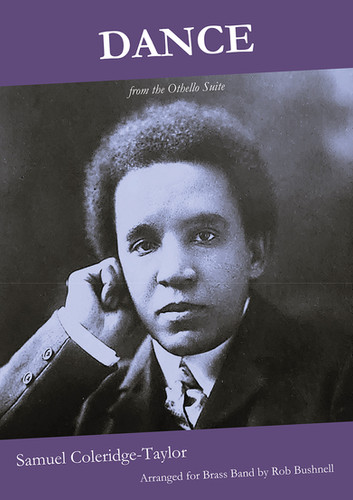
Dance from the Othello Suite (Brass Band) Coleridge-Taylor arr. Bushnell
Samuel Coleridge-Taylor is a British composer, who, from a young age, showed talent on the violin and entered the Royal College of Music, studying with Charles Villers Standford. His music become so popular that his Hiawatha trilogy was the second most performed choral piece (joint with Mendelssohn's Elijah, and only beaten by Handel's Messiah) with choral societies up and down the British Isles. In fact, Hiawatha was arranged by Charles Godfrey as a test-piece for the 1902 National Brass Band Championship of Great Britain, held at Crystal Palace.Commissioned by the theatre impresario Herbert Beerbohm, Coleridge-Taylor composed incidental music for His Majesty's Theatre London production of the Shakespeare play, Othello, in the West End, in 1909. In 1912, the play opened to the public, with a suite of five movements put together soon afterwards. The Dance, arranged here by Rob Bushnell, makes a great concert opener.This arrangement is for the British-style brass band, with alternative parts for horns in F and bass-clef lower brass. A recording of the original composition can be found at www.youtube.com/watch?v=OQeO_Ij9CV8 Duration: approx. 2.30 minutes Difficulty Level: 3rd Section + PDF download includes parts and score. Sheet music available at www.brassband.co.uk (UK) or https://satradecentral.org (USA) Instrumentation: Soprano Cornet Eb Solo Cornet Bb Repiano Cornet Bb 2nd Cornet Bb 3rd Cornet Bb Flugel Horn Bb Solo Horn Eb 1st Horn Eb 2nd Horn Eb 1st Baritone Bb 2nd Baritone Bb 1st Trombone Bb 2nd Trombone Bb Bass Trombone Euphonium Bb Bass Eb Bass Bb Timpani Percussion - Triangle, Cymbal & Bass Drum
In Stock: Estimated dispatch 1-3 working days
-
 £62.49
Temperamental (Brass Band) Fendall Hill
This work by Fendall Hill was the set test for the 2021 National Brass Band Championships of New Zealand, B Grade. The composer writes: 'J.S. Bach (1685-1750) is deemed by many to be the 'Ulimate Composer'. He added an incredible proportion to the DNA of western music, and his influence is heard in the music of today. Like many artists, he was not overly recognised as a composer during his lifetime, and it took an 1829 performance of the St Matthew Passion by Mendelssohn to ignite a recognition of his place in the music world, a place he has maintained ever since. This piece starts with a similar spark of rediscovery of the music of Bach. It contains arrangements of various works, interspersed with composition based on Bach's chord structures, sections in the style of Bach, and original sections inspired by the moods created along the way. The first section explores the Toccata, and great organ works. This leads into an exploration of his choral works, and a finale based on the Preludes. The word 'Tempered' has different meanings, and all seem to apply to the music of Bach, and these appeal to the musical, engineering and spiritual aspects of my personal life. His music reaches to the humanity and divinity, it has strength, structure and order that creates frameworks in which incredible complexity reigns; and the complexity leads to a wildness, a kind of craziness that represents a range of human moods, and can change without warning. The same piece of music affects people in very different ways. I don't know if it's Bach's music, or us, but it can seem out of control and under control at the same time - the combination is highly temperamental. To view a follow-the-score video of the work please visit: https://youtu.be/zpNxITUqXZU Sheet music available from: UK - www.brassband.co.uk USA - www.solidbrassmusic.com Difficulty Level: 1st Section + Instrumentation: Soprano Cornet Eb Solo Cornet 1&2 Bb Solo Cornet 3&4 Bb 2nd Cornet Bb 3rd Cornet Bb Flugel Horn Bb Solo Horn Eb 1st Horn Eb 2nd Horn Eb 1st Baritone Bb 2nd Baritone Bb 1st Trombone Bb 2nd Trombone Bb Bass Trombone Euphonium Bb Bass Eb Bass Bb Timpani Percussion 1-4
In Stock: Estimated dispatch 1-3 working days
-
 £79.95
Neverland - Christopher Bond
"All children, except one, grow up" wrote J.M. Barrie about Peter Pan in 1911; the first line and an expression of beautiful melancholy and fantasy, coming to represent one of the best-loved children's stories of the twentieth century. 'Peter & Wendy', as the book was first released, has subsequently been transformed into adaptations for film and stage, with subsequent books based on this iconic tale. In writing this new work for brass band, the composer has taken three of the main themes from J. M. Barrie's book, and used these themes to create new musical material, forming a work in three contrasting sections. I. Journey to Neverland The opening of the work, mysterious in its style, reflects the opening chapters of the story - a leafy London street, still in the dead of night - with the music transforming quickly as it builds in texture and momentum - a Journey to Neverland through the night sky; Second Star to the Right and straight on 'til morning. "Then Peter knew that there was not a moment to lose. 'Come,' he cried imperiously, and soared out at once into the night, followed by John and Michael and Wendy. Mr & Mrs Darling and Nana rushed into the nursery too late. The birds were flown." II. The Windows that Closed The central section of the work takes its inspiration from the sense of longing throughout the book, mainly by Peter Pan, the Darling Children & The Lost Boys. Distant memories of life before Neverland, memories of the Lost Boys' mothers, and regret at what the children have missed. Peter says "Long ago, I thought like you that my mother would always keep the window open for me; so I stayed away for moons and moons and moons, and then flew back; but the window was barred, for mother had forgotten all about me, and there was another little boy sleeping in my bed." III. Aboard the Pirate Ship The final section of the work takes its inspiration from the Pirate Ship, and Peter Pan's ultimate battle with its infamous Captain Hook. "In person, he was cadaverous and blackavized, and his hair was dressed in long curls, which at a distance looked like black candles, and gave a singularly threatening expression to his handsome countenance. His eyes were the blue of the forget-me-not, and of a profound melancholy, save when he was plunging his hook into you, at which time two red spots appeared in them and lit them up horribly."
Estimated dispatch 10-14 working days
-
 £10.00
The Once and Future King
DescriptionThe Once and Future King is a suite of three movements; each movement was inspired by an Arthurian legend. The first movement, 'Tintagel', concerns the famous Cornish promontory said to be the birthplace of King Arthur. In Arthur's time, Tintagel was part of the court of King Mark of Cornwall and the music imagines a visit by the King of the Britons to his Cornish neighbour and the place of his birth, reflecting the ceremony and drama of such an occasion; the music is strongly antiphonal, contrasting the more strident fanfares of the cornets and trombones with the warmth of the saxhorns and tubas.The second movement, 'Lyonesse', takes its inspiration from the mythical land which once joined Cornwall to the Isles of Scilly. One legend claims that after the disastrous battle of Camlan where Arthur and Mordred were both killed, the remnants of Arthur's army were pursued across Lyonesse to Scilly, whereupon Merlin cast a spell to sink Lyonesse behind them and drown the pursuers. Some say the bells of the 140 churches inundated that day can still be heard ringing. All the material in this movement derives from two short motifs heard in counterpoint at the very beginning, which are intentionally dissonant and bitonal in character.The final movement, 'Badon Hill', takes its title from the legendary site of Arthur's last battle with the Saxons and is a lively toccata based on the medieval secular song L'Homme Armee ('The Armed Man'). The music uses a number of medieval devices including "hocketing" (passing melody from one voice to another). The actual site of Badon Hill is unknown but it has been associated with Badbury Rings in Dorset and a lot of evidence now points towards the town of Bath. Arthur's victory at Badon Hill was the last great victory for Celtic Britain over the Saxon invaders, but in the end only set the conquest back by a few decades. Arthur himself was dead by then, betrayed and defeated by his nephew Mordred, but it is said that Arthur only sleeps and will return in a time of dire need - hence the legend that Arthur's dying words were: Bury me in Britain, for I am the Once and Future King.Performance NotesWhere space and practicality permits the opening movement should be played with cornets and trombones standing behind the band facing the audience; they should retake their seats for the second and third movements.PercussionConcert Bass Drum (ideally NOT Kit/Pedal Bass Drum), Suspended Cymbal, pair of Clash Cymbals, Glockenspiel, Snare Drum, Tambourine, 2 x Timpani (Eb-G, Bb-D), 2 x Tom-toms, Triangle, Tam-Tam* (only if available), Tubular Bells *(only if available).MutesBaritones, all cornets and trombones will require metal straight mutes; all trombones and cornets will require cup mutes.*The Once and Future King was set as the test-piece for the 3rd section of the Swiss National Championships in 2007. The score was then slightly revised in July 2008, the main alteration being the exclusion of the tubular bells part for the Regional Championships of Great Britain in 2009. Some parts which were optional (or cued on other instruments) at the request of the Swiss Brass Band Association were restored to their original octaves and instruments. In 2015 the tubular bells part was restored in the optional Percussion 3 part; all parts in Percussion 3 are optional, although some are cued in the percussion 1 & 2 parts (and the cues should be played if only two players are available).Listen to a preview and follow along with the score below!
Estimated dispatch 7-14 working days
-
£70.00
Macbeth - Peter Meechan
Commissioned by the Scottish Brass Band Association for the 2007 Scottish Open Championship, Macbeth takes itsa inspiration from the Shakespeare play of the same name. Character portraits (Of the three witches as well as Macbeth himself), abstractions (The lament), and scenes (Macbethas final battle with Macduff) make up the nine sections of the piece.i: WitchesThe prophecies of the three witches are an integral part of the play, and in this opening section, these mysterious characters are represented by three different sections of music that introduces the listener to the musical material of the piece.ii: DaggerMacbethas aIs this a dagger I see before theea speech, where an imaginary dagger leads him to contemplate the pending murder, builds in intensity before the bell tolls at itsa conclusion - a sign from Lady Macbeth that Duncan is now alone.iii: General MacbethA character portrait of Macbeth - a fearless General who has led his armies to defeat foes from all over Europe. His ambition and flair that make him such a great General are also the characteristics that lead to his eventual downfall.iv: Contemplations of Lady MacbethAlone and mad, Lady Macbeth ponders all that has gone, before taking her own life.v: LamentAlthough the play tells of Macbeth not feeling the pain of his wifeas death, this lament ponders not only her death, but the tale as a whole.vi: Tomorrow and tomorrow and tomorrowIt is in this final soliloquy that we see the ultimate tragedy of Macbeth - the realisation that his life is ultimately worthless.vii: A spell still castThis acts as an prologue to section eight, restating the original awitchesa music, before heading into Macbethas final battle.viii: Final BattleMacbethas final battle, where he locks swords with Macduff.ix: Not of woman bornMacbethas realisation that the witches have misled him comes all too late, as Macduff beheads Macbeth, fulfilling the last prophecy.
Estimated dispatch 12-14 working days
-
 £30.00
O.B.1. Fanfare - Tom Watson
Tom Watson was born into a musical family in Hertfordshire, England and showed a flare for playing the trumpet from the age of just 4. Taught by his father James Watson, the prolific international soloist, conductor, educator and session trumpeter, Tom studied at the Royal Academy of Music, where he gained a first class honours degree. Whilst still at college, Tom embarked on a varied professional freelance-playing career and was guest principal trumpet with the Mahler Chamber Orchestra performing under Claudio Abbado, Daniel Harding, and Sir Neville Marriner. Tom can be regularly found performing and recording with the London Symphony Orchestra, The BBC National Orchestra of Wales and many of the UK's finest orchestras. Commercially, Tom has played in sessions or concerts for artists such as Sir Elton John, Sir Paul McCartney, Sir Tom Jones, Dame Shirley Bassey, Ozzy Osbourne, Phil Collins, Eric Clapton, Joe Cocker, Jarvis Cocker, Pete Doherty, Nick Cave, Karl Jenkins and Victoria Wood. Some of his film session work has included recording the scores for Brave, Eragon and Stormbreaker. Tom also works as a musical director, arranging and conducting various projects such as Tony Christie's album Made in Sheffield and for renowned harpist Catrin Finch. Tom also runs his own independent recording and production company Pro Audio, part of Prozone Music, which Tom owns and runs alongside his brother William. The O.B.1. Fanfare was written for the Harper Ensemble, a brass ensemble comprising of Tom's contemporaries from his time at the Royal Academy of Music. It was written for the Leicester Square UK premiere of the film "Ali" starring Will Smith. Composed as a salute to Hollywood and the big screen, this fine pastiche of film scoring is an ideal fanfare and concert opener.
-
 £77.00
General Series Brass Band Journal, Numbers 2234 - 2237, August 2023
2234: Festival March - Above all names (Geoff McCorriston)This Festival March was originally written for the Camberwell Citadel Band, Melbourne, Australia. This composition marks the composers debut within our band journals. Geoff McCorriston served as Deputy Bandmaster at Preston Corps (Australia) for many years before joining the Camberwell Citadel Band. He has also been a member of the Melbourne Red Shield Band. Above all names is distinct from a standard street march in that it is more developed, both rhythmically and thematically. It is an original march that references We plough the fields and scatter (S.A.S.B. 70) and Camberwell (T.B. 182).2235: Flugel Horn Solo - Father, Creator (Simon Gash)Emma Pears has a gift for contemporary song-writing, with several of her songs featuring in the Sing to the Lord publication. The style and relaxed nature of the melody of Father, Creator (first published in the Children's Voices Series in 2011, and later in the Mixed Voices in 2014) seemed a perfect fit for the Flugel Horn. Throughout the piece, juxtaposed with Father, Creator, we hear snippets of the tune St Theodulph (T.B. 231), which outline the first lines of Albert Chesham's words, 'O Father and Creator, Thou God of perfect love' (S.A.S.B. 46).2236: A winter's carol (trs. Neil Smith)The history of the carol O come, Immanuel (C.C. 62) is, like the carol itself, a little mysterious! The melody was conceived as a monastic chant during the 8th century. It was not until 1851 that the priest and hymn writer John Mason Neale translated the verses into English, exposing the carol to a wider audience. There is an aura and enigmatic feel to this melody which is captivating to so many who hear it. This setting was originally conceived for wind band by American composer Mark Williams. The brass band transcription introduces a new name to our journals, Bandmaster Neil Smith, who is the Territorial Music Director for the USA Western Territory.2237: Mighty to keep (Eiliv Herikstad)Mighty to keep marks the composer's first publication since his Promotion to Glory in April 2023. Bandmaster Eiliv Herikstad served faithfully in his native Norway throughout his life, and since the early 1970s, has provided The Salvation Army with a wealth of original compositions and skilful arrangements. Eiliv explored many styles of big-band and jazz writing which, in the 70s, were not commonplace amongst brass bands, particularly in The Salvation Army. Music Editorial are grateful to Eiliv for using his gifts to support Salvation Army music ministry.The subject of this piece is Herbert Booth's song Mighty to keep, which was first published by The Salvation Army in 1889. The chorus of the song is more well-known that the verse and was included in the chorus section of the 1986 Salvation Army Song Book.
Estimated dispatch 7-14 working days
-
 £70.00
Jodrell Bank - P. Yorke/J. B Ham
The title refers to the big radio telescope at Jodrell Bank in England. This composition is not exactly a symphonic poem, although it tries to give a musical portrait of eternity and infinity. 'Jodrell Bank' is a real classic of the brass band repertoire with its romantic style, its impressive climaxes alternating with quiet pauses and its sparkling finale. Peter York was above all a composer of film and theatre music and was very active in the world of entertainment and light music. Yet he had one musical hobby: composing for brass band even if he had no links at all with the brass band world. At first, he signed his brass band compositions with the pen name Ivor Gould but later used his own name. Among his most important compositions are The Shipbuilders Suite, Gallions Reach and Jodrell Bank.
Estimated dispatch 10-14 working days
-
The Crown of Roses - Tchaikovsky - Len Jenkins
Tchaikovsky wrote this in his 'Songs for Young People' in Moscow in 1883 to words by Pletchtcheev. The story it tells is about Jesus Christ when he was a young child, having a small wild garden in which roses grew. Passing children saw the roses and plucking them mockingly asked if he wove rose garlands in his hair. Christ says to take the roses, but to leave the thorns. Instead, they make a crown of these and forced it onto his head so that it bleeds, symbolic of what was going to happen later in his lifetime. The melody contains all the passion that we associate with Russian church music and is equally suitable for a contemplative Christmas or Passiontide. This arrangement is faithful to the four verses of the original lyrics, but with an optional ending half-way if preferred.
-
 £15.00
Symphony in Two Movements (Study Score Only)
Selected as the Championship Section test piece for the National Brass Band Championships of Great Britain 2025This work was jointly commissioned by the National Youth Brass Band of Great Britain (NYBBGB) and the National Youth Brass Band of Wales (NYBBW), the latter with funding from T Cerdd (Music Centre Wales), to celebrate their 60th and 30th anniversaries respectively. The first performances were given at Cadogan Hall, London, in April 2012, by the NYBBGB, conducted by Bramwell Tovey; and at the Great Hall, Aberystwyth University, in July 2012, by the NYBBW, conducted by Nicholas Childs.When I was approached about a joint commission to write a new work to celebrate the anniversaries of these two outstanding youth bands I was delighted to accept, and decided to respond by writing a work apposite for the magnitude of these special occasions, namely a 'symphony for brass'.Through a long journey of writing music for brass band, which commenced with Connotations (1977), and continued with Dances and Arias (1984), Of Men and Mountains (1991), The Trumpets of the Angels (2000) and Rococo Variations (2008), I arrived at what I regard as the most important work of the cycle to date, combining as it does serious musical intent with considerable technical demands. It is perhaps my most abstract work for brass band, avoiding any programmatic content.The symphony lasts for some 19 minutes and is structured in two linked movements. The form is based on that used by Beethoven in his final piano sonata (Op.111), which is in two movements only: a compact sonata-form allegro, followed by a more expansive theme and four variations. Prokofiev also adopted this model in his 2nd Symphony of 1925.The opening Toccata of this Symphony is highly dramatic but compact, whilst still retaining the 'traditional' structural elements of exposition, development and recapitulation; indeed, it also has the 'traditional' element of a contrasting second subject - a gentle, lyrical modal melody first heard on solo cornets.In contrast, the longer and more substantial second movement Variations is built around a theme and four variations. The slowly unfolding chorale-like theme accumulates both added note harmony and increasing instrumentation, whilst the four variations which follow are by turn mercurial (fast, starting with all the instruments muted), march-like (menacing, with short rhythmic articulations underpinning an extended atonal melody), serene (a series of 'romances' for solo instruments alongside echoes of the chorale) with an emerging theme eventually bursting into a climax of passionate intent; whilst the final variation is a dynamic scherzo (concertante-like in its series of rapid-fire solos, duets, trios and quartets) with the music gradually incorporating elements of the main ideas from the first movement, thus acting as a recapitulation for the whole work. It reaches its peroration with a return to the very opening of the symphony, now in the 'home' tonality of F, and thus creating a truly symphonic dimension to the music.Most of the melodic material of the symphony is derived from the opening eleven-note 'row', which contains various intervallic sets, and although the work is not serially conceived it does use some typical quasi-serial procedures, such as canons, inversions, and retrogrades. The symphony uses somewhat limited percussion, in line with a 'classical' approach to the sound world of the brass band, alongside a use of multi-divisi instrumentation, whereby each player has an individual part rather than the traditional doubling within certain sections of the band.- Edward GregsonDuration: 19.00
Estimated dispatch 7-14 working days
 View Music